
How Much Do Solar Panels Cost in the UK in 2026?
Solar panels represent a substantial financial commitment, yet understanding the complete cost picture helps you make informed decisions about this renewable energy investment. In 2026, a typical 4kW solar panel system for a standard three-bedroom home costs between £6,600 and £8,100 including installation. This guide examines every cost component, from initial equipment expenses through 25-year ownership, helping you evaluate whether solar panels deliver value for your specific situation.
Table of Contents
ToggleThe total investment extends beyond purchase price alone. Equipment quality, installation complexity, regional location, battery storage additions, and ongoing maintenance all influence your final expenditure. Recent market trends show prices declining 17 percent since 2023, making solar energy increasingly accessible. Government support through 0 percent VAT until March 2027 reduces costs further, while many solar panel financing options spread payments across manageable terms.
This comprehensive analysis breaks down costs by system size, explores regional pricing variations across England, Scotland, and Wales, and calculates realistic return on investment timelines. You will discover how different factors affect pricing, which hidden costs to anticipate, and strategies for reducing your overall expenditure without compromising system quality.
Understanding solar panels cost in the UK in 2026
Solar panel system costs vary by size, with residential installations typically ranging from £3,800 for compact 2kW systems through £12,200 for larger 6kW arrays. The most common installation, a 4kW system suitable for average three-bedroom homes, costs £6,600 to £8,100 including all equipment and professional installation. These prices represent complete turnkey installations covering panels, inverters, mounting hardware, electrical work, scaffolding, certification, and labour.
System pricing does not scale linearly because certain costs remain fixed regardless of array size. Scaffolding hire, for example, costs approximately £800 whether installing six panels or sixteen. Design work, structural surveys, and MCS certification fees similarly affect smaller systems proportionally more than larger installations. A 2kW system therefore costs roughly £1,900 per kilowatt, while 6kW installations average £1,700 per kilowatt, demonstrating economies of scale.
Adding battery storage significantly increases total investment. A 4kW system paired with typical 9-10kWh battery storage costs £14,900 to £16,400, representing approximately £8,300 additional expenditure. Battery costs depend on capacity, with 5kWh units starting around £4,000, 9.5kWh units costing £5,500 to £7,000, and 13.5kWh batteries reaching £7,000 to £8,500. These prices include installation but can vary based on brand selection and whether batteries are installed simultaneously with panels or retrofitted later.
Equipment-only purchases excluding installation services cost substantially less but require DIY capability or separate contractor hire. Wholesale solar panels range from £150 to £450 per unit depending on efficiency and manufacturer tier, while string inverters cost £800 to £2,000 for residential applications. Mounting systems add £520 per installation on average, with electrical components contributing another £758. Total equipment costs for a 4kW system approximate £2,947 before labour, suggesting professional installation services represent roughly 53 percent of total project costs.
Regional pricing variations reflect local labour markets, with London installations costing 15 to 25 percent more than national averages due to higher wages and living costs. Scotland offers lower labour rates but limited installer density outside major cities. Wales presents moderate pricing with good installer availability in populated areas. Installation quotes should therefore be compared against regional benchmarks rather than national averages for accurate value assessment.
What affects the cost of solar panels?
Multiple interconnected factors determine final solar panel costs, with equipment selection representing the most controllable variable. Panel efficiency directly impacts pricing, as monocrystalline panels achieving 20 to 23 percent efficiency cost £200 to £450 per unit, while polycrystalline alternatives operating at 15 to 17 percent efficiency range from £180 to £200. Premium manufacturers including SunPower and Panasonic command higher prices through superior efficiency ratings and extended warranties, whereas mainstream brands like LONGi, JA Solar, and Trina deliver reliable performance at competitive prices.
Roof characteristics significantly influence installation complexity and associated costs. Slate roofs require extra care during mounting due to tile fragility, increasing labour time and potentially necessitating tile replacement. Flat roofs demand different mounting systems that elevate panels to optimal angles, adding £100 to £300 per panel compared to pitched installations. Multiple roof orientations complicate array design, requiring additional electrical components and extended installation periods that increase labour charges.
System size affects per-kilowatt pricing through economies of scale. Larger installations spread fixed costs including scaffolding, design work, and certification across more generating capacity, reducing unit costs. A 2kW system costs approximately £3,800 to £4,600, equating to £1,900 to £2,300 per kilowatt. In contrast, a 6kW installation ranging from £10,000 to £12,200 costs £1,667 to £2,033 per kilowatt, demonstrating how increased capacity improves value despite higher absolute expenditure.
Installation difficulty encompasses factors beyond basic roof access. Properties requiring electrical upgrades to accommodate solar input incur additional costs ranging from £300 for simple consumer unit modifications through £800 for complete rewiring. Loft access limitations complicate cable routing, extending installation timelines. Listed buildings and conservation areas may require planning permission applications costing £100 to £300 in fees plus architectural consultation expenses. Structural surveys identifying roof reinforcement needs add £150 baseline costs, with actual strengthening work varying widely based on requirements.
Location within installer service areas affects travel time and associated charges. Installations at the edges of coverage zones may incur additional transport fees or higher daily rates compensating for extended journey times. Urban areas generally offer more competitive pricing through greater installer density, while rural properties face limited competition and potentially higher quotes. Comparing multiple local estimates remains essential regardless of location to identify fair market pricing.
How much do solar panels cost by system size?
System sizing decisions balance electricity generation capacity against upfront investment and available roof space. A 2kW system comprising 5 to 7 panels costs £3,800 to £4,600 and suits small households with modest electricity consumption around 1,800kWh annually. These compact installations fit easily on limited roof areas and provide meaningful bill reductions for one to two-bedroom properties, though higher per-kilowatt costs reflect reduced economies of scale.
Three-kilowatt installations costing £5,700 to £7,000 accommodate slightly larger homes consuming approximately 2,700kWh yearly. Using 7 to 10 panels depending on individual panel wattage, these systems suit homes seeking substantial bill savings without maximizing roof coverage. The system size balances investment against return, offering improved per-kilowatt pricing compared to 2kW arrays while remaining affordable for moderate budgets.
| System Size | Number of Panels | Household Size | Annual Generation | Cost (No Battery) | Cost (With Battery) | Battery Capacity | Annual Savings | Break-Even (Years) |
|---|---|---|---|---|---|---|---|---|
| 2kW | 5-7 | 1-2 bedrooms | 1,700 kWh | £3,800-£4,600 | £12,100-£13,400 | 6-7 kWh | £783 | 7 |
| 3kW | 7-10 | 2 bedrooms | 2,550 kWh | £5,700-£7,000 | £12,100-£13,400 | 6-7 kWh | £783 | 7 |
| 4kW | 10-13 | 3 bedrooms | 3,400 kWh | £6,600-£8,100 | £14,900-£16,400 | 9-10 kWh | £1,304 | 6 |
| 5kW | 13-16 | 3-4 bedrooms | 4,250 kWh | £8,300-£10,200 | £19,300-£21,200 | 11-12 kWh | £1,304 | 6 |
| 6kW | 16-20 | 4-5 bedrooms | 5,100 kWh | £10,000-£12,200 | £22,900-£25,100 | 13-14 kWh | £1,567 | 6 |
| 7kW | 19-23 | 5+ bedrooms | 5,950 kWh | £13,000 (est.) | £26,500-£28,500 | 13-14 kWh | £1,825 | 7 |
Four-kilowatt systems represent the most popular residential choice, costing £6,600 to £8,100 for 10 to 13 panels. This capacity matches typical three-bedroom house electricity usage and delivers strong return on investment through optimal balance between cost and generation. Annual electricity savings range from £1,083 to £1,304 based on usage patterns, with 6 to 7 year break-even periods making these installations financially attractive for long-term homeowners.
Larger 5kW and 6kW installations costing £8,300 to £10,200 and £10,000 to £12,200 respectively serve bigger properties or households with above-average consumption. These systems generate sufficient electricity to power four to five-bedroom homes, electric vehicle charging, or heat pumps, maximizing renewable energy usage and electricity bill displacement. The increased capacity justifies higher investment for families committed to comprehensive electrification or those with significant roof space available.
Seven-kilowatt systems costing approximately £13,000 represent upper residential limits before DNO grid connection requirements become more complex. These large arrays suit homes with substantial electricity consumption exceeding 4,100kWh annually or properties combining solar generation with energy-intensive equipment like electric vehicles and heat pumps. The enhanced capacity provides maximum bill savings approaching £1,825 annually while delivering strong environmental benefits through significant carbon emission reductions.
Adding battery storage to any system size increases costs substantially but improves energy independence and bill savings. A 5kWh battery paired with a 2-3kW system costs approximately £4,000 additional, while 9-10kWh batteries suitable for 4-5kW arrays add £5,500 to £7,000. Larger 13-14kWh batteries serving 6-7kW installations increase expenditure by £7,000 to £8,500. These additions prove most economical when installed alongside initial panel arrays rather than retrofitted later, avoiding duplicate scaffolding and electrical connection costs.
What is the cost breakdown of solar panel installation?
Understanding how installation process costs distribute across components helps identify value and potential savings opportunities. Equipment costs represent approximately 47 percent of total expenditure for a typical 4kW system, with panels contributing £1,002 or 16 percent, inverters £667 or 11 percent, mounting hardware £520 or 8 percent, and electrical components £758 or 12 percent. These equipment costs vary based on brand selection, with premium manufacturers commanding 20 to 40 percent price premiums over mainstream alternatives.
Installation services account for the remaining 53 percent of project costs, demonstrating the labour-intensive nature of solar installations. Design and installation work represents the largest single expense at £1,965 or 30 percent of total costs, reflecting the technical expertise required for safe, compliant, efficient system configuration. This portion covers site surveys, electrical design, DNO application preparation, physical installation labour, and project management coordinating multiple installation stages.
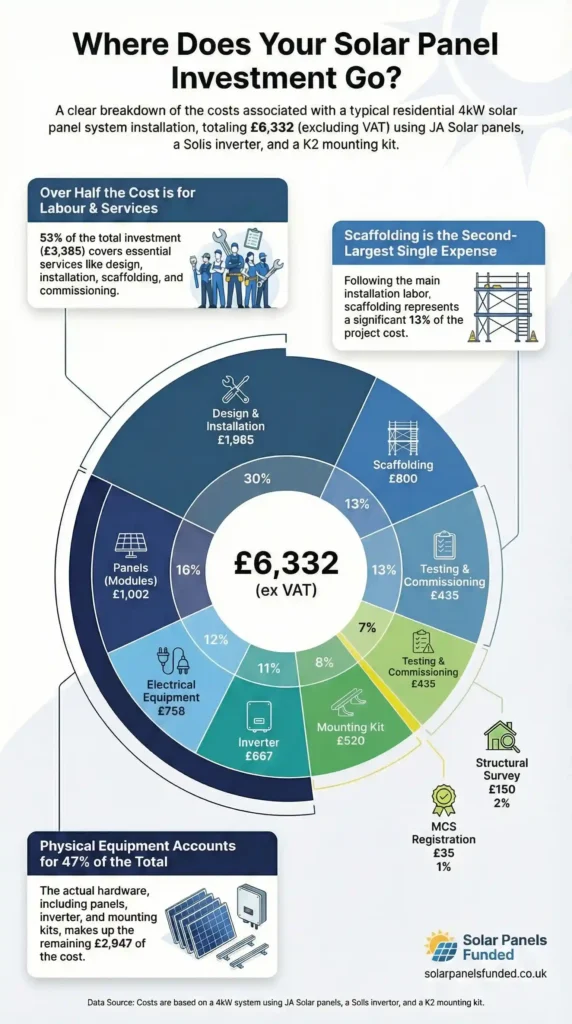
Scaffolding hire consumes approximately 13 percent or £800 of total costs for standard two-storey residential installations. This expense covers delivery, erection, rental for installation duration typically spanning two to three weeks, and subsequent removal. Multi-storey buildings or complex roof configurations increase scaffolding requirements substantially, potentially adding £300 to £600 additional costs. Flat roofs or bungalows occasionally permit scaffolding elimination, reducing total project costs accordingly.
Testing, commissioning, and certification contribute 10 percent of total expenditure through activities ensuring system safety and regulatory compliance. Testing costs £435 on average and includes voltage checks, inverter function verification, panel output testing, and grid connection safety confirmation. MCS certification registration costs approximately £35 but remains essential for accessing Smart Export Guarantee payments. Structural surveys adding £150 verify roof capacity to support panel weight, protecting homeowners from potential structural damage.
| Cost Component | Category | Cost (ex VAT) | Percentage of Total | Notes |
|---|---|---|---|---|
| EQUIPMENT | £2,947 | 47% | ||
| Solar Panels (Modules) | Equipment | £1,002 | 16% | JA Solar 435W × 13 panels |
| Inverter | Equipment | £667 | 11% | Solis 4kW string inverter |
| Mounting System | Equipment | £520 | 8% | K2 system, concrete tile compatible |
| Electrical Components | Equipment | £758 | 12% | Wiring, isolators, consumer unit connections |
| LABOUR & SERVICES | £3,385 | 53% | ||
| Design & Installation | Labour | £1,965 | 30% | Site survey, design, DNO application, installation |
| Scaffolding | Service | £800 | 13% | 2-3 week rental, delivery, erection, removal |
| Testing & Commissioning | Labour | £435 | 7% | Safety testing, grid connection, inverter setup |
| Structural Survey | Service | £150 | 2% | Roof capacity assessment |
| MCS Certification | Service | £35 | 1% | Registration fee |
| TOTAL | £6,332 | 100% |
Hidden costs occasionally emerge during installation when unforeseen issues arise. Consumer unit upgrades cost £300 to £800 when existing electrical panels lack sufficient capacity or safety features for solar integration. Roof repairs identified during installation range from £200 for minor tile replacement through £2,000 for significant structural work. Asbestos presence on older buildings requires specialist removal costing £500 to £1,500 before panel installation proceeds. These contingencies highlight the importance of thorough pre-installation surveys identifying potential complications before work commences.
How much do solar batteries add to the cost?
Solar battery additions transform how households consume generated electricity but represent significant additional investment beyond panel costs alone. Battery capacity measured in kilowatt-hours determines storage capability and pricing, with residential systems typically ranging from 5kWh through 14kWh. A 5kWh battery suitable for smaller households costs £4,000 to £5,500 installed, storing sufficient energy to power evening usage after daily generation ceases.
For comprehensive solar battery cost breakdown including brand comparisons and technology differences, detailed analysis covers all battery investment considerations.
| Battery Brand | Capacity (kWh) | Usable Capacity (kWh) | Cost Installed | Cost per kWh | Warranty (Years) | Cycle Life | Technology Type | Best For |
|---|---|---|---|---|---|---|---|---|
| Entry-Level | ||||||||
| GivEnergy Gen 2 | 5.2 | 4.6 | £4,200 | £808 | 10 | 6,000 | LiFePO4 | Small homes, budget-conscious |
| Puredrive PureStorage II | 5 | 4.5 | £4,000 | £800 | 10 | 6,000 | Lithium-ion | Entry-level, basic needs |
| Mid-Range | ||||||||
| GivEnergy Gen 2 | 9.5 | 8.2 | £6,000 | £632 | 10 | 6,000 | LiFePO4 | Most 3-bed homes |
| SunSynk 8.8kWh | 8.8 | 7.04 | £5,500 | £625 | 10 | 6,000 | LiFePO4 | Value-focused buyers |
| SolaX Triple Power | 9 | 8.1 | £6,200 | £689 | 10 | 6,000 | Lithium-ion | Integrated inverter seekers |
| Premium | ||||||||
| Tesla Powerwall 3 | 13.5 | 13.5 | £8,500-£9,000 | £630-£667 | 10 | 10,000+ | Lithium-ion | Premium brand, high capacity |
| GivEnergy Gen 3 | 13.5 | 12.15 | £7,500 | £556 | 12 | 10,000 | LiFePO4 | Best value premium option |
| SigenStor 17.5kWh | 17.5 | 15.75 | £9,500 | £543 | 10 | 6,000 | LiFePO4 | Large homes, high usage |
Mid-sized 9.5kWh batteries representing the most common residential choice cost £5,500 to £7,000 installed and suit average three-bedroom households consuming 2,700kWh annually. This capacity stores substantial daytime generation for evening and overnight usage, significantly reducing grid electricity purchases. When paired with 4-5kW solar arrays, these batteries enable households to achieve 60 to 70 percent energy independence under typical UK weather conditions.
Larger 13.5kWh batteries serving bigger properties or those with electric vehicles cost £7,000 to £8,500 installed. This substantial storage capacity supports comprehensive electrification strategies combining solar generation with heat pumps and vehicle charging. The enhanced storage justifies higher investment for households maximizing renewable energy usage and seeking maximum grid independence.
Battery technology selection influences both performance and pricing. Lithium-ion batteries dominate residential installations through proven reliability and good energy density, though lithium iron phosphate alternatives offer enhanced safety and longer cycle life at 15 to 20 percent cost premiums. Premium brands including Tesla Powerwall command £8,000 to £9,000 for comparable 13.5kWh capacity through stronger brand recognition and integrated inverter functionality. Mid-tier brands including GivEnergy, SunSynk, and Puredrive deliver equivalent performance at £5,000 to £6,500, representing better value for cost-conscious buyers.
Installation timing significantly affects total battery costs. Simultaneous installation with initial solar arrays minimizes expenses by sharing scaffolding, electrical work, and labour charges. Retrofitting batteries to existing systems costs £5,000 to £9,000 for AC-coupled solutions or £4,000 to £7,000 for DC-coupled alternatives, with the higher figures reflecting duplicate electrical work and additional site visits. Homeowners uncertain about battery economics should ensure hybrid inverter selection enabling future battery addition without inverter replacement.
Warranty terms and cycle life projections influence long-term battery value. Most manufacturers guarantee 10 to 15 years or 6,000 to 10,000 charge cycles, whichever arrives first. Daily cycling suggests 6,000-cycle batteries last approximately 16 years, while 10,000-cycle units extend to 27 years. These warranties protect against premature failure but rarely cover full replacement costs, typically offering degraded capacity compensation instead. Factoring eventual battery replacement into 25-year ownership calculations provides realistic total cost expectations.
What are the long-term costs of solar panels?
Beyond initial installation investment, solar panels incur ongoing expenses affecting total ownership costs over typical 25-year operational lifespans. Maintenance requirements remain minimal compared to many home improvements, with annual professional inspections costing £100 to £200 recommended but not strictly necessary for properly functioning systems. These inspections identify developing issues like wiring degradation, mounting hardware corrosion, or panel damage before they impact generation or create safety hazards.
| Maintenance Item | Frequency | Cost per Event | Annual Cost (Amortized) | Cumulative Cost (25 years) | Necessity Level | Notes |
|---|---|---|---|---|---|---|
| Regular Maintenance | ||||||
| Professional Inspection | Annual (optional) | £100-£200 | £100-£200 | £2,500-£5,000 | Optional | Most systems don't require annual service |
| Panel Cleaning (Pitched Roof) | 1x per year | £100-£150 | £100-£150 | £2,500-£3,750 | Low | Rain often sufficient |
| Panel Cleaning (Flat Roof) | 2-4x per year | £100-£150 | £200-£600 | £5,000-£15,000 | Medium | Dirt accumulates faster |
| Monitoring Subscription | Monthly | £5-£10/month | £60-£120 | £1,500-£3,000 | Optional | Basic inverter monitoring is free |
| Major Replacements | ||||||
| String Inverter Replacement | Every 10-15 years | £500-£1,000 | £40-£100 | £1,000-£2,000 | Essential | Expect 1-2 replacements in 25 years |
| Battery Replacement | Every 10-15 years | £4,000-£8,500 | £300-£600 | £7,500-£15,000 | Essential (if battery) | One replacement expected |
| Microinverter Replacement | Every 20-25 years | £100-£200 each | £5-£10 per unit | £100-£500 | Rare | Individual unit failures |
| Unexpected Repairs | ||||||
| Panel Replacement (Physical Damage) | As needed | £150-£350 per panel | £5-£15 (contingency) | £125-£375 | Rare | Usually covered by insurance |
| Wiring/Connection Repair | As needed | £100-£300 | £5-£10 (contingency) | £125-£250 | Rare | Quality install prevents |
| Roof Inspection | Every 5 years | £75-£150 | £15-£30 | £375-£750 | Recommended | Ensure mounting integrity |
| Insurance | ||||||
| Home Insurance Premium Increase | Annual | £10-£15/month | £120-£180 | £3,000-£4,500 | Automatic | Most policies auto-cover |
| Specialist Solar Insurance | Annual | £118-£152 | £118-£152 | £2,950-£3,800 | Optional | Enhanced coverage |
| TOTAL (Typical) | £500-£1,000/year | £12,500-£25,000 | Includes all maintenance & replacements |
Panel cleaning represents the most common maintenance activity, though necessity depends heavily on location and roof pitch. Pitched roofs benefit from rain naturally washing panels clean, minimizing manual cleaning requirements to once annually or less in most UK regions. Flat roof installations accumulate dirt more readily, potentially requiring two to four cleanings yearly at £100 to £150 per visit. Areas with high pollution, agricultural dust, or nearby construction see faster dirt accumulation necessitating more frequent cleaning to maintain optimal generation levels. Efficiency losses from dirty panels range from 15 to 25 percent, making periodic cleaning economically justified despite service costs.
Inverter replacement constitutes the single largest maintenance expense over system lifetimes. String inverters typically last 10 to 15 years, requiring replacement once during 25-year panel lifespans. Replacement costs range from £500 for basic 3kW units through £1,000 for 5kW inverters, plus £200 to £400 installation labour costs if electrical connections require modification. Microinverter systems avoid this concentrated expense through longer 20 to 25-year warranties matching panel lifetimes, though individual unit failures may necessitate occasional replacements costing £100 to £200 each.
Insurance coverage increases marginally with solar panel additions, though most standard home insurance policies automatically extend to cover roof-mounted panels at no additional premium. Specialist solar panel insurance costs approximately £118 to £152 annually, providing enhanced coverage including theft, weather damage, and underperformance protection beyond basic home insurance. This additional coverage proves most valuable for expensive premium panel installations or ground-mounted systems more vulnerable to theft.
Performance monitoring incurs minimal ongoing costs, with most inverters including basic generation tracking accessible through smartphone apps without subscription fees. Advanced monitoring systems offering detailed analytics, weather correlation, and fault detection may charge £50 to £100 annual subscriptions, though these services provide limited additional value for residential installations. Basic inverter monitoring suffices for most homeowners to identify obvious generation problems warranting professional inspection.
Structural maintenance considerations include periodic roof inspections ensuring mounting hardware integrity and weatherproofing. Panel mounting penetrates roof membranes at bracket attachment points, creating potential leak paths if seals degrade. Five-yearly roof inspections costing £75 to £150 identify developing issues before water ingress damages roof structures. Well-installed systems rarely experience these problems, but proactive inspections provide peace of mind and protect property values.
How much can you save with solar panels?
Solar panel electricity bill savings depend on system size, household consumption patterns, electricity tariff rates, and Smart Export Guarantee participation. A 4kW system in an average three-bedroom home consuming 2,700kWh annually saves approximately £1,083 to £1,304 yearly when household usage aligns reasonably with generation patterns. These savings combine displaced grid purchases during daylight hours with export payments for excess generation sent to the electricity network.
| Energy Supplier | Tariff Name | Rate (p/kWh) | Type | Customer Only? | Battery Required? | Annual Export Income (4kW)* | Best For |
|---|---|---|---|---|---|---|---|
| Premium Rates | |||||||
| Octopus Energy | Intelligent Octopus | 30.31 | Peak hours | Yes | Yes | Up to £875 | Battery owners optimizing export timing |
| Octopus Energy | Flux | 21 | Variable ToU | Yes | Yes | £450-£650 | Battery owners, flexible usage |
| Good Energy | Exclusive | 20 | Fixed | Yes | No | £400-£580 | High export volumes |
| So Energy | So Bright | 20 | Fixed | Yes | No | £400-£580 | Existing So Energy customers |
| OVO Energy | Exclusive | 20 | Fixed | Yes | No | £400-£580 | Existing OVO customers |
| Mid-Range Rates | |||||||
| E.ON | Next Export | 16.5 | Fixed | Yes | No | £330-£480 | E.ON customers, simple option |
| British Gas | Flex | 15.1 | Fixed | Yes | No | £302-£438 | British Gas customers |
| Good Energy | Solar | 15 | Fixed | Yes | No | £300-£435 | Non-exclusive Good Energy customers |
| ScottishPower | SmartGen | 12 | Fixed | No | No | £240-£348 | Open to anyone |
| Basic Rates | |||||||
| British Gas | Standard | 6.4 | Fixed | No | No | £128-£186 | Minimum compliance tariff |
| Rebel Energy | SEG | 6 | Fixed | No | No | £120-£174 | Basic export option |
| EDF | Standard | 4.3 | Fixed | No | No | £86-£125 | Minimum rate |
Self-consumption rates significantly influence savings magnitude, as using generated electricity onsite avoids purchasing power at 22.36 pence per kilowatt-hour current average rates, while excess exports earn only 4.3 to 30.31 pence depending on chosen Smart Export Guarantee tariff. Households occupying homes during daylight hours achieve 40 to 60 percent self-consumption rates, directly using generated electricity to power appliances, heating, and other devices. Evening-occupied households see lower 30 to 40 percent self-consumption without battery storage, reducing bill savings accordingly.
Smart Export Guarantee payments provide additional value from excess generation that cannot be self-consumed. Standard unbundled tariffs pay approximately 4.3 pence per kilowatt-hour, generating modest £30 to £97 annual income for average systems. Premium bundled tariffs available to existing customers of certain suppliers pay 13.8 pence per kilowatt-hour average, increasing export income to £80 to £470 yearly. The highest-paying Octopus Intelligent Octopus tariff offers 30.31 pence, potentially generating £875 annual income, though this rate applies only during specific hours and requires battery storage to maximize benefits.
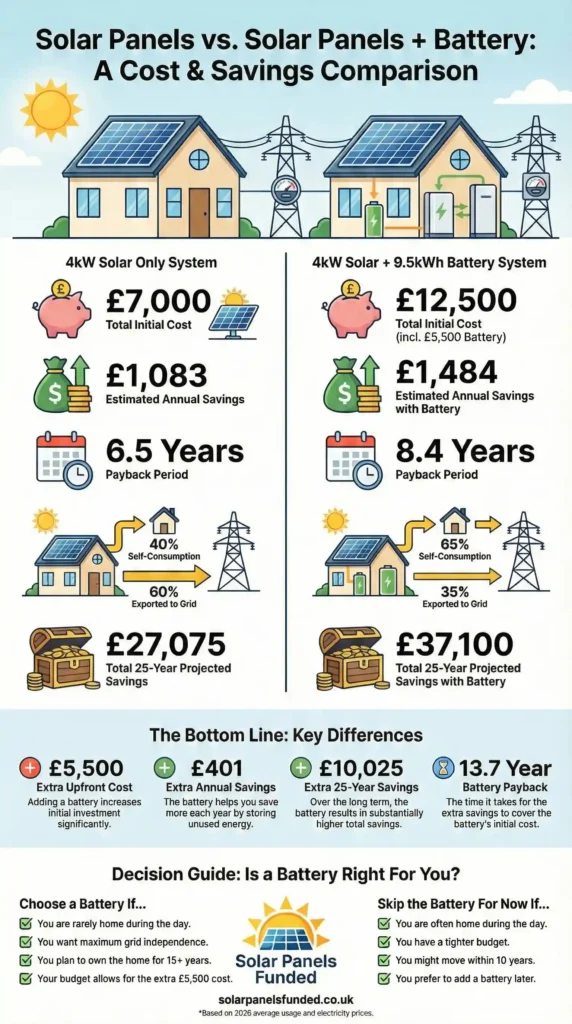
Battery storage substantially increases savings by enabling evening and overnight usage of daytime generation that would otherwise export at low rates. A 9.5kWh battery allows households to achieve 60 to 70 percent energy independence, displacing grid purchases valued at 22.36 pence with stored solar electricity that cost nothing to generate. This usage pattern transformation can increase total bill savings from £1,083 to £1,484 for 4kW systems, though the additional saving must justify the £5,500 to £7,000 battery investment over its operational lifetime.
Electricity price changes dramatically affect savings projections and payback calculations. Current rates of 22.36 pence per kilowatt-hour represent 58 percent increases from 2021 levels, with continued upward pressure expected as energy transition costs manifest. Projecting average rates of 42 pence over 25 years seems conservative given historical trends and planned grid investments. These higher future rates accelerate payback periods and increase lifetime savings, making solar panels increasingly valuable financial investments as grid electricity becomes more expensive.
Property value increases represent an often-overlooked financial benefit of solar panel installations. Research indicates solar-equipped homes sell for 0.9 to 6.8 percent premiums compared to equivalent properties without renewable generation. For a £300,000 property, this translates to £2,700 to £20,400 value addition, though realizing this premium requires finding buyers who value solar benefits. Survey data shows 69 percent of prospective buyers express willingness to purchase solar-equipped homes, suggesting broad market acceptance despite premium pricing.
When will you break even on solar panel costs?
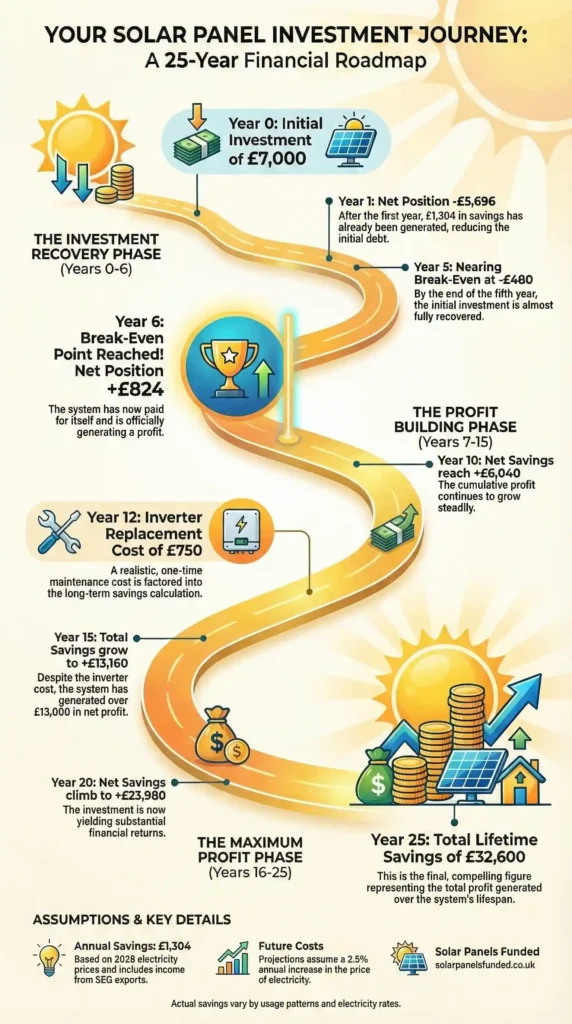
Break-even periods represent the time required for cumulative electricity bill savings to equal initial installation investment, marking the point where solar panels transition from net cost to net savings. For typical 4kW systems costing £6,600 to £8,100, break-even occurs between 6 and 7 years based on current electricity prices and average household usage patterns. This timeline assumes stable electricity pricing, though likely rate increases would accelerate payback by increasing displaced grid purchase value.
System size influences break-even periods through economies of scale affecting both installation costs and generation capacity. Smaller 2kW systems costing £3,800 to £4,600 achieve break-even in approximately 7 years despite lower absolute costs, as higher per-kilowatt installation expenses offset by reduced generation capacity. Larger 6kW installations breaking even in 6 years benefit from lower per-kilowatt costs and enhanced generation, demonstrating how larger systems often provide superior investment returns despite higher upfront expenditure.
Usage patterns significantly impact break-even calculations by determining self-consumption rates and grid purchase displacement. Households occupying homes during daylight hours maximize direct solar usage, achieving break-even in 5 to 6 years compared to 7 to 8 years for evening-occupied properties relying heavily on export income. Battery storage accelerates payback for evening-occupied households by enabling stored solar usage during high-rate evening hours, though battery costs must be factored into revised break-even calculations.
Smart Export Guarantee tariff selection affects break-even timelines by determining export income value. Households on premium 15 to 20 pence tariffs achieve break-even approximately 1 year faster than those accepting basic 4.3 pence rates, highlighting the importance of shopping for competitive export contracts. Time-of-use tariffs offering 30.31 pence during specific hours can further accelerate payback when combined with battery storage enabling strategic export timing.
Electricity price inflation represents the most uncertain variable in break-even projections, with substantial implications for actual payback periods. Historical trends show electricity prices increasing 58 percent between 2021 and 2026, suggesting continued upward trajectory as renewable energy transition costs accumulate. If electricity prices continue rising at historical rates, break-even periods shorten from projected 6 to 7 years to potentially 4 to 5 years, significantly improving solar panel investment returns.
Industry data from MCS indicates average break-even periods of 15.46 years using conservative assumptions excluding likely price increases. This longer timeline reflects cautious savings estimates and does not account for electricity price inflation that materially improves actual returns. Real-world installations frequently achieve payback within 8 to 10 years when accounting for price changes and optimized usage patterns, making solar panels financially sound investments for homeowners planning to remain in properties for at least a decade.
What financing options reduce solar panel costs?
Multiple financing mechanisms enable solar panel installation without full upfront payment, spreading costs across manageable periods while capturing immediate electricity bill savings. Green loans specifically designed for energy efficiency improvements offer £1,000 to £25,000 borrowing at 3.9 to 8.9 percent annual percentage rates over 1 to 10 year terms. Providers including Barclays, Nationwide, and TSB structure repayments allowing solar savings to partially offset loan costs, reducing net monthly expenditure compared to continued full grid electricity purchases.
Interest-free credit offerings from some installers enable spreading payments across 12 to 24 months without financing charges, effectively discounting system costs through avoided interest. These arrangements typically require good credit scores and may restrict equipment choices to specific brands or configurations, but eliminate financing costs that can add 10 to 20 percent to total expenditure over loan lifetimes. Comparing total payable amounts across financing options reveals true cost differences obscured by monthly payment marketing.
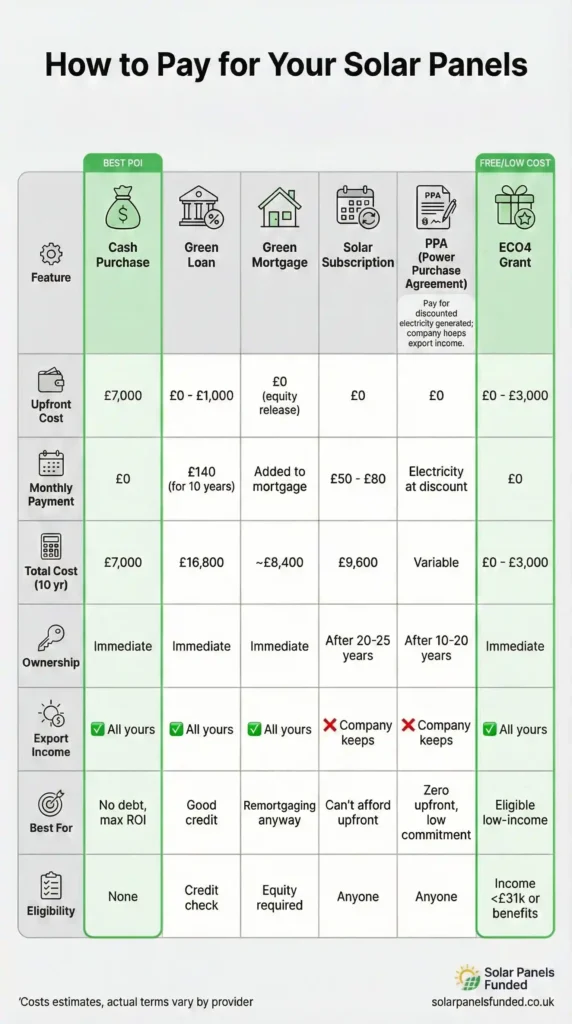
Green mortgage products provide preferential rates for energy-efficient properties, including solar panel installations. Major lenders offer 0.1 to 0.5 percentage point interest rate reductions for homes achieving Energy Performance Certificate ratings of A or B, savings that can exceed £1,000 annually on typical mortgage balances. Additionally, some lenders provide £500 to £2,000 cashback for completing qualifying energy improvements including solar installations within 6 months of mortgage completion or renewal.
Remortgaging to release home equity funds solar installations at mortgage interest rates typically ranging 4 to 6 percent, substantially lower than unsecured personal loan rates of 10 to 15 percent. This approach suits homeowners with significant property value appreciation or those refinancing anyway, spreading solar costs across remaining mortgage terms. Total interest paid exceeds shorter-term loans, but lower rates and extended payback periods reduce monthly payment impacts.
Solar subscriptions from providers including Otovo, Sunsave, and Solarus eliminate upfront costs entirely through £0 deposit, pay-as-you-save models. Households pay monthly fees covering installation amortization plus maintenance while receiving generated electricity at discounted rates compared to grid purchases. These 20 to 25 year contracts suit renters or homeowners unable to raise installation capital, though total costs over contract lifetimes typically exceed outright purchase equivalents by 15 to 30 percent.
Power Purchase Agreements represent another zero-upfront option where installation companies own panels while homeowners purchase generated electricity at fixed rates below grid equivalents. After initial contract periods of 10 to 20 years, panel ownership transfers to homeowners at nominal or zero cost. These arrangements provide immediate bill savings without capital investment but sacrifice export income and potential property value increases during contract periods.
| Financing Method | Upfront Cost | Monthly Payment | Loan Term | Interest Rate (APR) | Total Cost Over Term | Ownership | SEG Eligibility | Best For |
|---|---|---|---|---|---|---|---|---|
| Cash Purchase | £7,000 | £0 | N/A | 0% | £7,000 | Immediate | ✅ Yes | Lowest total cost, best ROI |
| Green Loan (Barclays) | £0-£500 | £146 | 10 years | 9.9% | £17,520 | Immediate | ✅ Yes | Good credit, spread cost |
| Green Loan (Effective Home) | £0-£500 | £140 | 10 years | 11.9% | £16,800 | Immediate | ✅ Yes | Typical green loan option |
| Interest-Free Credit (Installer) | £0 | £292 | 24 months | 0% | £7,000 | Immediate | ✅ Yes | 2-year affordability |
| Green Mortgage Cashback | £0 (equity) | Added to mortgage | 25 years | 4-6% | ~£10,500 | Immediate | ✅ Yes | Remortgaging anyway |
| Solar Subscription (Otovo) | £0 | £50-£80 | 20 years | N/A | £12,000-£19,200 | After 20 years | ❌ No | Zero upfront, no credit check |
| Power Purchase Agreement (PPA) | £0 | Electricity at discount | 10-20 years | N/A | Variable | After contract | ❌ No | Zero commitment |
| ECO4 Grant | £0-£3,000 | £0 | N/A | N/A | £0-£3,000 | Immediate | ✅ Yes | Income <£31k or benefits |
| Warm Homes Plan Grant | £0 | £0 | N/A | N/A | £0 | Immediate | ✅ Yes | EPC D-G, income <£36k |
Government solar panel grants dramatically reduce or eliminate solar panel costs for eligible low-income households. ECO4 scheme grants ranging £7,000 to £20,000 cover partial or complete installation expenses for households earning under £31,000 annually or receiving means-tested benefits. The Warm Homes Plan provides £15,000 grants for energy efficiency measures including solar panels, targeting properties with Energy Performance Certificate ratings of D through G. These schemes represent the most cost-effective financing for qualifying applicants, though eligibility restrictions limit availability.
How do solar panel costs vary across the UK?
Regional cost variations reflect local labour markets, installer density, and material transport expenses across England, Scotland, and Wales. London installations command 15 to 25 percent premiums over national averages due to higher living costs, wage rates, and travel time compensation in the densely populated capital region. A 4kW system averaging £7,000 nationally costs £8,050 to £8,750 in Greater London, representing £1,050 to £1,750 additional expenditure for equivalent equipment and installation quality.
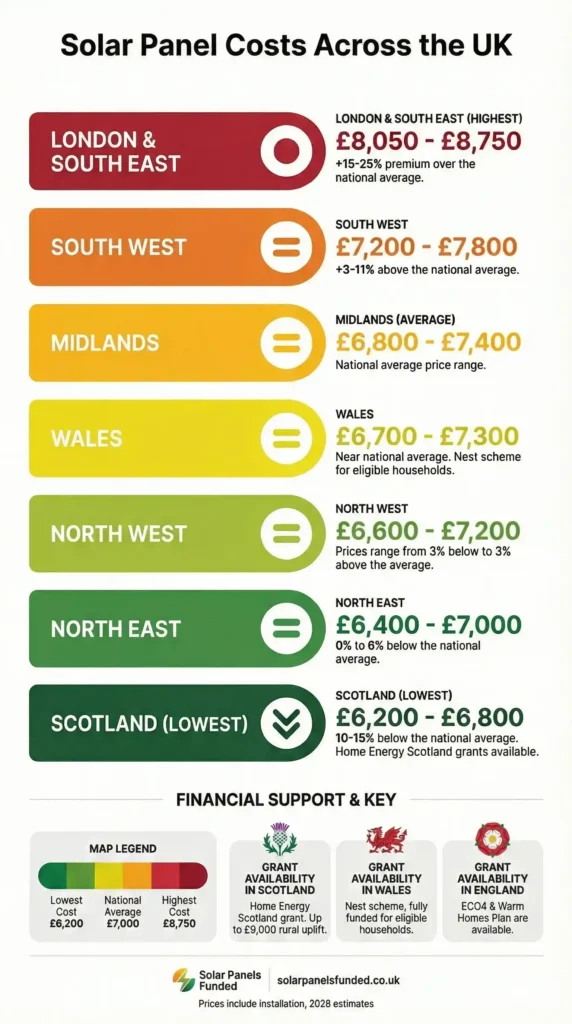
Scotland presents mixed pricing landscapes, with major cities including Glasgow and Edinburgh offering competitive rates through healthy installer competition, while rural and island communities face limited installer availability driving costs upward. Labour rates run 10 to 15 percent below English averages in Scottish cities, potentially saving £700 to £1,050 on typical installations. The Home Energy Scotland grant and loan programme providing up to £7,500 further reduces net costs for qualifying Scottish homeowners, making northern installations particularly attractive financially.
Wales demonstrates moderate pricing falling between English and Scottish extremes, with installer concentrations in Cardiff, Swansea, and Newport providing competitive quotes. Rural Welsh installations particularly in Pembrokeshire, Ceredigion, and Gwynedd encounter fewer installers and higher travel costs, increasing expenditure by approximately 5 to 10 percent compared to national averages. The Warm Homes Nest Scheme exclusive to Welsh residents provides fully funded installations for qualifying low-income households, eliminating costs entirely for successful applicants.
Regional grant availability further differentiates effective costs beyond installation pricing differences. England offers ECO4 and Warm Homes Plan support distributed through local authorities, with some councils providing additional borough-specific incentives. Scotland’s Home Energy Scotland programme delivers targeted support including rural uplift provisions increasing grant maxima from £7,500 to £9,000 for remote properties. Wales concentrates support through the Nest Scheme, offering comprehensive packages combining insulation, heating, and solar improvements for fuel-poor households.
| Region | 4kW System Cost | Variation vs National Average | Labour Rate Premium/Discount | Available Grants | Installer Density |
|---|---|---|---|---|---|
| London & South East | £8,050-£8,750 | +15% to +25% | +20-30% | ECO4, Warm Homes Plan | Very High |
| South West | £7,200-£7,800 | +3% to +11% | +5-15% | ECO4, Warm Homes Plan | High |
| East of England | £6,900-£7,500 | -1% to +7% | +2-10% | ECO4, Warm Homes Plan | High |
| Midlands | £6,800-£7,400 | 0% (baseline) | 0% (baseline) | ECO4, Warm Homes Plan | Medium-High |
| North West | £6,600-£7,200 | -3% to +3% | -5 to +5% | ECO4, Warm Homes Plan | Medium |
| North East | £6,400-£7,000 | -6% to 0% | -10 to -5% | ECO4, Warm Homes Plan | Medium |
| Yorkshire | £6,500-£7,100 | -4% to +1% | -8 to 0% | ECO4, Warm Homes Plan | Medium |
| Scotland (Cities) | £6,200-£6,800 | -10% to -15% | -15 to -10% | Home Energy Scotland (up to £9,000) | Medium (concentrated in cities) |
| Scotland (Rural) | £6,800-£7,400 | 0% to +5% | +5-10% (travel) | Home Energy Scotland + Rural Uplift | Low |
| Wales | £6,700-£7,300 | -3% to +4% | 0% to +5% | Nest Scheme, ECO4, Warm Homes | Medium |
| Northern Ireland | £7,000-£7,600 | +5% to +10% | +10-15% | Limited availability | Low |
Installer selection significantly affects regional cost variations beyond pure labour rate differences. National companies including Octopus Energy, EON Next, and British Gas offer standardized pricing minimizing regional variation through economies of scale and centralized operations. Local independent installers provide more variable quotes reflecting individual overhead structures and competitive positions, sometimes offering better value through lower markup percentages or alternatively charging premiums for specialized expertise or premium service levels.
How much do different types of solar panels cost?
Panel technology selection influences both upfront equipment costs and long-term generation value through efficiency variations affecting space requirements and output. Monocrystalline panels dominating UK residential installations achieve 20 to 23 percent efficiency and cost £200 to £450 per 400-watt unit depending on manufacturer tier and warranty provisions. These black-appearance panels require less roof space for equivalent capacity compared to alternatives, making them ideal for space-constrained installations.
Polycrystalline panels offering 15 to 17 percent efficiency represent budget alternatives costing £180 to £200 per equivalent-wattage unit. The blue-hued panels perform acceptably for basic electricity generation but require approximately 20 percent more roof area than monocrystalline equivalents to achieve identical capacity. This cost saving proves false economy on small roofs where generation constraints outweigh minor equipment savings, but suits large roof areas where space limitations do not apply.
Premium monocrystalline panels from manufacturers including SunPower, Panasonic, and LG achieve 22 to 23 percent efficiency with exceptional low-light performance and temperature coefficients. These units cost £350 to £450 each but deliver superior generation in typical UK weather conditions featuring frequent cloud cover and moderate temperatures. Extended 40-year product warranties versus standard 25-year coverage provide additional value justifying premium pricing for quality-focused buyers prioritizing long-term reliability over initial cost minimization.
Mainstream Tier 1 manufacturers including LONGi, JA Solar, Trina, and Canadian Solar occupy the market middle ground, offering 20 to 21 percent efficiency panels costing £200 to £280 per unit. These brands balance performance and affordability through proven manufacturing quality and standard 25-year product warranties, representing optimal value for most residential installations. Market share concentration among these manufacturers ensures replacement part availability and warranty claim processing reliability over multi-decade operational periods.
Bifacial panel technology capturing sunlight from both front and rear surfaces costs approximately 10 to 15 percent more than standard monocrystalline equivalents but delivers 5 to 15 percent additional generation depending on ground reflection and mounting configuration. These specialized panels suit ground-mounted installations where rear surface illumination proves practical, but provide minimal benefits for standard roof installations lacking significant reflected light. Cost premiums rarely justify generation increases for typical residential rooftop applications.
Aesthetic considerations influence panel selection for some buyers despite cost implications. All-black monocrystalline panels with black frames and backing cost £20 to £40 per unit more than standard black-cell, silver-frame alternatives but deliver visually consistent roof appearances preferred by design-conscious homeowners. Building-integrated photovoltaic options including in-roof panel systems and solar tiles command substantial 50 to 100 percent cost premiums over standard mounting approaches while delivering equivalent or reduced generation performance, appealing primarily to architectural preservation scenarios or luxury new-build developments.
Understanding where to buy solar panels affects total costs through wholesale versus retail pricing variations and supplier selection.
What hidden costs should you budget for?
Beyond standard installation quotes, several potential expenses emerge during or after solar panel deployment that catch unprepared homeowners by surprise. Consumer unit upgrades represent the most common unexpected cost, required when existing electrical panels lack sufficient spare ways for solar connections or fail to meet current RCD protection standards. These upgrades cost £300 for simple additions of solar-specific protection devices, escalating to £800 for complete consumer unit replacements including installation labour and certification.
| Potential Hidden Cost | Likelihood | Typical Cost Range | When It Occurs | How to Avoid | Budget Recommendation |
|---|---|---|---|---|---|
| Electrical Upgrades | |||||
| Consumer Unit Upgrade | Medium (30%) | £300-£800 | Pre-installation survey finds inadequate protection | Request electrical check before quoting | +£500 contingency |
| Complete Rewiring | Low (5%) | £1,500-£8,000 | Very old properties (pre-1970) | Pre-installation electrical survey | Only if flagged in survey |
| Three-Phase Conversion | Very Low (1%) | £2,000-£5,000 | Large systems >10kW in single-phase properties | Know your property's supply type | N/A for most residential |
| Structural Issues | |||||
| Roof Reinforcement | Low (8%) | £400-£1,200 | Structural survey reveals weak rafters | Mandatory structural survey before install | +£300 contingency |
| Roof Repairs | Medium (20%) | £200-£2,000 | Installation reveals damaged tiles/membrane | Thorough pre-installation survey | +£400 contingency |
| Asbestos Removal | Low (10%) | £500-£1,500 | Properties built before 2000, asbestos present | Asbestos survey for pre-2000 builds | +£200 contingency (if pre-2000) |
| Permission & Approvals | |||||
| DNO Application Fee (G99) | Low (15%) | £50-£150 | Systems >3.68kW or unusual configurations | Confirm if included in installer quote | Usually included in quote |
| Planning Permission | Very Low (2%) | £100-£300 | Listed buildings, conservation areas | Check local planning requirements early | Only if flagged |
| Building Regulations Fee | Very Low (5%) | £100-£200 | Some local authorities charge separately | Ask installer if included | Usually included in MCS |
| Installation Complications | |||||
| Additional Scaffolding | Low (10%) | £200-£600 | Multi-storey, complex roof shapes | Accurate roof assessment in quote stage | Usually quoted correctly |
| Access Difficulties | Very Low (5%) | £100-£400 | Narrow streets, crane required | Site visit should identify | Rare in suburban areas |
| Extended Installation Time | Low (8%) | £200-£500 | Weather delays, unforeseen complications | Choose summer installation | Installer usually absorbs |
| Post-Installation | |||||
| Pigeon Proofing/Mesh | Medium (25%) | £400-£600 | Properties with existing pigeon problems | Install mesh during initial installation | +£300 if near pigeon areas |
| Initial Yield Lower Than Projected | Medium (30%) | N/A | Overoptimistic quotes, shading, orientation | Request realistic, conservative generation estimates | Manage expectations |
| RECOMMENDED TOTAL CONTINGENCY | £1,000-£1,500 |
Roof condition assessments occasionally reveal structural inadequacies preventing immediate solar installation without remediation. Weak rafter sections unable to support panel weight require reinforcement costing £400 to £1,200 depending on extent, while sagging roof sections need comprehensive structural correction potentially exceeding £2,000. Pre-installation structural surveys costing £150 identify these issues before installation contracts commence, allowing cost incorporation into planning rather than discovering problems during installation.
Asbestos presence in older properties built before 2000 necessitates specialist handling before installation proceeds. Simple asbestos surveys cost £75 to £150 to identify material presence and type, with removal expenses ranging from £500 for limited quantities through £1,500 for extensive contamination requiring full scaffolding encapsulation. Properties likely containing asbestos should factor survey and potential removal costs into budgeting, avoiding installation delays and unexpected expenditure.
Electrical system upgrades extend beyond consumer units when properties feature outdated wiring incapable of safely handling bidirectional power flows from solar generation. Rewiring costs vary dramatically from £1,500 for single-circuit upgrades through £8,000 for complete property rewiring, making pre-installation electrical assessments essential. These upgrades may qualify for concurrent completion during solar installation, minimizing disruption and potentially reducing total costs through shared access and labour.
DNO grid connection applications for larger systems exceeding 3.68kW (G98 threshold) or properties with unusual electrical configurations sometimes incur approval costs ranging £50 to £150. Most standard residential installations under 3.68kW avoid these fees, but larger arrays or three-phase supplies require formal DNO permission adding time and expense to installation processes. Installation companies typically manage these applications, but homeowners should confirm whether quotes include associated fees.
Pigeon deterrence represents an often-overlooked ongoing cost when properties attract nesting birds beneath solar panels. Professional mesh installation around panel perimeters costs £400 to £600 and prevents pigeons establishing nests that accumulate droppings, damage wiring, and create health hazards. Properties near established pigeon populations should budget for this protection during initial installation, avoiding more expensive retrofitting after bird problems emerge.
How can you reduce solar panel installation costs?
Strategic timing significantly influences solar panel costs, with seasonal demand variations creating price fluctuations throughout the year. Winter installations during November through February often secure 5 to 10 percent discounts as installers maintain workforce employment during slower periods. Reduced demand allows greater negotiating latitude and potentially faster installation scheduling, though weather-dependent installation delays occur more frequently in winter months.
Multiple quote comparison remains the single most effective cost reduction strategy, with research showing homeowners obtaining three or more quotes save 15 to 20 percent compared to accepting first proposals. Quote variation reflects different installer overhead structures, markup percentages, equipment sourcing arrangements, and competitive positioning. Requesting detailed breakdowns enables component-by-component comparison, identifying whether price differences stem from equipment quality variations or simply installation charges.
Group buying schemes including Solar Together coordinate bulk installations across neighborhoods or regions, securing volume discounts of 30 to 50 percent through collective purchasing power. These programmes periodically run registration drives allowing households to submit interest without commitment, then organize competitive reverse auctions where installers bid for grouped installation contracts. Participants review winning bids and accept or decline without obligation, benefiting from professional procurement expertise without individual negotiation requirements.
DIY installation eliminates labour costs representing approximately 53 percent of total expenditure, though requires significant technical competence and understanding of electrical safety regulations. DIY installations forfeit MCS certification essential for Smart Export Guarantee eligibility, eliminating export income that typically contributes 5 to 15 percent of total system value. DIY approaches suit off-grid applications or technically skilled homeowners willing to sacrifice export payments for substantial cost savings, but risk improper installation creating safety hazards or performance problems.
Grant utilization dramatically reduces or eliminates installation costs for eligible households. ECO4 scheme grants ranging £7,000 to £20,000 cover partial or complete installations for families earning under £31,000 annually or receiving means-tested benefits. The Warm Homes Plan provides £15,000 grants targeting properties with poor energy efficiency, while regional programmes in Scotland and Wales offer additional support. Eligibility checking through official portals identifies available assistance before exploring paid financing alternatives.
Equipment selection allows cost reduction without compromising overall system quality by prioritizing value over premium branding. Mainstream Tier 1 manufacturers including LONGi, JA Solar, and Trina deliver reliable performance at 20 to 30 percent lower costs than premium brands SunPower or Panasonic while maintaining 25-year warranties. Similarly, choosing proven inverter brands including Solis, GrowWatt, or SolaX instead of premium SolarEdge or Fronius reduces equipment costs £200 to £400 without meaningful performance sacrifice for standard residential installations.
Battery elimination or deferral offers substantial immediate savings ranging £4,000 to £8,500, with batteries retrofittable later when budgets permit or prices decline further. Ensuring hybrid inverter selection during initial installation enables future battery addition without inverter replacement, maintaining upgrade flexibility while minimizing upfront expenditure. This phased approach suits budget-conscious buyers or those uncertain whether usage patterns justify battery investment.
How do solar panel costs compare to other renewables?
Solar panels represent the most accessible residential renewable energy option, with 4kW installation costs of £6,600 to £8,100 significantly lower than comparable home wind turbines costing £15,000 to £25,000 for equivalent capacity. Wind installations face additional planning permission complications, noise concerns, and maintenance requirements that solar panels largely avoid, making photovoltaic systems clearly superior choices for most residential applications despite wind energy’s theoretical higher capacity factors.
Heat pumps providing renewable heating rather than electricity generation cost £7,000 to £14,000 for air-source installations delivering 3 to 4 times heat output versus electrical input. Combined solar panel and heat pump installations costing £13,600 to £22,100 total create comprehensive home electrification strategies, with solar generation offsetting heat pump electricity consumption. Government grants through the Boiler Upgrade Scheme providing £7,500 for heat pump installations make combined approaches increasingly attractive for comprehensive decarbonization.
Ground-source heat pumps offering superior efficiency to air-source alternatives cost £18,000 to £28,000 including ground loop installation, positioning them as premium renewable heating options. Solar panels paired with ground-source systems total £24,600 to £36,100, representing substantial investments justified primarily by very low running costs and exceptional environmental performance. These combinations suit larger properties with significant land areas accommodating ground loops and high heating demands justifying investment through substantial energy cost savings.
Solar thermal systems heating water directly through roof-mounted panels cost £3,000 to £6,000 for typical residential installations. While cheaper than photovoltaic panels, solar thermal systems provide limited application serving only hot water needs. Solar photovoltaic panels costing £6,600 to £8,100 deliver greater versatility by generating electricity powering all household applications including water heating through immersion heaters or heat pumps, making them preferable investments for most situations.
Biomass boilers representing renewable heating alternatives cost £9,000 to £21,000 installed depending on capacity and fuel storage requirements. These systems deliver renewable heat but require ongoing fuel purchases and regular maintenance making operating costs significantly higher than heat pumps. Solar panels combined with heat pumps total less than biomass boiler costs while delivering superior convenience through minimal maintenance and zero fuel purchasing requirements.
Battery storage systems installed without solar panels cost £5,000 to £10,000 for residential capacities but provide limited value without on-site generation to charge them. Grid-charged batteries arbitrage day-night electricity price differentials, potentially saving £200 to £400 annually through off-peak charging and peak-hour discharge. These modest savings deliver 12 to 25 year payback periods, making standalone batteries poor investments compared to solar-plus-battery combinations costing marginally more while enabling substantially higher savings through free solar charging.
What warranties affect long-term costs?
Solar panel product warranties typically spanning 25 to 40 years protect against manufacturing defects and premature failure, with premium manufacturers offering extended coverage justifying higher purchase prices. Standard 25-year warranties cover material defects and workmanship flaws causing panel failures, providing replacement units for affected components. Premium 40-year warranties from manufacturers including SunPower and Panasonic extend this protection an additional 15 years, though panel degradation rather than catastrophic failure represents more likely scenarios over extended timeframes.
Performance warranties guarantee minimum generation capacity over warranty periods, typically ensuring 80 to 92 percent of original output after 25 years. Linear performance warranties provide more protection than stepped alternatives by guaranteeing specific degradation rates annually, enabling precise output predictions throughout system lifetimes. A linear warranty ensuring 0.4 percent annual degradation guarantees 90 percent output after 25 years, while stepped warranties may drop to 80 percent output year 25, representing significant generation differences over system lifetimes.
Inverter warranties spanning 5 to 15 years for string inverters and 20 to 25 years for microinverters substantially influence long-term ownership costs. String inverters requiring replacement during typical solar panel lifetimes add £500 to £1,000 expenses approximately year 12, while microinverters theoretically avoiding replacement represent superior long-term value despite 30 to 40 percent higher initial costs. Extended inverter warranties purchased during installation cost £200 to £400 and extend coverage from standard 5 years to 10 to 15 years, providing good value given likely replacement costs.
Installation workmanship warranties ranging 1 to 10 years protect against improper installation causing leaks, structural damage, or system failures. Reputable installers provide minimum 5-year workmanship coverage, with premium companies extending to 10 years or offering insurance-backed guarantees protecting against company insolvency. These extended protections prove valuable given installation complexity and potential for errors creating expensive remediation requirements discovered years after completion.
Battery warranties guarantee 10 to 15 years or 6,000 to 10,000 charge cycles, protecting against premature capacity loss or failure. Warranty terms specify retained capacity percentages at warranty expiration, typically 60 to 80 percent of original storage capability. Batteries losing capacity more rapidly than warranty terms qualify for proportional replacement or compensation, though actual remedies vary by manufacturer policies. Understanding warranty degradation allowances helps set realistic long-term performance expectations and budget for eventual replacement beyond warranty periods.
Comprehensive system warranties bundling equipment and installation coverage from single providers simplify claim processes and accountability. These warranties cost 3 to 5 percent additional but eliminate disputes about whether problems stem from equipment defects or installation errors. For £200 to £400 on typical installations, bundled warranties provide peace of mind and clearer recourse paths should problems emerge, representing worthwhile investments for risk-averse homeowners.
Frequently Asked Questions About Solar Panel Costs
How much do solar panels cost for a 3 bedroom house?
A three-bedroom house typically requires a 4kW solar panel system costing £6,600 to £8,100 installed. This capacity suits average household consumption of approximately 2,700kWh annually and provides strong return on investment through optimal balance between cost and generation. Adding a 9.5kWh battery increases total investment to £14,900 to £16,400 but improves energy independence and bill savings substantially. Final costs vary based on roof complexity, equipment selection, and regional pricing, making multiple installer quotes essential for accurate budgeting.
How much do solar panels cost for a 4 bedroom house?
Four-bedroom properties generally require 5 to 6kW systems costing £8,300 to £12,200 installed, matching higher electricity consumption of larger households. These systems comprising 13 to 16 panels generate sufficient electricity to power additional appliances and potentially electric vehicle charging. Battery storage additions of 11 to 13.5kWh cost £4,600 to £5,500 extra, providing enhanced energy independence for evening and overnight usage. Larger properties often justify higher investment through greater bill savings potential and available roof space accommodating bigger arrays.
How much does it cost to maintain solar panels?
Annual maintenance costs remain minimal, with professional inspections costing £100 to £200 recommended but not strictly necessary. Panel cleaning expenses range from zero on self-cleaning pitched roofs to £100 to £150 per visit for flat installations requiring one to four annual cleanings. The single significant maintenance expense involves inverter replacement every 10 to 15 years at £500 to £1,000, representing approximately £40 to £100 annual amortized costs. Total annual maintenance expenses typically range £40 to £300 depending on cleaning frequency and inverter replacement amortization.
How much do solar panel batteries cost?
Residential solar batteries cost £4,000 to £8,500 installed depending on storage capacity. Entry-level 5kWh units suitable for smaller households cost £4,000 to £5,500, mid-sized 9.5kWh batteries average £5,500 to £7,000, and larger 13.5kWh units reach £7,000 to £8,500. Premium brands including Tesla Powerwall command £8,000 to £9,000 for comparable capacity, while mainstream alternatives from GivEnergy, SunSynk, and Puredrive deliver equivalent performance at lower costs. Simultaneous installation with solar panels minimizes expenses compared to later retrofitting.
How long until solar panels pay for themselves?
Typical 4kW systems achieve break-even between 6 and 7 years based on current electricity prices and average household usage patterns. Smaller 2kW systems require approximately 7 years, while larger 6kW installations recover costs in 6 years through improved economies of scale. Industry data suggests more conservative 15.46-year average payback periods when excluding likely electricity price increases. Actual timelines depend on usage patterns, electricity rate changes, and Smart Export Guarantee tariff selection, with optimized installations potentially achieving payback within 5 years.
Can I get solar panels for free?
Free solar panel schemes no longer operate as widely as previously, though qualifying households can access substantial grants covering most or all installation costs. ECO4 scheme grants ranging £7,000 to £20,000 provide partial or complete coverage for families earning under £31,000 annually or receiving means-tested benefits. The Warm Homes Plan offers £15,000 grants for energy efficiency improvements including solar installations for properties with poor Energy Performance Certificate ratings. Social housing tenants may receive free installations through housing association programmes, while private homeowners must generally contribute toward costs even with grant assistance.
How much does it cost to clean solar panels?
Professional solar panel cleaning costs £100 to £150 per visit, with frequency requirements varying from once yearly for pitched roofs in rural areas through four times annually for flat installations in polluted urban locations. DIY cleaning eliminates service costs but requires appropriate equipment including soft-bristle brushes, extension poles, and safety equipment costing £50 to £150 one-time investment. Many pitched roof installations require minimal cleaning beyond natural rain washing, reducing annual cleaning costs to zero in favorable conditions. Flat roofs accumulate dirt faster, justifying professional cleaning expenses through generation improvements offsetting service costs.
Do solar panels increase property value?
Research indicates solar panel installations increase property values 0.9 to 6.8 percent compared to equivalent properties without renewable generation. For a £300,000 home, this translates to £2,700 to £20,400 value addition, though realizing premiums requires finding buyers valuing solar benefits. Survey data shows 69 percent of prospective buyers express willingness to purchase solar-equipped properties, demonstrating broad market acceptance. Actual value increases depend on local market conditions, installation quality, and remaining warranty coverage, with newer high-quality installations commanding stronger premiums.
How much do solar panels cost per kW?
Solar panel costs per kilowatt decline as system size increases due to economies of scale spreading fixed expenses across more capacity. Small 2kW systems cost £1,900 to £2,300 per kilowatt, 4kW installations average £1,650 to £2,025 per kilowatt, and larger 6kW arrays reduce to £1,667 to £2,033 per kilowatt. These per-kilowatt costs include complete installation covering equipment, labour, scaffolding, and certification. Regional variations influence these averages, with London installations commanding 15 to 25 percent premiums while Scottish cities offer 10 to 15 percent discounts compared to national figures.
What is the cheapest time to buy solar panels?
Winter months between November and February offer the best pricing opportunities as installer demand declines, creating opportunities for 5 to 10 percent discounts. Reduced workload allows installers greater flexibility accepting lower margins maintaining employment levels through slower periods. End-of-year timing around November through December may capture additional discounts as companies pursue annual sales targets and clear inventory before new equipment models arrive. However, winter installations face higher weather delay risks and potentially longer completion timelines compared to summer installations.
This comprehensive guide examined solar panel costs across multiple dimensions, from initial equipment expenses through 25-year ownership. A typical 4kW residential system costs £6,600 to £8,100 installed, delivering 6 to 7 year break-even periods and substantial long-term savings. Regional variations, equipment selection, financing options, and grant availability significantly influence final costs, making thorough research and quote comparison essential. Understanding total ownership costs including maintenance, inverter replacement, and cleaning enables realistic budget planning beyond installation expenses alone. While solar panels represent significant investments, declining prices, government support, and rising electricity costs continue improving financial returns, making renewable generation increasingly attractive for UK homeowners.

Solar Energy Funding Specialist & Home Energy Advisor
Zachariah Eaton is a UK-based solar energy funding specialist with a focus on helping homeowners access grants, financing schemes, and cost-saving renewable solutions. He has spent years researching government-backed programmes such as ECO4, Smart Export Guarantee (SEG), and local funding initiatives to make solar more accessible. Zachariah writes practical, easy-to-understand guides that help households reduce energy bills and transition to clean energy with confidence.
Top 7 Solar Panel Installers in Walsall
- Zachariah Eaton
- October 22, 2025
Best Solar Panel Installers in Sandwell
- Zachariah Eaton
- October 31, 2025