
Solar panel installers near me: how to choose, compare and get a reliable quote
Finding reliable solar panel installers in your local area requires careful research and verification. This comprehensive guide explains how to discover certified installers nearby, verify their credentials, request competitive quotes, and select the best professional for your solar panel installation project.
Table of Contents
ToggleHow do I find solar panel installers near me?
Multiple methods exist for locating qualified solar panel installers in your area. The MCS directory at mcscertified.com/find-an-installer provides the most authoritative search tool, listing all certified installers by postcode. Enter your location to display installers within a customisable radius, typically 25 to 50 miles.
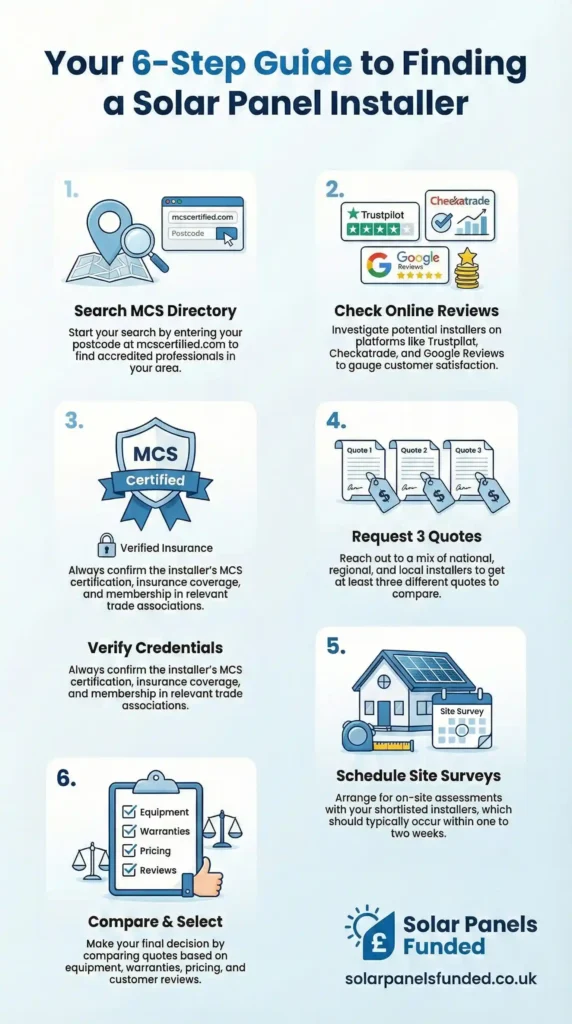
Online directories including Checkatrade, TrustATrader, and Which? Trusted Traders offer searchable databases of local installers with verified customer reviews. These platforms display installer profiles, completed project photos, and detailed feedback from previous customers who hired them for solar installations.
Local recommendations from neighbours who recently installed solar panels provide valuable firsthand insights into installer quality and service. Community social media groups and local forums often contain discussions about solar installers operating in your specific town or region.
Energy suppliers including Octopus Energy, E.ON, and British Gas operate their own installation services with local teams. These national providers maintain regional offices and can dispatch installers to your area, though they may charge premium rates compared to independent local installers.
What should I check when searching for local solar installers?
Verification of installer qualifications protects you from substandard work and ensures eligibility for government schemes. All legitimate solar installers must hold MCS certification, a mandatory requirement for SEG payments and grant applications. Request the installer’s MCS number and verify it directly through the MCS website.
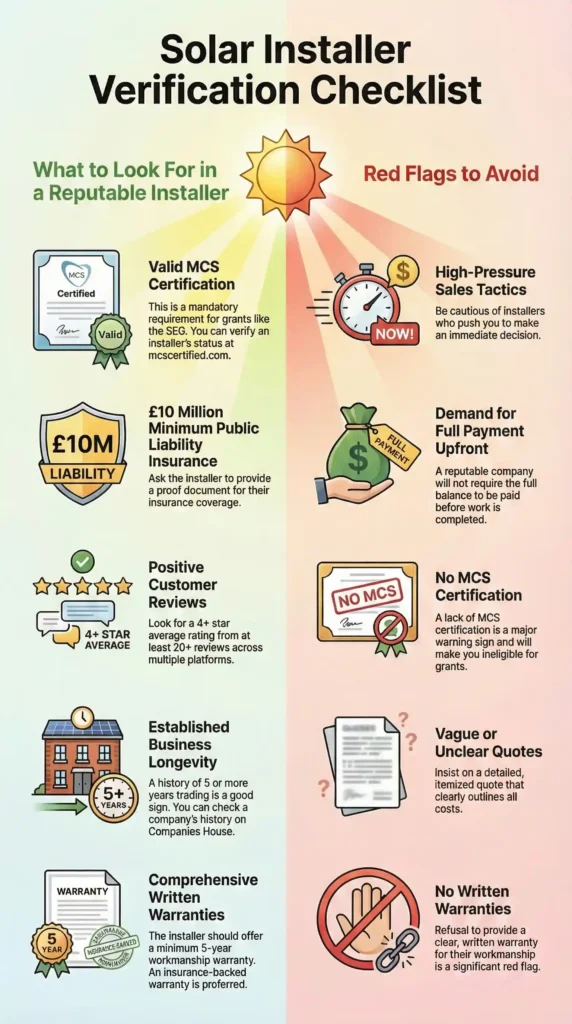
Insurance coverage including public liability insurance of £10 million and product liability insurance demonstrates professional operation. Ask installers to provide proof of current insurance documents before committing to any work. This protects you if installation causes property damage or injury occurs during the project.
Customer reviews across multiple platforms reveal patterns in installer performance. Check Trustpilot, Google Reviews, Checkatrade, and TrustATrader for consistent feedback. Be wary of installers with exclusively perfect reviews, as authentic feedback includes occasional criticism alongside predominantly positive experiences.
Business longevity indicates stability and experience in the solar industry. Installers operating for five years or more have navigated industry changes and built established supplier relationships. Newer installers are not automatically inferior, but established businesses offer greater certainty they will honour warranties.
Trading history available through Companies House reveals financial health and directorship information. Installers with stable finances are more likely to remain in business throughout your warranty period, essential for claiming on workmanship guarantees.
How many quotes should I get from local installers?
Three quotes represents the optimal number for comprehensive comparison without overwhelming yourself with information. This quantity allows meaningful comparison of pricing, equipment specifications, and installer approaches while remaining manageable within a reasonable timeframe.
Request quotes from a mix of installer types including one national provider, one established regional company, and one local independent installer. This combination reveals pricing patterns across different business models and helps identify whether premium charges from larger companies deliver corresponding value.
Obtain quotes within a two-week period to ensure pricing comparability. Solar equipment costs fluctuate based on market conditions, and quotes obtained months apart reflect different pricing environments rather than genuine installer differences.
Detailed written quotes should specify panel manufacturer and model, inverter type and warranty, mounting equipment specifications, scaffolding requirements, and all included services. Vague quotes lacking equipment details indicate installers unprepared to honour specific commitments.
Quote validity periods typically range from 30 to 90 days. Installers offering shorter validity periods may attempt to pressure quick decisions, while longer validity demonstrates confidence in pricing stability.
What questions should I ask local solar installers?
Experience with your specific property type determines installer competence. Ask how many installations they have completed on properties similar to yours, particularly if you have a listed building, flat roof, or older construction. Installers familiar with your property configuration anticipate challenges and deliver smoother installations.
Site visit procedures reveal thoroughness of installer assessment. Professional installers conduct comprehensive site surveys before quoting, examining roof condition, electrical systems, meter location, and potential shading and understanding the complete installation process your property will undergo.. Installers offering quotes without site visits often encounter unforeseen issues requiring costly variations.
Warranty terms covering workmanship separate quality installers from those offering minimal guarantees. Standard workmanship warranties range from two to ten years, with reputable installers offering five years minimum. Confirm whether warranties are insurance-backed, ensuring coverage even if the installer ceases trading.
Installation timeline expectations help plan around work commitments and seasonal weather. Most residential installations complete within one to three days once scheduled, but waiting times for initial surveys and installation dates vary from two to twelve weeks depending on installer demand.
Payment terms demonstrate financial stability and customer protection. Avoid installers demanding full payment upfront. Standard terms include a deposit of 10 to 25 percent upon contract signature, with balance due upon completion and successful commissioning.
Are local installers better than national companies?
Local installers often provide more personalised service and flexibility in scheduling. Independent businesses typically respond faster to queries, accommodate specific scheduling requests, and maintain ongoing relationships with customers. Decision-makers are more accessible, and local reputation matters greatly to their business success.
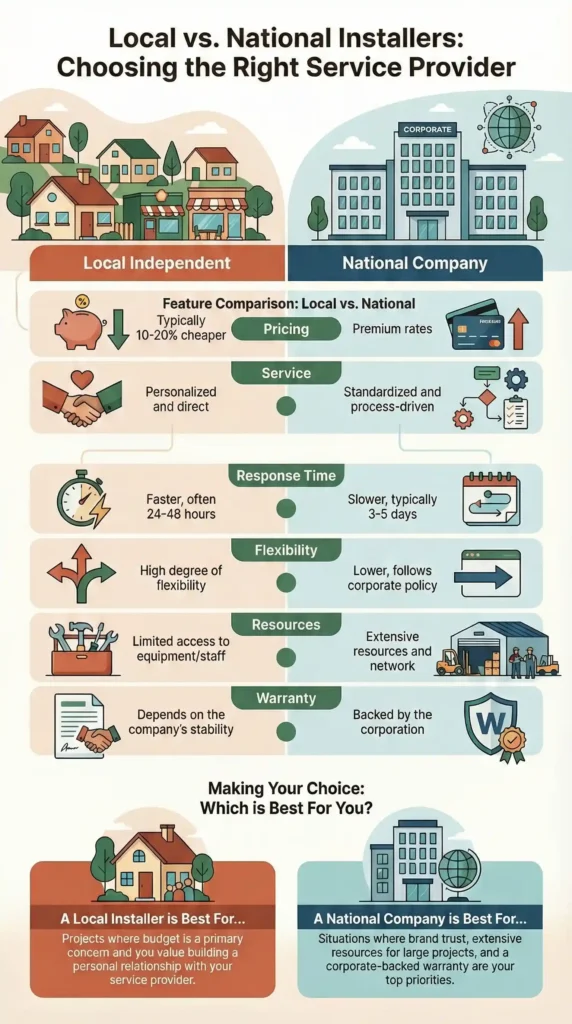
National companies offer standardised processes and extensive resources. Large providers maintain dedicated customer service teams, streamlined installation procedures, and broader equipment purchasing power. They absorb the financial risk if installation quality issues arise, as their resources ensure warranty honouring regardless of individual branch performance.
Pricing differences between local and national installers average 10 to 20 percent, with nationals typically charging premiums. This price difference reflects marketing costs, corporate overheads, and brand positioning rather than installation quality. Local installers operating with lower overheads pass savings to customers while maintaining equivalent technical competence.
Response times for post-installation support vary by company size and structure. Local installers often respond to service calls within 24 to 48 hours, while national providers may require longer due to centralised scheduling systems. However, nationals maintain larger service teams capable of handling surges in support requests.
Warranty security depends on business stability rather than size. Both local and national installers occasionally cease trading. Insurance-backed warranties protect customers regardless of installer size, making warranty type more important than company scale.
How far will solar installers travel to my property?
Standard service areas for most solar installers extend 30 to 50 miles from their base location. Within this radius, installers include travel costs in quoted prices without additional charges. Properties beyond this range may incur travel surcharges of £100 to £300 depending on distance.
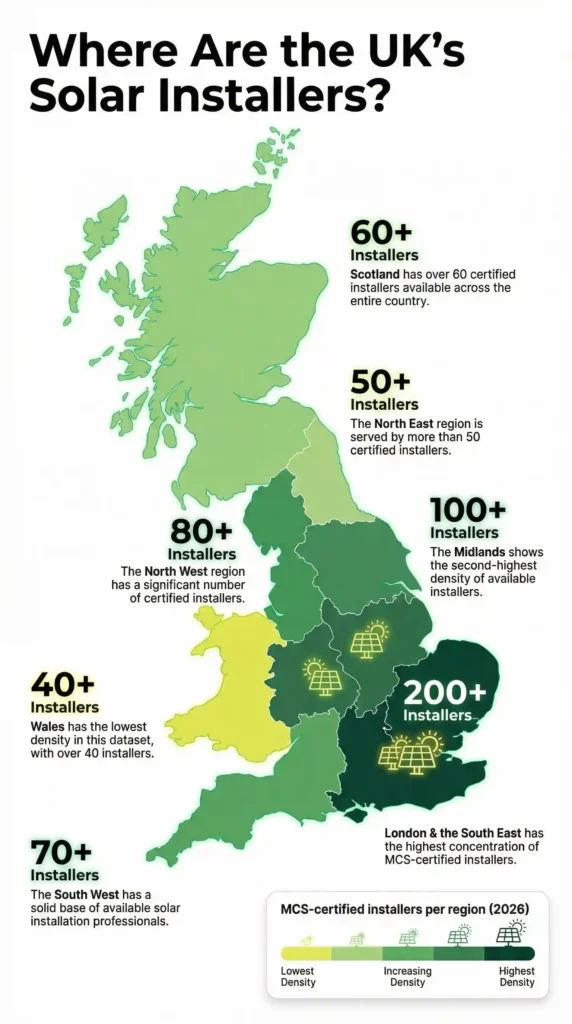
Urban areas benefit from higher installer density, with multiple companies operating within accessible range. London hosts over 200 MCS-certified installers, while Scotland has approximately 60 distributed across major cities. Rural locations face fewer local options, potentially requiring installers to travel further.
Travel distance affects several project aspects beyond cost. Installers working far from their base may schedule installations less flexibly, batch multiple properties in the same region, and take longer to respond to post-installation service calls. Consider these factors when evaluating installers from distant locations.
National installers maintain regional offices enabling broader geographical coverage. These companies operate from multiple bases, allowing them to serve wider areas while maintaining reasonable travel times. Verify which regional office will handle your installation when engaging national providers.
| Region | MCS Installers | Installer Density | Average Service Radius | Travel Surcharge Likelihood | Urban Availability | Rural Availability |
|---|---|---|---|---|---|---|
| London & South East | 200+ | Very High | 25 miles | Rare | Excellent | Good |
| Midlands | 100+ | High | 35 miles | Low | Excellent | Moderate |
| North West | 80+ | High | 35 miles | Low | Excellent | Moderate |
| South West | 70+ | Medium-High | 40 miles | Medium | Good | Limited |
| Scotland (all regions) | 60+ | Medium | 50 miles | Medium-High | Good (cities) | Limited |
| North East | 50+ | Medium | 45 miles | Medium | Moderate | Limited |
| Wales | 40+ | Medium-Low | 50 miles | High | Moderate | Very Limited |
| Northern Ireland | 25+ | Low | 60 miles | Very High | Moderate | Very Limited |
Remote or island locations require special consideration. Properties in the Scottish Highlands, Welsh valleys, or offshore islands may attract significant travel premiums or find limited installer willingness to quote. Some regional grant schemes offer rural uplifts to offset these additional costs.
What is the MCS directory and how do I use it?
The MCS directory represents the definitive database of certified solar panel installers in the UK. Operated by MCS, the organisation responsible for solar installer certification, this directory lists all companies meeting rigorous technical and business standards required for accreditation.
| Step | Action | Where/How | What to Look For | Tips |
|---|---|---|---|---|
| 1 | Access Directory | Visit mcscertified.com/find-an-installer | Search box on homepage | Bookmark this page for future reference |
| 2 | Enter Location | Type postcode or town name | UK postcode or town | Use your exact postcode for closest results |
| 3 | Select Technology | Choose "Solar Photovoltaic" from dropdown | Technology filter menu | Deselect other technologies for focused results |
| 4 | Set Search Radius | Choose 10-50 miles | Distance dropdown | Start with 25 miles, expand if needed |
| 5 | Review Results | Read installer profiles listed | Company name, distance, contact | Typically 5-20 results depending on location |
| 6 | Check Certification Details | Click installer name for full profile | MCS number, certification date, technologies | Verify certification is current (not suspended) |
| 7 | Note Contact Information | Copy phone/email/website | Contact details section | Contact 3-5 installers for quotes |
| 8 | Verify on Companies House | Search company name at gov.uk/companieshouse | Company number, directors, accounts | Check trading history 3+ years preferred |
| 9 | Research Reviews | Search company name on Google, Trustpilot | Star ratings, customer feedback | Look for 4+ stars, 20+ reviews |
| 10 | Make Initial Contact | Phone or email selected installers | Enquiry response time, professionalism | Note response quality for later comparison |
Accessing the directory requires visiting mcscertified.com/find-an-installer and entering your postcode. The search returns installers serving your area, displaying company names, contact details, and distance from your location. Filter results by technology type, selecting solar photovoltaic to focus exclusively on panel installers.
MCS certification requires installers to demonstrate technical competence, maintain appropriate insurance, follow consumer protection codes, and undergo regular audits. This certification is mandatory for homeowners to claim SEG payments for exported electricity and access most grant schemes.
Directory listings include installer company numbers enabling cross-reference with Companies House records. Verify business registration dates, director information, and financial accounts to assess installer stability and experience. This additional research provides context beyond the basic MCS listing.
Installers may serve areas beyond their listed postcode through regional branches or extended service zones. Contact installers directly to confirm whether they operate in your specific location, particularly if you fall near the edge of their stated coverage area.
How do I compare quotes from different local installers?
Equipment specifications form the foundation of meaningful quote comparison. Identify panel manufacturer, model number, wattage per panel, and total system capacity. Note inverter type, brand, and warranty duration. Quotes using identical equipment enable direct pricing comparison, while different equipment requires performance and quality assessment.
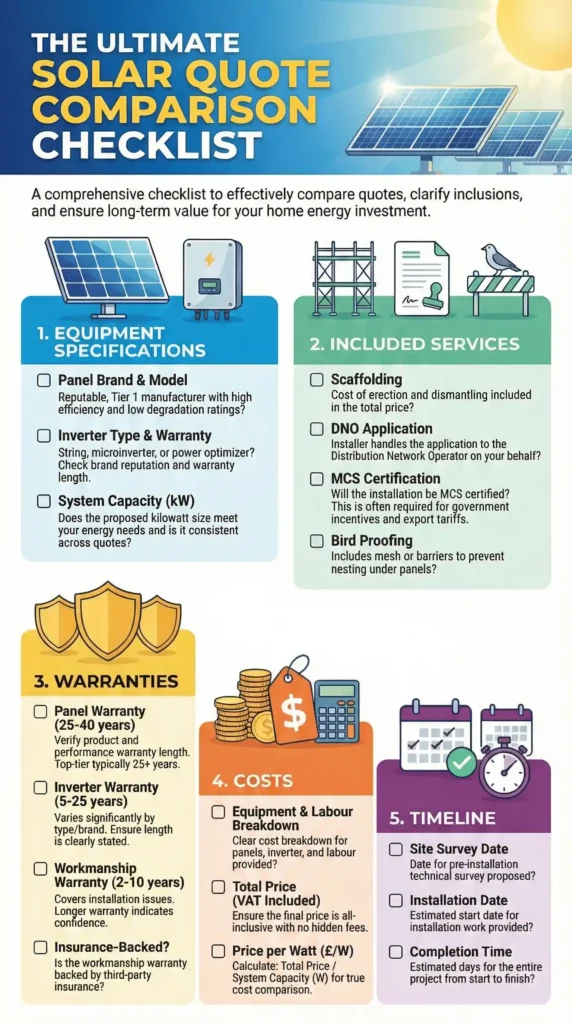
Itemised cost breakdowns reveal value distribution across project components. Reputable quotes separate panel costs, inverter expenses, mounting equipment, scaffolding, labour, and certification fees. Lump sum quotes without itemisation prevent understanding where money is allocated and make identifying overcharging difficult.
Warranty coverage varies significantly between installers despite similar upfront pricing. Compare panel warranties, inverter guarantees, battery coverage if applicable, and crucially, workmanship warranties. Longer workmanship warranties indicate installer confidence in installation quality.
Included services distinguish comprehensive quotes from basic offerings. Confirm whether quotes include scaffolding, DNO application fees, MCS certification registration, building regulations approval, and initial SEG tariff setup. Additional charges for these essential services inflate total costs beyond headline prices.
Once you have gathered multiple quotes and verified credentials, understanding how to choose between solar panel installers based on warranty quality, technical competence, and long-term value helps make informed decisions.
| Comparison Category | What to Check | Installer A | Installer B | Installer C |
|---|---|---|---|---|
| System Capacity | Total kW | _____ kW | _____ kW | _____ kW |
| Panel Quantity | Number of panels | _____ panels | _____ panels | _____ panels |
| Panel Specs | Brand, model, wattage per panel | ____________ | ____________ | ____________ |
| Panel Warranty | Product + performance warranty | _____ years | _____ years | _____ years |
| Inverter Type | String, micro, hybrid | ____________ | ____________ | ____________ |
| Inverter Brand | Manufacturer + model | ____________ | ____________ | ____________ |
| Inverter Warranty | Years covered | _____ years | _____ years | _____ years |
| Total Equipment Cost | Panels + inverter + mounting | £________ | £________ | £________ |
| Labour Cost | Installation + electrical work | £________ | £________ | £________ |
| Scaffolding | Included or additional? | ____________ | ____________ | ____________ |
| Certification Fees | MCS, DNO, Building Regs | ____________ | ____________ | ____________ |
| Total System Cost | Complete price | £________ | £________ | £________ |
| Price per Watt | Cost ÷ capacity (W) | £____/W | £____/W | £____/W |
| Workmanship Warranty | Years + insurance-backed? | ____________ | ____________ | ____________ |
| Deposit Required | Percentage upfront | _____% | _____% | _____% |
| Deposit Amount | Actual £ amount | £________ | £________ | £________ |
| Site Survey Date | When scheduled | ____________ | ____________ | ____________ |
| Installation Date | Estimated completion | ____________ | ____________ | ____________ |
| Post-Install Support | Included services, response time | ____________ | ____________ | ____________ |
Post-installation support terms affect long-term value. Clarify whether installers offer ongoing maintenance, monitoring setup assistance, and warranty claim handling. Some provide annual health checks, while others charge for all post-installation services.
What are the differences between independent and franchise solar installers?
Independent installers operate as standalone businesses making all decisions locally. These companies typically start as sole traders or small partnerships, growing through word-of-mouth recommendations and local reputation. Owners maintain direct involvement in installations, ensuring personal attention throughout projects.
Franchise installers operate under national brand licensing, following corporate procedures while maintaining local ownership. Franchisees pay ongoing fees to parent companies in exchange for branding, lead generation, training, and standardised processes. This model combines local operation with national company resources.
Quality control varies between operational models. Independents maintain quality through personal oversight and reputation management, while franchises implement corporate quality assurance procedures and regular audits. Neither model guarantees superior quality, but enforcement mechanisms differ significantly.
Equipment sourcing affects pricing and availability. Independent installers negotiate directly with distributors, accessing competitive pricing through established relationships. Franchises often benefit from bulk purchasing power negotiated by parent companies, though franchise fees may offset these savings.
Customer recourse channels differ if disputes arise. Independent installers resolve issues directly with customers, while franchises provide corporate complaints procedures and potentially stronger dispute resolution frameworks. Consumer protection legislation applies equally to both models.
How do I verify a solar installer’s credentials?
MCS certification verification requires visiting the MCS website and searching their certified installer database. Enter the company name or certificate number provided by the installer. The results display certification status, covered technologies, and any suspended or revoked accreditations.
| Credential Type | Where to Verify | What to Check | Red Flags | Importance |
|---|---|---|---|---|
| MCS Certification | mcscertified.com | Certificate number, active status, covered technologies | Expired, suspended, or no certification | CRITICAL |
| Public Liability Insurance | Direct from installer | £10 million minimum, current policy dates | Expired policy, insufficient coverage, no proof | CRITICAL |
| Product Liability Insurance | Direct from installer | Current coverage, policy details | No coverage, expired policy | HIGH |
| Companies House Registration | gov.uk/companieshouse | Trading history, director info, financial accounts | Recent incorporation (<1 year), poor finances | MEDIUM |
| Trade Association Membership | RECC, NAPIT, etc. | Current membership, good standing | No memberships, expired status | MEDIUM |
| Online Reviews | Trustpilot, Google, Checkatrade | Average 4+ stars, 20+ reviews, recent feedback | All 5-star (fake), no reviews, defensive responses | HIGH |
| Customer References | Direct from installer | 3+ recent customers (<6 months), varied projects | Unwilling to provide, old references only | MEDIUM |
| Warranty Documentation | Included in quote | Workmanship 5+ years, insurance-backed | Vague terms, verbal only, no written doc | HIGH |
| Physical Address | Google Maps, site visit | Legitimate office/warehouse, not PO box | Mobile only, PO box, no physical presence | MEDIUM |
Insurance documentation should be provided upon request before signing contracts. Request copies of public liability insurance certificates and product liability coverage. Verify policy validity dates and coverage amounts meet industry standards of £10 million public liability minimum.
Trade association memberships including RECC provide additional consumer protection. RECC members commit to codes of conduct and independent dispute resolution services. Verify memberships through association websites rather than relying solely on installer claims.
Online review verification across multiple platforms prevents manipulation. Search for the company on Trustpilot, Google, Checkatrade, and TrustATrader. Authentic review profiles show distribution across star ratings, detailed customer comments, and responses from installers to feedback.
Reference requests from recent customers provide firsthand accounts. Ask installers for contact details of three customers from the past six months. Speaking directly with previous customers reveals information about communication quality, installation tidiness, and problem resolution.
What red flags should I watch for when choosing local installers?
Pressure sales tactics including limited-time offers and same-day signing discounts indicate untrustworthy practices. Legitimate installers provide adequate consideration time for major financial decisions. Be particularly wary of doorstep sellers claiming special availability in your area.
Upfront payment demands exceeding 25 percent of total costs present financial risk. Standard industry practice involves deposits of 10 to 20 percent, with remaining balance due upon completion. Full payment before work commences leaves customers vulnerable to poor workmanship or abandonment.
Vague equipment specifications in quotes suggest installers intend to substitute inferior products. Reputable quotes name specific manufacturers and models for all major components. Phrases like “industry-leading panels” or “premium inverter” without brand names enable downgrading.
Unwillingness to provide written warranties or guarantee documentation indicates intention to avoid accountability. Professional installers readily supply detailed warranty terms before contract signing. Verbal promises without written confirmation hold no value if disputes arise.
Missing or expired MCS certification disqualifies installers from legitimate solar installation work. This certification is non-negotiable for accessing SEG payments and grant schemes. Never proceed with uncertified installers regardless of attractive pricing.
How do I arrange site visits with multiple installers?
Initial contact via phone, email, or website enquiry forms establishes interest and provides basic property information. Inform installers of your property type, approximate roof size, desired system capacity if known, and preferred contact method for scheduling.
Site visit scheduling typically occurs within 5 to 10 business days of initial enquiry for established installers. During busy periods in spring and summer, waiting times may extend to three weeks. Schedule visits over a one to two week period to receive comparable information while details remain fresh.
Site visit duration ranges from 45 minutes to two hours depending on property complexity. Installers inspect roof condition, measure available space, photograph surroundings for shading analysis, examine electrical systems, and discuss your energy usage patterns and expectations.
Preparation for site visits includes gathering recent electricity bills, noting any planned roof work or renovations, and listing questions gathered during research. Make relevant household members available if decisions require multiple perspectives.
Post-visit quote delivery timeframes typically range from 2 to 10 days. Complex installations requiring detailed shading analysis or structural calculations take longer. Follow up if quotes do not arrive within stated timeframes, as delays may indicate organisational issues.
What do local installers typically include in their quotes?
Equipment specifications list panel quantity, manufacturer, model, and wattage for solar modules. Inverter details including brand, type (string or micro), capacity, and warranty duration appear separately. Mounting equipment specifications cover rail type, fixings, and weather protection measures.
Labour costs encompass design, installation, and commissioning work. This includes pre-installation surveys, on-site installation, electrical connections, system testing, and initial operation demonstration. Experienced installers allocate two to three person-days for typical residential installations.
Scaffolding expenses represent a significant cost component, typically £600 to £1,200 for standard two-storey houses. Quotes should specify erection, hire duration, and removal. Some installers include scaffolding in headline prices, while others itemise it separately.
Certification and compliance costs cover MCS registration, DNO application fees, and building regulations approval. These administrative tasks ensure legal compliance and grant eligibility. Total certification costs typically range from £200 to £400.
Ancillary items including generation meters, isolation switches, cable runs, and consumer unit modifications appear in comprehensive quotes. Confirm whether bird-proofing mesh is included if your property experiences pigeon issues, as retrofitting costs £400 to £600.
How do I check reviews of local solar installers?
Multiple platform verification provides balanced perspective. Check Trustpilot for overall satisfaction trends, Google Reviews for recent feedback, Checkatrade for detailed project breakdowns, and TrustATrader for verified completion photos. Cross-platform consistency indicates authentic reputation.
Review age matters when assessing current performance. Prioritise feedback from the past 12 months, as installer quality can change with staff turnover, growth pressures, or management changes. Historical reviews show trajectory but may not reflect current operations.
Detailed reviews provide more valuable insights than brief star ratings. Look for comments addressing communication quality, punctuality, worksite cleanliness, problem-solving approach, and post-installation support. Specific examples carry more weight than generic praise.
Installer responses to negative reviews demonstrate customer service approach. Professional installers acknowledge issues, explain resolution steps, and show willingness to address concerns. Defensive or dismissive responses to criticism indicate poor accountability.
Review manipulation red flags include exclusively five-star ratings, generic wording across multiple reviews, and suspicious timing patterns with multiple reviews on the same day. Authentic review profiles show rating distribution and varied comment styles.
What happens during a site survey from a local installer?
Roof assessment examines structural integrity, covering material, pitch angle, orientation, and available mounting space. Installers measure roof dimensions, photograph the area, and identify potential fixings points. They assess whether your roof supports panel weight, typically 15 to 20 kilograms per square metre.
Shading analysis identifies obstructions affecting solar generation. Installers note nearby trees, neighbouring buildings, chimneys, and other features casting shadows throughout the day. Professional surveys use shading analysis tools providing month-by-month generation estimates.
Electrical system evaluation checks your consumer unit, main fuse rating, earthing arrangement, and meter location. Installers determine whether electrical upgrades are necessary before solar installation. They identify the optimal cable route from panels to inverter and inverter to consumer unit.
Structural survey requirements depend on property age and roof type. Properties built before 1960, flat roofs, or thatched constructions may require independent structural engineer assessments. Installers identify whether additional surveys are necessary before proceeding.
Usage pattern discussion helps size systems appropriately. Installers ask about daytime electricity consumption, planned appliance changes, electric vehicle ownership, and future plans affecting energy needs. This information informs system design recommendations.
How do I compare local installer pricing?
Price per watt calculations enable size-adjusted comparison. Divide total system cost by capacity in watts to obtain this metric. Systems ranging from 3.5 to 4.5 kilowatts typically cost £1,650 to £2,025 per kilowatt installed. Lower rates for larger systems reflect economies of scale.
Equipment quality justifies pricing differences. Premium panels from manufacturers like SunPower command £200 to £400 more per kilowatt than standard Tier 1 panels from JA Solar or Longi. Microinverters add £500 to £800 compared to string inverters. Assess whether performance gains justify cost increases.
Regional pricing variations affect local comparisons. London installers charge 15 to 25 percent premiums reflecting higher operating costs. Scottish cities show 10 to 15 percent discounts compared to UK averages. Compare quotes within your region rather than against national figures.
Included services value varies substantially between quotes. Calculate total project cost including all essential services rather than comparing baseline equipment prices. Quotes excluding scaffolding, certification, or ancillary equipment mislead with artificially low headline prices.
Financing options affect ultimate costs. Interest-free credit over 24 months costs the same as cash purchases. Loans at 9.9 percent APR double actual costs over ten years. Factor financing charges when comparing installers offering different payment options.
Knowing the detailed installation cost breakdown including labour, materials, and regional pricing variations helps evaluate whether quoted prices represent fair value for professional installation services.
What makes an installer local versus regional or national?
Geographic coverage defines installer categorisation. Local installers typically serve areas within 30 miles of their base, focusing on a town or small region. Regional installers cover counties or multiple counties, maintaining broader service networks. National companies operate country-wide through regional branches or franchises.
| Feature | Local Independent | Regional Company | National Provider |
|---|---|---|---|
| Service Area | 30 miles radius | Single county/multi-county | UK-wide (regional offices) |
| Team Size | 2-10 employees | 15-50 employees | 100+ employees |
| Annual Installations | 50-200 systems | 300-800 systems | 2,000+ systems |
| Pricing vs Average | 10-20% below | At average | 10-20% above |
| Quote Response Time | 24-72 hours | 2-5 days | 3-7 days |
| Site Survey Wait | 3-10 days | 7-14 days | 10-21 days |
| Installation Flexibility | High (owner decides) | Medium (PM decides) | Low (system-driven) |
| Post-Install Response | 24-48 hours | 2-5 days | 3-7 days |
| Payment Terms | 10-20% deposit | 20-25% deposit | 25% deposit |
| Warranty Security | Individual stability | Company stability | Corporate backing |
| Customer Interaction | Direct with owner | Project manager | Call center |
| Equipment Sourcing | Distributor | Volume discount | Manufacturer direct |
| Best For | Budget, personal service | Balance of all | Brand trust, resources |
Business structure indicates operational scale. Local installers often operate as sole traders or small limited companies with two to ten employees. Regional businesses employ 15 to 50 staff across design, installation, and administrative functions. National providers maintain hundreds of employees across multiple locations.
Installation volume reveals capacity differences. Local installers complete 50 to 200 installations annually, while regional companies install 300 to 800 systems per year. National providers conduct thousands of installations through distributed teams.
Supply chain relationships differ by scale. Local installers purchase through distributors, regional companies negotiate volume discounts, and national providers maintain direct manufacturer relationships. These differences affect equipment costs and availability.
Customer interaction patterns vary significantly. Local installers maintain direct owner communication throughout projects. Regional companies assign dedicated project managers. National providers operate through standardised customer service departments with less personalised interaction.
Not all MCS-certified installers participate in government solar panel grant schemes due to administrative requirements, so confirming grant acceptance before selecting installers prevents eligibility complications.
Can I get solar installers to match quotes from competitors?
Price matching policies vary widely between installers. Some explicitly offer to match or beat competitor quotes, while others maintain fixed pricing based on value assessment. Approach negotiations respectfully, recognising legitimate cost differences between installers.
Like-for-like comparison requirements must be met for meaningful negotiation. Ensure competing quotes specify identical equipment, capacities, and services. Installers legitimately decline matching quotes offering inferior equipment or omitting essential services.
Volume discount opportunities exist when multiple neighbours install simultaneously. Some installers offer 5 to 10 percent reductions for coordinated installations in the same area, reducing travel and setup costs. Community solar initiatives leverage this principle for group savings.
Timing considerations affect negotiation success. Installers facing quiet periods show greater pricing flexibility than those with full schedules. Winter months from November through February typically offer better negotiation opportunities.
Value proposition emphasis may succeed where price matching fails. Focus discussions on warranty extensions, equipment upgrades, or additional services rather than pure price reduction. Installers may accommodate service enhancements more readily than price cuts.
How do I find installers accepting specific grants or schemes?
ECO4 scheme participation requires installer registration with energy suppliers. Not all MCS-certified installers participate in ECO4 due to administrative requirements and payment terms. Contact the Home Energy Scotland or Warmer Homes Scotland programmes directly for lists of participating installers in Scotland.
Solar Together group buying schemes publish participating installer lists on their websites. These regional programmes coordinate installations through pre-vetted contractors offering volume-discounted pricing. Registration typically opens annually with limited enrolment windows.
Local authority flex schemes work with specific installer networks. Contact your local council’s energy efficiency team to request lists of approved installers for their programmes. These relationships ensure installers understand scheme requirements and paperwork.
Interest-free loans through local authorities restrict installers to approved panels. The Home Energy Scotland Loan connects customers with their certified installer network. Research scheme requirements before selecting installers to avoid eligibility issues.
Grant eligibility verification should occur before selecting installers. Determine whether you qualify for schemes before requesting quotes, as participating installers may charge assessment fees. Confirm installer experience with specific grants during initial enquiries.
What response times should I expect from local installers?
Initial enquiry responses typically arrive within 24 to 72 hours for professional installers. Automated email confirmations should arrive immediately, with personal contact following during business hours. Installers taking longer than one week to respond may face capacity constraints.
Site visit scheduling generally occurs within one to two weeks of initial contact. Spring and summer represent peak seasons when scheduling may extend to three weeks. Winter appointments are usually available with shorter notice periods.
Quote delivery timeframes range from 3 to 10 business days following site visits. Simple installations on standard properties generate quotes faster than complex projects requiring shading analysis, structural calculations, or DNO preliminary checks.
Post-installation service response standards vary between installers. Emergency issues like inverter failures should receive responses within 24 hours. Non-urgent maintenance requests typically schedule within one to two weeks. Establish service level expectations during contract negotiation.
Seasonal response variations affect all timeframes. Summer installation demand stretches resources, while winter offers faster responses and availability. Plan solar installations considering these cyclical patterns.
How do I verify an installer’s local presence?
Physical address verification through site visits or online mapping confirms genuine local operation. Be wary of installers providing only mobile numbers and PO box addresses. Legitimate businesses maintain office or warehouse facilities for equipment storage and administration.
Companies House registration shows registered office location and incorporation date. Compare this address with advertised business location, as some companies register at accountants’ offices while operating elsewhere. Trading history visible through accounts filing demonstrates operational continuity.
Staff location indicators include local telephone area codes, website content referencing regional landmarks, and case study properties in your area. National companies with regional branches should identify which office serves your location.
Online presence beyond basic website includes local directory listings, Google My Business profiles showing office locations, and social media accounts with local engagement. Established local installers maintain visible community presence.
Showroom or office visits before commitment allow direct assessment of operations. Reputable installers welcome customers to discuss projects in person, review equipment samples, and meet installation teams. Reluctance to facilitate office visits suggests lack of established presence.
What questions do local installers ask me during consultations?
Property ownership status determines eligibility and decision-making authority. Installers confirm you own the property or have landlord permission for installations. Leasehold properties require freeholder consent before proceeding.
Energy consumption patterns help size systems appropriately. Installers ask about current electricity usage, whether you are home during daytime, planned appliance additions like heat pumps or electric vehicles, and future energy needs.
Roof access and constraints affect installation planning. Installers enquire about roof material, any known repairs needed, loft accessibility for cable runs, and planning restrictions if in conservation areas or listed buildings.
Budget and financing preferences guide equipment recommendations. Installers determine whether you are paying cash, seeking financing, or qualifying for grants. This information shapes system specifications within financial constraints.
Timeline expectations help schedule installations. Installers ask about urgency, seasonal preferences, and any deadlines affecting project completion. Clear timeline communication ensures realistic expectation setting.
Frequently Asked Questions About Finding Solar Panel Installers Near Me
How do I find solar panel installers in my area?
Use the MCS directory at mcscertified.com/find-an-installer to search by postcode. This database lists all certified installers serving your location. Online platforms like Checkatrade, TrustATrader, and Which? Trusted Traders provide additional searchable directories with customer reviews. Ask neighbours with solar panels for recommendations. Contact national installers like Octopus Energy or British Gas who maintain local installation teams.
How far will solar installers travel?
Most installers serve areas within 30 to 50 miles of their base location without additional charges. Urban areas have higher installer density with multiple options nearby. Rural properties may require installers to travel further, potentially incurring £100 to £300 travel surcharges. National companies operate from regional offices enabling broader coverage. Confirm service area coverage when making initial enquiries.
Are local installers cheaper than national companies?
Local installers typically charge 10 to 20 percent less than national companies due to lower overheads. Independent installers operating with smaller teams pass savings to customers while maintaining equivalent technical competence. Price differences reflect marketing costs and corporate structure rather than installation quality. Obtain quotes from both local and national providers to compare actual pricing in your area.
How do I verify a solar installer is legitimate?
Check MCS certification through the MCS website database. Request proof of public liability insurance of £10 million minimum. Review customer feedback on multiple platforms including Trustpilot, Google, and Checkatrade. Verify business registration through Companies House. Ask for references from recent customers. Confirm trade association memberships like RECC. Avoid installers pressuring immediate decisions or requesting full payment upfront.
What should I ask local solar installers?
Ask about experience with properties similar to yours. Enquire whether they conduct site surveys before quoting. Request details about workmanship warranty duration and whether it is insurance-backed. Ask about typical installation timelines from contract to completion. Clarify payment terms including deposit percentage and balance timing. Confirm what services are included in quoted prices including scaffolding, certification, and DNO applications.
How many quotes should I get locally?
Three quotes provide optimal comparison without overwhelming information. Request quotes from different installer types including one national provider, one regional company, and one independent local installer. Obtain quotes within a two-week period for pricing comparability. Ensure quotes specify identical system capacities and component specifications. More than five quotes rarely provide additional valuable information.
What is the MCS directory?
The MCS directory is the official database of certified solar panel installers in the UK. MCS operates the certification scheme ensuring installers meet technical and business standards. Certification is mandatory for customers to claim SEG payments and access most grant schemes. Search the directory at mcscertified.com/find-an-installer by entering your postcode. Filter results by technology type to focus on solar photovoltaic installers.
Do I need to find MCS certified installers?
Yes, MCS certification is mandatory for accessing SEG payments for exported electricity and most government grant schemes. Installers must demonstrate technical competence, maintain appropriate insurance, and undergo regular audits to retain certification. Non-certified installers cannot legally install systems qualifying for financial incentives. Always verify certification status before engaging any installer.
How quickly do local installers respond?
Professional installers respond to enquiries within 24 to 72 hours during business hours. Site visit scheduling typically occurs within one to two weeks. Quotes arrive 3 to 10 days after site surveys. Installation scheduling depends on season, with summer bookings extending two to three months ahead. Winter availability is typically shorter at two to six weeks. Emergency post-installation support should receive 24-hour response.
Can I get recommendations for local installers?
Ask neighbours with visible solar panels about their installer experiences. Join local community groups on social media platforms discussing home improvements. Contact your local authority energy efficiency team for lists of installers working on council schemes. Check Solar Together programme lists if your region participates. Which? Trusted Traders and Checkatrade provide vetted installer recommendations based on verified customer reviews.
This comprehensive guide to finding solar panel installers near you provides the knowledge to research options, verify credentials, compare quotes, and select reliable professionals. Understanding local installer landscape, verification procedures, and selection criteria ensures confident decision-making for your solar installation project.

Solar Energy Funding Specialist & Home Energy Advisor
Zachariah Eaton is a UK-based solar energy funding specialist with a focus on helping homeowners access grants, financing schemes, and cost-saving renewable solutions. He has spent years researching government-backed programmes such as ECO4, Smart Export Guarantee (SEG), and local funding initiatives to make solar more accessible. Zachariah writes practical, easy-to-understand guides that help households reduce energy bills and transition to clean energy with confidence.
Best Solar Panel Installers in Sandwell
- Zachariah Eaton
- October 31, 2025
Best Solar Panel Installers in Solihull
- Zachariah Eaton
- November 8, 2025