

Solar panel installer: complete UK guide for choosing, fitting, and savings
Choosing the right solar panel installer determines your system’s performance, warranty protection and long-term savings. This guide explains how to identify qualified installers, verify credentials, compare quotes and avoid common mistakes when selecting solar installation companies in the UK. You will learn what certifications matter, which questions to ask and how to ensure your installer delivers professional workmanship that protects your investment.
Table of Contents
ToggleHow do I find qualified solar panel installers in the UK?
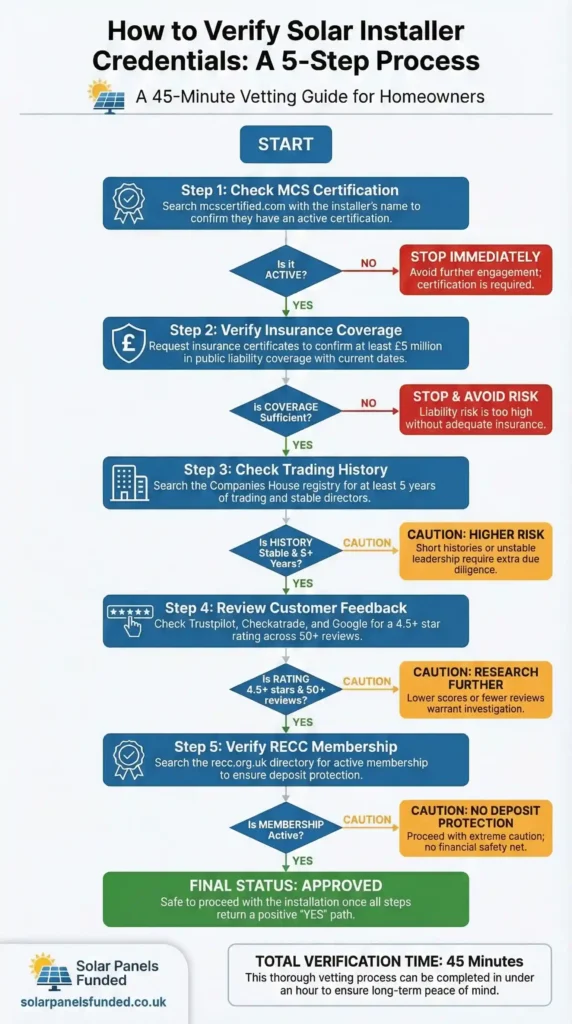
Start with MCS-certified installers listed on the official MCS database at mcscertified.com. MCS (Microgeneration Certification Scheme) certification confirms installers meet government-approved standards for design, installation and commissioning. Check local directories like Checkatrade, TrustATrader and Which? Trusted Traders for verified customer reviews. Request three written quotes from different installers to compare pricing, equipment specifications and warranty terms before making decisions.
Local installer directories and search tools make it easy to find local solar installers in your area who understand regional regulations, weather patterns and supply logistics. Proximity enables faster site visits, better after-sales support and knowledge of local planning requirements.
Search the Official MCS Installer Database
The MCS website hosts a searchable database of 1,800+ certified solar installers across England, Scotland, Wales and Northern Ireland. Enter your postcode to find installers operating within your area. MCS certification requires annual audits, insurance verification and compliance with Building Regulations and electrical safety standards.
Filter search results by installer type (domestic, commercial or both), distance from property and customer rating scores. MCS-certified companies display certification numbers on websites and marketing materials. Verify certificates directly through the MCS database using company registration numbers to confirm active status and coverage dates.
Use Consumer Protection Scheme Directories
RECC (Renewable Energy Consumer Code) membership provides additional consumer safeguards beyond MCS certification. RECC members follow strict sales practices, offer deposit protection and participate in independent dispute resolution. Search the RECC member directory at recc.org.uk for installers committed to higher service standards.
TrustMark-registered installers meet government-endorsed quality standards across home improvements. TrustMark companies undergo financial checks, technical assessments and complaint handling reviews. The TrustMark scheme covers solar installations under “renewable energy” categories with ongoing monitoring of member performance.
Check Online Review Platforms and Ratings
Trustpilot, Google Reviews and Checkatrade provide customer feedback on installer performance. Look for companies with 50+ reviews averaging 4.5 stars or higher. Read recent reviews (last 6-12 months) rather than focusing solely on overall ratings. Pay attention to how installers respond to negative feedback – professional responses demonstrate commitment to customer service.
Which? Trusted Traders undergo additional vetting including credit checks, trading history verification and ongoing mystery shopping assessments. Trading Standards-approved installers display “Buy with Confidence” logos indicating local authority endorsement. Regional trade associations like Renewable Energy Association (REA) membership signals industry engagement and professional standards.
| Verification Step | Information Source | Verification Time | Failure Risk if Skipped | Red Flag Indicators | Green Flag Indicators | Risk Level (High/Medium/Low) |
|---|---|---|---|---|---|---|
| MCS Certification Status | mcscertified.com database | 5 minutes | HIGH - No SEG/VAT relief eligibility | Expired/no certificate | Active certification 2+ years | HIGH |
| Companies House Trading History | companieshouse.gov.uk | 10 minutes | MEDIUM - Business stability unknown | <2 years trading, dissolved companies | 5+ years, stable directors | MEDIUM |
| Public Liability Insurance | Direct insurer contact | 15 minutes | HIGH - No damage/injury protection | Expired policy, <£2M coverage | £5M+ coverage, current policy | HIGH |
| RECC Membership | recc.org.uk directory | 3 minutes | MEDIUM - No deposit protection | Not listed | Active member 2+ years | MEDIUM |
| Online Reviews (Trustpilot/Google) | Review platforms | 20 minutes | MEDIUM - Service quality unknown | <4 stars, few reviews, complaint patterns | 4.5+ stars, 50+ reviews, recent positive | MEDIUM |
| Customer References | Direct customer contact | 30-45 minutes | LOW - Limited real experience data | Unwilling to provide, vague references | 3+ contactable recent customers | LOW |
| Physical Office Address | Google Maps/site visit | 15 minutes | MEDIUM - Legitimacy concerns | PO box only, residential address | Commercial premises, signage | MEDIUM |
| Warranty Documentation | Written warranty terms | 10 minutes | HIGH - No recourse for failures | Verbal only, unclear terms | Detailed written IBG coverage | HIGH |
| Electrical Certification | NICEIC/NAPIT verification | 10 minutes | HIGH - Non-compliant electrical work | No Part P registration | Active NICEIC/NAPIT membership | HIGH |
| Quote Itemization | Installer proposal | 5 minutes | MEDIUM - Hidden costs risk | Lump sum only | Detailed equipment/labour breakdown | MEDIUM |
| Manufacturer Training | Certificate requests | 10 minutes | LOW - Warranty optimization only | No brand training | Multiple manufacturer certifications | LOW |
| Payment Terms | Contract review | 5 minutes | MEDIUM - Financial exposure | >50% upfront | Staged payments, 25% max deposit | MEDIUM |
Request Personal Recommendations and Referrals
Ask neighbours, friends or colleagues who installed solar panels about their installer experiences. Personal recommendations provide insights into communication quality, timeliness, problem-solving and after-sales support. Request contact details for past customers from installers during quote processes – reputable companies willingly share references.
Local Facebook groups, community forums and neighbourhood apps like Nextdoor often feature installer discussions and recommendations. Search for location-specific solar energy groups where members share installer experiences, pricing comparisons and installation photos. Community recommendations reveal local installer reputations and service quality patterns.
Evaluate Installer Websites and Online Presence
Professional installer websites display clear contact information, company registration numbers, VAT numbers and physical office addresses. Look for detailed service descriptions, equipment specifications, warranty explanations and transparent pricing information. Companies hiding contact details or using generic website templates raise credibility concerns.
Check company registration status through Companies House (companieshouse.gov.uk). Verify trading history, financial health and director information. Companies operating 5+ years demonstrate stability and experience. Review social media activity for customer engagement, project updates and industry participation indicating active, established businesses.
What certifications and qualifications should solar installers have?
All UK solar installers must hold MCS certification to qualify installations for government incentive schemes and comply with Building Regulations. Installers need Part P electrical certification or employ qualified electricians for electrical work. Look for additional qualifications including NICEIC (National Inspection Council for Electrical Installation Contracting), ECS (Electrotechnical Certification Scheme) and manufacturers’ product training certificates demonstrating technical expertise.
MCS Certification Requirements and Validation
MCS certification covers design, installation, commissioning and handover procedures for solar PV systems. Certified installers undergo annual surveillance audits checking workmanship quality, documentation accuracy and customer satisfaction. MCS standards align with British Standards BS EN 62446 for PV systems and Building Regulations Part P for electrical safety.
MCS certificates expire annually requiring renewal audits and continued professional development. Verify current certification status through the MCS database rather than relying on website claims. Expired certificates invalidate installations for Smart Export Guarantee eligibility and VAT relief schemes. Request certification copies during quote processes and confirm details match company information.
Electrical Safety Certifications and Competent Person Schemes
Part P Building Regulations require qualified electricians for solar installation electrical work. Installers must register installations with local Building Control or operate under Competent Person Schemes (CPS) enabling self-certification. NICEIC, NAPIT and Elecsa operate major CPS covering solar electrical work.
Electrical Installation Certificates (EIC) confirm compliance with BS 7671 wiring regulations. Installers provide EICs after installation completion documenting circuit testing, earthing arrangements and safety verifications. Missing EICs indicate non-compliant installations risking insurance coverage, property sales and safety.
Manufacturer Product Training and Warranties
Premium inverter manufacturers (SolarEdge, Enphase, GivEnergy) require installer training before authorising warranty coverage. Trained installers access extended warranties, technical support and product updates unavailable to uncertified companies. Request evidence of manufacturer training certifications for specified equipment during quote evaluations.
NICEIC Approved Contractor status indicates rigorous technical assessments, insurance requirements and ongoing competency monitoring. NICEIC companies undergo regular inspections verifying work quality and compliance. ECS (Electrotechnical Certification Scheme) Gold Cards demonstrate individual electrician competency for solar electrical work.
Insurance Coverage and Financial Protection
Public liability insurance (minimum £5 million coverage) protects property owners against installation damage or accidents. Professional indemnity insurance covers design errors, specification mistakes or system underperformance claims. Request current insurance certificates showing adequate coverage levels and expiry dates.
RECC deposit protection schemes safeguard advance payments if companies cease trading before completing installations. Check membership status and deposit limits (typically 25% maximum deposits for RECC members). Payment protection insurance or escrow arrangements provide additional financial security for larger installations.
Health and Safety Accreditations
SSIP (Safety Schemes in Procurement) certification demonstrates commitment to workplace safety through CHAS, SafeContractor or Constructionline membership. Solar installers working at height require risk assessments, method statements and appropriate safety equipment. Companies employing scaffolders need CISRS (Construction Industry Scaffolders Record Scheme) certified workers.
IOSH (Institution of Occupational Safety and Health) training for site managers improves safety culture and regulatory compliance. Check accident records, Health and Safety Executive (HSE) enforcement actions and company safety policies. Poor safety records indicate systemic problems risking installation quality and worker welfare.
How much do solar panel installers charge in the UK?
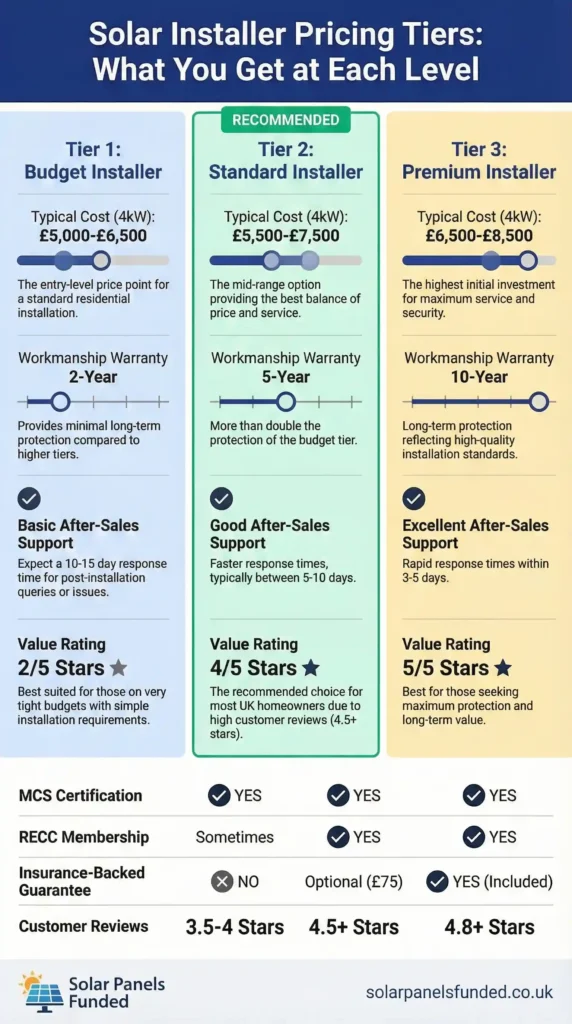
Solar installers charge £800-£1,200 per kW installed for domestic systems in 2026. A typical 4kW residential installation costs £3,200-£4,800 for labour, scaffolding and electrical work, plus £2,000-£3,500 for equipment (panels, inverter, mounting). Total installed costs range £5,500-£8,500 for standard 4kW systems or £8,000-£13,000 for 6kW systems with battery storage. Installation complexity, roof access, electrical upgrades and location affect final pricing.
Understanding comprehensive solar panel installation costs helps you evaluate installer quotes accurately and budget appropriately. Labour represents only one component of total project expenses alongside equipment, permissions and additional services.
Labour Cost Breakdown by System Size
3kW systems require 1-2 installers working 1-2 days, costing £1,200-£1,800 labour. 4kW installations need 2 installers over 1.5-2 days at £1,600-£2,400. Larger 6kW+ systems take 2-3 installers working 2-3 days, reaching £2,400-£3,600 labour costs. Labour represents 25-35% of total installation costs for straightforward projects.
| System Size | Standard Labour (Simple Install) | Complex Labour (Difficult Access) | Installer Count | Installation Days | Hourly Rate Range | Scaffolding Cost | Electrical Work | Total Labour (Simple) | Total Labour (Complex) | Labour as % of Total Cost | Cost per kW (Labour Only) | Regional Variation |
|---|---|---|---|---|---|---|---|---|---|---|---|---|
| 3kW | £1200-£1600 | £1800-£2400 | 1-2 installers | 1-1.5 days | £25-£45/hour | £400-£600 | £200-£400 | £1800-£2600 | £2400-£3400 | 30-35% | £600-£800/kW | ±15% by region |
| 4kW | £1600-£2200 | £2200-£3000 | 2 installers | 1.5-2 days | £25-£45/hour | £400-£800 | £300-£500 | £2300-£3500 | £2900-£4300 | 28-33% | £575-£750/kW | ±15% by region |
| 5kW | £2000-£2600 | £2600-£3400 | 2 installers | 2-2.5 days | £25-£45/hour | £500-£800 | £300-£600 | £2800-£4000 | £3400-£4800 | 27-32% | £560-£680/kW | ±15% by region |
| 6kW | £2400-£3000 | £3000-£3800 | 2-3 installers | 2-3 days | £25-£45/hour | £600-£1000 | £400-£700 | £3400-£4700 | £4000-£5500 | 26-31% | £567-£783/kW | ±15% by region |
| 8kW | £3000-£3800 | £3800-£5000 | 2-3 installers | 2.5-3.5 days | £25-£45/hour | £600-£1200 | £500-£800 | £4100-£5800 | £4900-£7000 | 25-30% | £513-£625/kW | ±15% by region |
| 10kW | £3600-£4600 | £4600-£6200 | 3 installers | 3-4 days | £25-£45/hour | £800-£1400 | £600-£1000 | £5000-£7000 | £6000-£8600 | 24-29% | £500-£620/kW | ±15% by region |
Hourly rates for qualified solar installers range £25-£45 depending on experience level and location. London and Southeast rates reach £40-£50 per hour versus £25-£35 in Northern England, Scotland and Wales. Specialist electrical work bills separately at £40-£60 per hour for Part P certified electricians.
Scaffolding and Access Equipment Costs
Standard 2-storey scaffolding hire costs £400-£800 for 1-2 week installations. Three-storey properties require £600-£1,200 scaffolding. Mobile scaffolding towers suitable for bungalows cost £200-£400. Roof ladder and edge protection equipment adds £100-£200 for single-storey installations not requiring full scaffolding.
Complex roof access increases costs 15-30%. Listed buildings, conservation areas or difficult access properties needing specialized equipment reach £1,000-£2,000 scaffolding costs. Ground-mounted systems avoid scaffolding expenses but require concrete bases (£300-£600) and trenching for cable runs (£200-£500).
Electrical Work and Consumer Unit Upgrades
Basic AC connections to existing consumer units cost £200-£400 included in standard installations. Consumer unit replacements or upgrades required for 30-40% of installations add £400-£800. Properties needing DNO (Distribution Network Operator) applications for systems exceeding 3.68kW pay £150-£300 application fees plus electrical certification.
Installing new AC isolators, DC isolators, generation meters and surge protection costs £300-£600 materials and labour. Rewiring from roof to consumer units through multiple floors adds £200-£500 depending on cable run complexity. Smart meter installations coordinating with solar systems cost £0-£200 depending on existing meter arrangements.
Additional Installation Services and Costs
Battery storage integration adds £600-£1,200 installation labour beyond battery equipment costs (£3,000-£6,000). EV charger installation alongside solar costs £400-£800 labour plus charger equipment (£400-£1,200). Bird protection mesh installation prevents nesting under panels at £150-£400 for standard residential arrays.
Remote monitoring system setup, Wi-Fi gateway configuration and mobile app training typically include in standard installations. Premium monitoring solutions with real-time alerts and predictive maintenance cost £200-£500 additional. Annual maintenance contracts cost £100-£250 covering inspections, cleaning and performance verification.
Regional Pricing Variations Across UK
London and Southeast England installations cost 15-25% above national averages (£6,500-£10,000 for 4kW systems). Scotland, Northeast England and Wales see lowest pricing at £5,000-£7,500 for equivalent systems. Midlands and Northwest England fall mid-range at £5,500-£8,500.
Island locations (Isle of Wight, Scottish islands, Channel Islands) face 20-40% premiums due to travel costs, accommodation and equipment transport. Rural installations more than 50 miles from installer bases add £200-£500 travel charges. Urban installations benefit from installer competition driving competitive pricing and faster response times.
Installation labour represents 25-35% of total system costs with equipment, permissions and additional services comprising remaining expenses. Understanding complete cost structures helps you evaluate whether installer quotes represent fair market value.
Quote Comparison and Price Negotiation Strategies
Request itemized quotes separating equipment costs, labour, scaffolding, electrical work and additional services. Compare like-for-like specifications including panel wattage, inverter brands, warranty terms and monitoring systems. Lowest quotes often use cheaper equipment or exclude essential services creating hidden costs.
Installers discount 5-10% for multiple referrals, off-season installations (October-March) or joining existing installation schedules in your area. Payment terms affect pricing – full upfront payment may secure 3-5% discounts versus staged payments. Finance arrangements through installers typically add 10-15% to total costs versus cash payments.
What questions should I ask solar panel installers during consultations?
Ask installers about MCS certification status, insurance coverage levels, warranty terms (workmanship and equipment), expected system performance, monitoring arrangements and after-sales support procedures. Request detailed equipment specifications, installation timelines, payment schedules and guarantees on quoted prices. Clarify who handles DNO applications, Building Regulations notifications, Smart Export Guarantee registrations and ongoing system maintenance requirements.
Certification and Credentials Verification Questions
“What is your MCS certification number and expiry date?” – Verify through MCS database. “Do you hold RECC membership?” – Confirms consumer protection commitments. “Which electrical certification schemes do you belong to?” – NICEIC, NAPIT or Elecsa demonstrate electrical competency.
“Are your installers employed or subcontracted?” – Employed teams ensure quality control and accountability. “What manufacturer training certifications do you hold?” – Trained installers access extended warranties and technical support. “Can you provide insurance certificates showing current coverage?” – Minimum £5 million public liability required.
Equipment Specifications and Performance Questions
“Which panel brands do you recommend and why?” – Understand equipment selection rationale. “What efficiency ratings and degradation rates do specified panels have?” – Premium panels maintain 85-90% output after 25 years. “Which inverter brand and model will you install?” – Inverter choice affects monitoring, efficiency and battery compatibility.
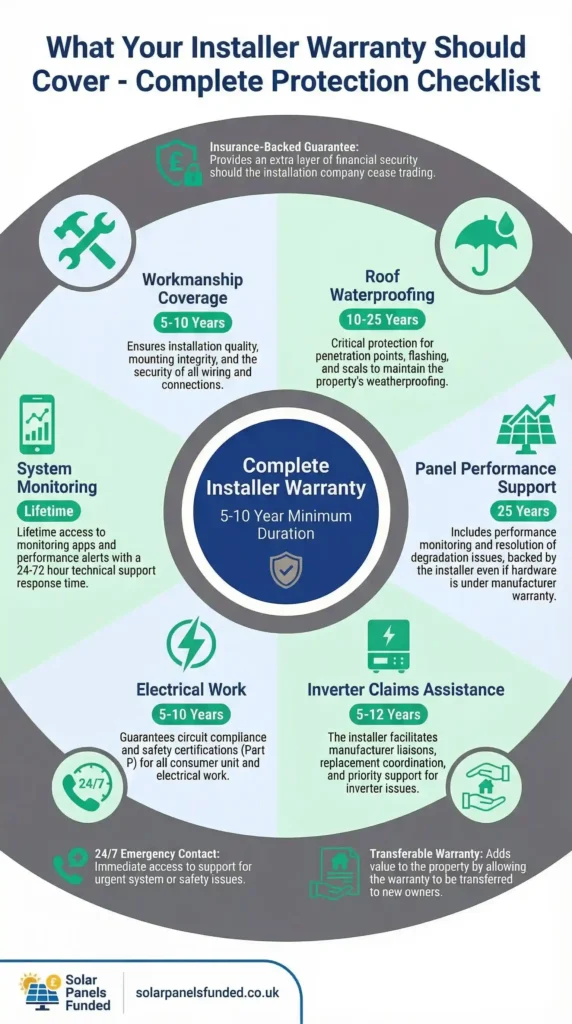
“What warranties cover panels, inverters and installation workmanship?” – Standard warranties: panels 25 years, inverters 5-12 years, workmanship 2-10 years. “How do warranty claims work?” – Understand claim processes, response times and coverage terms. “Will you provide system performance estimates?” – Request annual generation forecasts in kWh based on roof orientation and shading.
Installation Process and Timeline Questions
“How long will installation take?” – Standard 4kW systems complete in 1-2 days. “Will you handle all permissions and applications?” – DNO notifications, Building Control and SEG registrations should be installer responsibilities. “What preparation do I need to complete before installation?” – Roof access, parking and consumer unit accessibility requirements.
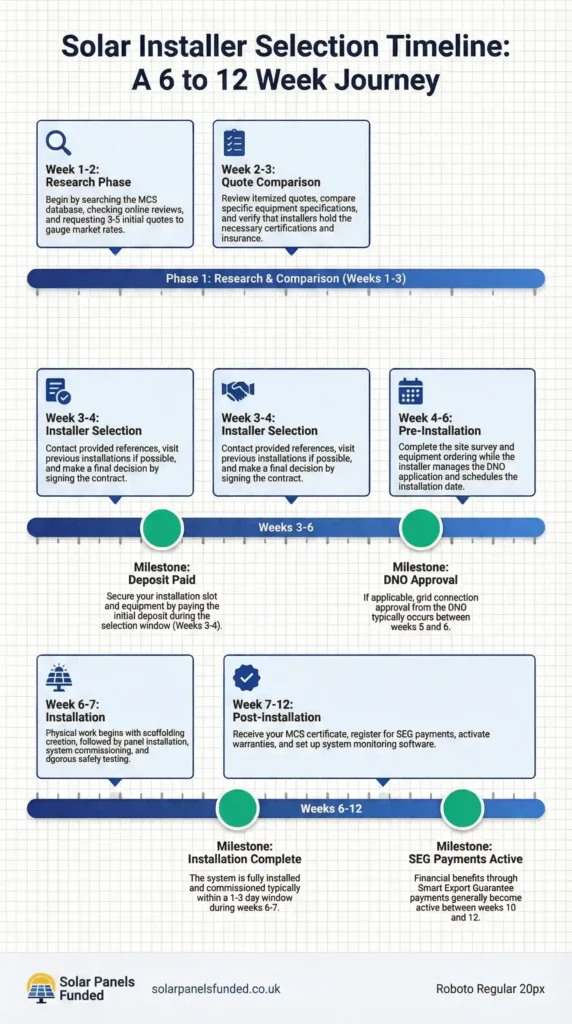
Understanding the complete solar installation process and timeline helps you plan around installer schedules and prepare your property appropriately. Professional installers follow standardized procedures ensuring quality and compliance throughout every phase.
“Who will supervise the installation?” – Experienced project managers ensure quality standards. “What happens if weather delays installation?” – Understand rescheduling policies and communication procedures. “Will you provide progress updates during installation?” – Communication expectations prevent surprises.
Financial and Payment Questions
“What deposit do you require?” – RECC members limit deposits to 25% of total cost. “What are your payment terms?” – Staged payments (deposit, mid-installation, completion) reduce risk. “Do you offer finance arrangements?” – Compare installer finance versus independent green energy loans.
| Installer Tier | Workmanship Warranty | Insurance-Backed Guarantee | Panel Warranty Facilitation | Inverter Warranty Support | Roof Penetration Coverage | Warranty Transferability | Response Time (Warranty Claims) | Claim Process Complexity | Annual Service Inclusion | Deposit Protection | Typical Total System Cost | Overall Value Rating |
|---|---|---|---|---|---|---|---|---|---|---|---|---|
| Budget (Basic MCS) | 2 years | NO | Manufacturer only (25yr) | Manufacturer only (5-10yr) | 2 years | Non-transferable | 10-15 working days | Complex (multiple contacts) | NO | RECC (if member) | £5000-£6500 (4kW) | ⭐⭐ (2/5) |
| Standard (Local Installer) | 5 years | Sometimes (£75 cost) | Assisted registration | Assisted claims | 5-10 years | Sometimes | 5-10 working days | Moderate (single point) | Optional (£100-£150/yr) | RECC member | £5500-£7500 (4kW) | ⭐⭐⭐⭐ (4/5) |
| Premium (Established Local) | 10 years | YES (included) | Full management | Priority support | 10-15 years | YES (no fee) | 3-5 working days | Simple (dedicated contact) | Included 1st year | RECC + escrow | £6500-£8500 (4kW) | ⭐⭐⭐⭐⭐ (5/5) |
| National (Large Company) | 5-10 years | YES (included) | Centralized process | Call center support | 10 years | YES (transfer fee £50) | 7-10 working days | Moderate (ticket system) | Optional (£150-£250/yr) | Deposit insurance | £6000-£8000 (4kW) | ⭐⭐⭐⭐ (4/5) |
| Premium National | 10-15 years | YES (included) | Concierge service | Dedicated account manager | 15-25 years | YES (no fee) | 24-48 hours | Simple (priority hotline) | Included 2 years | Full protection | £7500-£10000 (4kW) | ⭐⭐⭐⭐⭐ (5/5) |
“Is the quote fixed or subject to changes?” – Fixed quotes protect against price increases. “What costs could increase the quoted price?” – Understand variation triggers like structural work or electrical upgrades. “Do you offer price-match guarantees?” – Some installers match verified competitor quotes.
After-Sales Support and Maintenance Questions
“What after-sales support do you provide?” – Availability, response times and support channels (phone, email, online portal). “Do you offer maintenance packages?” – Annual inspections cost £100-£250 covering cleaning, testing and performance checks. “How long have you been installing solar panels?” – Experience correlates with installation quality and problem-solving capabilities.
“Can you provide references from recent customers?” – Contact 2-3 references to verify satisfaction levels. “What happens if problems occur after installation?” – Understand complaint procedures, resolution timelines and escalation processes. “Will you help with insurance claims if needed?” – Some installers assist with property insurance notifications and valuations.
How long does professional solar panel installation take?
Standard residential installations (3-5kW systems) complete in 1-2 working days with 2-3 qualified installers. Day one covers scaffolding erection, roof mounting, panel installation and DC wiring. Day two includes inverter installation, AC connections, system testing and commissioning. Complex installations involving battery storage, electrical upgrades or difficult access extend timelines to 2-3 days. Commercial installations take 3-10 days depending on system size and building complexity.
Pre-Installation Preparation Timeline (1-4 Weeks)
Site surveys take 1-2 hours assessing roof condition, orientation, shading, electrical infrastructure and structural capacity. Surveyors measure roof dimensions, photograph installation areas and discuss equipment preferences. Survey reports include system designs, performance estimates and detailed quotations within 3-7 days.
DNO applications for systems exceeding 3.68kW take 10-15 working days for approval. Building Regulations notifications process same day through Competent Person Schemes or require 5-10 days through local Building Control. Planning permission applications (listed buildings, conservation areas) take 6-8 weeks for decisions.
Installation Day Schedule and Activities
Morning (8am-12pm): Scaffolding erection (1-2 hours), roof assessment and preparation, mounting rail installation, panel positioning and securing. Installers work in pairs with one on roof and one handling materials. Health and safety briefings, toolbox talks and risk assessments precede physical work.
Afternoon (12pm-5pm): Panel wiring and string connections, DC cable runs from roof to inverter location, inverter mounting and AC connections, system testing and commissioning. Electricians handle all electrical work under Part P regulations. Final day includes generation meter installation, monitoring system configuration and homeowner handover.
System Testing and Commissioning (2-3 Hours)
Installers test all electrical connections, measure string voltages and currents, verify inverter operation and confirm monitoring system connectivity. Insulation resistance testing, earth continuity testing and polarity checks ensure electrical safety. Inverter commissioning includes Wi-Fi setup, utility grid connection and performance verification.
System handoff involves homeowner training on monitoring apps, inverter operation, isolation procedures and maintenance requirements. Installers provide EIC (Electrical Installation Certificate), system documentation, warranty registration details and emergency contact information. Final walkarounds confirm tidy workmanship, debris removal and property protection.
Post-Installation Documentation and Registrations (1-2 Weeks)
MCS installation certificates issue within 5-10 working days enabling SEG applications. Building Regulations completion certificates arrive 7-14 days through Competent Person Schemes or Building Control inspections. DNO commissioning confirmations take 5-10 working days confirming grid connection approvals.
Smart Export Guarantee applications through chosen suppliers process within 10-20 working days. Some installers handle SEG applications as part of installation packages. Warranty registrations with manufacturers require completion within 30-90 days of installation dates to activate coverage.
Factors Extending Installation Timelines
Structural roof repairs add 1-3 days for timber replacements, fascia repairs or roof tile work. Consumer unit upgrades require electricians spending additional 2-4 hours installing new boards and circuit protection. Battery storage integration adds 3-6 hours for battery mounting, inverter configuration and charge controller setup.
Listed buildings or conservation areas requiring specialized fixing methods extend installations by 1-2 days. Multiple roof aspects with complex panel layouts need additional planning and installation time. Ground-mounted systems require 2-3 days for base preparation, framework installation and cable trenching before panel mounting.
What warranties and guarantees should installers provide?
Installers should provide separate warranties covering panels (25 years performance), inverters (5-12 years manufacturer warranty), installation workmanship (minimum 2 years, preferably 5-10 years) and roof penetration weatherproofing (10-25 years). Insurance-backed warranties protect against installer business failure. Request written warranty documentation specifying coverage terms, exclusions, claim procedures and transferability conditions for future property sales.
Solar Panel Performance and Product Warranties
Panel manufacturers guarantee 80-85% output after 25 years through linear degradation warranties. Premium panels (REC, LG, SunPower) offer 92% output after 25 years. Product warranties cover manufacturing defects, material failures and premature degradation for 10-25 years depending on brand tier.
Tier 1 manufacturers (Q CELLS, JinkoSolar, Canadian Solar) provide 12-25 year product warranties and 25-30 year performance guarantees. Budget panels offer 10-12 year product warranties and 25 year performance warranties. Performance warranty claims require documented annual generation data proving underperformance below guaranteed thresholds.
Inverter Manufacturer Warranties
String inverters carry 5-10 year manufacturer warranties with optional extensions to 20 years (£200-£500 additional cost). Microinverters include 15-25 year warranties reflecting longer lifespan expectations. Hybrid inverters with battery management features offer 5-12 year coverage depending on brands.
Premium inverter brands (SolarEdge, SMA, Fronius) provide 12 year standard warranties versus 5 years for budget alternatives (Growatt, Solis). Warranty extensions require purchase during installation or within first operational year. Extended warranties cost 10-15% of inverter replacement costs providing value for long-term protection.
Installation Workmanship Guarantees
Minimum 2-year workmanship warranties cover installation quality, fixing integrity and system commissioning. Premium installers offer 5-10 year guarantees demonstrating confidence in work quality. Workmanship warranties address mounting failures, roof leaks, wiring faults and system underperformance caused by installation errors.
Insurance-backed guarantees (IBG) through schemes like HomePro or GGF protect warranty validity if installers cease trading. IBG policies cost £50-£150 added to installation prices protecting workmanship guarantees for 5-10 years. Verify IBG coverage includes deposit protection, remedial work and alternative installer appointments if original companies close.
Roof Waterproofing and Penetration Warranties
Roof penetration points for mounting brackets require proper flashing and weatherproofing preventing water ingress. Installers guarantee waterproof installations for 10-25 years depending on fixing methods and materials used. Roof warranties void if unauthorized alterations occur or maintenance neglect allows damage.
Integrated mounting systems (replacing roof tiles) need specialist warranties covering both mounting and weatherproofing functions. Some installers coordinate with roofing contractors for combined warranties. Request written confirmation that mounting work complies with BS 5534 (slating and tiling code) and BS 8000-6 (workmanship on building sites).
Battery Storage Warranties and Coverage
Battery manufacturers provide 10 year warranties covering 70-80% capacity retention and manufacturing defects. Premium lithium batteries (Tesla, LG Chem) offer 10-15 year warranties with 70% end-of-warranty capacity. Budget batteries guarantee 60-70% capacity after 10 years with lower cycle count ratings.
Battery management systems (BMS) and inverter integration carry separate warranties typically 5-10 years. Installer workmanship warranties should cover battery mounting, electrical connections and commissioning for minimum 2 years. Hybrid inverter warranties cover battery charging/discharging functions under standard inverter warranty terms.
Warranty Transfer and Property Sale Implications
Transferable warranties maintain property value when selling homes with solar installations. Some manufacturers require transfer notifications and fees (£50-£150) to activate coverage for new owners. Non-transferable warranties expire upon property ownership changes reducing resale value.
Request warranty transfer procedures during installation including required documentation, timeframes and costs. Solar installations with comprehensive transferable warranties command £3,000-£8,000 premiums in property sales. Estate agents require warranty documentation during property listings and purchase negotiations.
How do I verify installer credentials and avoid scams?
Verify MCS certification through the official database at mcscertified.com using installer company names or certification numbers. Check Companies House records for trading history, director information and financial status. Confirm insurance coverage through direct insurer contact rather than accepting photocopies. Request customer references and verify installations through site visits or phone conversations with past clients.
MCS Certification Verification Process
Access the MCS installer search at mcscertified.com and enter company details or postcodes. Verify certification status shows “Active” rather than “Expired” or “Suspended”. Check certification scope covers solar PV installations for intended system size and type. Note certification numbers and cross-reference with installer marketing materials.
Request MCS certificate copies during quote processes showing current validity dates. Certificates display installer addresses, contact information and scope limitations. Beware installers claiming MCS certification without providing proof or displaying incorrect certificate details. Contact MCS directly (info@mcscertified.com) to verify questionable certifications.
| Certification/Credential | Issuing Body | Validity Period | Cost to Installer | Verification Method | What It Covers | Mandatory for UK? | Consumer Benefit |
|---|---|---|---|---|---|---|---|
| MCS Certification | MCS Charitable Foundation | Annual renewal | £1200-£2500/year | MCS database search (mcscertified.com) | Design, installation, commissioning standards | YES (for incentives) | SEG eligibility, VAT relief, quality assurance |
| RECC Membership | Renewable Energy Consumer Code | Annual renewal | £500-£1000/year | RECC member directory (recc.org.uk) | Sales practices, deposit protection, dispute resolution | NO (recommended) | Deposit protection, complaints process |
| NICEIC Approved Contractor | NICEIC (electrical safety) | Annual assessment | £400-£800/year | NICEIC contractor search | Electrical installation competency | NO (alternative: NAPIT) | Electrical work quality, insurance claims |
| Part P Certification | Competent Person Scheme | Ongoing membership | £300-£600/year | Building Control notification | Electrical safety compliance | YES (for electrical work) | Building Regulations compliance |
| TrustMark Registration | TrustMark scheme | Annual renewal | £600-£1200/year | TrustMark directory | Government-endorsed quality standards | NO (recommended) | Additional consumer protection |
| ECS Gold Card | ECS (individual certification) | 5 year renewal | £50-£100 (per individual) | Card verification with employer | Individual electrician competency | NO (installer-level) | Qualified individual workers |
| Manufacturer Training | Equipment manufacturers | Varies (1-3 years) | £200-£800 per brand | Manufacturer certificate verification | Product-specific installation | NO (warranty benefit) | Extended warranties, technical support |
| Public Liability Insurance | Insurance providers | Annual policy | £500-£2000/year | Direct insurer verification | Minimum £5 million coverage | YES (legal requirement) | Financial protection from damage/injury |
Companies House and Trading History Checks
Search Companies House at companieshouse.gov.uk using company names or registration numbers. Review incorporation dates indicating trading experience (5+ years demonstrates stability). Check director information for multiple companies or frequent director changes suggesting instability.
Examine annual accounts for financial health indicators including turnover, profits and liabilities. Companies with negative equity or declining turnover face higher failure risks. Read filing history for late submissions or compliance issues. Dissolved companies or those in administration cannot honor warranties or after-sales commitments.
Insurance Verification and Coverage Confirmation
Request insurance schedules showing policy numbers, coverage amounts, covered activities and expiry dates. Verify public liability insurance minimum £5 million coverage for property damage or injury claims. Check professional indemnity insurance covers design errors, mis-selling or performance shortfalls.
Contact insurance providers directly using policy numbers to confirm active coverage and policy validity. Insurers verify coverage over phone using policy references without disclosing client details. Expired or insufficient insurance exposes homeowners to financial risks from installation accidents, property damage or injury claims.
Customer Reference and Site Visit Validation
Request 3-5 customer references from installations completed within last 12 months in your region. Contact references asking about communication quality, installation professionalism, system performance and after-sales support. Request addresses for possible site visits viewing completed installations and workmanship quality.
Analyze online reviews across multiple platforms (Trustpilot, Google, Checkatrade) for patterns in feedback. Excessive 5-star reviews within short timeframes suggest manipulation. Look for detailed reviews describing specific experiences rather than generic praise. Recent negative reviews about communication, quality or warranty support raise concerns.
Red Flags Indicating Potential Scams
Pressure sales tactics demanding immediate decisions or same-day deposits indicate unprofessional practices. Offers significantly below market rates (30%+ under average pricing) suggest substandard equipment, unlicensed work or business instability. Requests for large upfront payments (50%+ of contract value) before work commences risk deposits if companies cease trading.
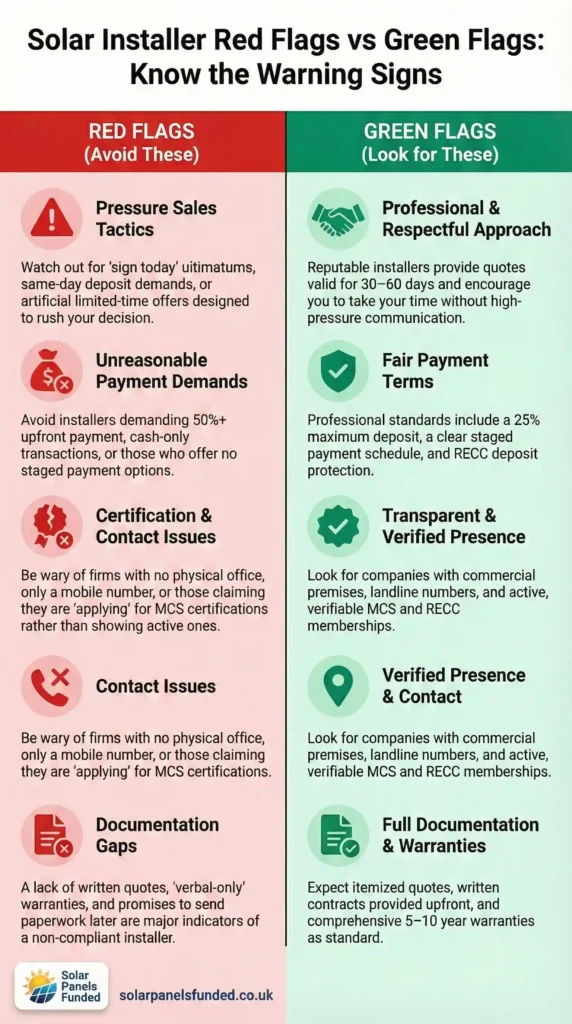
Lack of physical business addresses, showing only mobile numbers or PO boxes, suggests unestablished or untrustworthy operations. Unwillingness to provide written quotes, warranty documentation or insurance certificates indicates unprofessional standards. Claims that permits, certifications or notifications are unnecessary show ignorance of regulations risking non-compliant installations.
Protecting Against Installer Business Failure
Choose RECC members offering deposit protection schemes limiting financial exposure if companies collapse. Pay deposits by credit card (£100-£30,000 purchases) gaining Section 75 protection for refunds if services not delivered. Escrow payment arrangements release funds only after satisfactory installation completion.
Request insurance-backed guarantees protecting workmanship warranties against installer insolvency. Avoid paying full amounts before installation completion and commissioning verification. Retain 10-20% final payments until receiving MCS certificates, electrical certificates and documentation confirming regulatory compliance.
Frequently Asked Questions About Solar Panel Installers
Do I need planning permission for solar panel installation?
Most residential solar installations fall under permitted development rights not requiring planning permission. Exceptions include listed buildings, conservation areas, World Heritage Sites or panels exceeding roof planes by more than 200mm. Ground-mounted systems larger than 9m² or installations on buildings in National Parks require planning applications. Consult local planning authorities or installers familiar with local regulations before proceeding.
How do I find local solar panel installers near me?
Search the MCS installer database filtering by postcode and maximum distance from your property. Use Checkatrade, TrustATrader and Which? Trusted Traders entering your location for local installer listings with verified reviews. Ask neighbours with solar installations for installer recommendations and experiences. Join local Facebook groups or community forums discussing solar installations for area-specific installer suggestions.
What is the average cost of hiring solar panel installers?
Professional installation labour costs £800-£1,200 per kW for standard residential projects. A typical 4kW system costs £3,200-£4,800 installation labour plus £2,500-£3,500 equipment totaling £5,700-£8,300. Scaffolding adds £400-£800, electrical work £200-£600 and battery storage installation £600-£1,200 additional labour. Regional variations, roof complexity and property access affect final pricing.
Should I choose local or national solar installation companies?
Local installers offer personalized service, faster response times and knowledge of regional regulations and weather patterns. National companies provide standardized pricing, established supply chains and nationwide warranty support. Both deliver quality installations if properly certified. Choose based on credentials, reviews, equipment specifications and warranty terms rather than company size.
What happens if my solar panel installer goes out of business?
Insurance-backed guarantees (IBG) protect workmanship warranties through alternative installer appointments if original companies cease trading. Product warranties from panel and inverter manufacturers remain valid regardless of installer status. RECC deposit protection schemes refund advance payments if member companies fail before completing installations. Choose installers offering IBG coverage and maintain all warranty documentation.
How long should I expect solar panel installation to take?
Standard 3-5kW residential installations complete in 1-2 working days including scaffolding, panel mounting, wiring and commissioning. Battery storage additions extend timelines to 2-3 days. Commercial installations or complex residential projects take 3-10 days depending on system size and building characteristics. Weather delays, electrical upgrades or structural work may extend scheduled timelines.
Can solar panel installers help with financing options?
Many installers partner with finance providers offering 0% APR loans (12-24 months) or longer-term green energy loans at 4-8% APR. Some installers provide in-house financing at competitive rates. Compare installer finance with independent personal loans, green mortgages or energy efficiency schemes. Calculate total repayment costs including interest against cash purchase savings before committing.
What maintenance do solar panels need after installation?
Solar panels require minimal maintenance beyond annual visual inspections and occasional cleaning. Professional maintenance visits cost £100-£250 annually covering performance testing, connection checks and panel cleaning. Most installers recommend inspections every 1-2 years. Heavy soiling from bird droppings, pollen or urban pollution may require cleaning 1-2 times yearly maintaining optimal output.
Do solar panel installers provide monitoring and support?
Professional installers include monitoring system setup with Wi-Fi gateways, mobile apps and online portals tracking generation, consumption and system health. Most provide 1-2 years technical support for monitoring questions and system optimization. Annual maintenance packages often include remote monitoring reviews and performance assessments. Premium installers offer lifetime monitoring support and priority service scheduling.
How do I compare quotes from different solar panel installers?
Request itemized quotes separating equipment costs, labour, scaffolding, electrical work and additional services. Compare panel specifications (efficiency, warranty, degradation rates), inverter brands and monitoring systems across quotes. Verify all quotes include DNO applications, Building Regulations notifications and SEG registration assistance. Choose based on total value including warranties, support and equipment quality rather than lowest price alone.

Solar Energy Funding Specialist & Home Energy Advisor
Zachariah Eaton is a UK-based solar energy funding specialist with a focus on helping homeowners access grants, financing schemes, and cost-saving renewable solutions. He has spent years researching government-backed programmes such as ECO4, Smart Export Guarantee (SEG), and local funding initiatives to make solar more accessible. Zachariah writes practical, easy-to-understand guides that help households reduce energy bills and transition to clean energy with confidence.
solar inverter cost in the UK
- Zachariah Eaton
- November 20, 2025
Solar Panel Installation Cost
- Zachariah Eaton
- November 30, 2025