
Pool Solar Panels Installation Guide for Homes in the UK
Solar heating extends swimming seasons by 2-4 months while cutting energy costs by 60-80% compared to electric heaters. This guide covers complete pool solar panel installation for UK homes including system sizing, DIY installation steps, professional installer selection, cost breakdowns and performance expectations. You will learn collector types, roof mounting techniques, plumbing requirements and realistic temperature gains for outdoor and indoor pools.
Table of Contents
ToggleHow do pool solar panels work for heating?
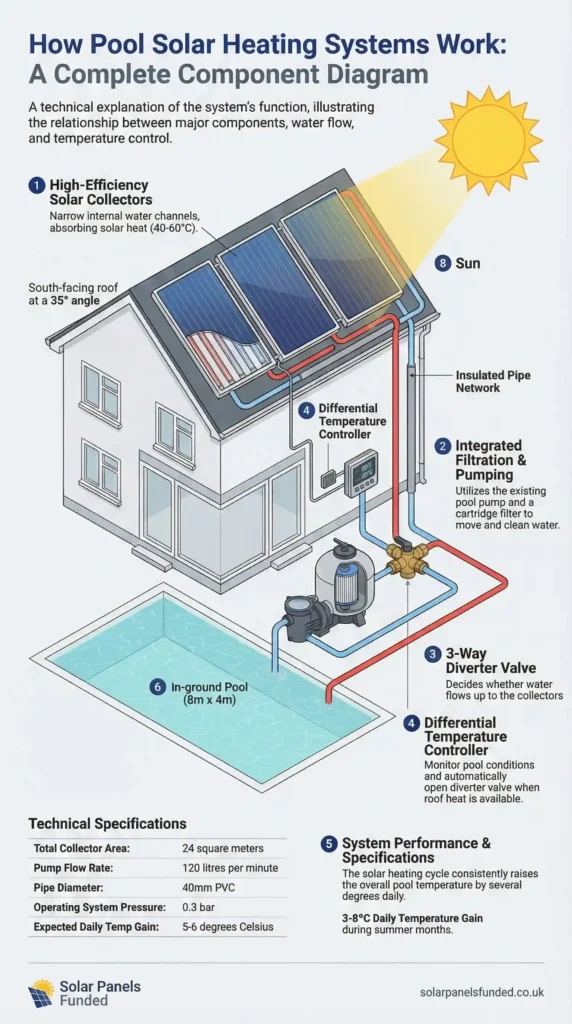
Pool solar panels work by circulating pool water through solar collectors where sunlight heats the water before returning it to the pool. Your existing pool pump pushes filtered water through rooftop or ground-mounted collectors containing narrow tubes or channels. Solar radiation warms these collectors to 40-60°C transferring heat to the flowing water. The warmed water returns to your pool raising overall temperature by 3-8°C on sunny days.
The system operates whenever the pump runs during daylight hours. A diverter valve controls whether water flows through collectors or bypasses them. Automatic controllers monitor collector and pool temperatures opening the diverter valve when collectors are warmer than pool water. This maximises heating efficiency while preventing heat loss during cloudy periods or overnight.
System Components and Functions
Complete solar pool heating systems include solar collectors, circulation pump, filter, diverter valve, flow control valve, pressure gauge and temperature sensors. Your existing pool pump typically provides sufficient flow when sized correctly. The filter removes debris before water enters collectors preventing blockages. The diverter valve directs water flow between collectors and pool return line.
Pressure gauges indicate system resistance confirming proper flow rates. Temperature sensors mounted on collector outlets and pool returns provide data for automatic control. Check valves prevent reverse flow when the pump stops. Air release valves remove trapped air from collector systems mounted above pool level.
Pool Types Suitable for Solar Heating
Above-ground pools respond fastest to solar heating due to smaller water volumes. A 15,000-litre above-ground pool warms 1-2°C daily with properly sized collectors. In-ground pools require larger collector areas but achieve similar temperature gains over longer periods. Indoor pools benefit from solar heating reducing conventional heating loads by 40-60% when collectors supply pre-heated water.
Saltwater and chlorine pools both work with solar collectors. Collector materials resist chemical corrosion from properly balanced pool water. Heated spas and hot tubs require different systems because target temperatures exceed solar collector capabilities without supplementary heating.
Why install solar panels for pool heating in the UK?
UK swimming seasons extend from May to September averaging 16-18 weeks annually. Solar heating extends usable periods to April through October reaching 24-28 weeks in southern regions. This 40-60% season extension transforms outdoor pools from occasional-use facilities to regular family amenities. Temperature increases of 4-6°C convert uncomfortably cold pools (18-20°C) to comfortable swimming conditions (22-26°C).
Running cost savings reach £400-£800 annually for typical residential pools replacing electric heating. Solar systems eliminate 2,000-4,000 kWh annual electricity consumption for pool heating. At current UK electricity rates of 24-28p per kWh this represents substantial savings. Payback periods range 3-7 years depending on system costs, pool size and previous heating method.
Climate Suitability for Pool Solar Heating
UK solar irradiance averages 900-1,100 kWh/m² annually with southern England receiving highest values. Summer months provide 4-6 peak sun hours daily enabling effective pool heating. Solar collectors operate efficiently even on cloudy days capturing diffuse radiation. Performance drops 30-50% on overcast days but systems still contribute meaningful heating.
Coastal regions including Poole, Dorset and Cornwall benefit from mild temperatures and extended seasons. Northern regions experience shorter seasons but still achieve 3-5°C temperature gains during summer months. East-facing and west-facing collector installations capture morning and afternoon sun respectively with south-facing orientations providing optimal performance.
Environmental Benefits
Solar pool heating eliminates 1.5-2.5 tonnes annual CO₂ emissions per residential pool replacing fossil fuel heating. Zero operating emissions during 15-20 year system lifespans create substantial environmental benefits. Reduced electricity demand during peak summer periods eases grid strain. Silent operation eliminates noise pollution from heat pumps or gas heaters.
What are the different types of solar pool collectors?
Solar pool collectors fall into three main categories: unglazed flat-plate collectors, glazed flat-plate collectors and evacuated tube collectors. Unglazed collectors dominate UK residential installations due to cost-effectiveness and suitable performance for seasonal heating. Material choices include EPDM rubber, polypropylene plastic and UV-resistant polymers. Collector efficiency ranges 50-70% for unglazed types and 70-85% for glazed collectors.
Combined solar pool heating plus residential solar panel systems create comprehensive renewable energy solutions. Rooftop PV panels generate electricity for pool pumps while thermal collectors heat pool water eliminating both electricity and heating costs across extended swimming seasons.
Unglazed Flat-Plate Collectors
Unglazed collectors consist of black rubber or plastic panels with internal water channels. These lightweight panels install easily on roofs, ground frames or fences. No glass covering reduces costs and weight while maintaining adequate performance for pool heating. Operating temperatures reach 30-45°C suitable for extending swimming seasons without approaching pool water boiling points.
Popular designs include mat-style collectors and rigid panel collectors. Mat collectors feature flexible rubber sheets connecting via manifolds. Rigid panels use extruded polypropylene with integral channels. Both types resist pool chemicals, UV degradation and freeze damage when properly drained.
| Collector Type | Material | Weight | Cost per m² | Efficiency | Lifespan | Best Application |
|---|---|---|---|---|---|---|
| Rubber Mat | EPDM rubber | 2-3 kg/m² | £40-£60 | 50-60% | 10-15 years | Above-ground pools, budget installations |
| Polypropylene Panel | PP plastic | 4-6 kg/m² | £60-£90 | 55-65% | 15-20 years | In-ground pools, permanent installations |
| Rigid Panel | UV-resistant polymer | 5-8 kg/m² | £80-£120 | 60-70% | 20-25 years | Large pools, commercial applications |
Glazed Flat-Plate Collectors
Glazed collectors feature glass-covered absorber plates creating insulated chambers. This design reduces heat loss enabling operation in cooler weather and achieving higher water temperatures. Glazed collectors extend heating seasons into spring and autumn months when unglazed systems underperform. Construction includes aluminium frames, tempered glass covers, copper or aluminium absorber plates and insulated backing.
Higher costs (£150-£250 per m²) limit glazed collector adoption for seasonal pool heating. Applications include year-round indoor pool heating, spa heating and installations prioritising shoulder-season performance. Efficiency ratings reach 70-85% with operating temperatures up to 60-80°C.
Evacuated Tube Collectors
Evacuated tube collectors comprise individual glass tubes containing absorber elements. Vacuum insulation minimises heat loss achieving efficiencies above 75%. High costs (£200-£400 per m²) and complex installation make these systems rare for pool heating. Applications focus on spa heating, tropical pool temperature requirements or combined pool and domestic hot water systems.
Ground-Mounted vs Roof-Mounted Systems
| Installation Type | Advantages | Disadvantages | Typical Cost | Best For |
|---|---|---|---|---|
| Roof-Mounted | Space-efficient, optimal sun exposure, permanent installation | Requires roof access, structural assessment, professional installation often needed | £1,200-£2,500 (materials + labour) | Limited garden space, strong existing roofs, long-term installations |
| Ground-Mounted Frame | Easy DIY installation, accessible maintenance, adjustable angle, portable | Requires garden space, potential shading issues, less aesthetic | £800-£1,800 (materials + frame) | Large gardens, rental properties, DIY enthusiasts, flexible setups |
| Fence-Mounted | Uses existing structures, space-efficient, east/west facing option | Limited sun exposure, structural limitations, aesthetic concerns | £600-£1,400 (materials only) | Small gardens, existing suitable fences, supplementary heating |
How much collector area do you need?
Collector area requirements equal 50-100% of pool surface area depending on desired temperature increase, season length and climate. A 32m² (8m × 4m) pool requires 16-32m² of collectors. Larger collector areas (80-100% pool surface) enable 6-8°C temperature gains and extend seasons by 8-12 weeks. Smaller areas (50-60% pool surface) provide 3-4°C gains suitable for peak summer use only.
Above-ground pools heat faster requiring smaller collector ratios (50-70% pool surface area). These pools have smaller water volumes and faster heat transfer. In-ground pools need larger ratios (70-100%) due to greater thermal mass and heat loss through walls. Indoor pools benefit from 40-60% ratios because reduced wind and evaporative losses improve efficiency.
Calculating Your Pool Surface Area
Rectangular pools: multiply length × width. Circular pools: multiply radius² × 3.14. Irregular shapes: divide into rectangles and circles calculating each section separately. Typical UK residential pools range 20-40m² surface area. Olympic-sized pools reach 1,250m².
Sizing Examples for Common Pool Sizes
| Pool Size (L×W) | Pool Surface Area | Recommended Collector Area (50%) | Recommended Collector Area (75%) | Recommended Collector Area (100%) | Expected Temp Gain (75% ratio) |
|---|---|---|---|---|---|
| 6m × 3m | 18m² | 9m² | 13.5m² | 18m² | 4-5°C (peak summer) |
| 8m × 4m | 32m² | 16m² | 24m² | 32m² | 5-6°C (May-September) |
| 10m × 5m | 50m² | 25m² | 37.5m² | 50m² | 6-7°C (April-October) |
| 12m × 6m | 72m² | 36m² | 54m² | 72m² | 6-8°C (extended season) |
Note: Temperature gains assume south-facing collectors, proper pump sizing and pool cover usage overnight.
Adjusting for Roof Orientation
South-facing roofs provide 100% baseline performance. Southeast and southwest orientations deliver 90-95% performance requiring 5-10% additional collector area. East or west-facing installations achieve 70-80% performance needing 20-30% extra area. North-facing roofs are unsuitable for UK pool heating due to minimal direct sun exposure.
Roof pitch affects collector efficiency. Optimal angles range 30-40° matching UK latitude. Flat roofs (0-10°) reduce efficiency by 10-15%. Steep roofs (50-60°) decrease efficiency similarly. Ground-mounted frames enable angle optimization while roof installations must accept existing pitches.
What does pool solar panel installation cost in the UK?
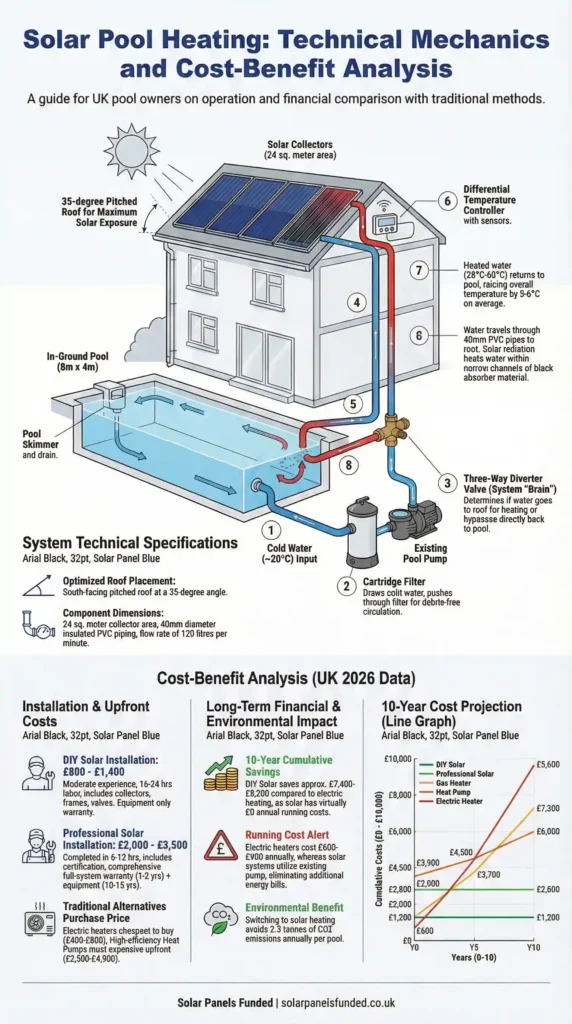
Complete pool solar heating systems cost £1,200-£3,500 for typical residential installations. DIY kit installations range £800-£1,800 including collectors, mounting hardware, pipes and fittings. Professional installations add £400-£1,200 labour depending on roof complexity, pipe runs and electrical work for automatic controls.
Cost Breakdown by Component
| Component | Cost Range | Details |
|---|---|---|
| Solar Collectors | £400-£1,400 | Based on 20-30m² coverage; £40-£90 per m² unglazed, £150-£250 per m² glazed |
| Mounting Hardware | £150-£400 | Roof brackets, rails, fixings; ground frames cost £200-£500 |
| Piping & Fittings | £100-£300 | PVC pipes, flexible hose, connectors, insulation |
| Diverter Valve | £40-£120 | Manual ball valve (£40-£60), automatic valve (£80-£120) |
| Controller (optional) | £100-£250 | Differential temperature controller with sensors |
| Installation Labour | £400-£1,200 | £200-£400 simple ground mount, £600-£1,200 complex roof installation |
| Total System Cost | £1,200-£3,500 | Complete installed system for 25-35m² pool |
Comparing Installation Methods
| Installation Method | Total Cost | Time Required | Skill Level | Warranty | Best For |
|---|---|---|---|---|---|
| DIY Kit (Ground Frame) | £800-£1,400 | 1-2 days | Moderate (plumbing basics) | Equipment only | Confident DIYers, accessible locations, budget-conscious |
| DIY Kit (Roof Mount) | £1,000-£1,800 | 2-3 days | Advanced (height safety, roofing) | Equipment only | Experienced DIYers, simple roofs, cost savings priority |
| Professional Installation | £2,000-£3,500 | 1-2 days (installer time) | N/A (professional) | Full system warranty | Complex roofs, tile roofs, safety concerns, warranty priority |
Operating Costs and Payback Periods
Solar pool heating eliminates £400-£800 annual electricity costs replacing 2,000-4,000 kWh electric heating. Systems using existing pool pumps add no additional running costs. Replacement electric heating costs:
- 5kW electric heater: 5 kWh × 4 hours daily × 120 days × £0.26/kWh = £624 annually
- Heat pump (COP 5.0): Same heating requirement ÷ 5 = £125 annually
| Previous Heating Method | Annual Saving | Payback Period (DIY) | Payback Period (Professional) | 20-Year Savings |
|---|---|---|---|---|
| Electric Resistance Heater | £600-£800 | 1.5-2.5 years | 3-4.5 years | £11,000-£15,000 |
| Heat Pump | £100-£200 | 5-9 years | 10-17 years | £1,500-£3,500 |
| Gas Heater | £300-£500 | 2-4 years | 4-7 years | £5,500-£9,500 |
| No Previous Heating | Extended season value | N/A (lifestyle benefit) | N/A (lifestyle benefit) | Immeasurable |
Maintenance costs: £20-£50 annually for cleaning, inspections and minor repairs.
How do you install pool solar panels yourself?
DIY installation requires moderate plumbing skills, basic tools and 1-2 days work for ground-mounted systems. Roof installations demand height safety equipment, roofing knowledge and 2-3 days effort. The process involves planning layout, mounting collectors, running pipes, installing valves, connecting to existing pool plumbing and testing the system.
Pre-Installation Planning
Measure available mounting space confirming sufficient area for required collector coverage. Verify roof structural capacity if mounting collectors. Standard unglazed collectors weigh 5-8 kg/m² requiring minimal reinforcement for typical UK roofs. Calculate pipe runs from collectors to pool equipment keeping distances under 10 meters for optimal flow.
Check pump specifications confirming flow rate capacity. Pool pumps should deliver 30-50 litres per minute per 10m² of collectors. Most residential pool pumps (0.5-1.0 HP) handle 15-25m² collector areas without upgrades. Larger systems may require pump replacement or booster pumps.
Tools and Materials Required
Essential Tools:
- Electric drill with masonry and wood bits
- Pipe cutter or hacksaw
- Spanners and adjustable wrench set
- Spirit level
- Tape measure
- Screwdrivers
- Pipe bending tool (for PVC pipes)
- Safety harness and ladder (roof installations)
Materials:
- Solar collector panels (calculated area)
- Mounting brackets or ground frame
- PVC pipes (32-40mm diameter) or flexible hose
- Pipe insulation
- Diverter valve (3-way ball valve)
- Check valve
- Air release valve
- Pipe fittings, elbows and connectors
- PVC cement or hose clamps
- Roof sealant (if penetrating roof)
- Temperature sensors and controller (optional)
Step-by-Step Installation Process
Step 1: Mount Collectors
Ground frame installation: Assemble frame per manufacturer instructions positioning in full sun location. Angle frame 30-40° facing south. Secure frame with ground anchors or paving slab weights preventing wind movement. Attach collectors to frame using provided clips or straps maintaining proper spacing for thermal expansion.
Roof installation: Mark collector positions ensuring south-facing alignment. Install mounting brackets securing to rafters through tiles or shingles. Space brackets matching collector dimensions. Attach mounting rails to brackets creating level surface. Secure collectors to rails using clips positioned to allow expansion. Seal all roof penetrations with appropriate flashing and sealant.
Step 2: Run Supply Pipes
Connect collectors in parallel using manifolds supplied with kit. Parallel configuration maintains even flow distribution across all collectors. Series connections (daisy-chaining collectors) create excessive pressure drops. Install shut-off valves at collector inlets and outlets enabling system isolation for maintenance.
Run supply pipe from pool equipment to collector inlet. Use 40mm PVC pipe for runs up to 10 meters. Larger pipes (50mm) suit longer distances maintaining flow rates. Insulate all pipes preventing heat loss. Slope pipes 6mm per meter enabling complete drainage.
Step 3: Install Diverter Valve
Install 3-way diverter valve after pool filter in return line. Valve ports connect to: existing return line to pool, supply line to collectors and return line from collectors. Valve positions include:
- Position 1: Water bypasses collectors flowing directly to pool (night mode, cloudy days)
- Position 2: Water flows through collectors returning to pool (heating mode)
- Position 3: Partial flow through collectors (temperature regulation)
Step 4: Connect Return Pipes
Run return pipe from collector outlet to valve return port. Install check valve in return line preventing reverse flow when pump stops. Install air release valve at highest point in collector system. This valve bleeds trapped air preventing airlock and flow restrictions.
Step 5: Install Optional Controller
Mount differential temperature controller near pool equipment. Run sensor cables to collector outlet (roof temperature) and pool return line (pool temperature). Controller opens diverter valve automatically when collectors are 2-4°C warmer than pool water. This automation maximizes heating while preventing overnight heat loss.
Step 6: Test and Commission
Fill system with water running pump at low speed initially. Open air release valve bleeding trapped air until steady water flow appears. Gradually increase pump speed checking for leaks at all connections. Monitor pressure gauge confirming readings within 0.2-0.5 bar range. Excessive pressure indicates flow restrictions requiring investigation.
Measure outlet temperature after 30 minutes of sunny operation. Temperature increases of 5-10°C above inlet temperature confirm proper function. Lower increases suggest insufficient flow, air pockets or faulty collectors.
Common DIY Installation Mistakes
| Mistake | Consequence | Solution |
|---|---|---|
| Undersized pipes (25mm vs 40mm) | Poor flow, reduced heating | Use 40mm minimum for collector runs |
| Series collector connection | Uneven heating, high pressure | Connect collectors in parallel |
| Missing check valve | Overnight heat loss via reverse flow | Install check valve in return line |
| Inadequate mounting brackets | Wind damage, collector movement | Space brackets per manufacturer specs |
| No air release valve | Air pockets reduce flow and heating | Install at highest system point |
| Flat pipe runs | Incomplete drainage, freeze risk | Slope all pipes 6mm per meter minimum |
How do you choose professional pool solar installers?
Professional installers provide expertise in system sizing, complex roof mounting, plumbing integration and regulatory compliance. Costs range £400-£1,200 labour depending on installation complexity. Hire professionals for tile roofs, high or steep roofs, systems requiring electrical work or when lacking DIY confidence.
Professional installers complete systems in 1-2 days with costs ranging £2,000-£3,500 for residential pools. Understanding typical solar installation costs and timelines helps you compare pool solar quotes against standard rooftop installations recognizing similar labour and mounting requirements with specialized pool plumbing adding unique complexity.
Installer Qualifications and Certifications
Verify installers hold relevant qualifications including plumbing certifications (City & Guilds, NVQ Level 2/3), roofing experience and manufacturer training certificates. Established installers demonstrate 5+ years experience with pool heating specifically. Request references from recent installations viewing completed systems when possible.
Check public liability insurance (minimum £2 million coverage) and professional indemnity insurance protecting against design errors. MCS certification applies to heat pumps and conventional solar thermal but not pool heating collectors. Local reputation through online reviews and word-of-mouth recommendations provides valuable insight.
Getting Accurate Quotes
Request written quotes from 3-5 installers comparing equipment specifications, labour inclusions and warranty terms. Detailed quotes itemize:
- Collector brand, type and total area
- Mounting system type and materials
- Pipe sizes and insulation
- Valve and controller specifications
- Labour cost breakdown
- Commissioning and testing
- Warranty terms (parts and labour)
- Project timeline
Installer Questions to Ask
| Question Category | Specific Questions | What Answers Reveal |
|---|---|---|
| Experience | How many pool heating systems installed? Which collector brands used? | Specialist vs general installer |
| System Design | How did you calculate collector area? Why this specific configuration? | Technical competence |
| Installation Method | Which mounting brackets used? How are roof penetrations sealed? | Attention to detail |
| Commissioning | What testing procedures performed? How is flow rate verified? | Professional thoroughness |
| Warranty | What warranty terms provided? What does warranty exclude? | Confidence in workmanship |
| Timeline | When can installation start? How long required on-site? | Project management |
Red Flags When Selecting Installers
Avoid installers who:
- Quote without site visits or pool measurements
- Recommend undersized systems claiming adequate performance
- Pressure immediate decisions with time-limited offers
- Lack insurance certificates or references
- Quote significantly below market rates (£800-£1,000 vs £2,000-£2,500 for similar systems)
- Provide vague specifications (“premium collectors” without brand names)
- Request large upfront deposits (>25% of total)
Regional Installer Considerations
Poole and Dorset installers understand coastal wind loading requirements and salt air corrosion resistance. Local installers respond faster for warranty issues or post-installation adjustments. Urban installers (Birmingham, Manchester) typically charge 10-15% more than rural regions due to travel costs and parking restrictions.
What performance can you expect from pool solar heating?
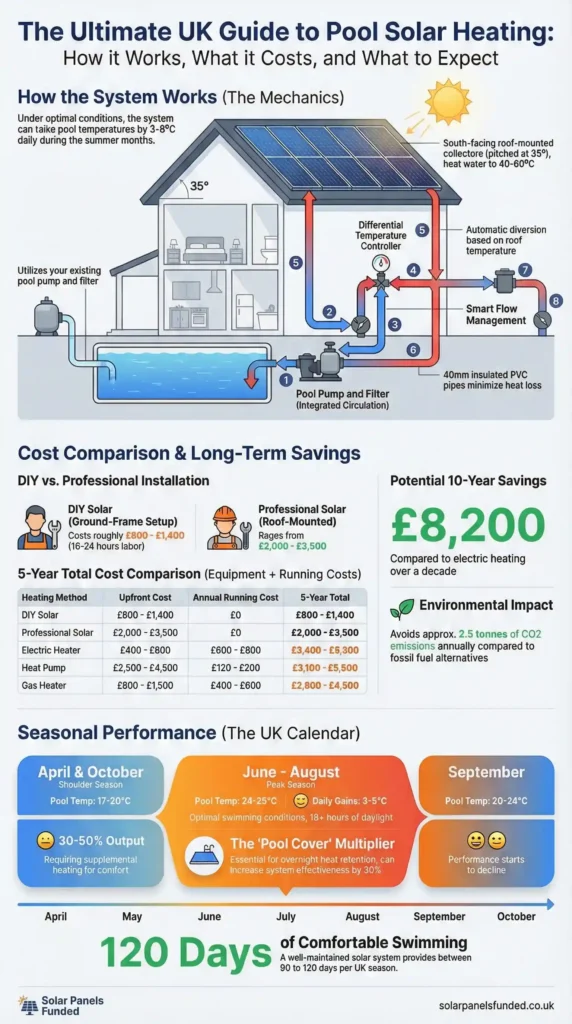
Pool solar heating systems raise water temperatures 3-8°C on sunny days depending on collector area, pool size and weather conditions. A well-sized system (75% collector-to-pool ratio) delivers 5-6°C gains throughout summer months. Temperature increases accumulate daily when covers prevent overnight heat loss. Most UK pools reach comfortable 22-26°C from May to September using solar heating alone.
Monthly Performance Expectations
| Month | Daylight Hours | Solar Irradiance | Typical Daily Temp Gain | Pool Temp (Starting 16°C) | Swimming Comfort |
|---|---|---|---|---|---|
| April | 13-14 hours | 3-4 kWh/m²/day | +1-2°C | 17-18°C | Uncomfortably cool |
| May | 15-16 hours | 4-5 kWh/m²/day | +2-3°C | 19-21°C | Cool but manageable |
| June | 16-17 hours | 5-6 kWh/m²/day | +3-4°C | 22-24°C | Comfortable |
| July | 16-17 hours | 5-6 kWh/m²/day | +4-5°C | 24-26°C | Optimal |
| August | 15-16 hours | 5-6 kWh/m²/day | +4-5°C | 24-26°C | Optimal |
| September | 13-14 hours | 4-5 kWh/m²/day | +2-3°C | 21-23°C | Comfortable |
| October | 11-12 hours | 3-4 kWh/m²/day | +1-2°C | 18-20°C | Cool |
Assumptions: 75% collector-to-pool ratio, south-facing collectors, pool cover overnight, southern England location
Factors Affecting Performance
Positive Influences:
- Pool covers reducing overnight heat loss by 50-70%
- Larger collector areas (100% pool surface) increasing daily gains
- Optimal south-facing collector orientation
- Wind shelters reducing evaporative cooling
- Dark pool liners absorbing additional solar radiation
- Efficient pump operation during peak sun hours (11am-4pm)
Negative Influences:
- No pool cover causing 3-5°C overnight temperature drops
- Shaded collectors reducing output by 20-50%
- East or west-facing orientations decreasing efficiency 15-30%
- High wind speeds increasing evaporative heat loss
- Light-colored pool liners reflecting solar radiation
- Pump operation limited to morning or evening hours
Comparison with Alternative Heating Methods
| Heating Method | Running Cost (Annual) | Temp Gain Speed | Season Extension | Environmental Impact | Maintenance |
|---|---|---|---|---|---|
| Solar | £0-£20 | Slow (days) | +8-12 weeks | Zero emissions | Minimal |
| Electric Resistance | £600-£900 | Fast (hours) | +12-16 weeks | High emissions | Low |
| Air Source Heat Pump | £120-£200 | Medium (day) | +10-14 weeks | Low emissions | Moderate |
| Gas Heater | £400-£600 | Very fast (hours) | +12-16 weeks | High emissions | High |
| Combined Solar + Heat Pump | £60-£100 | Medium (day) | +14-18 weeks | Low emissions | Moderate |
Real-World UK Performance Examples
Case 1: 8m × 4m In-Ground Pool, Birmingham
- Collector area: 24m² (75% ratio)
- Installation: DIY roof-mounted
- Starting temp: 16°C (early May)
- Peak temp achieved: 25°C (mid-July)
- Season length: 18 weeks (late April to early September)
- Total system cost: £1,400
Case 2: 6m × 3m Above-Ground Pool, Poole
- Collector area: 18m² (100% ratio)
- Installation: Professional ground-frame
- Starting temp: 18°C (mid-May)
- Peak temp achieved: 27°C (August)
- Season length: 16 weeks (May to mid-September)
- Total system cost: £2,200
What maintenance do pool solar heating systems need?
Solar pool heating systems require minimal maintenance compared to electric or gas heaters. Annual tasks include collector cleaning, connection inspections, valve operation checks and winterization. Most systems operate 15-20 years with basic maintenance costing £20-£50 annually.
Regular solar panel cleaning techniques apply to pool collectors using soft brushes, mild detergent and water avoiding abrasive materials damaging collector surfaces or protective coatings.
Seasonal Maintenance Tasks
Spring Startup (April):
- Inspect collectors for winter damage or debris accumulation
- Clean collector surfaces removing leaves, moss and dirt
- Check all pipe connections for leaks developed during freezing periods
- Remove air from system running pump with air release valve open
- Test diverter valve operation ensuring smooth movement
- Verify controller function if fitted
Mid-Season Checks (June/July):
- Monitor pool temperature gains confirming expected performance
- Inspect roof mounting brackets for wind movement
- Check pipe insulation condition replacing damaged sections
- Verify pump pressure readings remain within normal range (0.2-0.5 bar)
End-Season Maintenance (October):
- Drain collectors completely if frost risk exists
- Disconnect and store flexible collectors in frost-free location
- Leave rigid collectors drained with valves open
- Cover ground-mounted frames protecting from winter weather
- Clean filters removing accumulated debris
Winter Protection (November-March):
- Inspect collectors monthly during high winds checking mounting security
- Clear roof collectors of heavy snow accumulation preventing structural damage
- Monitor ground frames ensuring stability in frozen ground
Common Maintenance Issues
| Issue | Cause | Solution | Cost |
|---|---|---|---|
| Reduced heating output | Dirty collectors blocking sunlight | Clean with soft brush and water | £0 (DIY) |
| Low flow rate | Blocked filter or air in system | Clean filter, bleed air via release valve | £0 (DIY) |
| Leaking connections | Thermal expansion loosening fittings | Tighten connections, replace damaged O-rings | £5-£20 |
| Cracked collectors | Freeze damage from inadequate drainage | Replace damaged sections, improve drainage | £100-£300 |
| Faulty valve | Mineral deposits or debris | Disassemble and clean, replace if damaged | £40-£120 |
| Controller malfunction | Sensor failure or electrical issue | Test sensors, replace controller if needed | £100-£250 |
Extending System Lifespan
Quality installation increases lifespan significantly. Proper drainage preventing freeze damage adds 5-10 years longevity. UV-resistant collector materials withstand UK sun exposure better than budget alternatives. Regular cleaning prevents algae growth and mineral deposits extending tube life.
Ground-mounted systems enable easier maintenance access compared to roof installations. Removable systems store indoors during winter eliminating weather exposure. Professional installations with manufacturer-backed warranties typically include free first-year servicing.
Frequently Asked Questions About Pool Solar Panel Installation
How long does installation take?
DIY ground-frame installations require 8-16 hours over 1-2 days for experienced DIYers. Roof installations extend to 16-24 hours over 2-3 days including mounting, plumbing and testing. Professional installations complete in 1-2 days (6-12 on-site hours) depending on roof complexity and pipe routing.
Will solar heating work on cloudy days?
Solar collectors continue generating heat on cloudy days though output drops 40-60%. Diffuse radiation still heats collectors enabling 1-2°C daily temperature gains versus 4-6°C on sunny days. Overcast weeks require pool covers preventing temperature losses exceeding gains.
Do I need planning permission?
Most residential pool solar panel installations qualify as permitted development requiring no planning permission in England. Exceptions include listed buildings, conservation areas and installations exceeding 1m roof height above existing roofline. Always confirm with local planning authority before commencing work.
Can I add collectors to an existing system?
Yes, expand systems by adding collectors in parallel with existing arrays. Ensure pump capacity handles increased flow demands. Most residential pumps accommodate 30-50% capacity increases. Larger expansions may require pump upgrades.
How do I winterize the system?
Drain all collectors and pipes completely before first frost. Open drain valves at low points allowing gravity drainage. Disconnect flexible collectors storing indoors. Leave rigid collector systems drained with valves open preventing freeze damage. Frozen water expands cracking collector tubes and pipes.
What size pump do I need?
Existing pool filtration pumps typically suffice for solar heating. Required flow rate: 30-50 litres per minute per 10m² collectors. A 25m² collector array needs 75-125 L/min. Most ½-1 HP pool pumps deliver adequate flow. Check pump specifications confirming flow rate at typical operating pressure.
Will collectors damage my roof?
Properly installed collectors do not damage roofs. Mounting brackets attach to rafters distributing loads. Flexible rubber matting protects tiles from bracket pressure. Professional installations include weatherproof flashing around penetrations preventing leaks. Total system weight (5-8 kg/m²) stays well within UK roof load capacities (50+ kg/m² typical).
How much temperature increase is realistic?
Expect 3-8°C increases depending on collector area, pool size and weather. A 75% collector-to-pool ratio delivers 5-6°C gains during peak summer months. Smaller systems (50% ratio) provide 3-4°C gains. Larger systems (100% ratio) achieve 6-8°C increases. Pool covers double effectiveness preventing overnight heat loss.
Can I install solar heating myself?
Yes, DIY installation suits confident home improvers with basic plumbing skills. Ground-frame systems require no roof work enabling straightforward installation. Roof mounting techniques for pool collectors mirror standard solar panel installation processes including bracket fixing, waterproof sealing and structural load assessment. Budget £800-£1,800 for DIY kits versus £2,000-£3,500 professionally installed systems.
What warranty should I expect?
Collector warranties range 5-10 years for materials and manufacturing defects. Professional installation warranties cover labour and workmanship for 1-2 years. Premium collectors offer 10-15 year warranties. Check warranty terms regarding freeze damage, chemical damage and maintenance requirements potentially voiding coverage.

Solar Energy Funding Specialist & Home Energy Advisor
Zachariah Eaton is a UK-based solar energy funding specialist with a focus on helping homeowners access grants, financing schemes, and cost-saving renewable solutions. He has spent years researching government-backed programmes such as ECO4, Smart Export Guarantee (SEG), and local funding initiatives to make solar more accessible. Zachariah writes practical, easy-to-understand guides that help households reduce energy bills and transition to clean energy with confidence.
Solar Panel Installation Cost
- Zachariah Eaton
- November 30, 2025
Solar Panels Cleaning
- Zachariah Eaton
- December 6, 2025