

Solar Panel Cleaning: Practical Guide to Keep Panels Productive and Safe
Dirty solar panels lose 15-25% efficiency reducing annual energy generation by 300-600 kWh for typical residential systems. This guide covers complete solar panel cleaning requirements for UK homes and businesses including DIY cleaning methods, professional service selection, equipment recommendations, cost analysis and safety protocols. You will learn optimal cleaning frequency, efficiency loss data by contamination type, regional considerations and when professional services provide better value than DIY approaches.
Table of Contents
ToggleWhy do solar panels need regular cleaning?
Solar panels need regular cleaning because accumulated dirt, dust, pollen, bird droppings and pollution create opaque layers blocking sunlight from reaching photovoltaic cells. Even thin contamination films reduce light transmission by 10-15% cutting electricity generation proportionally. UK panels face unique challenges from industrial pollution in urban areas, salt spray in coastal regions, agricultural dust in rural locations and tree debris near wooded sites.
Efficiency losses compound over time as dirt layers thicken and certain contaminants like bird droppings cure onto glass surfaces creating permanent etching. Regular cleaning restores lost generation capacity maintaining optimal system performance throughout 25-30 year panel lifespans. Manufacturers typically require periodic cleaning as warranty conditions with some voiding coverage for panels showing damage from neglected maintenance.
How much efficiency do dirty panels lose?
Efficiency losses range 5-25% depending on contamination severity and panel location. Light dust accumulation reduces output by 5-7% while heavy soiling from bird droppings, pollen or industrial fallout decreases generation by 15-25%. Coastal panels face accelerated deterioration from salt deposits creating semi-permanent haze even after rain. Urban panels collect carbon particulates forming stubborn films resistant to natural rainfall cleaning.
| Contamination Type | Efficiency Loss | Accumulation Time | Rain Effectiveness | Cleaning Difficulty | UK Regions Most Affected |
|---|---|---|---|---|---|
| Light Dust | 5-7% | 3-6 months | 60-70% removed | Easy (water rinse) | All regions, worse during dry summers |
| Heavy Dust | 8-12% | 6-12 months | 30-40% removed | Moderate (brush + water) | Urban areas, construction zones |
| Pollen | 10-15% | Spring season | 40-50% removed | Moderate (requires brushing) | Rural areas, near forests |
| Bird Droppings | 15-20% | Ongoing | 0-10% removed | Difficult (manual scraping) | All regions, worse near nesting sites |
| Industrial Pollution | 12-18% | 6-12 months | 20-30% removed | Difficult (chemical cleaning) | Manchester, Birmingham, London |
| Salt Spray | 15-25% | 3-6 months | 10-20% removed | Very difficult (acid wash) | Coastal areas: Brighton, Poole, Cornwall |
| Tree Sap/Debris | 10-15% | Seasonal | 5-15% removed | Difficult (solvent required) | Wooded areas, autumn peak |
Note: Efficiency loss percentages represent reduction from clean baseline performance. Multiple contamination types compound effects.
Does rain clean solar panels effectively?
Rain provides partial cleaning removing 30-50% of loose dust but fails to eliminate sticky contaminants like bird droppings, tree sap or industrial residue. Light showers spread dirt across panel surfaces without sufficient force to wash away particles. Heavy downpours clean better but UK rainfall patterns leave panels dirty for extended periods between storms. Angled panels (30-45° pitch) benefit more from rain compared to shallow installations where water pools rather than sheets across glass.

Research from UK solar installations demonstrates rain-only cleaning allows 8-12% efficiency loss accumulation annually requiring intervention every 12-18 months for performance recovery. Coastal and industrial sites need more frequent cleaning due to aggressive contaminants rain cannot remove.
How often should you clean solar panels in the UK?
Residential solar panels require cleaning every 12-18 months under typical UK conditions. Urban locations with higher pollution need annual cleaning while rural areas with minimal contamination extend intervals to 18-24 months. Coastal installations require 6-12 month cleaning frequency due to salt accumulation. Panels near trees or bird nesting sites benefit from quarterly inspections with cleaning as needed.
Commercial installations warrant more frequent attention with large ground-mounted arrays inspected quarterly and cleaned 2-4 times annually. Solar farms generating revenue from every kilowatt-hour prioritize preventive cleaning maximizing uptime and generation. Automated monitoring systems track performance drops indicating cleaning requirements before efficiency losses become severe.
Seasonal cleaning recommendations
| Season | Recommended Action | Why | Typical Efficiency Impact | Priority Regions |
|---|---|---|---|---|
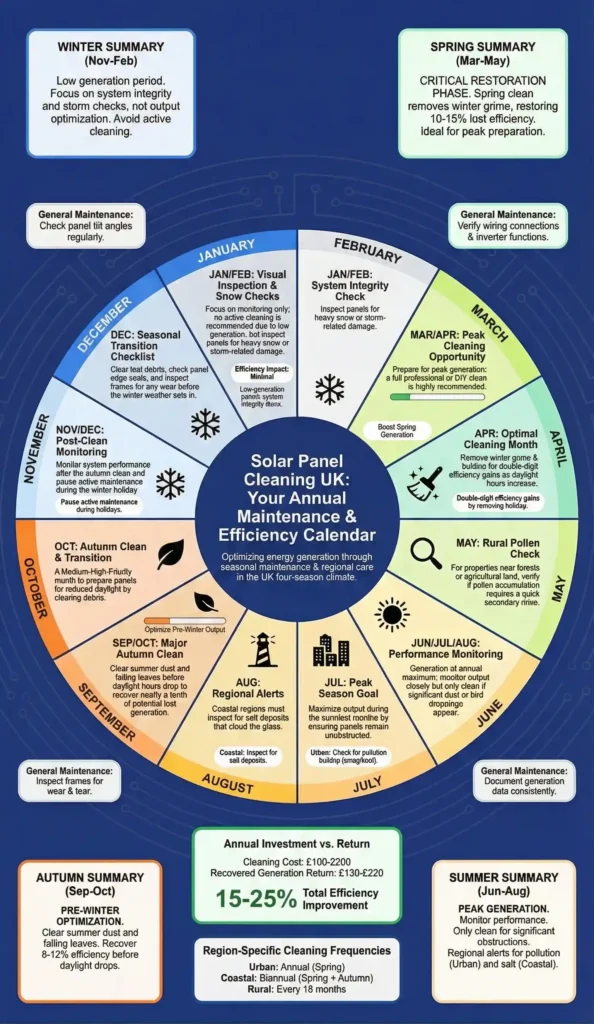
| Spring (March-May) | Full clean after winter | Remove winter grime, prepare for peak generation months | Restore 10-15% lost efficiency | All UK regions |
| Summer (June-August) | Inspection only (clean if needed) | Peak generation months, maximize output | Maintain optimal performance | Urban areas, near agricultural fields |
| Autumn (September-November) | Clean after leaf fall | Remove tree debris, bird droppings before winter | Recover 8-12% efficiency loss | Wooded areas, rural locations |
| Winter (December-February) | Monitor only (no active cleaning) | Snow clears naturally, low generation period | Minimal impact due to reduced sun | Snow-prone areas: Scotland, Pennines |
Best cleaning timing: Early morning or late evening when panels are cool prevents thermal shock and water spotting from rapid evaporation.
Signs panels need immediate cleaning
Visual indicators include visible dirt streaks, white salt deposits on coastal panels, dark spots from bird droppings, green moss growth at panel edges and performance drops exceeding 10% compared to historical generation data. Monitoring systems showing output decline without corresponding weather changes signal cleaning needs. Panels appearing hazy or showing rainbow-like interference patterns require immediate attention before permanent etching develops.
What does professional solar panel cleaning cost in the UK?
Professional solar panel cleaning costs £60-£300 for residential systems depending on array size, roof access difficulty and contamination severity. Standard 4kW residential installations cost £80-£150 for routine cleaning. Larger 6-10kW systems range £120-£200. Additional charges apply for difficult access including scaffolding hire (£150-£300) or cherry picker use (£200-£400) for high or steep roofs.
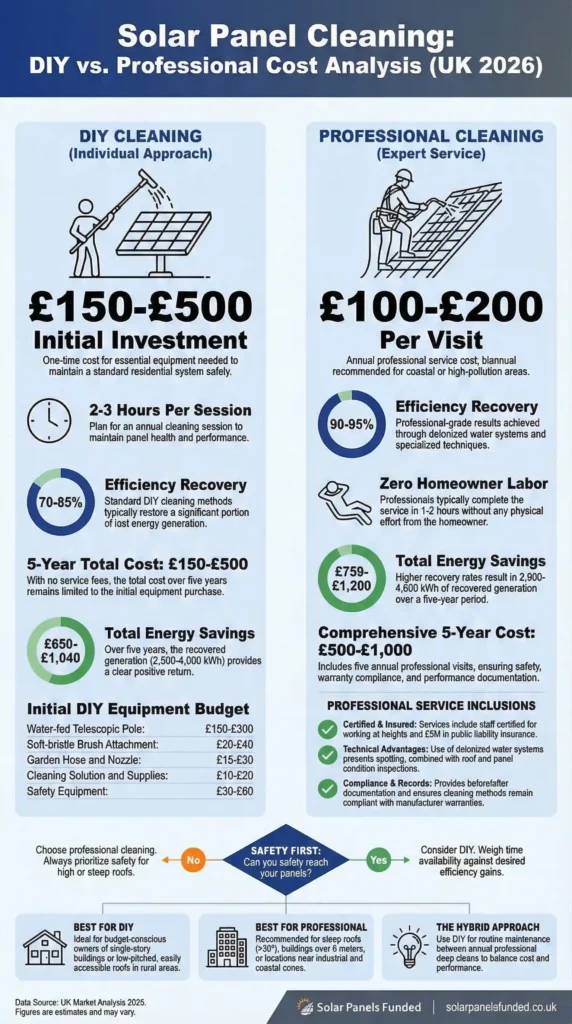
Commercial cleaning costs £150-£800 for small business installations and £500-£2,000+ for solar farms. Per-panel pricing ranges £3-£8 for residential work and £2-£5 for commercial volume cleaning. Many companies offer annual maintenance contracts bundling 1-2 cleanings with visual inspections saving 15-25% versus one-time service calls.
Residential cleaning price breakdown
| System Size | Panel Count | Standard Clean Cost | Difficult Access Cost | Annual Contract (2 visits) | Cost Per Panel |
|---|---|---|---|---|---|
| 3kW | 8-10 panels | £60-£100 | £150-£250 | £100-£160 | £6-£10 |
| 4kW | 10-12 panels | £80-£150 | £180-£300 | £130-£240 | £6-£12 |
| 5kW | 13-15 panels | £100-£180 | £220-£350 | £160-£290 | £6-£12 |
| 6kW | 15-18 panels | £120-£200 | £250-£400 | £190-£320 | £7-£11 |
| 8kW | 20-24 panels | £160-£250 | £300-£500 | £260-£400 | £7-£10 |
| 10kW | 25-30 panels | £200-£300 | £350-£600 | £320-£480 | £7-£10 |
Additional costs: Scaffolding hire £150-£300, cherry picker £200-£400, hot water cleaning (stubborn grime) +£30-£60, protective coating application +£40-£100
Commercial cleaning costs
Large-scale commercial cleaning benefits from economies of scale with per-panel costs dropping to £2-£5. Solar farms negotiate annual contracts covering multiple cleaning sessions, performance monitoring and emergency call-outs. 100kW commercial rooftop installations cost £400-£800 quarterly while 1MW ground-mounted solar farms pay £2,000-£5,000 per cleaning depending on site access and water availability.
| Installation Type | System Size | Panels | Quarterly Clean | Annual Contract (4x clean) | Per Panel Cost |
|---|---|---|---|---|---|
| Small Business Roof | 10-30kW | 30-90 | £150-£400 | £500-£1,300 | £4-£6 |
| Large Commercial Roof | 50-100kW | 150-300 | £300-£800 | £1,000-£2,600 | £3-£5 |
| Small Solar Farm | 500kW | 1,500-2,000 | £1,200-£2,500 | £4,000-£8,000 | £2-£4 |
| Large Solar Farm | 5MW | 15,000-20,000 | £8,000-£15,000 | £28,000-£50,000 | £1.50-£2.50 |
Contract benefits: Scheduled cleaning prevents efficiency losses, fixed annual costs, priority emergency service, performance reporting, warranty compliance documentation
How do you clean solar panels safely yourself?
DIY solar panel cleaning requires turning off inverters, using correct tools and following height safety protocols. Clean panels on cool overcast days preventing thermal shock from cold water contacting hot glass. Work from stable ground using water-fed poles for roof-mounted arrays avoiding ladder work on steep roofs. Ground-mounted panels offer safest DIY access enabling cleaning without height risks.
slip footwear with good grip, securing extension poles before reaching high panels and never walking on panel surfaces. Fragile roof materials like slate or older tiles require professional assessment before attempting cleaning. Always have someone present during roof work for emergency assistance.
DIY cleaning equipment and tools needed
Essential Equipment:
- Telescopic water-fed pole (6-12 meters extending length)
- Soft-bristle brush attachment (avoid stiff bristles scratching glass)
- Garden hose with adjustable spray nozzle
- Squeegee for streak-free finish
- Bucket for cleaning solution
- Safety harness and roof anchor (pitched roof access)
- Non-slip shoes
- Work gloves
Optional Equipment:
- Deionized water system (prevents water spotting)
- Pressure washer (low pressure 20-40 bar only)
- Microfiber cloths for stubborn spots
- Extension ladder with stabilizer bars
- Panel monitoring equipment verifying improvement
Cleaning Solutions:
- Mild dish soap diluted 1:20 with water
- Specialist solar panel cleaning solution
- Isopropyl alcohol (70%) for sticky residue
- Vinegar solution (1:10) for hard water deposits
Avoid: Abrasive cleaners, metal scrapers, high-pressure washers above 60 bar, harsh chemicals, rough sponges
Step-by-step DIY cleaning process
Step 1: Safety Preparation Turn off solar system at inverter and DC isolators preventing electric shock during wet cleaning. Check weather forecast avoiding gusty winds or approaching storms. Inspect roof condition confirming safe access and tile stability.
Step 2: Initial Rinse Spray panels with plain water using garden hose removing loose dust and debris. Start from top panels working downward allowing dirty water to flow off lower panels. Let water soak stubborn dirt for 5-10 minutes softening buildup.
Step 3: Soap Application Mix mild cleaning solution in bucket applying with soft brush attached to extension pole. Use gentle circular motions avoiding excessive pressure on glass. Focus extra attention on panel edges where dirt accumulates and around mounting frames where water pools.
Step 4: Scrubbing Stubborn Spots Address bird droppings with targeted brushing using slightly increased pressure. Avoid metal scrapers preventing glass scratches. For extremely stubborn spots apply isopropyl alcohol directly to affected areas waiting 2-3 minutes before brushing.
Step 5: Thorough Rinse Rinse panels completely using clean water ensuring all soap residue washes away. Soap left on panels attracts dirt accelerating recontamination. Multiple rinse passes guarantee soap-free finish especially important in hard water areas.
Step 6: Squeegee and Inspection Pull squeegee across panels removing standing water preventing spots as water evaporates. Inspect cleaned panels for missed areas, cracks or damage. Compare panel appearance to pre-cleaning photos documenting improvement.
Step 7: System Restart Verify panels are completely dry before reconnecting DC isolators and restarting inverter. Monitor system output over next few days confirming generation improvement validates cleaning effectiveness.
Common DIY cleaning mistakes
| Mistake | Consequence | Correct Approach |
|---|---|---|
| Using cold water on hot panels | Thermal shock cracking glass | Clean early morning/evening when panels cool |
| High-pressure washing above 60 bar | Damaged panel seals, water ingress | Use garden hose pressure (2-5 bar) or low-pressure washer |
| Abrasive brushes or sponges | Scratched anti-reflective coating | Soft-bristle brushes designed for glass |
| Walking on panels | Cracked cells, broken glass, voided warranty | Work from ground/ladder using extension poles |
| Leaving soap residue | Attracts dirt, creates hazy film | Multiple rinses until water runs clear |
| Cleaning in strong sunlight | Rapid evaporation leaves spots | Overcast days or early/late hours |
| Using harsh chemicals | Damaged protective coatings | Mild soap or specialist panel cleaners only |
| Ignoring electrical safety | Electric shock risk | Turn off all isolators before water contact |
When should you hire professional solar panel cleaners?
Hire professional cleaners for roofs steeper than 30°, panels higher than 6 meters above ground, arrays exceeding 20 panels or installations showing significant contamination requiring specialist treatment. Professionals provide insurance coverage for damage, working-at-height certifications and equipment handling difficult-to-reach arrays safely. Commercial installations always warrant professional service ensuring warranty compliance and performance documentation.
Cost-benefit analysis favors professionals when cleaning frequency exceeds twice annually, when safety equipment purchases exceed annual service costs or when efficiency losses suggest chemical cleaning requirements beyond basic washing. Professionals restore 90-95% of lost generation while DIY approaches achieve 70-85% recovery for equivalent contamination levels.
Professional services and qualifications
| Service Provider Type | Typical Cost | Services Included | Best For |
|---|---|---|---|
| General Window Cleaners | £60-£120 | Basic water cleaning, no specialist training | Light maintenance, easy-access ground-floor panels |
| Specialist Solar Cleaners | £100-£200 | Deionized water, trained staff, insurance | Standard residential systems, roof-mounted arrays |
| Commercial Solar Maintenance | £200-£800 | Performance testing, detailed reporting, warranty documentation | Large residential, commercial buildings, solar farms |
| Robotic Cleaning Systems | £2,000-£5,000 annual contract | Automated cleaning, remote monitoring, minimal disruption | Solar farms, large commercial arrays, hard-to-access installations |
Essential qualifications: Working at Height certification, public liability insurance (£5 million minimum), solar panel cleaning training, NICEIC or equivalent electrical awareness.
Professionals provide working-at-height certifications and proper access equipment handling difficult arrays safely. Many solar panel cleaning companies partner with professional solar panel installation teams offering bundled maintenance packages combining annual cleaning, electrical inspections and performance monitoring supporting long-term system health.
Questions to ask professional cleaners
Insurance and Certification:
- What public liability insurance coverage do you carry?
- Are staff Working at Height certified?
- Do you hold solar-specific cleaning qualifications?
Cleaning Method:
- What water purification system do you use?
- What cleaning products do you apply?
- How do you handle stubborn contamination like bird droppings?
Safety Protocols:
- How do you ensure electrical system safety?
- What roof protection measures do you employ?
- Do you provide risk assessments before work?
Service Details:
- What pre-cleaning and post-cleaning checks do you perform?
- Do you provide before/after generation data?
- What warranty do you offer on cleaning work?
Pricing and Contracts:
- Is scaffolding/access equipment included in quoted price?
- Do you offer annual maintenance contracts?
- What payment terms and cancellation policies apply?
What equipment and products work best for solar panel cleaning?
Water-fed poles with soft-bristle brush heads provide optimal cleaning for most UK installations enabling ground-based cleaning without roof access. Deionized or purified water prevents mineral deposits and water spotting eliminating need for squeegee drying. Specialist solar panel cleaning solutions remove stubborn contamination safely without damaging anti-reflective coatings while biodegradable formulations prevent environmental damage.
Soft-bristle brushes protect anti-reflective coatings on photovoltaic panels while similar gentle cleaning methods apply to pool solar heating collectors preventing damage to thermal absorber surfaces. Both system types benefit from regular debris removal maintaining optimal sun exposure and heat transfer efficiency.
Commercial operations benefit from automated cleaning robots running on rails or tracks across panel arrays. These systems operate on schedules maintaining consistent cleanliness with minimal labor costs. Robotic cleaners cost £15,000-£50,000 upfront but reduce cleaning costs by 60-70% annually for installations exceeding 500kW capacity.
Equipment comparison for residential use
| Equipment Type | Cost Range | Effectiveness | Ease of Use | Best Application | Limitations |
|---|---|---|---|---|---|
| Garden Hose + Soft Brush | £15-£40 | 70-80% | Very easy | Ground-mounted panels, low roofs | Limited reach, manual labor intensive |
| Water-Fed Pole System | £150-£500 | 85-95% | Moderate | Roof-mounted arrays up to 12m | Requires practice, water supply needed |
| Low-Pressure Washer | £100-£300 | 75-85% | Easy | Ground-mounted, stubborn dirt | Risk of seal damage if pressure too high |
| Deionized Water System | £200-£800 | 90-95% | Moderate | All installations, hard water areas | Higher equipment cost, DI resin refills |
| Professional Service | £100-£200/visit | 90-95% | Very easy | All installations | Ongoing service costs |
Cleaning product recommendations
Recommended Products:
- Biodegradable solar panel cleaning solution (pH neutral, no harsh chemicals)
- Mild dish soap diluted 1:20 for routine cleaning
- Isopropyl alcohol 70% for adhesive residues and tree sap
- White vinegar 1:10 dilution for hard water deposits
- Specialist glass cleaners labeled solar-panel safe
Avoid These Products:
- Ammonia-based glass cleaners (damage anti-reflective coatings)
- Abrasive creams or powders (scratch glass)
- Petroleum-based solvents (degrade rubber seals)
- Bleach or chlorine solutions (harm protective coatings)
- High-alkaline detergents pH above 9
How does location affect cleaning requirements?
Urban areas require annual cleaning due to industrial pollution, vehicle emissions and particulate accumulation. Cities like Birmingham, Manchester and London experience 20-30% higher contamination rates than rural locations. Coastal installations need 6-12 month cleaning intervals as salt spray creates difficult-to-remove deposits causing permanent etching when neglected. Rural agricultural areas face seasonal contamination from harvest dust and pollen requiring spring and autumn cleaning.
Tree-shaded panels accumulate organic debris including leaves, seeds, pollen and bird droppings from roosting attracting wildlife. Wooded locations benefit from quarterly inspections with targeted cleaning addressing contamination before efficiency losses exceed 15%. Industrial zones near factories or quarries experience heavy dust deposition requiring specialized cleaning methods and increased frequency.
Regional cleaning frequency recommendations
| UK Region | Typical Frequency | Primary Contaminants | Special Considerations | Average Annual Cost (4kW system) |
|---|---|---|---|---|
| London & Southeast | 10-12 months | Urban pollution, vehicle emissions | Higher service costs due to access issues | £150-£250 |
| Coastal (Brighton, Poole, Cornwall) | 6-9 months | Salt spray, marine moisture | Requires specialist salt removal treatment | £200-£350 |
| Midlands (Birmingham, Coventry) | 12 months | Industrial pollution, urban dust | Standard cleaning adequate | £120-£200 |
| Northwest (Manchester, Liverpool) | 12-15 months | Industrial emissions, high rainfall | Rain provides partial natural cleaning | £120-£200 |
| Scotland | 15-18 months | Less pollution, more rain | Lower frequency needs, winter snow clears panels | £100-£180 |
| Wales | 15-18 months | Agricultural dust, high rainfall | Spring pollen peak requires attention | £100-£180 |
| Rural England | 15-24 months | Agricultural dust, pollen | Seasonal cleaning during spring/autumn | £80-£150 |
| Near Trees/Forests | 6-12 months | Leaves, tree sap, bird droppings | Quarterly inspections recommended | £150-£300 |
What are the benefits of regular solar panel cleaning?
Regular cleaning maintains 15-25% higher electricity generation compared to neglected panels recovering lost output worth £80-£200 annually for typical 4kW residential systems. Clean panels extend system lifespan by preventing corrosive buildup that degrades protective coatings and seals. Most manufacturers require documented maintenance including cleaning as warranty conditions with neglect voiding coverage for efficiency claims or physical damage.
Regular cleaning protects solar panel system investments worth £5,000-£10,000 for typical residential installations by preventing corrosive buildup degrading protective coatings. Maintenance costs representing 1-2% annual system value preserve 25-30 year equipment lifespans maximizing return on investment.
Performance monitoring becomes more reliable with clean panels eliminating false alerts from dirt-induced output drops. Visual inspections during cleaning identify developing issues like loose connections, damaged frames or degraded sealants enabling early intervention preventing costly repairs. Clean professional-looking installations maintain property values while dirty neglected systems signal poor maintenance to prospective buyers.
Financial return on cleaning investment
| System Size | Annual Generation | Efficiency Loss (Dirty) | Lost Generation | Lost Value (£0.26/kWh) | Professional Clean Cost | Net Annual Benefit |
|---|---|---|---|---|---|---|
| 3kW | 2,500 kWh | 15% | 375 kWh | £98 | £80-£100 | Break-even to £18 |
| 4kW | 3,400 kWh | 15% | 510 kWh | £133 | £100-£150 | £0-£33 |
| 5kW | 4,250 kWh | 15% | 638 kWh | £166 | £120-£180 | £0-£46 |
| 6kW | 5,100 kWh | 15% | 765 kWh | £199 | £150-£200 | £0-£49 |
| 10kW | 8,500 kWh | 20% | 1,700 kWh | £442 | £200-£300 | £142-£242 |
| 50kW (Commercial) | 42,500 kWh | 20% | 8,500 kWh | £2,210 | £600-£800 | £1,410-£1,610 |
Note: Assumes southern England generation, £0.26/kWh electricity value, 15-20% efficiency loss from dirt, annual professional cleaning
Additional benefits beyond electricity recovery:
- Warranty compliance maintaining coverage validity
- Extended panel lifespan preventing premature degradation
- Early fault detection during cleaning inspections
- Enhanced property appearance supporting resale values
- Reduced fire risk from leaf accumulation and debris
Frequently Asked Questions About Solar Panel Cleaning
How often should I clean my solar panels?
Clean residential solar panels every 12-18 months under typical UK conditions. Urban areas require annual cleaning due to pollution while rural locations extend to 18-24 months. Coastal panels need 6-12 month cleaning frequency because of salt accumulation. Monitor generation data cleaning whenever output drops 10% below expected performance for weather conditions.
Can I use a pressure washer on solar panels?
Use pressure washers only at low settings below 40 bar (580 psi) maintaining 30cm distance from panel surfaces. High pressure damages seals allowing water ingress and voids warranties. Garden hose pressure (2-5 bar) provides safer cleaning sufficient for most contamination. Professional services use specialized equipment with pressure controls preventing damage.
What cleaning products are safe for solar panels?
Mild dish soap diluted 1:20 with water provides safe effective cleaning for routine maintenance. Specialist solar panel cleaning solutions formulated pH-neutral prevent coating damage. Avoid ammonia-based glass cleaners, abrasive products and petroleum solvents harming protective layers. Deionized water alone cleans effectively without soap for light dust.
Will cleaning void my solar panel warranty?
Proper cleaning using approved methods maintains warranty validity while neglect voids coverage for efficiency claims. Most manufacturers require periodic cleaning documented with photos and service records. Avoid abrasive tools, harsh chemicals and walking on panels preventing warranty-voiding damage. Professional cleaning provides documentation supporting warranty claims.
Is it safe to clean solar panels myself?
DIY cleaning suits ground-mounted arrays and easily accessible low-pitched roofs when following safety protocols. Turn off electrical systems, use proper equipment and avoid roof work in wet or windy conditions. Hire professionals for steep roofs above 30°, panels higher than 6 meters or complex installations requiring scaffolding access.
Do solar panels need cleaning in winter?
Winter cleaning provides minimal benefit because low sun angles reduce generation and snow naturally clears panels when melting. Schedule cleaning in spring before peak generation months restoring efficiency for April-September period. Winter inspections check for snow damage or ice accumulation but avoid cleaning frozen panels risking thermal shock.
How long does professional solar panel cleaning take?
Professional cleaners complete standard 10-15 panel residential systems in 1-2 hours including setup and safety checks. Larger arrays or difficult access requiring scaffolding extend to 3-4 hours. Commercial installations take full days with 50-100 panel arrays requiring 4-6 hours cleaning time. Most companies work efficiently minimizing disruption and system downtime.
Qualified solar installers often offer maintenance contracts including annual cleaning, electrical inspections and performance testing ensuring systems remain safe and warranty-compliant throughout operational lifespans.
Can dirty solar panels cause fires?
Extremely dirty panels with leaf accumulation present fire risks though incidents remain rare. Dry leaves collecting in panel gaps combined with electrical arcing from damaged connections create ignition sources. Regular cleaning removes combustible debris while inspections identify electrical faults. Maintain clear space between panels and flammable roof materials following installation standards.
How much more energy do clean panels produce?
Clean panels produce 15-25% more electricity compared to heavily soiled panels depending on contamination severity. Light dust reduces output 5-7% while bird droppings and industrial pollution decrease generation 15-25%. Typical 4kW residential system generates additional 500-850 kWh annually when maintained clean worth £130-£220 at current electricity rates.
Should I clean panels before selling my house?
Clean panels before listing properties improving curb appeal and demonstrating proper system maintenance to buyers. Dirty neglected panels signal maintenance issues lowering perceived values while clean systems appear well-maintained supporting asking prices. Document recent cleaning and maintenance providing records to buyers demonstrating system care and warranty compliance.

Solar Energy Funding Specialist & Home Energy Advisor
Zachariah Eaton is a UK-based solar energy funding specialist with a focus on helping homeowners access grants, financing schemes, and cost-saving renewable solutions. He has spent years researching government-backed programmes such as ECO4, Smart Export Guarantee (SEG), and local funding initiatives to make solar more accessible. Zachariah writes practical, easy-to-understand guides that help households reduce energy bills and transition to clean energy with confidence.
Pool Solar Panels Installation
- Zachariah Eaton
- December 2, 2025
Solar Panel Funding in the UK
- Zachariah Eaton
- December 12, 2025