

Buy Solar Panels in the UK: Complete 2026 Purchasing Guide
Buying solar panels in the UK requires understanding current market options, manufacturer quality standards, and purchase routes delivering genuine value. Solar panel costs range from £4,500 to £9,000 for typical residential systems in 2026, with equipment quality, installation complexity, and supplier choice significantly affecting final prices. This guide examines where to buy solar panels, which manufacturers and panel types offer best performance, and how to evaluate suppliers ensuring long-term system reliability.
Table of Contents
ToggleWhere to Buy Solar Panels in the UK in 2026?
Multiple purchase routes exist for UK homeowners seeking solar panels, each offering distinct advantages regarding pricing, support levels, and installation services. Direct manufacturer sales, wholesale suppliers, certified installers, and online retailers compete across different market segments, with selection depending on technical expertise, budget constraints, and desired involvement levels.
MCS-Certified Installation Companies
MCS-certified installers represent the most common purchase route for UK homeowners, combining equipment supply with professional installation and certification. Companies including Octopus Energy, EON Next, and regional specialists handle complete system design, installation, and Smart Export Guarantee registration. Installation packages typically cost £4,995-£6,495 for 6-12 panel systems in 2026, covering panels, inverters, mounting hardware, labour, scaffolding, and MCS certification enabling export payments.
Selecting quality contractors involves verifying credentials, comparing quotes, and reviewing customer testimonials. Our guide to choosing certified solar panel installers explains how to assess installer qualifications, verify MCS registration, compare service offerings, and avoid common contractor selection mistakes that compromise system performance and warranty protection.
MCS certification remains mandatory for accessing Smart Export Guarantee tariffs, which pay 4p-17.5p per kWh for surplus electricity exported to the national grid. Installers certified by the Microgeneration Certification Scheme guarantee workmanship meeting Building Regulations, electrical safety standards, and Distribution Network Operator connection requirements. Homeowners should verify installer MCS registration numbers through the official MCS directory before committing to purchases.
The advantage of certified installers lies in comprehensive service site surveys, system sizing calculations, planning permission applications where required, and ongoing maintenance support. Installation timelines typically span 4-8 weeks from initial survey through final commissioning, with most residential systems completing within 1-3 days on-site.
Wholesale Solar Panel Suppliers
Wholesale suppliers including Solar Trade Sales, Wydels Electrical, Midsummer Wholesale, and Green2Go serve both trade customers and experienced DIY buyers purchasing equipment separately from installation. Wholesale pricing offers 15-30% savings compared to full installation packages, with 400W-550W panels costing £150-£280 per unit depending on manufacturer and order quantities.
Solar Trade Sales and Wydels stock leading brands including LONGi, JA Solar, Trina Solar, and UKSOL, alongside inverters from SolarEdge, GivEnergy, and Fronius. Minimum order quantities vary, with some suppliers requiring 4+ panel purchases while others accommodate single-panel orders. Trade accounts unlock additional discounts, though most wholesalers welcome public buyers paying standard retail rates.
Wholesale purchases suit homeowners employing separate electricians for installation, provided installers hold relevant qualifications including 18th Edition wiring regulations, BS 7671 certification, and preferably MCS accreditation enabling Smart Export Guarantee eligibility. Buyers must verify warranty registration transfers correctly and equipment qualifies for VAT zero-rating when purchased for residential installation before March 2027.
Direct Manufacturer Purchase Options
Several manufacturers including UKSOL, Project Solar, and REA Solar offer direct sales channels, particularly for larger commercial orders or bulk residential purchases. UKSOL operates approved installer networks providing quotes directly through their website, while maintaining 30-year product warranties and UK-based support teams. Direct manufacturer sales often include extended warranties and faster replacement processes compared to third-party distributors.
EON Next and City Plumbing partner with specific manufacturers offering exclusive panel access. EON Next’s 2026 offerings feature AIKO ABC modules with 22-23% efficiency ratings and enhanced high-temperature performance, priced from £4,995 for 6-panel (2.85kWp) systems. City Plumbing’s 350+ UK branches stock LONGi, Technaxx, and Viridian panels alongside mounting accessories and inverters, enabling same-day collection or next-day delivery.
Direct purchase requires careful verification of warranty terms, particularly whether manufacturer coverage transfers properly and UK service centres handle repairs. Some manufacturers void warranties when panels install through non-approved contractors, making installer selection critical for long-term protection.
Online Solar Panel Retailers
Online platforms including Sunstore, specialist electrical retailers, and marketplace sellers provide equipment access without location constraints. Online purchases suit DIY installations on sheds, garages, or off-grid applications where MCS certification holds less importance. Delivery costs typically add £50-£150 for pallet shipments, with collection options available from some suppliers reducing transport expenses.
Online buyers should verify several critical details before purchasing:
- Warranty registration requirements and whether UK coverage applies
- Panel serial numbers confirming manufacture dates within 12 months
- Import duties and taxes included in advertised prices
- Return policies for damaged or defective panels
- Compatibility with existing or planned inverter systems
- Whether quoted prices include or exclude VAT (zero-rated for qualifying residential installations)
Eco-Worthy and similar international sellers offer complete solar kits including panels, inverters, charge controllers, and mounting hardware targeting off-grid and mobile applications. These kits suit caravans, boats, and remote cabins, though typically lack MCS certification preventing Smart Export Guarantee participation for grid-connected homes.
What Types of Solar Panels Are Available to Buy in 2026?
Panel technology determines efficiency, physical size requirements, aesthetic appearance, and long-term performance characteristics. UK buyers primarily choose between monocrystalline, polycrystalline, and emerging technologies including bifacial panels and perovskite tandem cells, with selection depending on roof space, budget, and performance priorities.
Monocrystalline Solar Panels
Monocrystalline panels dominate UK residential installations in 2026, offering 18-24% efficiency ratings in compact footprints. LONGi’s Hi-MO series, JA Solar’s DeepBlue range, and Trina Solar’s Vertex modules represent current mainstream options, with 400-550W outputs per panel. Monocrystalline technology uses single-crystal silicon producing uniform black appearance and superior low-light performance compared to alternatives.
Premium monocrystalline panels including SunPower Maxeon achieve 22-23% efficiency with 40-year warranties, though costs reach £350-£450 per panel versus £150-£250 for mainstream brands. AIKO’s ABC (All-Back-Contact) modules feature cells with electrical contacts positioned on rear surfaces, improving aesthetics while delivering 22-23% efficiency and enhanced high-temperature performance.
N-type monocrystalline cells represent advancing technology offering lower degradation rates (0.25-0.4% annually versus 0.5-0.8% for standard P-type cells) and better performance in partial shading. LONGi, JA Solar, and DMEGC produce N-type panels at prices approaching mainstream monocrystalline costs, making them increasingly popular for long-term installations prioritising minimal performance decline.
Monocrystalline panels suit limited roof spaces where maximising generation per square metre justifies higher costs. A 4kWp system requires approximately 8-10 panels occupying 15-20m², compared to 10-12 panels and 20-24m² for equivalent polycrystalline capacity.
Polycrystalline Solar Panels
Polycrystalline panels offer 15-17% efficiency at 10-20% lower costs than monocrystalline equivalents, suiting larger roofs where space constraints matter less than budget considerations. Polycrystalline technology uses multiple silicon crystals producing characteristic blue-tinted appearance with visible grain boundaries. UKSOL, Sharp, and budget ranges from major manufacturers continue producing polycrystalline options, though market share declines as monocrystalline pricing becomes increasingly competitive.
Output differences mean 6kWp polycrystalline systems require 14-16 panels versus 11-13 monocrystalline panels, translating to 28-32m² versus 22-26m² roof coverage. Installation labour increases slightly with additional panels, though material cost savings typically offset these differences.
Polycrystalline panels perform adequately in UK conditions, generating 3,200-3,600 kWh annually for 4kWp systems in central England. Performance warranties typically guarantee 80-83% output after 25 years, slightly below 85-90% guarantees from premium monocrystalline manufacturers.
Bifacial and Advanced Panel Technologies
Bifacial panels capture sunlight from both front and rear surfaces, increasing generation by 5-25% depending on ground reflectivity and mounting height. REA Solar’s Fusion panels combine N-type cells with bifacial design in dual-glass construction, achieving equivalent 440W front output plus additional 60-110W rear capture. Bifacial technology particularly benefits ground-mounted installations over light-coloured surfaces, though roof installations see smaller gains (5-10%) unless elevated mounting creates rear exposure.
Oxford PV’s perovskite tandem technology represents emerging advancement combining traditional silicon with perovskite top layers, achieving 25% efficiency currently with roadmaps targeting 27% by 2027 and 30% by 2030. Perovskite panels enter commercial production in 2026, with initial availability through specialist installers and premium pricing reflecting novel technology status. Long-term degradation characteristics remain under real-world evaluation, though laboratory testing demonstrates promising stability.
Flexible thin-film panels using CIGS (Copper Indium Gallium Selenide) technology offer 12-15% efficiency in lightweight formats suiting curved surfaces, temporary installations, and weight-sensitive applications. BIPVCo’s Flextron modules apply directly to metal and membrane roofing without traditional racking, though higher costs (£3-£4 per watt versus £0.60-£1.20 for rigid panels) limit mainstream residential adoption.
How Much Does It Cost to Buy Solar Panels in the UK in 2026?
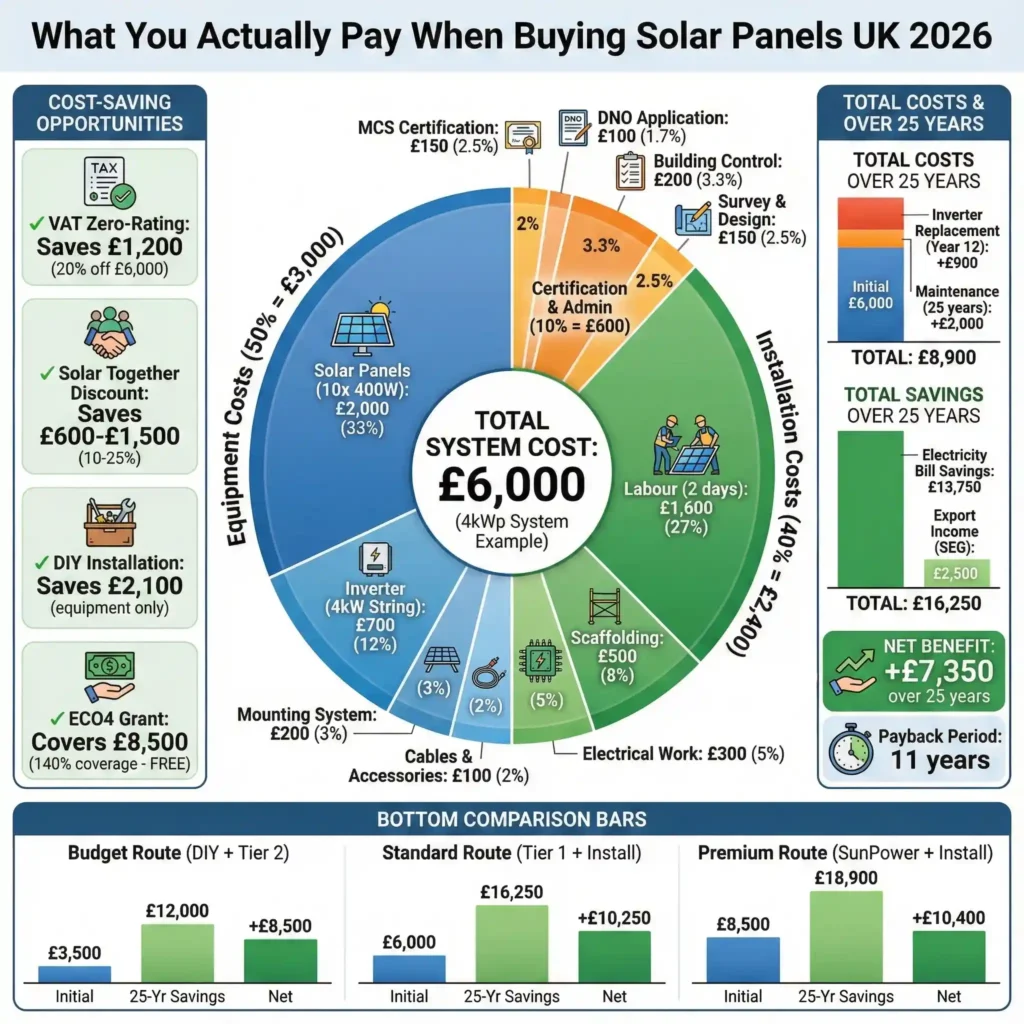
Solar panel costs vary significantly based on system size, equipment quality, installation complexity, and supplier choice. Complete installed systems cost £4,500-£9,000 for residential properties, with equipment-only purchases reducing expenses by 20-35% when homeowners arrange separate installation.
| System Size | Panel Quantity | Equipment Cost | Installation Cost | Total Cost | Annual Generation |
|---|---|---|---|---|---|
| 3kWp | 7-8 panels | £2200-£2800 | £1800-£2400 | £4000-£5200 | 2550-2900 kWh |
| 4kWp | 9-10 panels | £2900-£3600 | £2100-£2700 | £5000-£6300 | 3400-3850 kWh |
| 5kWp | 11-13 panels | £3600-£4400 | £2400-£3100 | £6000-£7500 | 4250-4800 kWh |
| 6kWp | 13-15 panels | £4300-£5300 | £2700-£3500 | £7000-£8800 | 5100-5750 kWh |
Installation costs include labour (£1,500-£2,500), scaffolding (£300-£800 depending on property height and access), electrical connections (£200-£400), DNO grid connection applications (£50-£150), and MCS certification (£100-£200). Complex installations involving difficult roof access, asbestos removal, or consumer unit upgrades increase costs by £500-£1,500.
Understanding how these components contribute to total project expenses helps buyers evaluate quotes and identify overcharging. Our detailed breakdown of solar panel installation costs examines labour rates, scaffolding requirements, electrical work specifications, and certification fees across different property types and system sizes throughout the UK.
VAT zero-rating applies to qualifying residential solar installations until March 2027, reducing costs by 20% compared to previous pricing including standard VAT. Buyers should confirm zero-rating eligibility covers complete installations including panels, inverters, batteries, and labour, as standalone battery purchases outside solar installations still incur standard 20% VAT.
Equipment-Only Purchase Costs
Wholesale panel pricing in 2026 ranges from £0.60-£1.20 per watt depending on manufacturer tier, order quantities, and specific models. Premium brands including SunPower, REA, and AIKO command £0.90-£1.50 per watt, while mainstream Tier 1 manufacturers (LONGi, JA Solar, Trina) cost £0.60-£0.90 per watt. Tier 2 and budget options reduce costs to £0.45-£0.65 per watt, though warranty terms and long-term reliability may compromise value.
Individual Component Costs:
| Component Category | Specification Range | Cost Per Unit | System Quantity | Total Cost Range |
|---|---|---|---|---|
| SOLAR PANELS | ||||
| Mainstream 400W | Tier 1 monocrystalline | £150-£220 | 10 panels | £1500-£2200 |
| Premium 450W | N-type/high-efficiency | £200-£280 | 9 panels | £1800-£2520 |
| High-output 500W | Bifacial/advanced | £240-£350 | 8 panels | £1920-£2800 |
| INVERTERS | ||||
| String Inverter 3-4kW | Standard | £600-£900 | 1 unit | £600-£900 |
| String Inverter 5-6kW | Standard | £800-£1200 | 1 unit | £800-£1200 |
| Hybrid Inverter 3-4kW | Battery-compatible | £1200-£1800 | 1 unit | £1200-£1800 |
| Microinverters | Per-panel optimization | £80-£150 | 10 units | £800-£1500 |
| MOUNTING & ACCESSORIES | ||||
| Mounting Rails/Brackets | Per panel | £25-£45 | 10 panels | £250-£450 |
| Tile Hooks/Fixings | Per panel | £3-£8 | 10 panels | £30-£80 |
| Cables & Connectors | Complete system | £150-£300 | 1 set | £150-£300 |
| Isolators & Protection | AC/DC switches | £80-£150 | 1 set | £80-£150 |
| Monitoring System | Real-time tracking | £100-£300 | 1 unit | £100-£300 |
Solar Panels (per unit):
- 400W mainstream monocrystalline: £150-£220
- 450W premium monocrystalline: £200-£280
- 500W N-type/bifacial: £240-£350
- 550W high-output modules: £280-£400
Inverters:
- 3-4kW string inverters: £600-£900
- 5-6kW string inverters: £800-£1,200
- 3-4kW hybrid inverters: £1,200-£1,800
- 5-6kW hybrid inverters: £1,600-£2,400
- Microinverters (per panel): £80-£150
Mounting and Accessories:
- Roof mounting rails and brackets (per panel): £25-£45
- Tile hooks or fixings (per panel): £3-£8
- Cables and connectors (complete system): £150-£300
- AC/DC isolators and protection: £80-£150
- Monitoring systems: £100-£300
Equipment-only purchases suit experienced DIY installers or those employing separate electricians, reducing total costs to £3,500-£5,500 for 4-5kWp systems. Buyers should factor electrician fees (£400-£800 per day, typically 1-2 days for residential installations) plus scaffolding hire (£300-£600 weekly) when calculating total expenses.
Second-Hand and Clearance Panel Costs
Used panels sell for £30-£80 each depending on age, condition, manufacturer, and original quality. Panels under 5 years old from Tier 1 manufacturers represent best value, particularly when sellers provide performance testing documentation and warranty transfer capabilities. Older panels (10-15 years) often sell at 70-85% below original costs, though degradation typically reaches 5-12% reducing output accordingly.
Clearance stock from supplier inventory rotation or discontinued models offers 30-50% discounts on new panels, with warranties typically valid provided installation occurs within 12-18 months of manufacture dates. Midsummer Wholesale, Solar Trade Sales, and specialist clearance retailers periodically offer bulk discounts on overstocked lines.
Risks of second-hand purchases include:
- Warranty limitations or complete exclusions
- Unknown handling history and potential micro-cracking
- Compatibility issues with modern inverters
- Inability to claim Smart Export Guarantee without MCS certification
- Performance degradation exceeding seller claims
Buyers purchasing used panels should request serial numbers for manufacturer verification, obtain written guarantees of minimum output levels, and insist on refund provisions if panels fail performance testing during installation.
Which Solar Panel Manufacturers Offer Best Value in 2026?
Manufacturer selection balances initial costs, warranty terms, efficiency ratings, degradation rates, and long-term reliability. Tier 1 manufacturers demonstrate financial stability, vertical integration, and quality control processes distinguishing them from budget alternatives, with premium brands offering extended warranties justifying higher upfront costs through superior long-term performance.
Tier 1 Mainstream Manufacturers
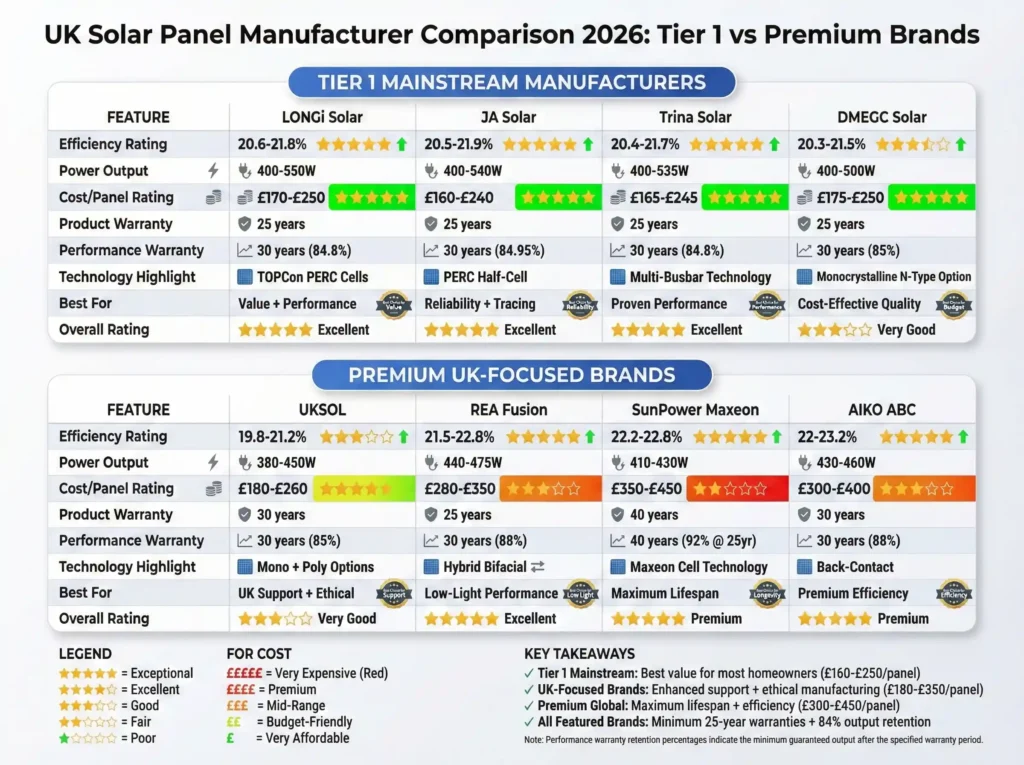
Tier 1 classification indicates manufacturers meeting financial stability, production volume, and quality criteria established by independent rating agencies. Leading Tier 1 brands in UK market include:
| Manufacturer | Efficiency Range | Power Output | Cost Per Panel | Product Warranty | Performance Warranty | Key Technology |
|---|---|---|---|---|---|---|
| LONGi Solar | 20.6-21.8% | 400-550W | £170-£250 | 25 years | 30 years (84.8%) | TOPCon, PERC |
| JA Solar | 20.5-21.9% | 400-540W | £160-£240 | 25 years | 30 years (84.95%) | DeepBlue, Half-Cell |
| Trina Solar | 20.4-21.7% | 400-535W | £165-£245 | 25 years | 30 years (84.8%) | Vertex, Multi-Busbar |
| DMEGC Solar | 20.3-21.5% | 400-500W | £175-£250 | 25 years | 30 years (85%) | Monocrystalline |
LONGi Solar:
- Market position: World’s largest monocrystalline manufacturer
- Efficiency range: 20.6-21.8%
- Power outputs: 400-550W
- Product warranty: 25 years
- Performance warranty: 30 years (84.8% output retention)
- Typical cost: £170-£250 per panel
- Key features: Hi-MO 6 series, PERC and TOPCon cell technology, strong price-performance ratio
JA Solar:
- Market position: Top 3 global manufacturer, strong UK presence
- Efficiency range: 20.5-21.9%
- Power outputs: 400-540W
- Product warranty: 25 years
- Performance warranty: 30 years (84.95% output retention)
- Typical cost: £160-£240 per panel
- Key features: DeepBlue 4.0 series, half-cell technology, material traceability commitment
Trina Solar:
- Market position: Established global brand, extensive UK distribution
- Efficiency range: 20.4-21.7%
- Power outputs: 400-535W
- Product warranty: 25 years
- Performance warranty: 30 years (84.8% output retention)
- Typical cost: £165-£245 per panel
- Key features: Vertex series, multi-busbar technology, comprehensive testing protocols
These manufacturers balance affordability with reliability, offering warranties comparable to premium brands at 30-50% lower costs. UK distribution networks ensure replacement panel availability and service support throughout system lifetimes.
Premium UK-Focused Brands
| Manufacturer | Efficiency Range | Power Output | Cost Per Panel | Product Warranty | Performance Warranty | Unique Features |
|---|---|---|---|---|---|---|
| UKSOL | 19.8-21.2% | 380-450W | £180-£260 | 30 years | 30 years (85%) | UK-based, Ethical auditing |
| REA Fusion | 21.5-22.8% | 440-475W | £280-£350 | 25 years | 30 years (88%) | Hybrid bifacial, Low-light |
| SunPower Maxeon | 22.2-22.8% | 410-430W | £350-£450 | 40 years | 40 years (92% @25yr) | Maxeon cells, 40-yr warranty |
| AIKO ABC | 22.0-23.2% | 430-460W | £300-£400 | 30 years | 30 years (88%) | Back-contact design |
| DMEGC | 20.3-21.5% | 400-500W | £175-£250 | 25 years | 30 years (85%) | Cost-effective quality |
UKSOL:
- Market position: British family-owned manufacturer emphasising ethical production
- Efficiency range: 19.8-21.2%
- Power outputs: 380-450W (residential range)
- Product warranty: 30 years
- Performance warranty: 30 years
- Typical cost: £180-£260 per panel
- Key features: Sedex SMETA ethical auditing, UK-based support, ECO funding approval with 45% uplift, local stock in Felixstowe and Doncaster
REA Solar (Fusion Series):
- Market position: Australian-founded, UK specialist distribution
- Efficiency range: 21.5-22.8%
- Power outputs: 440-475W
- Product warranty: 25 years
- Performance warranty: 30 years
- Typical cost: £280-£350 per panel
- Key features: Hybrid dual-cell technology (N-type + thin-film), bifacial design, microinverter compatibility, excellent low-light performance
DMEGC Solar:
- Market position: Established manufacturer, strong installer partnerships
- Efficiency range: 20.3-21.5%
- Power outputs: 400-500W
- Product warranty: 25 years
- Performance warranty: 30 years
- Typical cost: £175-£250 per panel
- Key features: Cost-effective quality, reliable performance, strong safety credentials
Premium Global Brands
SunPower Maxeon:
- Market position: Premium efficiency leader
- Efficiency range: 22.2-22.8%
- Power outputs: 410-430W
- Product warranty: 40 years
- Performance warranty: 40 years (92% output retention after 25 years)
- Typical cost: £350-£450 per panel
- Key features: Maxeon cell technology, anti-reflective glass, N-type silicon, superior aesthetics (all-black or white backing)
AIKO (ABC Module):
- Market position: Technology innovator, growing UK market
- Efficiency range: 22.0-23.2%
- Power outputs: 430-460W
- Product warranty: 30 years
- Performance warranty: 30 years
- Typical cost: £300-£400 per panel
- Key features: All-Back-Contact cells, superior high-temperature performance, aesthetic rear-contact design
Premium brands justify higher costs through extended warranties, slower degradation, and superior low-light performance. A SunPower system costing £8,000 versus mainstream £5,500 alternative generates similar output initially, but after 25 years maintains 92% capacity (3,128 kWh annually) versus 84.8% (2,883 kWh annually), creating cumulative advantage of 6,125 kWh over system lifetime worth approximately £1,850 at current electricity prices.
Emerging and Specialist Technologies
Oxford PV:
- Technology: Perovskite-silicon tandem cells
- Efficiency range: 25% (current), targeting 27% by 2027, 30% by 2030
- Status: Commercial production beginning 2026
- Availability: Specialist installers, premium pricing
- Key features: Highest efficiency commercially available, lower manufacturing carbon footprint, compatible with standard modules
Viridian Solar:
- Specialisation: Aesthetic in-roof integration systems
- Market position: UK-focused premium installer partnerships
- Key features: Clearline Fusion in-roof collectors, thermal and PV integration, superior building aesthetics
Specialist technologies suit specific requirements including maximum roof efficiency (perovskite), aesthetic priorities (Viridian in-roof), or hybrid thermal-electric generation, though higher costs require careful payback analysis against mainstream alternatives.
How to Choose and Verify Solar Panel Suppliers?
Supplier selection determines equipment quality, installation standards, warranty support, and long-term system reliability. Verification processes should examine certifications, financial stability, customer feedback, and contractual terms before committing to purchases or installations.
Essential Supplier Certifications
MCS Certification (Microgeneration Certification Scheme): MCS certification remains mandatory for installers seeking to qualify customers for Smart Export Guarantee payments. MCS registration numbers verify through the official directory at mcscertified.com, with valid installers listed alongside specialisms, geographic coverage, and certification dates. MCS standards require annual audits ensuring continued compliance with installation protocols, electrical safety, and customer protection requirements.
Product Certifications:
- TÜV (Technischer Überwachungsverein): German testing certification verifying safety and performance standards
- IEC (International Electrotechnical Commission): Global quality standards including IEC 61215 (design qualification), IEC 61730 (safety qualification)
- CE marking: European Conformity indicating compliance with EU safety, health, environmental requirements
- UKCA marking: UK Conformity Assessed replacing CE for GB market from 2026
Panels lacking proper certification may fail building control inspections, invalidate home insurance, or prove ineligible for export payments and warranty claims. UK-sold panels should carry UKCA marking confirming standards compliance for British market.
Installer Business Credentials:
- NAPIT or NICEIC electrical registration
- 18th Edition BS 7671 wiring regulations certification
- Public liability insurance (minimum £5 million coverage)
- Professional indemnity insurance
- TrustMark government-endorsed quality scheme membership
- Trade association membership (REA, Solar Energy UK)
Warranty Terms Verification
Solar panel warranties divide into product coverage and performance guarantees, with terms varying significantly between manufacturers and affecting long-term value calculations.
Product Warranties: Product warranties cover manufacturing defects, physical panel deterioration, and component failures. Standard terms span 25 years for mainstream Tier 1 manufacturers, extending to 30 years (UKSOL, AIKO) or 40 years (SunPower Maxeon) for premium brands. Warranty coverage should specify:
- Defect definitions and exclusion criteria
- Repair or replacement obligations
- Labour and shipping cost responsibilities
- Claims processes and response timeframes
- Warranty transfer conditions for property sales
Performance Warranties: Performance warranties guarantee minimum power output levels over specified periods, typically guaranteeing 84-92% output retention after 25 years. Tier 1 manufacturers commonly guarantee:
- Year 1: 97-98% of rated output
- Year 10: 90-92% of rated output
- Year 25: 84-88% of rated output
- Year 30: 83-85% of rated output (extended warranties)
SunPower Maxeon warranties guarantee 92% output after 25 years and 88% after 40 years, representing market-leading degradation protection. Performance testing requirements specify standard test conditions (STC: 1000W/m² irradiance, 25°C cell temperature, AM1.5 spectrum) ensuring consistent measurement standards.
Warranty claims require documented evidence of output deficiencies, typically through professional testing confirming performance below guaranteed thresholds. Buyers should verify UK service centres handle claims domestically rather than requiring international shipping, reducing claim complexity and downtime.
Supplier Financial Stability Assessment
Manufacturer bankruptcies potentially void warranties and complicate replacement panel sourcing, making financial stability assessment prudent for long-term protection. Tier 1 classification provides some stability assurance, though additional verification strengthens confidence:
- Bloomberg NEF Tier 1 listing (updated quarterly)
- Public company financial statements (for listed manufacturers)
- Production capacity and market share data
- Years of continuous operation
- Ownership structure and parent company backing
LONGi, JA Solar, and Trina maintain top-3 global production positions with decades of operation and publicly-traded status providing financial transparency. UKSOL, REA, and DMEGC demonstrate strong regional presence and established distribution networks indicating operational stability.
For installers and suppliers, verification should include:
- Companies House registration and annual accounts
- MCS certification status and history
- Insurance policy confirmations
- Customer review aggregation (Trustpilot, Which?, Checkatrade)
- Trading history and director backgrounds
Supplier failures potentially leave customers without warranty support, delayed installations, or deposit losses. HIES (Home Insulation & Energy Systems Quality Assured Contractors Scheme) membership provides 2-year deposit protection and dispute resolution for qualifying installers.
What Common Mistakes Should Buyers Avoid?
Purchase decisions significantly impact system performance, costs, and long-term satisfaction. Common errors include prioritising lowest costs over quality, inadequate warranty verification, mismatched system sizing, and insufficient supplier due diligence.
Focusing Solely on Initial Cost
Lowest-cost options frequently compromise on panel quality, installation standards, or warranty terms, reducing lifetime value despite attractive upfront pricing. A £4,000 budget system using Tier 2 panels with 15-year product warranties and 10-year performance guarantees may generate 20% less electricity over 25 years compared to £5,500 Tier 1 alternative with 25-30 year warranties and 0.4% annual degradation versus 0.7%.
Understanding the complete financial picture including equipment quality, efficiency ratings, and warranty coverage requires examining comprehensive solar panel costs that factor long-term performance alongside initial purchase prices. Installation quality matters equally to equipment specifications, with MCS-certified installers guaranteeing workmanship standards preventing expensive rectification work.
Cumulative performance differences multiply over decades. A 4kWp system generating 3,400 kWh annually with 0.7% degradation produces 77,988 kWh over 25 years, while identical capacity at 0.4% degradation generates 80,895 kWh, creating 2,907 kWh additional output worth approximately £900 at current electricity rates (£0.31/kWh average).
Installation quality matters equally to equipment specifications. MCS-certified installers guarantee workmanship standards, electrical safety, and grid compliance, while unqualified installers may create dangerous installations voiding insurance, failing building control inspections, or preventing export payment eligibility. £500-£1,000 savings employing uncertified installers potentially costs £1,500-£3,000 rectifying deficient work or £15,000-£25,000 replacing entire systems failing safety inspections.
Inadequate Roof Suitability Assessment
Panel purchases without proper roof evaluation waste money on unsuitable equipment or installations failing to deliver expected generation. Critical assessment factors include:
Structural Capacity: Typical solar arrays add 15-25 kg/m² loading to roofs, requiring structural adequacy confirmation particularly for older properties or those with slate, tile, or weak timber supports. Structural surveys cost £200-£400 but prevent catastrophic failures during winter snow loading or high winds.
Orientation and Shading: South-facing roofs without shading deliver optimal generation, though east/west orientations produce 85-90% of south-facing output. North-facing installations generate 60-70% less energy and rarely justify costs except for large properties with limited south/east/west roof access.
Shading from chimneys, trees, neighboring buildings, or roof features reduces generation by 5-40% depending on shadow coverage and timing. Shading analysis tools including SolarEdge’s Designer software or professional surveys using solar pathfinders determine expected losses, with mitigation strategies including:
- Panel repositioning avoiding shaded areas
- Optimizer or microinverter systems minimizing shading impacts
- Tree trimming or removal where feasible
- Higher-efficiency panels compensating for reduced roof area
Planning Permissions: Standard installations qualify as permitted development, though listed buildings, conservation areas, and specific roof configurations require planning permission. Application costs range £200-£500 plus potential architect fees, with approval timescales extending installations by 8-12 weeks. Buyers should verify requirements through local planning authorities before equipment purchases to avoid wasted expenditure on prohibited installations.
Mismatched System Sizing
Oversized systems waste money generating excess electricity households cannot consume or store, while undersized installations fail to maximize available roof space and potential savings. Optimal sizing depends on:
Annual Electricity Consumption: Review 12 months of energy bills determining total kWh usage. UK households average 2,700-3,500 kWh annually, though consumption varies significantly with property size, occupancy, and appliance usage. System capacity should target 80-120% of annual consumption for optimal self-consumption rates without excessive export dependency.
Self-Consumption Patterns: Households occupied during daytime utilize 40-60% of solar generation directly, while unoccupied properties export 60-70% to the grid. Smart Export Guarantee rates (4-17.5p/kWh) pay substantially less than grid electricity costs (27-35p/kWh), making direct consumption economically superior to exports.
Battery storage increases self-consumption to 70-85%, though battery costs (£3,000-£8,000) require careful payback analysis. A 5kWh battery costing £4,000 storing 1,200 kWh annually saves £370 (assuming 27p/kWh grid costs versus 5p/kWh export rates), creating 11-year payback period before battery replacement (typical 10-15 year lifespans).
Understanding which battery capacity suits specific consumption patterns and whether storage justifies investment requires examining solar battery storage costs and specifications including lithium-ion versus alternative chemistries, warranty terms, and compatibility with different inverter systems.
Future Consumption Changes: Electric vehicle adoption, heat pump installations, or home expansions significantly increase electricity demand. Buyers anticipating these changes should size systems accommodating future needs, as adding capacity later requires duplicate installation costs (scaffolding, electrical work, certification) and potential inverter upgrades.
A household installing a heat pump increasing annual consumption from 3,500 kWh to 8,500 kWh benefits from 6kWp systems sized for future demand, versus 4kWp addressing current usage requiring expensive expansion later.
Insufficient Warranty Documentation
Warranty claims require comprehensive documentation including purchase receipts, installation certificates, serial numbers, performance testing, and maintenance records. Missing documentation voids claims, leaving buyers responsible for replacement costs potentially totaling thousands of pounds.
Essential documentation to retain includes:
- Original purchase invoices with VAT details
- MCS installation certificates
- Panel serial numbers and manufacture dates
- Inverter registration and commissioning reports
- Warranty certificates in purchaser’s name
- Structural calculations and building control approvals
- DNO grid connection permissions
- Annual performance monitoring data
Digital backups stored securely ensure documentation survives house moves, property sales, or physical damage. Warranty transfers during property sales require formal notifications to manufacturers, with transfer fees sometimes applicable (typically £50-£150).
What Finance Options Exist for Buying Solar Panels in 2026?
Solar panel purchases require significant upfront investment, though multiple financing mechanisms spread costs across extended periods or reduce initial payments through grants and incentives. Finance routes include home improvement loans, green mortgages, installer payment plans, and government schemes providing subsidies for qualifying households.
Home Improvement Loans and Green Finance
Personal loans specifically designed for home improvements offer fixed-rate borrowing spanning 5-15 years with interest rates between 5-12% APR depending on credit ratings and loan amounts. Banks including Nationwide, NatWest, Barclays, and specialist green lenders provide unsecured loans up to £25,000 for solar installations.
A £6,000 loan at 7% APR over 10 years costs £69.60 monthly (£8,352 total repayment), versus £5,000 at 6% over 7 years costing £71.50 monthly (£6,006 total). Interest charges add 30-40% to system costs, though monthly payments align with electricity savings offsetting loan expenses through reduced energy bills.
Green Mortgages and Remortgage Products: Nationwide Building Society, Barclays, and NatWest offer preferential mortgage rates for energy-efficient properties or homeowners funding renewable installations. Interest rate discounts range 0.1-0.5 percentage points for homes achieving EPC ratings A or B, with some lenders providing cashback incentives (£500-£2,000) for solar installations completed within 6 months of mortgage completion.
Remortgaging to release equity for solar purchases suits homeowners with substantial property value increases or those refinancing anyway. Extending mortgage terms distributes solar costs across 20-30 years at mortgage interest rates (4-6%) rather than personal loan rates, though total interest payments increase significantly over extended periods.
Installer Payment Plans and Solar Subscriptions
Some installers offer in-house financing avoiding third-party loan applications, with payment plans spanning 3-10 years and interest rates between 6-15% APR. Octopus Energy, EON Next, and specialist solar companies provide flexible payment options requiring minimal deposits (10-20% of system cost) and monthly instalments aligned with projected savings.
Subscription and Rental Models: Solar subscription services eliminate upfront costs entirely, with homeowners paying monthly fees (£50-£120) for panel usage rather than ownership. Providers retain equipment ownership, handling maintenance, insurance, and replacements throughout contract periods (typically 20-25 years). Subscribers benefit from electricity generation without capital outlay, though total payments over contract terms exceed outright purchase costs by 50-100%.
Subscription contracts transfer to new property owners when homes sell, maintaining obligations throughout terms. Early termination typically requires buyout payments covering remaining contract value, creating financial penalties for households planning moves within subscription periods.
Government Grants and Funding Schemes
ECO4 (Energy Company Obligation) scheme provides grants covering solar panel costs for qualifying low-income households receiving means-tested benefits or meeting income thresholds. Grant amounts range £7,000-£20,000 depending on property characteristics and measures installed, with many eligible households receiving completely free installations.
Warm Homes Plan allocates £15,000 for energy efficiency improvements including solar panels, plus additional £15,000 for low-carbon heating systems. Combined measures packages receive maximum funding, with solar-plus-battery-plus-insulation projects accessing £12,000-£18,000 in support.
Understanding complete eligibility criteria, application processes, and regional scheme variations requires examining available solar panel grants and government funding across England, Scotland, and Wales. Regional schemes including Wales’s Nest programme and Scotland’s Home Energy Scotland provide additional grant routes with varying eligibility criteria and funding levels.
Regional schemes including Wales’s Nest programme and Scotland’s Home Energy Scotland provide additional grant routes with varying eligibility criteria and funding levels. Grant availability changes annually based on budget allocations and scheme priorities, requiring regular verification through local authorities or energy suppliers administering programmes.
Interest-free loan options supplement grants for households requiring additional funding beyond grant limits. Scotland’s Home Energy loans reach £7,500 (£9,000 for rural properties) at zero interest over 5-10 years, covering costs exceeding grant allocations.
Solar Together Group Buying Schemes
Solar Together coordinates collective purchasing across multiple local authority areas, using bulk ordering to negotiate discounted pricing from vetted installers. Participating households register during open periods, receive personalized quotes typically 10-25% below standard market rates, then choose whether accepting offers without obligation.
Registration requires no upfront payments or commitments, with participants declining quotes without penalties if pricing or system specifications prove unsuitable. Successful participants proceed with standard payment terms (typically 10% deposit, 90% on completion), benefiting from group-negotiated discounts while maintaining individual purchase flexibility.
Solar Together operates waves throughout the year across different regions. Current 2026 schemes include multiple English councils, Welsh authorities, and Scottish regions, with registration windows advertised through participating local authority websites.
How to Plan Solar Panel Purchases and Installations?
Successful solar installations require careful planning addressing roof suitability, equipment selection, supplier verification, installation scheduling, and regulatory compliance. Structured planning processes reduce costs, prevent delays, and ensure systems deliver expected performance throughout 25-30 year operational lifespans.
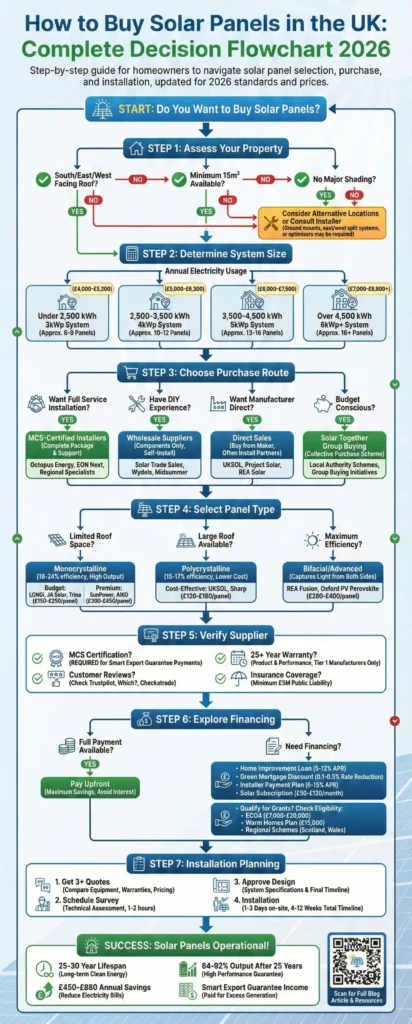
Pre-Purchase Assessment Checklist
Roof Evaluation:
- Measure available roof area (minimum 15m² for 3kWp systems)
- Determine roof orientation (south, southeast, southwest optimal)
- Assess roof pitch (20-50 degrees ideal for fixed mounting)
- Identify shading sources (trees, chimneys, neighboring buildings)
- Verify roof age and condition (replacement within 5 years delays installation)
- Confirm structural capacity (typically requires 15-25 kg/m² loading capacity)
- Check roof material compatibility (tile, slate, metal, flat membrane)
Energy Consumption Analysis:
- Gather 12 months electricity bills
- Calculate total annual consumption in kWh
- Identify seasonal variation patterns
- Determine daytime consumption percentage
- Project future consumption changes (electric vehicles, heat pumps)
- Establish target system size (80-120% of annual usage)
Regulatory and Permission Requirements:
- Verify permitted development eligibility
- Confirm whether planning permission required (listed buildings, conservation areas)
- Check DNO grid connection requirements
- Review building regulation compliance needs
- Assess listed building consent requirements if applicable
Budget and Finance Planning:
- Establish total available budget
- Research grant eligibility (ECO4, Warm Homes Plan, regional schemes)
- Compare loan options and interest rates
- Calculate monthly payment capacity
- Determine acceptable payback periods
- Factor maintenance and insurance costs
Obtaining and Comparing Quotes
Minimum 3 quotes from different suppliers enables meaningful price and specification comparison. Quote requests should provide identical information ensuring comparable proposals:
Information to Provide Suppliers:
- Property address and postcode
- Roof photographs (all angles)
- Recent electricity bills (12 months)
- Roof dimensions and orientation
- Shading concerns or constraints
- Budget range and finance preferences
- Installation timeline expectations
- Battery storage interest
Quote Comparison Criteria:
- Total system cost including VAT (zero-rated residential installations)
- Equipment specifications (panel manufacturer, model, wattage, quantity)
- Inverter type and manufacturer
- Mounting system type and materials
- Predicted annual generation (kWh)
- Expected payback period
- Product warranty terms
- Performance warranty guarantees
- Installation timeline
- Payment schedule
- Aftercare and maintenance provisions
- MCS certification confirmation
- Insurance coverage
Quotes should itemize equipment, labour, scaffolding, electrical work, and certification costs separately, enabling precise comparison and identifying padding in aggregate pricing. Suppliers refusing itemized breakdowns warrant suspicion regarding hidden costs or inflated margins.
Installation Process Timeline
Typical installation timelines span 4-12 weeks from contract signing through final commissioning:
| Timeline Phase | Duration | Key Activities | Responsible Party | Critical Dependencies |
|---|---|---|---|---|
| Week 1-2: Survey & Design | 1-2 weeks | Technical site survey (1-2 hrs), Shading analysis, System design, DNO application, Building control notification | Installer, Design Team | Property access, Roof measurements, Electricity bills |
| Week 2-4: Ordering | 2-3 weeks | Equipment ordering, Delivery coordination, Scaffolding booking, Installation scheduling | Installer, Suppliers | Equipment availability, Scaffold availability, Weather windows |
| Week 4-6: Installation | 1-3 days | Scaffolding erection, Mounting installation, Panel fitting, Electrical connections, System commissioning, Scaffolding removal | Installation Team, Electricians, Scaffolders | Dry weather, Property access, DNO grid approval |
| Week 6-8: Certification | 1-2 weeks | MCS certification, DNO grid approval, Monitoring setup, Homeowner handover | MCS Body, DNO, Installer | Inspection compliance, Grid capacity confirmation |
| Week 8-12: Post-Install | 2-4 weeks | SEG tariff application, Building control inspection, Warranty registration, Insurance notification | Homeowner, Energy Supplier, Installer | System operational, Documentation complete |
Week 1-2: Survey and Design
- Technical site survey (1-2 hours)
- Shading analysis and generation modeling
- Final system design and specifications
- DNO grid connection application
- Building control notification (if required)
Week 2-4: Ordering and Scheduling
- Equipment ordering and delivery coordination
- Scaffolding booking
- Installation date confirmation
- Homeowner preparation instructions
Week 4-6: Installation
- Scaffolding erection (Day 0 or morning Day 1)
- Roof mounting and panel installation (1-2 days)
- Inverter and electrical connections (0.5-1 day)
- System commissioning and testing (0.5 day)
- Scaffolding removal (Day 2-3 or following day)
Week 6-8: Commissioning and Certification
- MCS certification issuance
- DNO grid connection approval
- Monitoring system setup
- Homeowner handover and training
Week 8-12: Post-Installation
- Smart Export Guarantee tariff application
- Building control final inspection (if applicable)
- Warranty registration
- Insurance notification
Complex installations involving battery storage, electrical upgrades, or difficult access extend timelines by 2-6 weeks. Delays occur from adverse weather preventing roof work, equipment supply shortages, or DNO connection approval backlogs.
What Happens During Installation Day?
Understanding installation procedures helps homeowners prepare properties and recognize quality workmanship. Professional installers follow structured processes ensuring safety, efficiency, and system reliability.
Pre-Installation Preparation:
- Clear roof access routes through property
- Protect flooring and furniture near cable routes
- Provide parking for installer vehicles (ideally adjacent to property)
- Ensure pets secured away from work areas
- Arrange childcare if young children present
- Confirm loft access available for cable routing
Installation Sequence:
Stage 1: Scaffolding (if required) Scaffolding crews erect structures surrounding installation areas, typically requiring 2-4 hours for standard residential properties. Tower scaffolding suits single-story installations, while full scaffolding systems support multi-story or complex roof access.
Stage 2: Roof Mounting Installers fix mounting rails to roof structures using appropriate fixings for roof types:
- Tile hooks for concrete/clay tiles
- Slate hooks for natural slate
- Direct fixings for metal or membrane roofs
- Through-roof fixings with weatherproofing
Rails align precisely using laser levels ensuring panels sit flush and parallel. Poor alignment creates visible asymmetry and potential water pooling issues.
Stage 3: Panel Installation Panels attach to mounting rails using manufacturer-specified clamps and fixings. Installers verify:
- Correct panel orientation (landscape versus portrait)
- Proper spacing for thermal expansion
- Secure clamp tightness preventing movement
- Series wiring configurations for string inverters
- Individual microinverter connections (if applicable)
Stage 4: Electrical Connections Qualified electricians complete AC/DC connections:
- DC cable routing from panels to inverter location
- Inverter mounting (typically in loft, garage, or utility room)
- AC connection to consumer unit via dedicated circuit breaker
- Isolation switches installation for safety disconnection
- Earthing and bonding compliance with regulations
- Smart Export Guarantee meter installation or upgrade
Stage 5: System Commissioning Installers test complete systems verifying:
- All panels generating expected voltages
- Inverter operating correctly and grid-synchronized
- No electrical faults or isolation issues
- Monitoring systems connecting properly
- Export meter registering correctly
Stage 6: Handover and Documentation Installers provide:
- System operation demonstration
- Monitoring app setup and training
- MCS certificate copies
- Warranty documents
- Maintenance guidance
- Emergency shutdown procedures
Professional installations complete within specified timeframes (1-3 days for typical residential systems) with minimal property disruption and thorough site cleanup. Understanding each stage from scaffolding erection through final commissioning helps homeowners prepare properties and verify quality workmanship. Our comprehensive guide to the solar panel installation process explains detailed procedures including roof mounting techniques, electrical connections, inverter placement, and MCS certification requirements ensuring systems meet all safety and performance standards.
Frequently Asked Questions About Buying Solar Panels
Where to Buy Solar Panels in the UK?
UK homeowners buy solar panels through MCS-certified installers providing complete installation packages, wholesale suppliers for DIY purchases, online retailers, or direct from manufacturers. Octopus Energy, EON Next, regional installers, and wholesale specialists including Solar Trade Sales and Wydels represent primary purchase routes. Certified installers provide simplest purchases combining equipment, installation, and Smart Export Guarantee eligibility, while wholesale buying suits experienced DIY buyers or those employing separate electricians.
How Much Are Solar Panels to Buy in 2026?
Complete installed solar systems cost £4,500-£9,000 for residential properties in 2026. A typical 4kWp system (9-10 panels) costs £5,000-£6,300 including panels, inverter, mounting, labour, scaffolding, and MCS certification. Equipment-only purchases reduce costs to £2,900-£3,600 for equivalent capacity, though buyers must arrange separate installation and certification. Premium manufacturers including SunPower and AIKO increase costs by 30-50% versus mainstream Tier 1 brands like LONGi and JA Solar.
Are Second-Hand Solar Panels Worth Buying?
Second-hand panels suit budget-conscious buyers accepting reduced warranties and potential performance compromises. Panels under 5 years old from Tier 1 manufacturers offer best value when accompanied by performance testing documentation and warranty transfer capabilities. Older panels (10-15 years) save 70-85% versus new prices but typically suffer 5-12% degradation and often lack valid warranties. Used panel purchases should include serial number verification, output testing, and written guarantees of minimum performance levels, with refund provisions if panels fail commissioning tests.
Can You Buy Leased Solar Panels?
Leased panel purchases depend on contract terms governing ownership transfer and remaining obligations. Many lease agreements spanning 20-25 years restrict transfers or require leaseholder company approval. Buyers purchasing properties with leased systems should request complete lease documentation, verify transfer permissions, and confirm ongoing maintenance responsibilities. Solicitors should review lease terms identifying potential liabilities or restrictions before property purchases complete. Some circumstances favor allowing leases to expire rather than attempting early buyouts or transfers.
What Is the Best Type of Solar Panel to Buy in 2026?
Monocrystalline panels represent the best type for most UK homeowners in 2026, offering 18-24% efficiency in compact footprints with 25-30 year warranties. Tier 1 manufacturers including LONGi, JA Solar, and Trina provide reliable mainstream options at £150-£250 per panel, while premium brands like SunPower Maxeon and AIKO ABC modules deliver 22-23% efficiency with 40-year warranties at £300-£450 per panel. Polycrystalline panels suit larger roofs prioritizing budget over space efficiency, while bifacial and advanced technologies benefit specific applications requiring maximum efficiency or specialized performance characteristics.
How Long Do Solar Panels Last?
Solar panels operate effectively for 25-30 years with minimal performance degradation and longer physical lifespans. Tier 1 manufacturers guarantee 84-92% output after 25 years, with premium brands like SunPower warranting 92% retention through 25 years and 88% through 40 years. Inverters require replacement after 10-15 years costing £600-£2,400 depending on capacity and type. Mounting systems and cables typically survive panel lifespans without replacement, making panels the longest-lasting system components. Many panels continue generating electricity beyond warranty periods, though output gradually decreases by 0.25-0.8% annually depending on technology and manufacturing quality.
Do Solar Panels Work in UK Winter Conditions?
Solar panels generate electricity throughout UK winters, though output reduces compared to summer months due to lower sun angles, shorter daylight hours, and increased cloud coverage. Winter generation typically reaches 20-30% of summer output, with December producing 100-150 kWh monthly for 4kWp systems versus 400-500 kWh in June. Modern panels perform efficiently in low-light conditions, generating usable electricity even on overcast days. Snow accumulation temporarily blocks generation until melting or removal, though UK snowfall frequency causes minimal annual impact. Annual generation patterns balance summer surplus against winter deficits, with yearly totals meeting design expectations despite seasonal variations.
Can I Install Solar Panels Myself?
DIY solar panel installation is technically legal for homeowners in the UK, though practical and regulatory barriers make self-installation inadvisable for most buyers. Installation requires electrical qualifications including 18th Edition wiring regulations and BS 7671 certification for safe AC connections to consumer units. MCS certification remains mandatory for Smart Export Guarantee eligibility, obtainable only through certified installer involvement.
Homeowners performing panel mounting and DC wiring may employ certified electricians for AC connections and final commissioning, reducing total costs while maintaining safety and export payment eligibility. Complete DIY installations suit off-grid applications (sheds, caravans, boats) where grid connection and export payments prove irrelevant, though homeowners should understand electrical safety requirements and local building regulations.
Roof work presents significant safety risks, with scaffolding hire costs (£300-£600 weekly) often negating labor savings from self-installation. Professional installers carry public liability insurance covering property damage or injuries, protection absent from DIY projects potentially affecting home insurance coverage.
What Maintenance Do Solar Panels Require?
Solar panels require minimal maintenance beyond periodic cleaning and annual visual inspections. Panel efficiency gradually declines when dirt, bird droppings, pollen, or leaf debris accumulates, reducing generation by 5-15% in neglected systems. Cleaning frequency depends on environmental conditions, with urban properties near roads requiring more frequent cleaning than rural installations.
Annual maintenance tasks include:
- Visual inspection of panels for cracks, delamination, or physical damage
- Mounting system checks verifying secure fixings and rail integrity
- Inverter operation verification and error code review
- Electrical connection inspection for corrosion or loosening
- Monitoring system review confirming accurate data reporting
- Performance comparison against predicted output identifying underperformance
Professional maintenance services cost £100-£200 annually, though many homeowners manage basic inspections independently. Inverter replacements after 10-15 years represent the primary maintenance expense (£600-£2,400), with panels themselves requiring no component replacements throughout operational lifespans. Warranty compliance often requires periodic professional inspections, with specific requirements detailed in warranty documentation.
Top 7 Solar Panel Installers in Wolverhampton
- October 8, 2025
Top 8 Solar Panel Installers in Dudley
- October 17, 2025