

Solar Panel Inverter Cost: A Practical Guide for UK Homeowners
Solar inverters convert DC electricity from your panels into usable AC power for your home. Understanding solar panel inverter cost helps you budget for installation, plan for replacement and choose the right technology for your property. This guide provides current UK pricing, replacement timelines, brand comparisons and practical advice to help you select the most cost-effective inverter without compromising performance.
Table of Contents
ToggleHow much do solar panel inverters cost in the UK in 2026?
Solar panel inverter costs range from £500 to £2,500 for most domestic installations in 2026. String inverters sit at the lower end (£500-£1,500), microinverters increase total system cost (£1,500-£2,500 for typical arrays) and hybrid inverters cost £1,200-£2,000. Your final cost depends on inverter type, system capacity, brand choice and installation complexity. Inverters represent 8-15% of complete system costs, making them significant components requiring careful selection and budgeting.
| Capacity | String Inverter (Equipment) | String Inverter (Installed Total) | Microinverter System (Equipment) | Microinverter System (Installed Total) | Hybrid Inverter (Equipment) | Hybrid Inverter (Installed Total) |
|---|---|---|---|---|---|---|
| 3kW | £500-£700 | £700-£1100 | £600-£900 | £1200-£1800 | £1100-£1300 | £1500-£1900 |
| 3.6kW | £550-£800 | £750-£1200 | £720-£1080 | £1320-£1980 | £1200-£1400 | £1600-£2000 |
| 4kW | £600-£900 | £800-£1300 | £800-£1200 | £1400-£2100 | £1250-£1450 | £1650-£2050 |
| 5kW | £700-£1200 | £900-£1600 | £1000-£1500 | £1600-£2400 | £1400-£1700 | £1800-£2300 |
| 6kW | £900-£1400 | £1100-£1800 | £1200-£1800 | £1800-£2700 | £1600-£1900 | £2000-£2500 |
| 8kW | £1200-£1700 | £1400-£2200 | £1600-£2400 | £2200-£3300 | £1900-£2200 | £2300-£2900 |
| 10kW | £1500-£2000 | £1700-£2600 | £2000-£3000 | £2600-£3900 | £2200-£2500 | £2600-£3200 |
Entry-Level String Inverter Pricing (£500-£800)
Budget string inverters from manufacturers like Growatt, Solis or generic Chinese brands provide basic DC-to-AC conversion for simple roof layouts. These units typically offer 5-year warranties, basic monitoring and 96-97% efficiency. Entry models suit price-conscious homeowners with straightforward installations and no future battery plans.
A 3kW entry-level string inverter costs £500-£600 including VAT. A 5kW model reaches £650-£800. Installation labour adds £200-£400 depending on location and electrical work required. Budget inverters save upfront cost but expect replacement within 8-10 years rather than 12-15 years with premium alternatives.
Mid-Range String Inverter Pricing (£800-£1,500)
Mid-range inverters from GivEnergy, SunSynk, Solax or Sungrow balance cost and quality. These brands offer 10-year warranties, 97-98% efficiency, Wi-Fi monitoring apps and better thermal management. Mid-tier models suit most UK homes with standard installation requirements.
A 3.6kW mid-range inverter costs £800-£1,000. A 5kW model reaches £1,100-£1,300. A 6kW unit designed for larger homes costs £1,200-£1,500. Installation labour remains £200-£500 depending on complexity. Mid-range inverters provide reliable performance and manufacturer support networks across the UK.
Premium String Inverter and Hybrid Pricing (£1,200-£2,500)
Premium inverters from SolarEdge, Fronius, SMA or Huawei deliver 98-99% efficiency, 12-15 year warranties, advanced monitoring, rapid shutdown features and battery compatibility. Hybrid models from GivEnergy, SunSynk or Solax integrate battery charging without separate controllers.
A premium 5kW string inverter costs £1,200-£1,600. A hybrid 5kW inverter with battery integration costs £1,400-£1,800. High-capacity 8-10kW hybrids for large homes or commercial applications reach £1,800-£2,500. Installation costs increase to £400-£700 for hybrid units due to additional wiring and configuration.
Hybrid inverters integrate battery charging without separate controllers. Properties planning storage additions within 1-5 years should review battery storage costs to understand complete system pricing before selecting inverter types.
Microinverter System Pricing (£1,500-£2,500 Total)
Microinverter systems from Enphase or APsystems require one unit per panel. Individual microinverters cost £60-£120 each in 2026. A typical 10-panel system needs £600-£1,200 in microinverter hardware. A 14-panel array reaches £840-£1,680 for equipment alone.
Installation labour for microinverters costs £600-£900 due to roof-level wiring complexity. Total microinverter system cost reaches £1,500-£2,500 for standard domestic installations. Premium Enphase IQ8 microinverters cost more but offer 25-year warranties matching panel lifespan, eliminating replacement expenses.
Power Optimiser System Pricing (£1,000-£1,800 Total)
Power optimiser systems combine panel-level optimisation with central string inverters. SolarEdge dominates this category with optimisers costing £40-£70 per panel plus a compatible inverter at £900-£1,400 for 5kW capacity.
A 12-panel SolarEdge system costs £480-£840 for optimisers plus £1,000-£1,300 for the inverter, totalling £1,480-£2,140 in equipment. Installation labour adds £300-£500. Optimiser systems suit partially shaded roofs or complex layouts where microinverters seem excessive but string inverters underperform.
What factors affect solar panel inverter costs?
Solar panel inverter price varies based on power capacity, technology type, efficiency ratings, warranty coverage, brand reputation and installation complexity. Higher-wattage inverters cost more, hybrid models exceed standard string inverters by £400-£800, and premium brands charge 30-50% premiums for longer warranties and better support. Installation costs double when consumer unit upgrades or complex wiring are needed.
Power Output Capacity and Sizing
Inverter capacity directly influences cost. A 3kW inverter costs £500-£800, while 5kW models reach £1,000-£1,500 and 8kW units cost £1,600-£2,200. Oversizing by 10-20% above panel capacity allows future expansion but adds £100-£300 to equipment cost.
Undersized inverters save £200-£400 upfront but clip peak production on sunny days, wasting potential energy. Correctly sized inverters match panel output within 90-110% ratio. A 4.5kWp panel array pairs with a 4kW or 5kW inverter depending on roof orientation and shading patterns.
Inverter Technology Type
String inverters cost least at £500-£1,500 for domestic installations. Microinverters multiply per-panel costs, reaching £1,500-£2,500 for complete systems. Hybrid inverters add battery integration, costing £1,200-£2,000 versus £800-£1,400 for equivalent non-hybrid models.
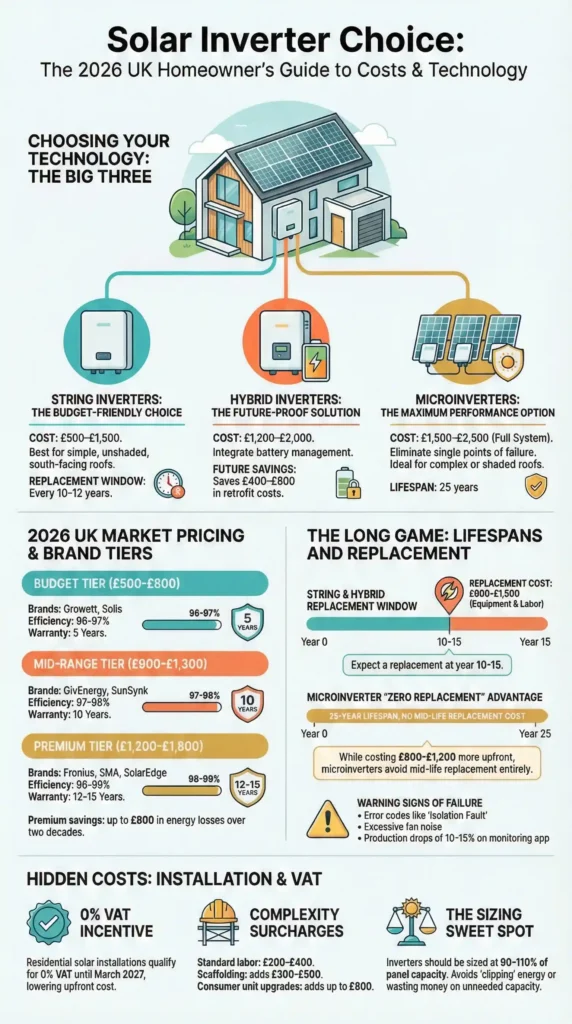
Power optimiser systems sit between string and microinverter pricing at £1,000-£1,800 total. Technology choice impacts both upfront and lifetime costs. Microinverters eliminate replacement expenses with 25-year warranties, while string inverters require replacement every 10-12 years at £600-£1,200 per event.
Efficiency Ratings and Performance
Inverter efficiency ratings of 96-97% suit budget applications. Mid-range 97-98% efficiency inverters cost £200-£400 more but save £30-£60 annually through reduced conversion losses. Premium 98-99% efficiency models cost £400-£700 more upfront.
Over 20 years, a 1% efficiency difference on a 4kW system saves approximately £600-£900 in energy generation. Budget inverters waste 3-4% of panel output through heat and conversion losses. Premium models waste only 1-2%, justifying higher prices for long-term savings.
Warranty Length and Coverage
Five-year warranties come standard on budget inverters. Ten-year warranties add £100-£300 to inverter cost. Twelve to fifteen-year warranties on premium models add £300-£500. Extended warranties reduce replacement frequency and protect against premature failure.
Warranty coverage varies. Some policies cover parts only, requiring labour payment for installation or removal. Comprehensive warranties include labour, shipping and roof access costs. Transferable warranties maintain property value when selling homes, while non-transferable warranties expire upon ownership change.
Brand Reputation and Support
Established brands like Fronius, SMA or SolarEdge charge 30-50% premiums over generic alternatives. GivEnergy, SunSynk and Solax offer middle-ground pricing with strong UK support networks. Budget brands save £300-£600 upfront but may lack local service engineers or replacement part availability.
Premium brands provide dedicated phone support, online monitoring portals and rapid warranty claim processing. Budget brands often rely on installer networks or Chinese-based support teams, extending downtime during failures. Annual monitoring subscription fees of £0-£100 vary by manufacturer.
Installation Complexity and Labour Costs
Standard ground-floor installations cost £200-£400 in labour. Loft installations in restricted spaces add £100-£200. Three-storey properties requiring scaffolding add £300-£500 for access equipment. Hybrid inverter installations cost £400-£700 labour due to battery wiring and configuration time.
Consumer unit upgrades add £300-£800 when existing units lack capacity for AC connections. DNO G99 applications for systems above 3.68kW add £150-£300 in administrative and electrical certification costs. Installation complexity can double total inverter project costs from £800 to £1,600 for identical equipment. Understanding professional installation requirements helps homeowners budget for electrical work beyond inverter equipment costs.
How long do solar panel inverters last and when do they need replacing?
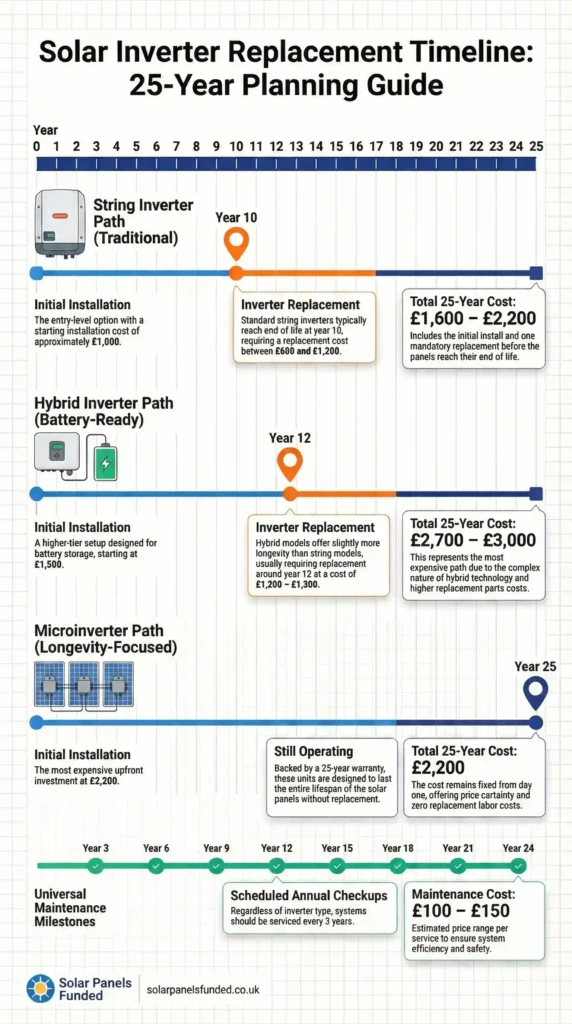
String inverters last 10-12 years on average, microinverters reach 20-25 years and hybrid inverters operate 12-15 years with proper maintenance. Most UK homeowners replace string inverters once during a 25-year solar panel lifespan. Replacement planning at year 8-10 prevents generation gaps and allows budget allocation for £600-£1,500 replacement costs.
String Inverter Lifespan Patterns (10-12 Years)
String inverters contain electrolytic capacitors, fans and power electronics that degrade over time. Heat accelerates component failure. Loft-mounted inverters in hot summer conditions fail earlier than garage or exterior-mounted units with better ventilation.
Budget string inverters survive 8-10 years before efficiency drops below 90% or complete failure occurs. Mid-range inverters reach 10-12 years. Premium models with better thermal management and no moving parts occasionally exceed 15 years. Annual degradation of 1-2% reduces output before catastrophic failure.
Microinverter Lifespan Patterns (20-25 Years)
Microinverters distribute heat across multiple small units rather than concentrating thermal stress in one device. Enphase microinverters carry 25-year warranties matching solar panel lifespans. Field data shows 20-25 year operational life with proper installation.
Individual microinverter failures affect single panels rather than entire arrays. Replacement of one failed unit costs £60-£120 plus £150-£250 labour. String inverter failures shut down complete systems, stopping all energy generation until replacement. Microinverter longevity eliminates replacement planning and budgeting requirements.
Hybrid Inverter Lifespan Patterns (12-15 Years)
Hybrid inverters manage higher thermal loads from battery charging cycles. Quality hybrids from GivEnergy or SunSynk last 12-15 years with regular firmware updates and proper ventilation. Budget hybrids survive 10-12 years before battery functionality degrades or complete failure occurs.
Battery cycling creates additional stress on hybrid inverters versus solar-only string inverters. Daily charge-discharge cycles wear components faster than solar conversion alone. Extended warranties of 10-12 years protect against early failure. Most hybrid owners replace units at year 12-14 rather than year 10 for standard string inverters.
Signs of Inverter Failure and Degradation
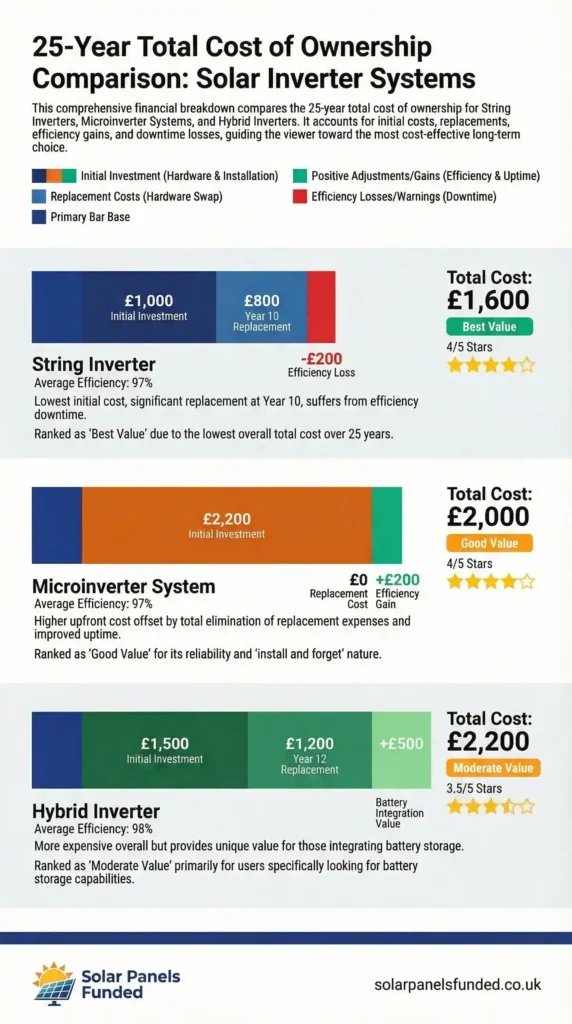
Inverters display failure through error codes, reduced output, fan noise, overheating or complete shutdown. Monitoring apps show declining efficiency before physical failure. Output drops of 10-15% below expected production indicate degradation.
Inverter display errors like “grid fault”, “overtemperature” or “isolation fault” signal component problems. Intermittent shutdowns during peak production hours suggest thermal stress. Complete failure presents as zero output with dead display panels. Professional diagnosis costs £80-£150 if not covered by active warranties.
Replacement Cost Planning and Budgeting
String inverter replacement costs £600-£1,200 for equipment plus £200-£400 labour in 2026 pricing. Hybrid replacement reaches £1,400-£1,800 installed. Homeowners should budget £600-£1,000 at year 10 for standard inverters or £1,200-£1,500 for hybrid replacements.
Replacement opportunities allow technology upgrades. Standard inverter replacement permits hybrid upgrades for £400-£800 additional cost, adding battery capability. Microinverter systems avoid replacement budgeting entirely with 25-year lifespans, saving £600-£1,500 over panel lifetimes.
Which solar panel inverter type offers best value for UK homes?
String inverters deliver best value for straightforward south-facing roof installations at £500-£1,500 total cost. Microinverters justify higher £1,500-£2,500 costs on shaded or complex roofs through better panel-level optimisation. Hybrid inverters suit homes planning battery storage, avoiding separate controllers at £1,200-£2,000 installed cost. Technology choice depends on roof complexity, shading patterns and future battery intentions.
String Inverters for Simple Roof Layouts (Best Budget Value)
String inverters suit unshaded south-facing roofs with panels at matching orientations. Single roof aspect installations with minimal surrounding obstacles work efficiently with string technology at lowest cost. Installers prefer string inverters for simplicity and proven reliability.
A 4kW string inverter costs £800-£1,200 installed for typical 3-bedroom homes. Replacement at year 10 adds £600-£1,000 future cost. Total 20-year ownership cost reaches £1,400-£2,200 for string systems. Simple installations with good solar access achieve 95-98% of theoretical maximum output with quality string inverters.
Microinverters for Complex or Shaded Roofs (Best Performance Value)
Microinverters excel on east-west roof combinations, partially shaded properties or multi-aspect installations. Panel-level maximum power point tracking captures 5-15% more energy than string inverters on compromised roof layouts. Tree shading, chimneys or dormer windows create production mismatch solved by microinverters.
A 14-panel microinverter system costs £1,800-£2,500 installed in 2026. No replacement costs accrue over 25 years with quality Enphase or APsystems units. Total lifetime cost of £1,800-£2,500 compares favourably with string systems costing £1,400-£2,200 plus £600-£1,000 replacement expenses, totalling £2,000-£3,200.
Hybrid Inverters for Battery-Ready Installations (Best Future-Proof Value)
Hybrid inverters integrate solar and battery management in single devices. Homes planning battery additions within 1-5 years benefit from hybrid installations. Retrofit battery additions to standard inverter systems require separate battery inverters or complete inverter replacement at £1,200-£1,800.
A 5kW hybrid inverter costs £1,400-£1,800 installed versus £1,000-£1,400 for equivalent string inverters. The £400 premium avoids future battery inverter costs of £800-£1,200. Battery-ready homes save £400-£800 total by choosing hybrid inverters during initial installation rather than retrofitting later.
Power Optimisers for Partial Shading Solutions (Best Compromise Value)
Power optimiser systems from SolarEdge cost £1,200-£1,800 installed for 12-14 panel arrays. Optimisers address partial shading affecting 2-6 panels without full microinverter system costs. Roof designs with minor shading obstacles benefit from targeted optimisation.
Optimiser systems deliver 85-90% of microinverter performance at 65-75% of microinverter cost. Homes with light seasonal shading or small permanent obstacles achieve better value with optimisers than complete microinverter conversions. Fully unshaded roofs gain minimal benefit from optimisers versus standard string inverters.
Grid-Tied Inverters for Export-Focused Systems (Best SEG Value)
Grid-tied inverters prioritise export to maximise Smart Export Guarantee payments. Properties with low daytime consumption benefit from export-optimised inverters costing £800-£1,200. Advanced export control features prevent grid saturation while maximising payment eligibility.
Export-focused homes earning £200-£400 annually through SEG payments recover inverter costs within 3-6 years. Standard inverters provide basic export functionality without optimisation features. Export-enhanced models cost £100-£300 more but increase annual SEG income by £50-£100 through better grid synchronisation.
How much does solar panel inverter replacement cost in the UK?
Solar panel inverter replacement cost ranges from £600 to £1,500 in 2026 for standard domestic installations. String inverter replacement costs £600-£1,200 (equipment £400-£800, labour £200-£400), hybrid inverter replacement reaches £1,200-£1,500 and microinverter replacement affects single units at £150-£300 per panel. Installation complexity, electrical upgrades and warranty coverage influence final replacement pricing.
| Inverter Type | Equipment Cost | Labour (Standard) | Labour (Complex) | Electrical Work | Consumer Unit Upgrade | Total (Simple) | Total (Complex) | Typical Lifespan | Replacement Frequency | Lifetime Replacement Cost |
|---|---|---|---|---|---|---|---|---|---|---|
| 3kW String | £400-£600 | £200-£300 | £400-£500 | £50-£150 | £300-£500 | £600-£900 | £1000-£1250 | 10-12 years | Once in 25 years | £600-£1250 |
| 5kW String | £500-£800 | £200-£350 | £400-£550 | £50-£150 | £300-£500 | £700-£1150 | £1100-£1500 | 10-12 years | Once in 25 years | £700-£1500 |
| 6kW String | £600-£1000 | £250-£400 | £450-£600 | £100-£200 | £400-£600 | £850-£1400 | £1350-£1800 | 10-12 years | Once in 25 years | £850-£1800 |
| 5kW Hybrid | £800-£1200 | £400-£550 | £600-£800 | £100-£250 | £400-£600 | £1200-£1750 | £1700-£2250 | 12-15 years | Once in 25 years | £1200-£2250 |
| Microinverter (per panel) | £60-£120 | £90-£150 | £150-£250 | £20-£50 | N/A | £150-£270 | £230-£420 | 20-25 years | Rare individual failures | £150-£600 total |
| Power Optimiser System | £900-£1300 | £300-£450 | £500-£700 | £100-£200 | £400-£600 | £1200-£1750 | £1800-£2300 | 12-15 years | Once in 25 years | £1200-£2300 |
Standard String Inverter Replacement (£600-£1,200)
String inverter replacement involves removing failed units, installing new inverters and reconnecting DC cables from panels. Straightforward replacements on ground floors with existing mounting brackets cost £600-£800 total. Complex replacements requiring new mounting, consumer unit modifications or scaffolding reach £1,000-£1,200.
Equipment costs £400-£800 for replacement string inverters in 2026. Labour costs £200-£400 for 3-5 hour installations including testing and commissioning. Loft installations add £50-£100 for restricted access. Three-storey properties requiring scaffolding add £300-£500, increasing total replacement costs to £1,200-£1,600.
Hybrid Inverter Replacement (£1,200-£1,500)
Hybrid inverter replacement costs more due to battery integration complexity. Disconnecting battery systems, reconfiguring charge controllers and testing storage functionality extends installation time to 5-8 hours. Equipment costs reach £800-£1,200 for quality hybrid replacements in 2026.
Labour costs increase to £400-£600 for hybrid installations. Battery recalibration and monitoring setup add complexity. Total hybrid replacement costs £1,200-£1,500 for straightforward installations or £1,500-£1,800 when electrical upgrades accompany inverter replacement. Homes with battery storage should budget £1,200-£1,500 for replacement at year 12-15.
Microinverter Replacement (£150-£300 Per Panel)
Microinverter failures affect individual panels rather than complete arrays. Replacing one failed microinverter costs £60-£120 for equipment plus £90-£180 labour for roof access and installation. Total single-unit replacement reaches £150-£300 depending on roof complexity and access requirements.
Multiple microinverter failures rarely occur simultaneously due to distributed stress patterns. Replacing 2-3 units over 20-25 year spans costs £300-£900 total versus £1,200-£2,400 for two complete string inverter replacements. Microinverter economics favour long-term ownership despite higher initial costs.
Warranty Replacement Costs and Coverage
Active warranty coverage reduces replacement costs to £0 for parts plus potential labour charges of £100-£300. Some manufacturers cover labour within warranty periods, eliminating homeowner costs entirely. Non-transferable warranties expire when properties sell, requiring new owners to fund replacements.
Extended warranties costing £100-£300 upfront save £600-£1,200 on replacement expenses if failures occur within coverage periods. Warranty claim processing takes 7-21 days for parts delivery. Temporary generation loss during warranty claims costs £50-£150 in grid electricity purchases depending on system size and season.
| Inverter Category | Average Lifespan | Warranty Standard | Warranty Premium | Typical Failure Rate (5yr) | Typical Failure Rate (10yr) | Mean Time Between Failure | Degradation Rate (Annual) | Coverage Type | Labour Included | Transferable | Extended Warranty Cost |
|---|---|---|---|---|---|---|---|---|---|---|---|
| Budget String | 8-10 years | 5 years | 7-10 years | 3-5% | 8-12% | 9 years | 2-3% | Parts only | No | Rarely | £100-£200 |
| Mid-Range String | 10-12 years | 10 years | 12 years | 1-2% | 4-6% | 11 years | 1.5-2.5% | Parts + labour | Sometimes | Sometimes | £150-£300 |
| Premium String | 12-15 years | 12 years | 15 years | 0.5-1% | 2-4% | 13 years | 1-2% | Comprehensive | Yes | Yes | £200-£400 |
| Hybrid (Budget) | 10-12 years | 5-10 years | 10 years | 2-4% | 6-10% | 10.5 years | 2-3% | Parts only | No | Rarely | £150-£250 |
| Hybrid (Premium) | 12-15 years | 10 years | 12-15 years | 1-2% | 3-6% | 13 years | 1.5-2.5% | Parts + labour | Sometimes | Sometimes | £250-£400 |
| Microinverters | 20-25 years | 20-25 years | 25 years | 0.3-0.8% | 1-3% | 22 years | 0.5-1% | Comprehensive | Yes | Yes | Included |
Upgrade Opportunities During Replacement
Inverter replacement presents upgrade opportunities. Standard string inverter failures allow hybrid inverter upgrades for £400-£800 additional cost beyond standard replacement pricing. Battery compatibility retrofits without replacing entire systems when upgrading to hybrid inverters during scheduled replacements.
Technology improvements over 10-12 year periods include better efficiency (96% to 98%), improved monitoring (basic displays to Wi-Fi apps) and longer warranties (5 to 10-12 years). Upgrade costs of £200-£400 during planned replacements provide meaningful performance improvements without full system overhauls.
What size solar panel inverter do I need for my home?
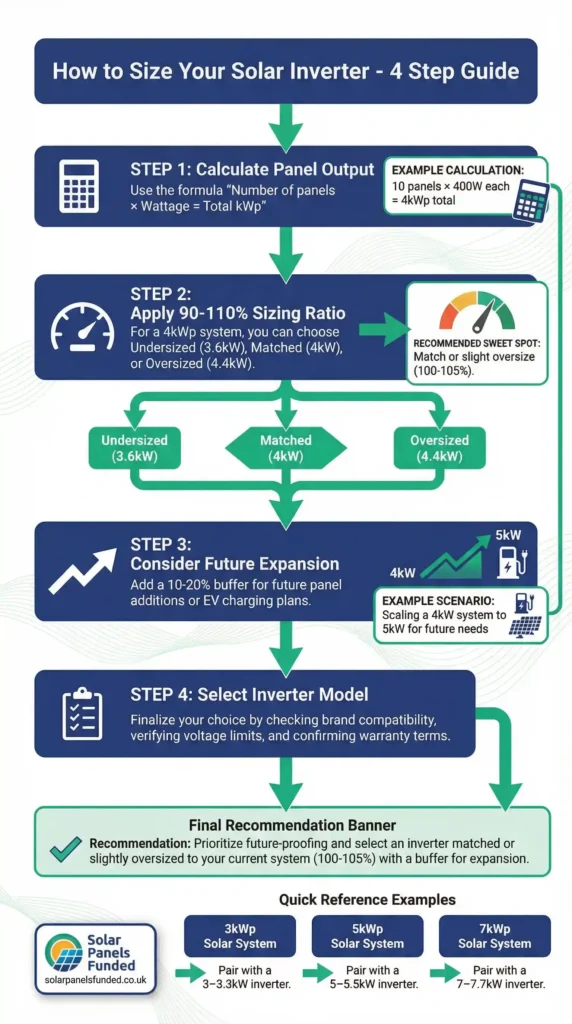
Solar panel inverter sizing matches panel array capacity within 90-110% ratio for optimal performance. A 4kWp solar system needs a 3.6-4.5kW inverter, a 5kWp system pairs with 4.5-5.5kW inverters and a 6kWp array requires 5.5-6.5kW capacity. Undersizing by 10-20% saves £100-£300 but clips peak production, while oversizing by 10-20% allows expansion but adds £100-£300 in upfront costs.
Calculating Inverter Size from Panel Capacity
Inverter sizing starts with total panel capacity in kilowatts peak (kWp). A 10-panel array with 400W panels generates 4kWp total capacity (10 × 400W = 4,000W = 4kWp). Inverter capacity should match or slightly exceed panel capacity to handle peak production.
UK solar panels rarely achieve rated peak output due to temperature derating, suboptimal angles and atmospheric losses. Real-world output reaches 80-90% of rated capacity in typical conditions. A 4kWp array produces 3.2-3.6kW in average sunlight, allowing slight inverter undersizing without clipping meaningful production.
Undersizing Strategies and Trade-Offs (90-95% Ratio)
Undersizing inverters to 90-95% of panel capacity saves £100-£300 in equipment costs. A 4.5kWp panel array paired with a 4kW inverter operates within capacity 95% of the year. Peak summer production clips at inverter maximum for 20-40 hours annually, wasting 1-2% of potential generation.
Undersizing suits budget-conscious homeowners with south-facing roofs achieving strong production. Energy loss from clipping totals £10-£30 annually on 4kW systems. Equipment savings of £200 recover 7-20 years of minor production losses. Conservative undersizing to 90% capacity clips excessive production hours, wasting 3-5% annually at £30-£80 lost value.
Matched Sizing for Balanced Performance (95-105% Ratio)
Matched inverter sizing provides balanced performance without clipping or wasted inverter capacity. A 4kWp panel array pairs with 4kW or 4.5kW inverters depending on roof orientation. South-facing installations achieving peak output benefit from 105% inverter capacity (4.2-4.5kW for 4kWp panels).
East-west roof configurations producing lower peaks suit 95-100% inverter ratios (3.8-4kW for 4kWp split arrays). Matched sizing eliminates production clipping while avoiding oversized inverter costs. Most installers recommend 1:1 ratios or slight oversizing for optimal long-term performance.
| Panel Array (kWp) | Recommended Inverter (Matched) | Undersized Option (90-95%) | Oversized Option (110-120%) | Typical Home Type | Annual Generation (kWh) | Peak Output (kW) | Suitable String Inverter Models | Suitable Hybrid Models | Cost Difference (Matched vs Undersized) | Cost Difference (Matched vs Oversized) |
|---|---|---|---|---|---|---|---|---|---|---|
| 3kWp | 3kW | 2.7-2.85kW | 3.3-3.6kW | 1-2 bed flat | 2400-2800 | 2.4-2.7kW | Growatt 3kW, Solis 3kW | GivEnergy 3.6kW | £50-£100 saved | £100-£200 added |
| 3.6kWp | 3.6kW | 3.2-3.4kW | 4-4.3kW | 2 bed house | 2900-3400 | 2.9-3.2kW | Solis 3.6kW, Solax 3.6kW | GivEnergy 3.6kW, SunSynk 3.6kW | £100-£150 saved | £150-£250 added |
| 4kWp | 4kW | 3.6-3.8kW | 4.4-4.8kW | 3 bed house | 3200-3800 | 3.2-3.6kW | Growatt 4kW, Sungrow 4kW | SunSynk 5kW, Solax 5kW | £100-£200 saved | £200-£300 added |
| 5kWp | 5kW | 4.5-4.75kW | 5.5-6kW | 3-4 bed house | 4000-4700 | 4-4.5kW | Solis 5kW, Solax 5kW, Fronius 5kW | GivEnergy 5kW, SunSynk 5kW | £150-£250 saved | £250-£400 added |
| 6kWp | 6kW | 5.4-5.7kW | 6.6-7.2kW | 4 bed house | 4800-5600 | 4.8-5.4kW | Sungrow 6kW, Fronius 6kW | GivEnergy 6kW, Huawei 6kW | £200-£300 saved | £300-£500 added |
| 8kWp | 8kW | 7.2-7.6kW | 8.8-9.6kW | Large 4-5 bed + EV | 6400-7500 | 6.4-7.2kW | SMA 8kW, Sungrow 8kW | Huawei 8kW, SunSynk 8kW | £250-£400 saved | £400-£600 added |
| 10kWp | 10kW | 9-9.5kW | 11-12kW | Large home/small commercial | 8000-9400 | 8-9kW | Fronius 10kW, SMA 10kW | Huawei 10kW, Sungrow 10kW | £300-£500 saved | £500-£700 added |
Oversizing for Future Expansion (105-120% Ratio)
Oversizing inverters to 110-120% of current panel capacity allows future array expansion without inverter replacement. A 4kWp array installed with a 5kW inverter accommodates 1kWp additions (2-3 panels) without additional inverter costs.
Oversizing adds £100-£300 in upfront inverter costs. Future panel additions cost £200-£400 per panel installed. Avoiding second inverter purchases saves £600-£1,200 if expansion occurs. Homeowners uncertain about future needs should budget for 10-15% oversizing during initial installation.
String Configuration and Voltage Limits
Inverter string inputs specify maximum DC voltage and current limits. Exceeding voltage limits damages inverters or triggers safety shutdowns. String configurations balance panel counts per string within inverter specifications.
A typical 400V string inverter accepts 2 strings of 5-6 panels each (10-12 panels total). Higher-voltage residential inverters handle 600-800V inputs, supporting 8-10 panels per string. Incorrect stringing causes voltage mismatches reducing efficiency by 5-10% or preventing operation entirely. Professional installers calculate string configurations based on panel specifications and inverter input limits.
What are typical solar panel inverter brand costs and specifications?
Budget brands (Growatt, Solis) cost £500-£800 for 5kW string inverters with 5-year warranties. Mid-range brands (GivEnergy, SunSynk, Solax) cost £900-£1,300 with 10-year warranties and 97-98% efficiency. Premium brands (Fronius, SMA, SolarEdge) cost £1,200-£1,800 with 12-year warranties and 98-99% efficiency. Microinverter leader Enphase costs £60-£120 per unit with 25-year warranties.
Budget Brand Inverter Pricing (£500-£800)
Growatt, Solis and generic Chinese manufacturers provide entry-level string inverters at £500-£800 for 4-6kW residential capacity. These brands offer 5-year warranties, 96-97% efficiency and basic monitoring through smartphone apps. Budget inverters suit price-sensitive installations with simple roof layouts.
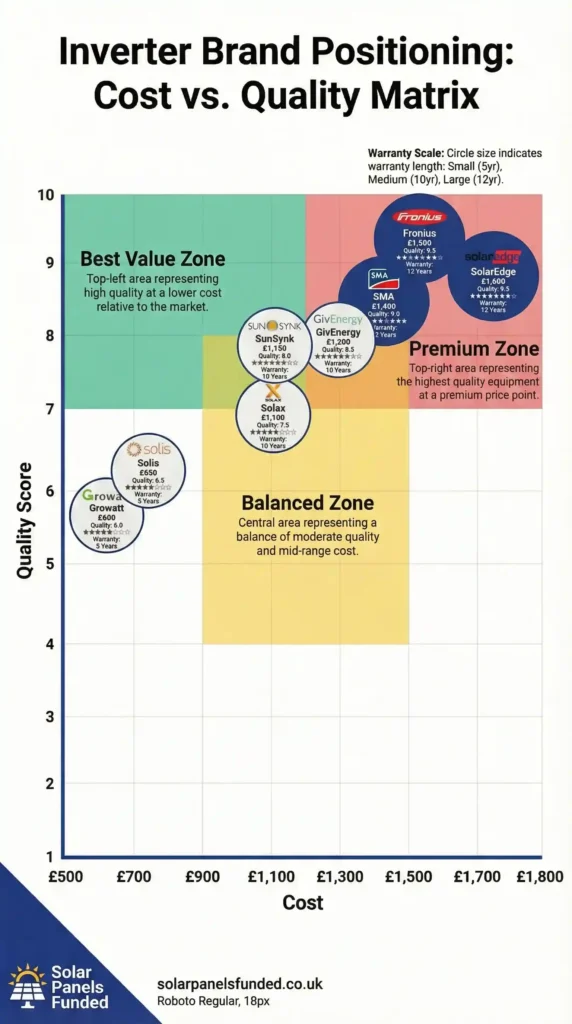
Generic alternatives drop to £500-£650 but lack UK support networks. Budget brands save £400-£700 versus premium alternatives but expect 8-10 year lifespans versus 12-15 years from premium manufacturers.
Mid-Range Brand Inverter Pricing (£900-£1,300)
GivEnergy, SunSynk and Solax dominate UK mid-range markets with strong installer networks and responsive customer support. These brands cost £900-£1,300 for 5kW string or hybrid inverters with 10-year warranties, 97-98% efficiency and comprehensive monitoring portals.
GivEnergy 5kW hybrid inverters cost £1,200-£1,400 installed in 2026. SunSynk 5kW hybrids reach £1,100-£1,300. Solax 5kW string inverters cost £900-£1,100. Mid-range brands balance cost and quality, providing reliable performance with acceptable failure rates of 1-2% within warranty periods.
Premium Brand Inverter Pricing (£1,200-£1,800)
Fronius, SMA and SolarEdge represent premium residential inverter markets. These brands cost £1,200-£1,800 for 5kW capacity with 12-15 year warranties, 98-99% efficiency, advanced monitoring and superior thermal management. Premium inverters suit performance-focused homeowners or commercial installations.
| Brand | Type | 5kW Price Range | Warranty (Years) | Efficiency | Origin | UK Support | Best For | Notable Features |
|---|---|---|---|---|---|---|---|---|
| Growatt | String | £550-£750 | 5 | 96.5-97.5% | China | Limited | Budget-conscious | Basic monitoring, proven reliability |
| Solis | String | £600-£800 | 5-10 | 97-97.8% | China | Moderate | Entry/mid-range | Good value, Wi-Fi included |
| GivEnergy | Hybrid | £1200-£1400 | 10 | 97.5-98% | UK-designed | Excellent | Battery-ready homes | GivEnergy battery integration, strong app |
| SunSynk | Hybrid | £1100-£1300 | 10 | 97.6-98.2% | South Africa | Good | Flexible battery compatibility | Works with multiple battery brands |
| Solax | String/Hybrid | £900-£1500 | 10 | 97.5-98% | China | Good | Mid-range reliability | Wide product range, stable performance |
| Sungrow | String/Hybrid | £1000-£1400 | 10 | 97.8-98.5% | China | Good | Commercial & residential | Global market leader, enterprise focus |
| Fronius | String | £1400-£1600 | 12 | 98-98.8% | Austria | Excellent | Premium residential | SnapINverter mounting, advanced monitoring |
| SMA | String/Hybrid | £1300-£1500 | 10-15 | 98-98.6% | Germany | Excellent | Performance-focused | Sunny Boy series, robust build |
| SolarEdge | Optimiser + String | £1600-£1800 | 12 | 97.5-99% | Israel | Excellent | Shaded/complex roofs | Power optimiser system, module-level monitoring |
| Enphase | Microinverter | £60-£120/unit | 25 | 96.5-97.5% | USA | Good | Complex installations | IQ8 series, grid-independent capability |
| Huawei | Hybrid | £1600-£2000 | 10 | 98-98.6% | China | Moderate | High-capacity systems | FusionSolar platform, enterprise features |
Fronius Primo 5kW inverters cost £1,400-£1,600 installed. SMA Sunny Boy 5kW models reach £1,300-£1,500. SolarEdge 5kW inverters with power optimisers total £1,600-£1,800 for complete systems. Premium brands justify higher costs through longer lifespans (12-15 years), lower failure rates (<1%) and comprehensive support networks.
Microinverter Brand Pricing (£60-£120 Per Unit)
Enphase dominates microinverter markets with IQ7 and IQ8 series products. Individual Enphase microinverters cost £60-£90 for IQ7 models or £80-£120 for advanced IQ8 units with 25-year warranties. APsystems provides alternative microinverters at £50-£80 per unit with 20-year coverage.
A 12-panel Enphase IQ8 system costs £960-£1,440 for microinverters plus £600-£900 installation labour, totalling £1,560-£2,340. APsystems alternatives reduce costs to £1,200-£1,800 total. Microinverter premiums of £600-£1,000 over string systems provide 25-year lifespans eliminating replacement expenses.
Hybrid Inverter Brand Comparison (£1,200-£2,000)
GivEnergy leads UK hybrid markets with Giv-Hybrid 5kW inverters at £1,200-£1,400. SunSynk 5kW hybrids cost £1,100-£1,300. Solax X-Hybrid 5kW models reach £1,300-£1,500. Premium Fronius or SMA hybrids cost £1,600-£2,000 for 5-6kW residential capacity.
Battery compatibility varies between brands. GivEnergy inverters pair exclusively with GivEnergy batteries. SunSynk supports multiple battery brands including Pylontech and BYD. Solax inverters work with Solax, Puredrive or third-party batteries. Brand lock-in affects future battery upgrade costs and flexibility.
How can I reduce solar panel inverter costs without compromising quality?
Compare three installer quotes to find competitive pricing, saving £200-£500 on identical equipment. Choose mid-range brands over premium alternatives, saving £300-£600 with minimal performance difference. Select string inverters for simple roof layouts rather than microinverters, saving £800-£1,200. Avoid unnecessary oversizing, saving £100-£300 in inverter capacity costs. Plan replacements during off-peak seasons (October-March) when installer availability improves and labour rates drop 10-15%.
Request Multiple Competitive Quotes (Save £200-£500)
Solar installers mark up inverter costs by 15-40% above wholesale pricing. Comparing three quotes reveals pricing variations of £200-£500 for identical equipment. Online comparison platforms generate quotes from vetted installers within 24-48 hours.
Request itemised breakdowns separating inverter costs from labour, mounting and electrical work. Challenge inflated equipment pricing with competitor quotes. Installers often match lower quotes rather than losing jobs to competitors. Quote comparison saves £200-£500 on typical domestic installations without quality compromise.
Choose Value Brands Over Premium (Save £300-£600)
Mid-range brands like GivEnergy, SunSynk or Solax provide 90-95% of premium brand performance at 60-70% of premium pricing. A £1,000 GivEnergy inverter performs comparably to a £1,500 Fronius unit for most residential applications. Warranty differences shrink from 15 to 10 years rather than compromising core functionality.
Premium brands justify costs through extended warranties, advanced features and brand recognition rather than fundamental performance advantages. Performance differences of 1-2% efficiency between mid-range and premium inverters save £15-£30 annually, requiring 20-30 years to recover £300-£600 price premiums.
Select Appropriate Technology for Roof Layout (Save £800-£1,200)
Microinverter systems cost £800-£1,200 more than string alternatives for simple south-facing roofs. Unshaded single-aspect installations gain minimal benefit from microinverter panel-level optimisation. String inverters provide 95-98% of microinverter performance on optimal roof layouts.
Restrict microinverters to complex roofs with multiple aspects, significant shading or irregular layouts where panel-level optimisation delivers measurable returns. Simple installations with minimal shading suit string inverters at £600-£1,000 lower total cost without meaningful production sacrifices.
Avoid Unnecessary Inverter Oversizing (Save £100-£300)
Inverters sized at 110-120% of panel capacity cost £100-£300 more than properly matched units. Oversized inverters provide no immediate benefit unless future panel expansion occurs. Most homeowners never expand initial installations, wasting inverter capacity costs.
Matched inverter sizing at 95-105% of panel capacity eliminates oversizing premiums while maintaining full production capability. Future expansion plans justify oversizing, but speculative capacity increases waste capital. Budget-conscious installations should match inverter capacity to installed panels without expansion buffers.
Plan Replacement During Off-Peak Periods (Save 10-15% Labour)
Installer demand peaks April-August when solar generation and homeowner interest surge. Winter months (October-March) offer 10-15% lower labour rates as installer schedules thin. Planning inverter replacements during off-peak periods saves £30-£100 on labour costs.
Advance scheduling locks competitive rates and ensures availability. Emergency replacements during summer peaks face premium rates and extended wait times. Proactive replacement planning at year 10 for string inverters or year 12 for hybrids avoids rushed decisions and peak-season pricing.
Frequently Asked Questions About Solar Panel Inverter Costs
Do solar panel inverters come with installation or are they purchased separately?
Most solar installations bundle inverter costs into complete system pricing. Standalone inverter purchases for replacements or upgrades require separate purchase and installation arrangements. Bundled installations simplify procurement and ensure compatibility between components.
What is the cheapest type of solar panel inverter?
Budget string inverters from Growatt or Solis cost £500-£800 for 4-6kW residential capacity, making them the most affordable option. Entry-level models sacrifice longevity (8-10 years) and advanced features but provide basic DC-to-AC conversion functionality.
How often do solar panel inverters need replacing?
String inverters require replacement every 10-12 years on average. Microinverters last 20-25 years, matching solar panel lifespans. Hybrid inverters operate 12-15 years before replacement. Most UK homeowners replace string inverters once during 25-year panel lifespans.
Can I upgrade my inverter to add battery storage later?
Standard string inverters cannot add battery functionality. Hybrid inverter upgrades during replacement cost £1,200-£1,500 versus £600-£1,000 for standard replacements. Installing hybrid inverters initially avoids future upgrade costs if battery plans exist within 5 years.
What warranty coverage should I expect on solar panel inverters?
Budget inverters include 5-year warranties. Mid-range brands offer 10 years standard. Premium models extend to 12-15 years. Microinverters provide 20-25 year coverage. Comprehensive warranties cover parts and labour, while basic warranties cover parts only with separate labour charges.
Do solar panel inverter costs include VAT?
Residential solar installations qualify for 0% VAT until March 2027 under energy-saving materials relief. Inverter costs quoted should exclude VAT for qualifying installations. Commercial installations pay standard 20% VAT, adding £100-£500 to inverter costs. Homeowners should explore available grants and funding schemes to reduce total system costs including inverter expenses.
How much does professional inverter installation cost separately from equipment?
Professional installation labour costs £200-£700 depending on complexity. Ground-floor standard string inverters cost £200-£400 labour. Loft installations add £50-£100. Hybrid inverters require £400-£700 labour for battery integration. Scaffolding for difficult access adds £300-£500.
Can I install a solar panel inverter myself to save money?
DIY inverter installation voids warranties and violates electrical regulations requiring Part P certified electricians. Improper installation creates fire hazards, electrocution risks and system failures. Professional installation ensures compliance, safety and warranty validity despite £200-£700 labour costs.
What is the cost difference between string inverters and microinverters?
String inverters cost £500-£1,500 installed for typical domestic systems. Microinverter systems cost £1,500-£2,500 for equivalent capacity. Initial cost differences of £800-£1,200 offset by microinverter longevity eliminating replacement expenses over 25-year lifespans.
Are expensive solar panel inverters worth the extra cost?
Premium inverters justify costs through longer warranties (12-15 vs 5-10 years), better efficiency (98-99% vs 96-97%) and superior support networks. Cost premiums of £300-£600 save £600-£1,200 on replacement avoidance and £200-£400 through efficiency gains over 20 years, providing marginal value for long-term ownership.
solar battery cost in the UK
- November 12, 2025
solar panel installer UK guide
- November 24, 2025