Solar Panel Grants and Free Solar Panels UK: Complete 2026 Guide
Table of Contents
ToggleEnergy costs continue to rise across the UK, pushing thousands of households to explore renewable alternatives. Solar panels offer a practical solution, but upfront installation costs between £5,000 and £15,000 create barriers for many families. Government schemes now provide solar panel grants and funding routes that cover partial or complete installation expenses. This guide examines who qualifies for free solar panels in 2026, which programmes deliver the most support, and how to apply successfully.
What Government Schemes Offer Free Solar Panels in the UK?
Multiple government-backed programmes provide free or subsidised solar panel installations across England, Scotland, and Wales. The Energy Company Obligation 4 (ECO4) scheme represents the primary route, allocating £4 billion until March 2026 for energy efficiency improvements including solar PV systems. The Warm Homes Plan, launched in April 2025, expands access with £13.2 billion funding for renewable installations running through 2030. Wales operates the Warm Homes Nest Scheme specifically for Welsh residents, while Scotland provides the Home Energy Scotland Grant combining grants with interest-free loans. Each programme targets low-income households, those receiving means-tested benefits, or properties with poor energy efficiency ratings between D and G.
ECO4 Scheme Eligibility and Grant Amounts
The ECO4 programme runs from April 2022 through March 2026, managed by energy regulator Ofgem. Large energy suppliers including British Gas, EDF Energy, OVO Energy, Scottish Power, and SSE must fund energy efficiency measures for qualifying households. Solar panel grants under ECO4 range from £7,000 for basic installations to £20,000 for comprehensive home energy upgrades combining solar, insulation, and heating improvements.
Households qualify when they meet income thresholds, receive specific benefits, or demonstrate energy vulnerability. Properties must hold Energy Performance Certificate ratings of E, F, or G, though Local Authority Flex extensions allow D-rated homes to qualify under certain circumstances.
ECO4 Qualifying Benefits:
- Universal Credit
- Income Support
- Pension Credit (Guarantee Credit or Savings Credit)
- Housing Benefit
- Child Tax Credits
- Working Tax Credits
- Income-based Jobseeker’s Allowance
- Income-related Employment and Support Allowance
Households with annual incomes below £31,000 often qualify even without receiving benefits, particularly when Local Authority Flex criteria apply. As of early 2026, over 80,000 microgeneration measures including solar panels have been installed through ECO4.
Warm Homes Plan 2025-2030 Details
The Warm Homes Plan represents the UK government’s largest public investment in home energy upgrades, providing £13.2 billion between 2025-2030. Unlike previous schemes focusing solely on insulation, this programme prioritises solar panels, battery storage, and heat pumps to create “zero bill homes” where renewable generation meets or exceeds household consumption.
Eligible households receive up to £15,000 for energy efficiency improvements including solar installations, plus an additional £15,000 for low-carbon heating systems. Social housing residents, low-income families earning under £36,000 annually, and private tenants with landlord permission qualify for support.
The scheme operates through local authorities who conduct retrofit assessments evaluating each property’s energy needs. Assessment results determine which combination of solar panels, batteries, insulation, and heating upgrades delivers maximum efficiency gains. Applications open through the government’s online eligibility checker for homeowners, while renters must apply directly through local councils.
Warm Homes Nest Scheme Wales Specific Programme
Welsh households access solar panel funding through the Warm Homes Nest Scheme, operated by the Welsh Government. This programme provides fully funded energy improvements including solar PV installations for low-income families and residents in deprived communities throughout Wales.
Unlike ECO4’s benefit-focused eligibility, Nest evaluates household circumstances including fuel poverty risk, health conditions, and property energy efficiency. Applicants contact the Nest service on 0808 808 2244 for telephone assessments, followed by home surveys determining appropriate measures.
The scheme includes ongoing energy advice support, helping households maximise savings from installed solar systems. Nest covers installation costs entirely, with no repayment requirements for qualifying applicants.
Home Energy Scotland Grant and Loan Structure
Scottish homeowners access solar panel funding through Home Energy Scotland’s combined grant and loan programme. The scheme provides up to £7,500 in grants for energy efficiency measures, with solar panel installations representing a qualifying improvement category.
Rural properties receive enhanced support through “rural uplift” provisions, increasing maximum grants to £9,000. Additional interest-free loans up to £4,750 spread remaining costs across extended payment periods, reducing financial barriers for families unable to afford full upfront payments.
Eligibility requires property ownership and residence in Scotland. Applicants need Energy Performance Certificate assessments or Home Energy Improvement Reports identifying recommended measures. Landlords and property developers cannot access this scheme.
Note: As of June 2024, Home Energy Scotland temporarily paused new solar panel and battery storage referrals while reviewing programme capacity. Previously approved applications continue processing. Homeowners should verify current availability before applying.
Who Qualifies for Free Solar Panel Grants in 2026?
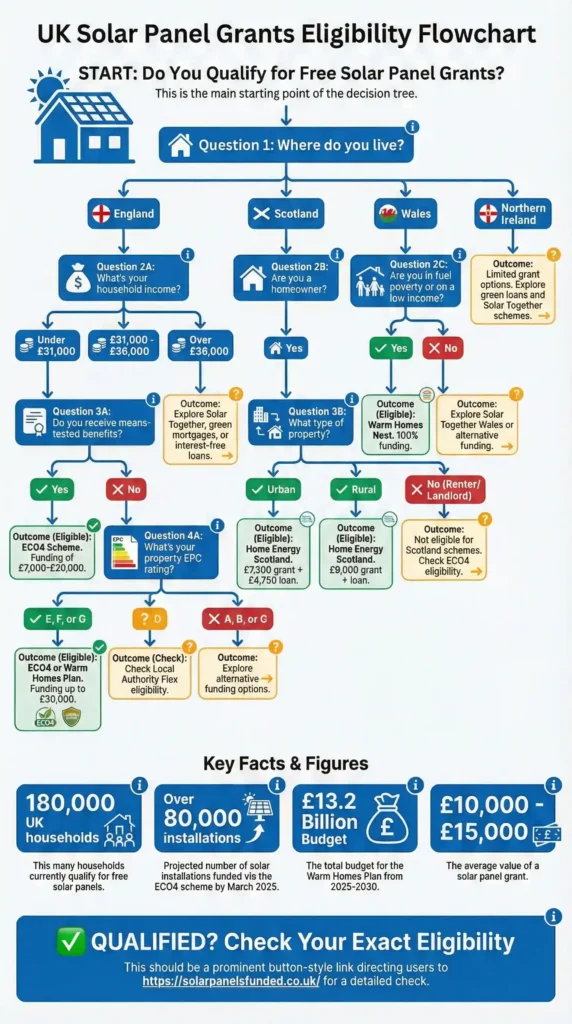
Free solar panel eligibility combines income levels, benefit receipt, property characteristics, and energy efficiency ratings. Qualification routes vary by scheme, but common criteria patterns emerge across programmes.
Income-Based Qualification Thresholds
Most solar panel grant programmes establish household income limits ensuring support reaches families experiencing genuine financial hardship. ECO4 and Warm Homes Plan schemes typically cap qualifying incomes at £31,000 to £36,000 annually, measured as combined gross household earnings.
Income verification requires recent payslips, benefit award letters, Universal Credit statements, or Pension Credit documentation. Self-employed applicants provide tax returns or accounts demonstrating annual earnings fall below thresholds.
Local authorities administering grants possess flexibility adjusting income limits based on regional cost-of-living differences and household composition. Families with multiple children, disabled members, or caring responsibilities may qualify above standard thresholds.
Energy Performance Certificate Rating Requirements
Property energy efficiency ratings determine solar panel grant eligibility across most programmes. Energy Performance Certificates classify buildings from A (most efficient) through G (least efficient) based on heating costs, insulation quality, and renewable energy integration.
ECO4 primarily targets properties rated E, F, or G where solar installations deliver maximum impact reducing fuel poverty. The Local Authority Flex extension permits D-rated homes to qualify when households demonstrate energy vulnerability through health conditions, age, or income constraints.
Warm Homes Plan assessments evaluate properties between D and G ratings, with retrofit surveys identifying optimal improvement combinations. Properties without current EPCs receive free assessments determining baseline efficiency before grant approval.
Homeowners obtain EPCs through accredited assessors listed on the government’s register. Certificates remain valid for 10 years unless significant property modifications occur.
Benefit Receipt and Vulnerable Household Status
Households receiving means-tested benefits automatically qualify for ECO4 and most grant programmes. Qualifying benefits demonstrate financial need without requiring separate income verification.
Beyond standard benefit categories, schemes recognise vulnerable household status through additional indicators including age over 80, disability benefit receipt, or chronic health conditions exacerbated by cold homes. Local Authority Flex provisions extend support to families narrowly missing benefit eligibility but facing genuine hardship.
Energy suppliers administering grants maintain obligation targets for vulnerable households, creating strong incentives to approve borderline applications. Applicants experiencing fuel poverty, those rationing energy use, or families with young children in cold homes often qualify even without formal benefit receipt.
Homeowner, Tenant and Landlord Eligibility Rules
Most solar panel grant schemes prioritise owner-occupiers and private tenants, with specific provisions governing rental properties. Homeowners control grant applications directly, receiving installations without landlord negotiations.
Private tenants qualify for ECO4, Warm Homes Plan, and other schemes with written landlord permission. Landlords benefit from improved property values, enhanced Energy Performance Certificate ratings, and reduced tenant energy costs, creating incentives for cooperation. Some schemes offer landlord contributions covering portions of installation costs not covered by grants.
Social housing residents access solar funding through dedicated Warm Homes Plan provisions designed for housing associations and council properties. These installations proceed without individual tenant applications, managed at property portfolio level.
Landlords themselves generally cannot access residential solar grants for rental properties, though commercial solar schemes exist for larger portfolios. Scotland’s Home Energy Scotland programme explicitly excludes landlords and property developers.
How Do Local Authority Flex Rules Expand Solar Grant Access?
Local Authority Flexible Eligibility (LA Flex) represents a crucial ECO4 extension enabling councils to broaden solar panel grant access beyond standard benefit and income criteria. This mechanism recognises fuel poverty and energy vulnerability extend beyond households meeting rigid qualification rules.
Council Determination of Energy Vulnerability
Local authorities assess energy vulnerability through multiple indicators beyond income and benefit receipt. Councils evaluate factors including household composition, occupant ages, health conditions, housing quality, and local cost-of-living pressures when determining LA Flex eligibility.
Families with young children under 5, households containing members over 65, or residents with chronic respiratory conditions, cardiovascular disease, or disabilities often qualify through vulnerability assessments. Properties suffering from damp, mould, or inadequate heating systems receive priority consideration.
Councils maintain autonomy designing LA Flex criteria matching their communities’ specific needs. Urban authorities may emphasise income thresholds in high-cost areas, while rural councils might prioritise isolated households facing heating oil dependency.
Income Flexibility and Borderline Cases
LA Flex provisions address borderline applicants earning slightly above standard income thresholds. Households with gross annual incomes between £32,000 and £40,000 qualify when councils identify specific vulnerability factors including high energy costs, chronic illness, or caring responsibilities.
Local authorities examine proportionate energy costs relative to income rather than applying blanket cutoff figures. Families spending more than 10% of household income on heating and electricity often meet vulnerability definitions regardless of absolute earnings.
Councils process individual circumstances holistically, considering debt levels, essential expenditures, and regional cost variations when determining eligibility. Applicants narrowly missing income thresholds should contact their local authority directly explaining their circumstances before assuming disqualification.
Application Process Through Local Authorities
Households applying through LA Flex routes contact their local council’s energy efficiency or housing department. Many authorities operate dedicated telephone lines or online portals for grant applications, though processes vary between regions.
Applications require documentation demonstrating both income levels and vulnerability factors. Councils typically request bank statements, utility bills, medical evidence for health conditions, and household composition details. Processing times range from 2 weeks to 6 weeks depending on local authority capacity and application complexity.
Approved applicants receive referrals to ECO4 obligated energy suppliers who arrange property surveys and installation scheduling. The local authority approval guarantees supplier acceptance without additional eligibility checks.
What Financial Support Supplements Free Solar Panel Schemes?
Beyond primary grant programmes, multiple financial mechanisms reduce solar panel costs for UK households. These supplementary supports combine with grants or provide alternatives for families narrowly missing programme eligibility.
Zero VAT Rate on Solar Installations Until 2027
The UK government eliminated VAT on solar panel installations for residential properties from April 2022 through March 2027. This zero-rating applies to complete systems including panels, inverters, batteries, and installation labour, saving households 20% on total project costs.
A 4kW solar system typically costing £8,000 including installation previously incurred £1,600 in VAT charges. The zero-rating delivers automatic savings without requiring applications or eligibility assessments. Both grant-funded and self-funded installations benefit from this relief.
The zero-rate covers renewable energy equipment installations but excludes stand-alone battery purchases or system expansions on properties with existing solar arrays. Households planning installations should complete projects before March 2027 to secure VAT savings.
Smart Export Guarantee Payment Schemes
The Smart Export Guarantee requires electricity suppliers to pay households for surplus solar generation exported to the national grid. Feed-in tariff rates range from 4p to 15p per kilowatt-hour depending on supplier and contract terms, creating ongoing revenue streams supplementing grant-funded installations.
Octopus Energy offers the highest export rates reaching 15p per kWh during peak demand periods through its Outgoing tariff. British Gas, EDF Energy, and OVO Energy provide standard rates between 4p and 7p per kWh with simplified payment structures.
Average 4kW systems export 40% of generation in homes without battery storage, translating to approximately 800-1,200 kWh exported annually. At 5p per kWh rates, households receive £40-£60 yearly income from exports. Combined with consumption savings averaging £450 annually, total financial benefits reach £500-£650 per year.
Solar Together Group Buying Programme
Solar Together operates collective purchasing schemes across England, Wales, and Scotland, coordinating bulk solar installations delivering discounted pricing through volume negotiation. Local authorities partner with Solar Together organising registration periods where residents express interest, then auction installation contracts to vetted suppliers.
Participating households receive no-obligation quotes typically 10-25% below market rates for equivalent systems. The programme conducts quality checks on installers, ensuring MCS certification and workmanship guarantees. No upfront registration fees apply, with participants free to decline quotes after receiving prices.
Solar Together operates in waves throughout the year, with different local authorities running auctions at scheduled intervals. Residents register during open periods, receive quotes within 4-6 weeks, then decide whether to proceed with discounted installations.
Green Mortgages and Energy Efficiency Loans
Several UK lenders offer green mortgages providing preferential interest rates for properties meeting energy efficiency standards or homeowners funding renewable installations. Nationwide Building Society, NatWest, and Barclays reduce standard mortgage rates by 0.1-0.5 percentage points for homes with EPC ratings A or B.
Energy efficiency loans through the Green Deal Finance Company provide unsecured borrowing up to £10,000 specifically for home improvements including solar installations. Interest rates vary between 8-12% annually with repayment periods extending to 10 years, reducing monthly payment pressures compared to standard personal loans.
Some local authorities operate interest-free loan schemes for solar installations, though availability varies regionally and programme capacity limits applications. Warmer Homes Scotland, administered by the Scottish Government, combines grants with interest-free loans covering gaps between grant funding and total installation costs.
How Much Do Solar Panel Grants Actually Cover?
Grant funding amounts vary significantly based on property characteristics, system specifications, and programme structures. Understanding realistic coverage levels helps households plan financial contributions and evaluate affordability.
ECO4 Grant Value Ranges by Property Type
ECO4 grants range from £7,000 for basic solar installations to £20,000 for comprehensive energy packages combining multiple measures. Stand-alone solar systems typically receive £7,000-£12,000 depending on system size and installation complexity.
Typical ECO4 Grant Coverage by System Size:
| System Size | Grant Amount | Typical Installation Cost | Household Contribution |
|---|---|---|---|
| 3kW (8-10 panels) | £7000-£9000 | £6000-£8000 | £0-£1000 |
| 4kW (10-12 panels) | £8500-£11000 | £7500-£9500 | £0-£1500 |
| 5kW (12-15 panels) | £10000-£12000 | £9000-£11000 | £0-£2000 |
| 6kW (15-18 panels) | £11500-£14000 | £10500-£13000 | £0-£2500 |
Detached properties with larger roof areas qualify for higher capacity systems and correspondingly larger grants. Terraced houses and flats with limited roof space receive proportionally smaller funding aligned with available installation area.
Grant amounts vary significantly based on property type and system specifications. While ECO4 funding covers £7,000 to £20,000 for qualifying households, understanding the full financial picture requires examining all expense categories. For detailed pricing information including equipment, labour, and ongoing expenses, review our complete breakdown of solar panel costs covering typical UK installations from 3kW to 8kW systems.
Warm Homes Plan Maximum Grant Calculations
Warm Homes Plan grants provide up to £15,000 for energy efficiency measures including solar panels, with additional £15,000 allocations for heat pump installations. Combined measure packages receive the highest funding, with solar-plus-battery-plus-insulation projects accessing maximum support.
Retrofit assessments determine optimal improvement combinations based on property characteristics and occupant needs. A 4kW solar system with 5kWh battery storage plus loft and wall insulation typically receives £12,000-£18,000 in combined funding.
The scheme prioritises “fabric first” approaches, addressing insulation and air sealing before adding renewable generation. Properties with poor baseline energy performance receive larger grant allocations reflecting the comprehensive work required to achieve target efficiency levels.
Scotland and Wales Regional Grant Differences
Scotland’s Home Energy Scotland programme caps solar grants at £7,500, with rural properties accessing enhanced £9,000 limits. Interest-free loans up to £4,750 supplement grants, creating maximum combined support of £13,750 for rural homeowners.
Wales’s Nest Scheme provides fully funded installations without fixed grant caps, covering complete system costs for qualifying households. The absence of contributory requirements makes Nest particularly valuable for lowest-income families unable to afford any upfront payments.
England operates through ECO4 and Warm Homes Plan without dedicated regional programmes, relying on local authority delivery partnerships. Grant amounts remain consistent nationally, though Local Authority Flex provisions create regional variation in eligibility rather than funding levels.
Cost Gaps and Household Contributions
Most grant programmes require household contributions when installation costs exceed maximum grant amounts. A 5kW system costing £10,000 with an £8,500 grant leaves a £1,500 gap families must cover through savings, loans, or alternative financing.
Energy suppliers sometimes waive household contributions for the most vulnerable applicants, particularly when properties need urgent energy efficiency improvements. Families unable to afford required contributions should discuss waiver possibilities during application processes.
Some schemes permit phased implementations, installing solar panels first under available grant funding, then adding battery storage later when household finances improve. This approach spreads costs across time periods while securing core benefits from solar generation.
What Is the Solar Panel Grant Application Process?
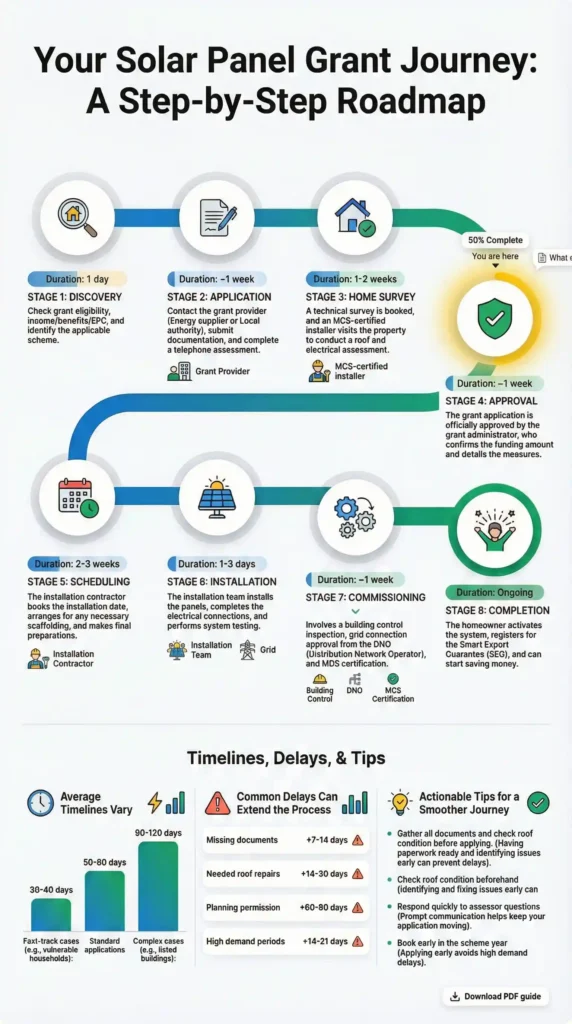
Grant application procedures vary between schemes but follow common patterns requiring documentation, property assessments, and supplier coordination. Understanding each stage helps applicants prepare materials and avoid delays.
Initial Eligibility Assessment and Documentation
Application processes begin with eligibility self-assessment using online checkers or telephone consultations with scheme administrators. Applicants confirm benefit receipt, income levels, property ownership status, and approximate Energy Performance Certificate ratings.
Required documentation typically includes:
- Recent utility bills (last 3 months)
- Benefit award letters or income evidence
- Property ownership documents or landlord permission letters
- Current Energy Performance Certificate (if available)
- Photo identification (passport or driving licence)
- Bank statements (last 3 months for income verification)
Gathering complete documentation before application reduces processing delays and follow-up requests. Missing documents pause applications until applicants provide outstanding items.
Energy Supplier ECO4 Application Steps
ECO4 applications proceed through energy suppliers obligated to deliver efficiency measures. Households identify participating suppliers through government listings or contact their current energy provider to confirm ECO4 programme participation.
Application steps follow this sequence:
- Initial contact with supplier or intermediary installer
- Basic eligibility screening via telephone or online form
- Documentation submission (benefits, income, property details)
- Property survey scheduling and home assessment
- Technical report preparation identifying eligible measures
- Grant offer letter detailing approved work and any household contributions
- Installation scheduling and date confirmation
Survey appointments typically occur 1-3 weeks after application approval. Installers assess roof condition, electrical systems, shading factors, and optimal panel placement during 1-2 hour visits. Survey findings determine final system specifications and grant amounts.
Installation schedules vary between 4-12 weeks after survey completion depending on supplier capacity and material availability. Some suppliers prioritise vulnerable households with health conditions or fuel poverty indicators.
Warm Homes Plan Local Authority Application Route
Warm Homes Plan applications proceed through local council retrofit programmes coordinated under Great British Insulation Scheme frameworks. Homeowners access applications via gov.uk eligibility checkers directing them to their local authority contact points.
Grant-funded installations follow the same technical procedures as privately funded projects, ensuring MCS certification and building regulation compliance. Homeowners should understand what happens during installation day, from scaffolding erection through final commissioning. Our comprehensive guide to the solar panel installation process explains each stage including roof preparation, electrical connections, and DNO grid approval requirements.
Local authorities conduct whole-house retrofit assessments examining insulation, heating systems, glazing quality, and renewable energy opportunities. Assessments generate recommendations prioritising measures delivering maximum energy savings per pound invested.
Approved applicants receive installation timelines spanning 8-16 weeks from assessment to completion. Complex projects involving multiple measures extend beyond simple solar installations, particularly when structural work or heating system replacements occur simultaneously.
Wales Nest and Scotland Home Energy Applications
Welsh residents apply to Nest via dedicated telephone service (0808 808 2244) operating Monday-Friday 8am-6pm. Telephone advisors conduct initial eligibility assessments, then arrange home visits for detailed property surveys.
Nest processes applications holistically, evaluating fuel poverty risk alongside technical retrofit opportunities. Advisors discuss household energy usage patterns, financial circumstances, and health vulnerabilities during consultations, building comprehensive pictures of applicant needs.
Scottish applications begin through Home Energy Scotland’s advice line (0808 808 2282) where advisors explain grant and loan options. Approved applicants receive referrals to accredited installers from approved supplier networks. Installation schedules depend on individual installer capacity rather than centralised programme management.
What Property Characteristics Affect Solar Grant Eligibility?
Property suitability extends beyond energy efficiency ratings, encompassing roof characteristics, electrical infrastructure, and planning permissions. Understanding physical requirements prevents application rejections and installation delays.
Roof Suitability Assessment Criteria
Solar panel installations require structurally sound roofs with adequate load-bearing capacity, appropriate orientation, and sufficient unshaded area. Pitched roofs facing south, southwest, or southeast deliver optimal generation, though east and west-facing installations remain viable with slightly reduced output.
Roof pitch angles between 15-50 degrees suit standard panel mounting systems. Flat roofs require specialist frames elevating panels to optimal angles, increasing installation complexity and costs. Some grant programmes apply stricter criteria to flat roof applications, though most schemes approve suitable systems.
Roof age and condition affect eligibility, with installations requiring replacement or major repairs within 5 years often deferred until roof work completes. Fragile materials including some slate, tile, or asbestos cement roofs need specialist assessment before approving panel installations.
Available roof area determines maximum system size. Each kilowatt capacity requires approximately 6-8 square metres of unshaded roof space. A 4kW system needs 24-32 square metres, while 6kW installations demand 36-48 square metres.
Shading Impact and Energy Generation Predictions
Shading from trees, chimneys, neighbouring buildings, or other obstructions reduces solar generation significantly. Surveys assess shading patterns throughout the year, calculating percentage losses from intermittent shadows crossing panel areas.
Properties with 30% or greater shading typically receive lower grant priorities or fail eligibility assessments entirely. Moderate shading between 10-30% prompts recommendations for panel placement optimisation or micro-inverter technologies minimising shading impacts.
Solar generation predictions incorporate shading analysis, roof orientation, property location, and historical weather patterns. Installers provide estimated annual generation figures in kilowatt-hours, forming the basis for financial savings projections and grant value calculations.
Households in northern Scotland receive lower generation predictions than southern England properties due to reduced annual sunshine hours. Grant amounts sometimes adjust for regional generation variations, ensuring equitable support across geographic areas.
Electrical System Adequacy Requirements
Solar installations require electrical systems meeting current wiring regulations with adequate capacity for additional generation equipment. Properties with outdated fuse boxes, insufficient earthing, or aluminium wiring need electrical upgrades before solar installation proceeds.
Consumer units must accommodate additional circuit breakers for solar inverters and battery systems. Older 4-way or 6-way consumer units often require replacement with modern 12-way or 16-way units providing space for solar equipment integration.
Grid connection applications submitted to Distribution Network Operators assess whether local electricity networks accommodate additional solar generation. Most residential systems below 4kW receive automatic approval, while larger installations need network capacity evaluations.
Listed Buildings and Conservation Area Restrictions
Listed buildings face additional planning consent requirements for solar installations. Grade I and Grade II* listed properties need Listed Building Consent from local planning authorities before proceeding, examining heritage impact and visual sensitivity.
Conservation areas impose design restrictions limiting panel visibility from public viewpoints. Some authorities require panels positioned on rear roof slopes invisible from streets, reducing available installation area and system capacity.
Permitted development rights allowing solar installations without planning permission exclude many heritage properties. Applicants should verify requirements with local planning departments before applying for grants, avoiding wasted effort on ineligible properties.
How Do Solar Panel Grants Reduce Energy Bills Long-Term?
Grant-funded solar installations deliver substantial long-term financial benefits through reduced electricity purchases, export payments, and protection from future energy price increases. Understanding realistic savings helps households evaluate programme value.
Annual Electricity Savings by System Size
Solar panels reduce household electricity bills by generating free power during daylight hours. Typical UK households consume 40-60% of solar generation directly, with remaining output exported to the grid or stored in batteries.
| System Size | Annual Generation | Self-Consumption | Annual Bill Saving | Annual Export Income | Total Annual Benefit |
|---|---|---|---|---|---|
| 3kW | 2,700 kWh | 1,080 kWh | £290-£350 | £65-£95 | £355-£445 |
| 4kW | 3,600 kWh | 1,440 kWh | £385-£465 | £85-£125 | £470-£590 |
| 5kW | 4,500 kWh | 1,800 kWh | £485-£580 | £105-£155 | £590-£735 |
| 6kW | 5,400 kWh | 2,160 kWh | £580-£695 | £130-£190 | £710-£885 |
Savings calculations assume average UK generation rates and household consumption patterns. Actual benefits vary based on occupancy patterns, appliance usage timing, and seasonal generation fluctuations.
Smart Export Guarantee Income Projections
Smart Export Guarantee payments provide ongoing income from surplus generation exported to the national grid. Export volumes depend on household consumption patterns, with daytime-empty properties exporting 60-70% of generation versus 30-40% for occupied homes.
A 4kW system generating 3,600 kWh annually exports approximately 2,160 kWh in unoccupied households, creating £108-£324 annual income at 5p-15p per kWh rates. Battery storage systems reduce exports by storing daytime generation for evening consumption, lowering export income but increasing self-consumption savings.
Households should compare Smart Export Guarantee tariffs across multiple suppliers selecting rates maximising combined savings and export income. Switching energy suppliers after solar installation remains possible, with new providers honouring export agreements.
Lifetime Cost Savings Over 25 Years
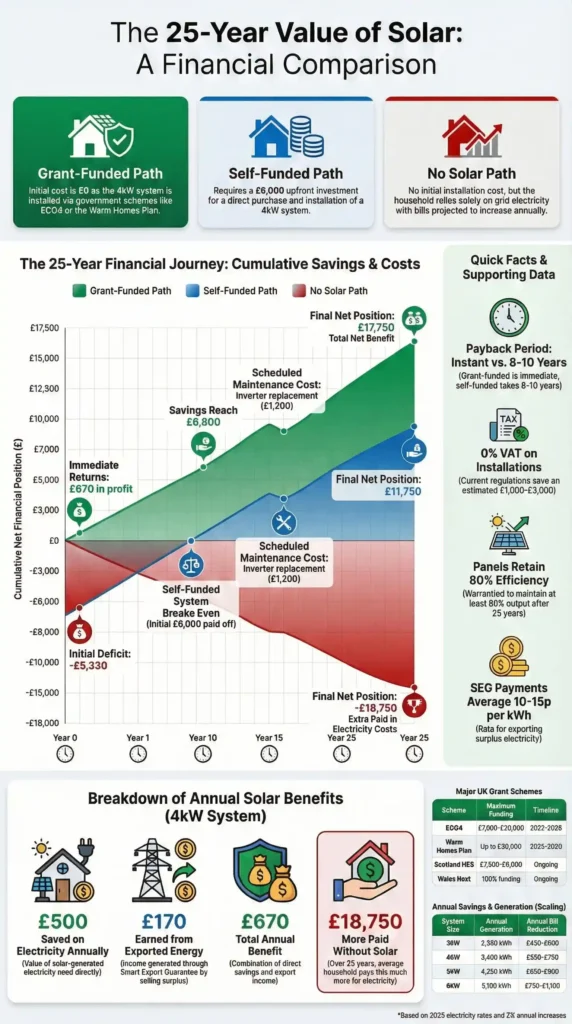
Solar panel systems operate effectively for 25-30 years with minimal maintenance requirements. Cumulative savings over system lifetimes substantially exceed initial installation costs, particularly for grant-funded installations requiring minimal household contributions.
| Cost/Saving Category | Amount |
|---|---|
| Total Installation Cost | £8500 |
| ECO4 Grant Funding | -£9000 |
| Net Household Cost | £0 (fully funded) |
| Annual Electricity Savings | £450 |
| Annual Export Income | £100 |
| Total Annual Benefit | £550 |
| 25-Year Total Savings | £13750 |
| Inflation-Adjusted Savings | £17750 |
| Net Lifetime Benefit | £17750 |
Projections assume 3% annual electricity price inflation and static export rates. Actual savings increase when energy costs rise faster than projected, as occurred during 2022-2023 when prices doubled within 12 months.
Energy Independence and Price Protection Benefits
Solar installations provide partial energy independence, reducing exposure to electricity price volatility and supply disruptions. Households generating 50-70% of annual consumption requirements depend less on grid supplies and energy market fluctuations.
Battery storage systems enhance independence, enabling households to operate essential appliances during power cuts when inverters include backup functionality. Off-grid capability becomes increasingly valuable as climate change increases extreme weather frequency and grid stress events.
Fixed solar generation costs contrast with variable grid electricity prices subject to wholesale market volatility, geopolitical events, and policy changes. Households with solar systems lock in predictable energy costs for 25-30 year periods, creating long-term budget certainty.
What Are Alternative Solar Funding Routes Beyond Grants?
Households earning above grant qualifying thresholds still access solar installations through various financing mechanisms. Interest-free loans, subscription models, and Solar Together group-buying schemes reduce upfront costs without requiring benefit receipt or low EPC ratings. Explore our alternative solar panel funding options including green mortgages, payment plans, and community solar cooperatives available across the UK market.
Interest-Free Solar Panel Loans
Several organisations provide interest-free loans specifically for renewable energy installations, eliminating borrowing costs while spreading payments across manageable terms. The Energy Saving Trust administers interest-free loan schemes in Scotland reaching £7,500 with 5-10 year repayment periods.
Local authorities operate regional loan programmes with varying terms, availability, and eligibility criteria. Some councils restrict loans to properties meeting minimum energy efficiency standards, while others provide universal access regardless of current EPC ratings.
Interest-free terms deliver substantial savings compared to commercial loans charging 8-15% annual interest. A £10,000 commercial loan at 10% interest costs £13,200 total over 10 years versus £10,000 for equivalent interest-free financing, saving £3,200.
Solar Panel Subscription and Rental Models
Subscription models eliminate upfront installation costs entirely, with households paying monthly fees for solar panel usage rather than purchasing systems outright. Providers retain equipment ownership, handling maintenance, insurance, and replacements throughout contract periods.
Companies including Sunsave and OVO Energy operate solar subscription schemes charging £50-£100 monthly depending on system size. Subscribers receive electricity generation benefits while providers recover installation costs plus profit margins over 20-25 year contracts.
Subscription agreements transfer to new property owners if households move, maintaining contract obligations throughout terms. Early termination typically requires buyout payments covering remaining contract value, creating financial penalties for cancellation.
Crowdfunding and Community Solar Projects
Community solar cooperatives pool resources from multiple households funding shared installations on community buildings, schools, or commercial properties. Members receive dividend payments from electricity sales or reduced energy costs through preferential supply agreements.
Energise Barnsley, Brighton Energy Coop, and Plymouth Energy Community operate successful community solar models across England. Investment minimums typically start at £100-£250, making participation accessible to households unable to afford full residential installations.
Returns vary between 3-7% annually depending on project performance and electricity sale agreements. Community projects provide social benefits beyond financial returns, supporting local renewable generation and climate action goals.
Employer and Workplace Solar Schemes
Some employers offer salary sacrifice schemes enabling employees to fund home solar installations through pre-tax payroll deductions. Sacrifice arrangements reduce income tax and National Insurance contributions, creating effective discounts on total system costs.
Self-funding represents the fastest route to solar installation for households with available capital or access to home improvement loans. Direct purchase eliminates grant application waiting periods and eligibility assessments, allowing immediate project commencement. Higher-income households often prefer outright ownership for maximum long-term value. Our comprehensive guide to buying solar panels directly compares equipment suppliers, installer selection criteria, and wholesale purchasing options across the UK market.
Workplace installation programmes coordinate group purchases for employee homes, leveraging bulk buying power to negotiate discounted supplier rates. Employers handle administration and quality assurance, simplifying selection processes for participating staff.
Salary sacrifice schemes require employer participation and operate within IR35 regulations governing benefit arrangements. Availability remains limited compared to individual purchase or loan routes.
What Common Mistakes Prevent Solar Grant Applications Succeeding?
Application errors cause unnecessary delays, rejections, and missed funding opportunities. Understanding frequent mistakes helps households avoid common pitfalls and secure approvals efficiently.
Incomplete or Inaccurate Documentation
Missing documents represent the most common application failure point. Applicants frequently submit incomplete benefit letters, outdated bank statements, or unsigned landlord permission forms, triggering requests for resubmission and extending processing times.
Common documentation errors include:
- Providing photocopies instead of original documents when required
- Submitting benefit letters older than 3 months
- Failing to include all household income sources for verification
- Missing signature fields on permission forms or declarations
- Illegible scans or photographs of required documents
Applicants should verify document requirements before submission, ensuring all items meet specified formats, dates, and quality standards. Creating checklists prevents overlooked requirements.
Property Characteristics Overlooked During Eligibility Checks
Households often apply without considering roof suitability, shading limitations, or electrical system requirements. Applications progress through initial eligibility screening only to fail during technical surveys, wasting time and creating disappointment.
Pre-application property assessments identify potential barriers before formal submissions. Homeowners should evaluate:
- Roof age and structural condition
- Shading from trees or buildings throughout the day
- Available unshaded roof area
- Consumer unit capacity for additional circuits
- Planning restrictions in conservation areas
Addressing identified issues before applying improves success rates. Tree trimming, electrical upgrades, or planning permission applications completed in advance prevent survey failures.
Timing Issues and Programme Capacity Limits
Grant programmes operate with annual or periodic capacity limits, closing applications when funding allocates entirely. Late-year applications often face depleted budgets or extended waiting lists as schemes approach capacity constraints.
ECO4 allocation to suppliers refreshes annually, with some providers exhausting annual budgets by autumn. Applications submitted January-June typically process faster than those lodged September-December when supplier capacity tightens.
Warm Homes Plan local authority programmes operate in waves, with some councils pausing applications between funding tranches. Monitoring local authority announcements and applying early during open periods improves approval chances.
Misunderstanding Eligibility Flexibility
Applicants often assume rigid eligibility criteria disqualify them without exploring Local Authority Flex provisions or borderline case assessments. Self-excluding based on incomplete understanding causes missed opportunities for households potentially qualifying through flexibility mechanisms.
Households earning slightly above income thresholds should contact local authorities directly discussing circumstances rather than abandoning applications. Councils evaluate individual situations considering regional cost variations, medical needs, and household composition.
Multiple application routes exist for most households. Families ineligible for ECO4 may qualify for Warm Homes Plan, Solar Together, or regional schemes operating different criteria. Exploring all options before concluding ineligibility prevents unnecessarily missed funding.
How Do Solar Grants Integrate with Other Home Improvements?
Combining solar installations with complementary energy efficiency measures maximises grant funding, enhances property performance, and delivers superior long-term savings compared to isolated improvements.
Combined Insulation and Solar Funding Packages
Grant programmes prioritise holistic retrofit approaches addressing insulation alongside renewable generation. Properties with poor baseline insulation waste solar generation gains through excessive heat loss, reducing overall efficiency improvements.
ECO4 and Warm Homes Plan actively encourage combined measure packages, often increasing grant allocations when applicants accept insulation alongside solar panels. A household qualifying for £9,000 solar funding may access £15,000-£18,000 when adding loft insulation, cavity wall insulation, and air sealing.
Insulation-first strategies deliver immediate benefits reducing heating demand before solar generation commences. Properties achieving good thermal performance (EPC rating C or above) maximise solar contribution percentages, as reduced overall consumption allows solar generation to cover larger proportions of remaining needs.
Heat Pump and Solar Panel Combination Benefits
Heat pumps powered by solar generation create highly efficient heating systems with minimal grid electricity dependency. Warm Homes Plan specifically funds heat pump and solar combinations, recognising synergistic benefits from coordinated installations.
Air source heat pumps consume approximately 8,000-12,000 kWh annually heating typical UK homes. A 6kW solar system generating 5,400 kWh annually covers 45-67% of heat pump electricity needs, substantially reducing operational costs.
Grant funding reaches £30,000 for combined solar and heat pump projects under Warm Homes Plan provisions. This comprehensive support enables complete heating decarbonisation while minimising household contributions.
Battery storage enhances solar-heat pump combinations by storing daytime generation for evening heating demand periods. Batteries prevent grid purchases during peak tariff times, maximising financial benefits from renewable integration.
Battery Storage Addition to Solar Installations
Warm Homes Plan grants specifically fund battery installations alongside solar panels, recognising storage systems double typical self-consumption rates from 40% to 80%. Battery capacity ranging from 5kWh to 13kWh determines how much daytime solar generation stores for evening usage. Before selecting battery size and brand, review detailed information on solar battery storage costs and specifications comparing leading manufacturers and capacity options available in 2026.
Batteries increase solar self-consumption from typical 40% levels to 70-85%, capturing morning and midday generation for evening consumption peaks. This shift dramatically improves bill savings and reduces grid dependency.
Battery costs range from £3,000 for 5kWh systems to £8,000 for 13kWh units. Grant programmes covering battery additions provide £2,500-£5,000 toward storage costs, reducing household contributions to manageable levels.
Time-of-use tariffs enhance battery value by enabling charging during cheap overnight periods supplementing solar charging. Batteries charged at 7p per kWh overnight rates discharge during 30p peak periods, creating additional arbitrage savings beyond solar storage benefits.
What Happens After Solar Panel Grant Approval?
Post-approval processes involve installation scheduling, system commissioning, and ongoing monitoring ensuring grant compliance and optimal performance.
Installation Timeline and Process Stages
Typical installation timelines span 1-3 days for residential systems depending on size and complexity. Installers follow structured processes ensuring safety, quality, and regulatory compliance.
Standard Installation Sequence:
- Scaffolding erection (if required) – Day 0 or Day 1 morning
- Roof preparation and mounting rail installation – Day 1
- Solar panel physical mounting – Day 1-2
- Electrical connections and inverter installation – Day 2
- Consumer unit modifications and circuit integration – Day 2
- System commissioning and testing – Day 2-3
- Scaffolding removal – Day 3 or Day 4
- Completion paperwork and handover – Day 3
Simple installations on accessible single-storey properties sometimes complete within a single day. Complex projects involving battery storage, difficult access, or electrical upgrades extend to 3-5 days.
Installers coordinate with Distribution Network Operators for grid connection approvals, though most residential systems receive automatic clearance. Properties in rural areas with weak grid infrastructure may face connection delays or network reinforcement requirements.
System Commissioning and Performance Verification
Commissioning involves testing all system components, verifying safe operation, and configuring monitoring equipment. Installers measure actual generation against predicted outputs, checking panel orientation, shading impacts, and electrical connections.
MCS-certified installers provide commissioning certificates documenting:
- System specifications and component serial numbers
- Generation capacity and predicted annual output
- Electrical test results and safety verifications
- Installation completion date for warranty commencement
- Homeowner training on system operation and monitoring
Homeowners receive instruction on monitoring apps or hardware displaying real-time generation, consumption, and export data. Understanding system performance helps identify faults or efficiency issues requiring attention.
Ongoing Maintenance Requirements
Solar systems require minimal upkeep beyond periodic inspections and cleaning. Panel efficiency gradually declines when dirt, bird droppings, or leaf debris accumulates on surfaces, reducing generation by 5-15% in some cases. Proper cleaning frequency depends on local environmental conditions and property location. Learn professional techniques and recommended schedules in our guide to solar panel cleaning and maintenance including DIY methods and professional service costs.
Annual inspections check electrical connections, mounting integrity, and inverter operation. Most installers offer maintenance contracts providing yearly service visits for £100-£200, though many households manage basic upkeep independently.
Inverters typically require replacement after 10-15 years, costing £800-£1,500 depending on system size and inverter type. Panels themselves last 25-30 years with gradual efficiency degradation of 0.5-0.8% annually.
Grant Scheme Monitoring and Compliance
Grant programmes require ongoing monitoring ensuring installations perform as specified and households maintain systems appropriately. ECO4 conducts random compliance checks including technical inspections and occupancy verifications.
Homeowners must retain installations for minimum periods, typically 5 years, without removal or significant modification. Early system removal may trigger grant repayment requirements depending on scheme terms.
Some programmes require annual generation reporting to verify environmental benefits and measure scheme effectiveness. Monitoring obligations vary between programmes, with specific requirements detailed in grant approval documentation.
What Regional Variations Exist in Solar Grant Availability?
Solar grant access varies significantly across the UK with distinct programmes, eligibility criteria, and funding levels in England, Scotland, Wales, and Northern Ireland.
England Local Authority Programme Differences
English households access solar grants primarily through ECO4 and Warm Homes Plan, both operating nationally with local authority delivery partnerships. However, implementation approaches vary substantially between councils.
Birmingham City Council operates a dedicated retrofit team coordinating multiple grant streams with centralised application portals. Manchester City Council partners with community organisations delivering grants through trusted local intermediaries. Rural authorities in Cornwall and Devon emphasise off-grid properties where solar delivers maximum independence benefits.
Local Authority Flex criteria vary regionally. London boroughs tend toward stricter income verification reflecting higher costs-of-living, while northern authorities emphasise fuel poverty indicators and health conditions. Applicants should research their specific council’s approach rather than assuming national standardisation.
Scotland’s Distinct Funding Landscape
Scotland operates separate schemes independent of English programmes. Home Energy Scotland provides the primary grant and loan route, with distinct eligibility rules and application processes from ECO4.
Scottish grants prioritise rural properties through enhanced rural uplift provisions recognising heating oil dependency and fuel poverty risks in remote areas. Island communities including Orkney, Shetland, and Western Isles receive priority treatment reflecting extreme costs and limited alternative energy sources.
The temporary pause on Home Energy Scotland solar referrals from June 2024 affects new applicants but existing approvals continue processing. Scottish Government announcements indicate programme reviews aim to increase capacity and expand eligibility when funding allocations finalise.
Wales Nest Scheme Unique Provisions
Wales’s Nest Scheme operates distinct qualification criteria from English and Scottish programmes, evaluating fuel poverty risk holistically rather than rigid income thresholds. This approach captures vulnerable households narrowly missing standard benefit categories.
Nest provides completely free installations without household contributions, contrasting with ECO4’s occasional cost-sharing requirements. The absence of upfront payments removes barriers for Wales’s lowest-income families.
Welsh language services operate throughout Nest application and installation processes, with bilingual documentation and Welsh-speaking advisors available. This provision ensures accessibility for Welsh-speaking households particularly in rural mid and northwest Wales.
Northern Ireland’s Limited Direct Grant Options
Northern Ireland lacks equivalent solar grant programmes to Great Britain schemes. The absence of ECO4 extension to Northern Ireland creates substantial funding gaps for households seeking renewable installations.
Some energy suppliers operate voluntary energy efficiency schemes in Northern Ireland, though participation and scope remain limited compared to mainland obligations. Applicants should contact suppliers directly inquiring about available support.
Northern Ireland Housing Executive administers limited grant schemes for social housing and low-income homeowners, though solar panels rarely feature as funded measures. Renewable heat initiatives dominate Northern Ireland energy programmes, with solar generation receiving lower policy priority.
How Will Future Policy Changes Affect Solar Grant Access?
Solar grant programmes evolve continuously responding to policy priorities, budget allocations, and renewable energy targets. Understanding expected developments helps households plan timing and application strategies.
2027 Future Homes Standard Impact
The Future Homes Standard implementing from 2027 requires all new-build homes to include renewable heating and high-efficiency specifications. This policy drives increased solar installation capacity and supply chain development, potentially reducing equipment costs and installation prices.
Falling installation costs benefit grant programmes by stretching fixed budgets across more installations. ECO4 successors may fund larger systems or additional households as market prices decline through scale and competition.
The standard excludes existing homes, though retrofit policies will likely tighten in parallel. Anticipated Energy Performance Certificate regulations may require rental properties achieve minimum EPC C ratings by 2030, creating solar installation demand among landlord populations.
Warm Homes Plan 2028 Extension Prospects
Current Warm Homes Plan funding runs through 2030, though policy reviews in 2027-2028 will determine extension prospects and budget allocations. Early indications suggest continuation recognising the substantial backlog of inefficient homes requiring retrofits.
Potential expansions could increase maximum grant amounts, broaden eligibility thresholds, or prioritise specific improvement types including battery storage and heat pumps. Programme reviews will assess delivery effectiveness, identifying successful approaches for scaling.
Political factors influence programme continuity, with different parties holding varying positions on public investment scales. Households considering applications should avoid excessive delay hoping for improved future terms, as funding availability remains uncertain beyond current commitment periods.
Potential New Grant Programmes Under Development
Industry stakeholders advocate for dedicated solar grant programmes separate from broader energy efficiency schemes. Standalone solar funding would simplify applications and recognise renewable generation’s distinct benefits beyond thermal improvements.
Scotland’s programme review may introduce new grant structures replacing or supplementing Home Energy Scotland provisions. Welsh Government consultations examine Nest expansion potentially increasing budget allocations and eligible household numbers.
Commercial and community solar grant programmes remain underdeveloped compared to residential schemes. Future initiatives may support larger installations on business premises, farms, or community buildings addressing gaps in current funding landscapes.
Frequently Asked Questions About Solar Panel Grants
Do I Qualify for Free Solar Panels if I Own My Home?
Homeowners qualify for free solar panel grants when meeting income thresholds, receiving qualifying benefits, or demonstrating energy vulnerability through Local Authority Flex provisions. Property ownership simplifies applications by eliminating landlord permission requirements.
ECO4 schemes require properties hold Energy Performance Certificate ratings between D and G, though most grant programmes accept applications from any EPC level when households meet financial criteria. Contact your energy supplier or local authority for initial eligibility assessments confirming your specific circumstances.
How Long Does the Solar Panel Grant Application Process Take?
Application timelines vary between 6-16 weeks from initial submission through installation completion. ECO4 applications through energy suppliers typically process within 8-12 weeks including property surveys and installation scheduling.
Warm Homes Plan applications involve retrofit assessments adding 2-4 weeks to timelines before installation quotations. Complex projects requiring multiple measures extend beyond simple solar installations. Wales Nest applications average 10-14 weeks, while Scotland Home Energy processes currently experience delays due to capacity reviews.
Will Solar Panel Grants Cover Battery Storage Too?
Warm Homes Plan explicitly funds battery storage alongside solar panel installations, recognising storage systems enhance self-consumption and maximise bill savings. Grant amounts for combined solar-plus-battery projects range from £12,000 to £18,000 depending on system specifications.
ECO4 grants sometimes include battery funding when suppliers identify storage as beneficial for energy efficiency targets. However, battery coverage remains less consistent than under Warm Homes Plan. Applicants should confirm battery inclusion during initial discussions with suppliers or local authorities.
What Happens if My Application Gets Rejected?
Rejected applications trigger appeal processes or alternative application routes. ECO4 rejections sometimes result from administrative errors, incomplete documentation, or technical survey failures rather than fundamental ineligibility.
Applicants should request detailed rejection explanations identifying specific issues preventing approval. Many rejections resolve through providing additional documentation, correcting property characteristics, or reapplying through different schemes or suppliers.
Local Authority Flex provisions offer reconsideration routes for borderline cases initially rejected under standard criteria. Contacting council energy teams directly explains circumstances potentially qualifying under flexibility mechanisms.
Do I Need Planning Permission for Grant-Funded Solar Panels?
Most residential solar installations proceed under permitted development rights without requiring planning applications. Panels installed on pitched roofs facing away from highways typically qualify for automatic permission.
Listed buildings, conservation areas, and certain roof configurations need planning consent before installation. Grant-funded and self-funded installations follow identical planning requirements, with grant programmes unable to bypass local authority restrictions.
Applicants should verify planning requirements with local authorities before applying for grants, avoiding wasted effort on ultimately prohibited installations. Installers typically advise on planning needs during initial property assessments.
How Much Will I Actually Save on Energy Bills?
Average UK households save £450-£650 annually from 4kW solar systems combining reduced electricity purchases with Smart Export Guarantee income. Savings vary based on household consumption patterns, occupancy during daytime, and regional generation rates.
Northern locations receive 10-15% lower generation than southern England properties due to reduced sunshine hours, affecting total savings proportionally. Battery storage systems increase savings by 30-50% through enhanced self-consumption, raising annual benefits to £600-£900 for typical households.
Inflation affects future savings, as rising electricity prices increase the value of solar generation over system lifetimes. Twenty-five year savings projections range from £11,000 to £22,000 depending on system size and energy cost trends.
Will Free Solar Panels Affect My Property Value?
Solar installations typically increase property values by 2-5% reflecting reduced running costs and improved Energy Performance Certificate ratings. Properties with EPC ratings A or B command premium prices in competitive markets.
Grant-funded installations deliver identical value impacts as self-funded systems, as property valuations assess installed equipment rather than funding sources. Buyer surveys frequently highlight solar panels as desirable features reducing long-term ownership costs.
Some buyers express concerns about remaining obligations on grant-funded systems, particularly where monitoring or maintenance requirements transfer to new owners. Clear documentation explaining grant terms during property sales prevents transaction complications.
Do Solar Panel Grants Require Repayment?
ECO4, Warm Homes Plan, Nest, and Home Energy Scotland grants require no repayment when households meet terms including minimum retention periods and compliance with installation standards. Grants operate as public investments in energy efficiency rather than loans.
Early system removal within 5-year minimum periods may trigger repayment requirements recovering public investment. However, normal household moves or unforeseen circumstances rarely invoke these provisions. Installations remaining throughout minimum periods incur zero repayment obligations.
Will My Energy Bills Go to Zero with Free Solar Panels?
Solar panels substantially reduce electricity bills but rarely eliminate costs entirely without battery storage and demand management. Typical 4kW systems generate 3,600 kWh annually while average households consume 2,900-3,800 kWh, creating close matches but not complete coverage.
Seasonal variations mean summer generation substantially exceeds consumption while winter output falls short of needs. Standing charges for grid connections typically cost £250-£350 annually even when consumption approaches zero.
Battery storage systems combined with consumption timing adjustments enable near-zero bills during summer months. However, most households continue drawing grid power during winter evenings and extended cloudy periods, maintaining £100-£400 annual bills.
How Do I Choose Between Different Grant Programmes?
Households qualifying for multiple programmes should compare total costs, installation timelines, and system specifications before selecting routes. ECO4 typically delivers faster installations than Warm Homes Plan’s comprehensive retrofit assessments.
Warm Homes Plan provides larger maximum grants particularly for combined measure packages including insulation and heating upgrades. Households needing whole-house improvements benefit from integrated assessments, while those requiring only solar panels may prefer ECO4’s streamlined approach.
Wales and Scotland residents access region-specific schemes operating distinct criteria from English programmes. Geographic location often determines available options, with some households accessing only one scheme rather than choosing between multiple routes.
Top 14 Solar Panel Installers in Birmingham
- September 26, 2025