

Solar panel installation cost: a practical UK guide
Understanding solar panel installation costs helps you budget accurately, compare installer quotes and avoid hidden expenses. This guide breaks down complete pricing for UK installations including labour, equipment, scaffolding and regional variations. You will learn typical costs by system size, identify hidden expenses, calculate payback periods and recognise fair quotes from inflated pricing.
Table of Contents
ToggleHow much does solar panel installation cost in the UK?
Complete solar panel installation costs £5,500-£8,500 for a typical 4kW residential system in 2026. This includes panels (£2,000-£3,000), inverter (£800-£1,500), mounting equipment (£400-£600), labour (£1,600-£2,400), scaffolding (£400-£800) and electrical work (£300-£600). Regional variations add or subtract 15-25% with London installations costing most. Systems with battery storage increase total costs by £3,500-£6,000.
Complete Cost Breakdown for Standard 4kW System
Labour costs represent 25-35% of total installation expenses at £1,600-£2,400 for standard two-storey properties. Two qualified installers working 1.5-2 days complete mounting, wiring and commissioning. Equipment costs include solar panels (£2,000-£3,000 for 10-12 panels), string inverter (£800-£1,500), mounting rails and brackets (£400-£600) and electrical components (£200-£400).
Knowing complete solar system costs including equipment helps you verify whether quoted prices represent fair value for specified components and quality tiers.
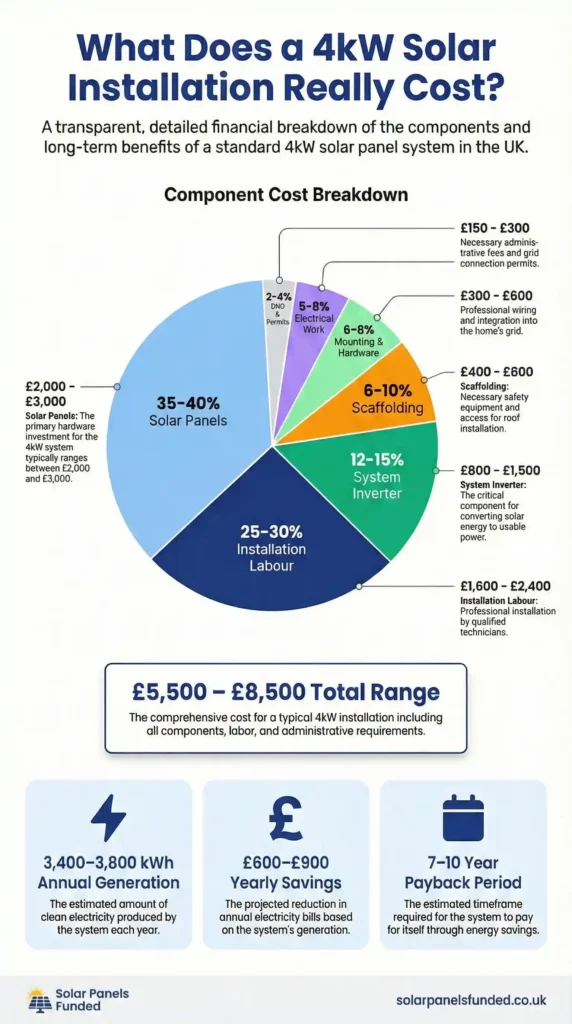
Scaffolding hire for 1-2 weeks costs £400-£800 for standard access. Three-storey properties or difficult access increase scaffolding to £600-£1,200. Electrical work including consumer unit connections, isolators and generation meters costs £300-£600. DNO (Distribution Network Operator) applications for systems exceeding 3.68kW add £150-£300.
| System Size | Panel Cost | Inverter Cost | Mounting Equipment | Labour Cost | Scaffolding | Electrical Work | DNO Application | Total Equipment | Total Labour/Installation | Complete Cost Range | Cost per kW | Annual Generation (kWh) |
|---|---|---|---|---|---|---|---|---|---|---|---|---|
| 3kW | £1,500-£2,200 | £600-£1,000 | £300-£500 | £1,200-£1,800 | £400-£600 | £200-£400 | £0-£150 | £2,600-£4,250 | £1,800-£2,950 | £5,000-£7,000 | £1,667-£2,333/kW | 2,550-2,850 |
| 4kW | £2,000-£3,000 | £800-£1,500 | £400-£600 | £1,600-£2,400 | £400-£800 | £300-£600 | £150-£300 | £3,550-£6,200 | £2,450-£4,100 | £5,500-£8,500 | £1,375-£2,125/kW | 3,400-£3,800 |
| 5kW | £2,500-£3,500 | £1,000-£1,800 | £450-£650 | £2,000-£2,600 | £500-£800 | £300-£600 | £150-£300 | £4,600-£7,150 | £2,950-£4,300 | £6,500-£9,500 | £1,300-£1,900/kW | 4,250-4,750 |
| 6kW | £3,000-£4,000 | £1,200-£2,000 | £500-£700 | £2,400-£3,000 | £600-£1,000 | £400-£700 | £150-£300 | £5,850-£8,700 | £3,550-£5,000 | £8,000-£11,000 | £1,333-£1,833/kW | 5,100-5,700 |
| 8kW | £3,800-£5,200 | £1,600-£2,600 | £600-£900 | £3,000-£3,800 | £600-£1,200 | £500-£800 | £150-£300 | £7,450-£11,000 | £4,250-£6,100 | £10,000-£13,500 | £1,250-£1,688/kW | 6,800-7,600 |
| 10kW | £4,500-£6,000 | £2,000-£3,200 | £700-£1,000 | £3,600-£4,600 | £800-£1,400 | £600-£1,000 | £150-£300 | £8,750-£12,900 | £5,150-£7,300 | £12,000-£16,000 | £1,200-£1,600/kW | 8,500-9,500 |
Cost Variations by Panel Quality and Brand
Budget panels from manufacturers like Trina Solar or JA Solar cost £150-£200 per panel (400W) totaling £1,800-£2,400 for 4kW systems. Mid-range panels from LONGi, Jinko or Canadian Solar cost £180-£250 per panel reaching £2,200-£3,000 for complete systems. Premium panels from REC, SunPower or LG cost £250-£350 per panel totaling £3,000-£4,200 for high-efficiency installations.
Higher efficiency panels reduce the number required for target output. A 4kW system needs 10-11 premium 400W panels versus 12-14 budget 300W panels. Premium panels typically carry 25-30 year product warranties versus 10-15 years for budget options. Performance warranties guarantee 85-92% output after 25 years depending on tier.
Inverter Costs and Technology Choices
String inverters for 4kW systems cost £800-£1,500 with 5-10 year warranties. Brands like Growatt, Solis and GivEnergy offer competitive pricing for residential installations. Microinverters from Enphase cost £1,500-£2,500 for complete 4kW systems but include 15-25 year warranties and panel-level optimization.
Hybrid inverters with battery compatibility cost £1,200-£2,000 for 4kW systems. These enable future battery additions without replacing inverters. Power optimizers combined with string inverters cost £1,000-£1,800 providing individual panel monitoring at lower prices than microinverters.
Labour and Installation Timeframes
Installer hourly rates range £25-£45 depending on experience and location. Southeast England rates reach £35-£50 per hour versus £25-£35 in Northern regions. Two installers working 12-16 hours complete standard 4kW installations. Complex roofs, multiple aspects or difficult access extend timeframes to 20-24 hours increasing labour costs.
Installation day one covers scaffolding, mounting rail installation and panel positioning. Day two includes wiring, inverter connection, electrical testing and commissioning. Single-storey bungalows or ground-mounted systems may complete in one full day reducing labour costs by £200-£400.
What factors increase solar installation costs?
Roof complexity increases installation costs by 15-40% through additional labour time, specialized mounting equipment and structural assessments. Multi-aspect installations across east and west-facing roofs require split arrays with separate string wiring. Steep roof pitches above 40 degrees need extra safety equipment and slower working speeds. Listed buildings or conservation areas require planning permission adding £500-£1,500 professional fees.
| Installation Type | Installer Count | Installation Days | Hourly Rate | Total Labour Hours | Standard Labour Cost | Complexity Premium | Total Labour (Simple) | Total Labour (Complex) | Main Complexity Factors | Additional Time Requirements |
|---|---|---|---|---|---|---|---|---|---|---|
| Simple Bungalow (3kW) | 1-2 | 1 day | £30-£40/hour | 8-10 hours | £960-£1,200 | 0% | £1,000-£1,400 | £1,200-£1,800 | Easy access, single storey, south-facing | Minimal |
| Standard Semi (4kW) | 2 | 1.5 days | £30-£40/hour | 24-30 hours | £1,440-£1,800 | 0-15% | £1,600-£2,400 | £2,000-£2,800 | Two storeys, standard tiles, good access | Scaffolding setup |
| Detached House (6kW) | 2-3 | 2-3 days | £30-£40/hour | 32-48 hours | £1,920-£2,880 | 10-25% | £2,400-£3,000 | £2,800-£3,800 | Larger roof area, potential multi-aspect | Extended scaffolding |
| Complex Roof (4kW) | 2 | 2-2.5 days | £30-£40/hour | 32-40 hours | £1,920-£2,400 | 25-40% | £2,200-£3,000 | £2,800-£3,600 | Steep pitch (>40°), multiple aspects, dormers | Specialist equipment |
| Listed Building (4kW) | 2-3 | 2-3 days | £35-£45/hour | 32-48 hours | £2,240-£3,360 | 30-50% | £2,800-£3,600 | £3,400-£4,400 | Heritage consent, specialist fixing, restrictions | Planning coordination |
| Flat Roof Commercial (10kW) | 3 | 3-4 days | £35-£45/hour | 72-96 hours | £5,040-£6,720 | 15-30% | £5,500-£7,000 | £6,500-£8,500 | Ballasted system, weatherproofing, access equipment | Crane hire potential |
Roof Condition and Preparation Costs
Poor roof condition requires repairs before installation preventing future warranty issues. Broken or loose tiles need replacement at £40-£80 per square meter for materials and labour. Fascia or soffit repairs cost £200-£600 depending on extent. Roof structural surveys cost £150-£400 verifying load capacity for panel weight.
Flat roofs require ballasted mounting systems or penetrating fixings with professional waterproofing. Ballasted systems cost £600-£1,200 for mounting frames and ballast weights. Penetrating fixings with EPDM or GRP roofing membrane work cost £400-£800 for waterproof installation. Metal or corrugated roofs need specialist fixings adding £300-£600 to standard mounting costs.
Electrical System Upgrades
Consumer unit replacement or upgrades required for 30-40% of installations add £400-£800. Older fuse boxes need replacing with modern RCD-protected consumer units meeting current regulations. Additional circuit capacity or surge protection costs £200-£400. Smart meter installation coordinating with solar systems costs £0-£200 depending on existing arrangements.
Properties requiring DNO applications for export capacity pay £150-£300 application fees. Three-phase supply installations cost £600-£1,200 more than single-phase for larger systems. Meter relocation for optimal inverter placement costs £300-£800 including electrician and DNO coordination.
Battery Storage Addition Costs
Battery systems add £3,500-£6,000 to installation costs depending on capacity. Entry-level 5kWh batteries from manufacturers like Pylontech or Growatt cost £3,500-£4,500 installed. Mid-range 9-10kWh systems from GivEnergy or Solax cost £4,500-£5,500. Premium 13-16kWh batteries from Tesla or LG cost £6,000-£8,500.
Getting knowledge of detailed solar battery storage costs and integration requirements helps you evaluate whether battery additions provide sufficient value through increased self-consumption versus higher upfront investment.
Battery installation labour adds £600-£1,200 beyond standard solar installation. Electricians mount batteries, connect inverters, configure charge controllers and test backup functionality. AC-coupled battery systems require additional inverters costing £800-£1,500. DC-coupled systems integrate directly with hybrid inverters avoiding extra equipment costs.
Planning and Permission Costs
Standard residential installations qualify for permitted development avoiding planning fees. Listed buildings require Listed Building Consent costing £100-£300 application fees plus £500-£1,500 professional drawings and reports. Conservation areas need planning permission at £206 application fees plus £600-£1,200 professional support.
Ground-mounted systems exceeding 9 square meters require planning permission at £206 fees. Agricultural or commercial installations need detailed structural calculations (£400-£800) and electrical design reports (£300-£600). Building Regulations compliance for all installations costs £0-£200 through Competent Person Schemes or Building Control notifications.
Scaffolding and Access Equipment Variations
Standard two-storey scaffolding for 1-2 weeks costs £400-£800. Three-storey properties require £600-£1,200 for additional height and safety equipment. Mobile scaffolding towers for bungalows cost £200-£400. Roof ladders with edge protection for accessible single-storey installations cost £100-£200.
Difficult access properties facing narrow streets or gardens need scaffolding erected over buildings. This increases costs by 30-50% reaching £800-£1,400 for standard installations. Listed buildings or conservation areas may require traditional tube scaffolding instead of system scaffolding adding £200-£400. Remote locations more than 50 miles from suppliers face delivery charges of £150-£300.
How much do solar installations cost by system size?
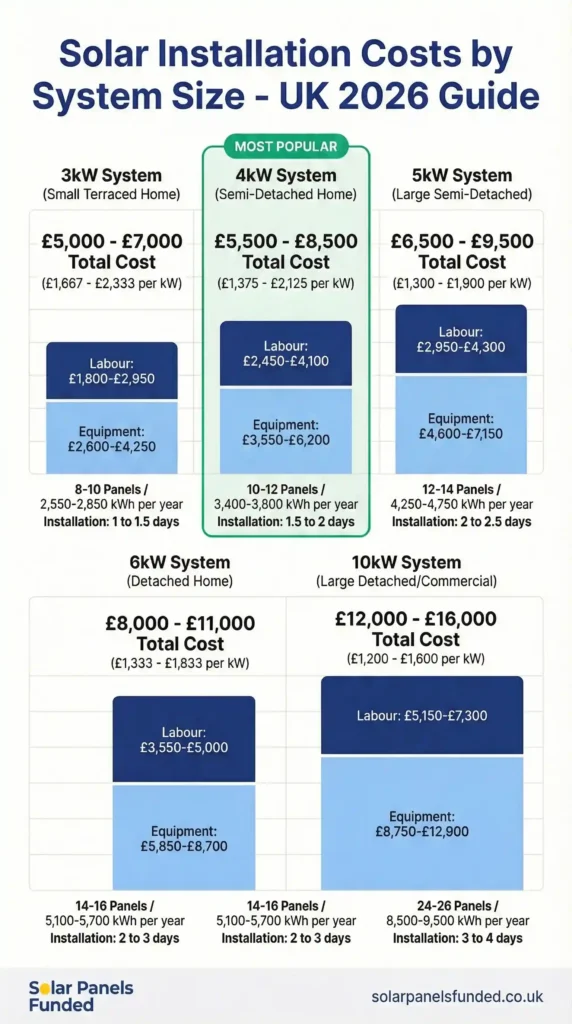
Solar installation costs scale with system size but per-kW pricing decreases as systems grow larger. A 3kW system costs £5,000-£7,000 (£1,667-£2,333 per kW) while a 6kW system costs £8,000-£11,000 (£1,333-£1,833 per kW). Labour efficiency improves with larger systems as scaffolding and setup time remains similar. Equipment bulk discounts reduce per-panel costs for 6kW+ installations.
3kW System Installation Costs
Three-kilowatt systems suit small terraced houses or properties with limited roof space. Total installed costs range £5,000-£7,000 including 8-10 panels, inverter, mounting and labour. Panel costs reach £1,500-£2,200 for 8-10 units at 350-400W each. String inverters cost £600-£1,000 for 3kW capacity.
Labour for 3kW installations takes 1-1.5 days with 1-2 installers costing £1,200-£1,800. Scaffolding costs £400-£600 for standard two-storey access. Electrical work and commissioning costs £200-£400. Annual generation estimates reach 2,550-2,850 kWh depending on roof orientation and location.
4kW System Installation Costs
Four-kilowatt systems represent the most common UK residential size for semi-detached properties. Complete costs range £5,500-£8,500 with regional and equipment variations. Budget installations with entry-level panels and inverters cost £5,500-£6,500. Mid-range systems with established brands cost £6,500-£7,500. Premium installations with high-efficiency panels cost £7,500-£8,500.
Panel costs reach £2,000-£3,000 for 10-12 units. Inverters cost £800-£1,500 for 4kW capacity. Labour takes 1.5-2 days costing £1,600-£2,400. Scaffolding costs £400-£800. Electrical work costs £300-£600. Annual generation estimates reach 3,400-3,800 kWh producing £600-£900 yearly savings at current electricity prices.
Understanding the complete installation process and timeline helps you plan around installer schedules and verify quoted labour hours reflect actual work required.
5kW System Installation Costs
Five-kilowatt systems suit larger semi-detached or smaller detached properties. Total costs range £6,500-£9,500 depending on equipment quality. Budget systems cost £6,500-£7,500 while premium installations reach £8,500-£9,500. Panel costs total £2,500-£3,500 for 12-14 units at 350-400W each.
String inverters for 5kW capacity cost £1,000-£1,800. Hybrid inverters for future battery additions cost £1,400-£2,200. Labour takes 2-2.5 days costing £2,000-£2,600. Scaffolding costs £500-£800. Electrical work costs £300-£600. Annual generation reaches 4,250-4,750 kWh producing £750-£1,100 yearly savings.
6kW System Installation Costs
Six-kilowatt systems suit larger detached properties with higher electricity consumption. Complete installation costs range £8,000-£11,000. Budget systems start at £8,000-£9,000 while premium installations reach £10,000-£11,000. Panel costs total £3,000-£4,000 for 14-16 panels.
Inverters for 6kW capacity cost £1,200-£2,000. Hybrid inverters cost £1,600-£2,400. Labour takes 2-3 days costing £2,400-£3,000. Scaffolding costs £600-£1,000 for increased roof coverage. Electrical work including potential consumer unit upgrades costs £400-£700. Annual generation reaches 5,100-5,700 kWh producing £900-£1,300 yearly savings.
8kW and 10kW Large System Costs
Eight-kilowatt systems cost £10,000-£13,500 suitable for large detached properties or small commercial installations. Labour costs £3,000-£3,800 for 2.5-3.5 days installation. Scaffolding costs £600-£1,200. Ten-kilowatt systems cost £12,000-£16,000 with labour reaching £3,600-£4,600 for 3-4 days work.
Larger systems often require three-phase connections adding £600-£1,200 installation costs. DNO approval takes 10-15 working days for export capacity verification. Commercial installations exceed 10kW requiring different pricing structures based on site conditions and grid requirements.
What are the regional installation cost variations?
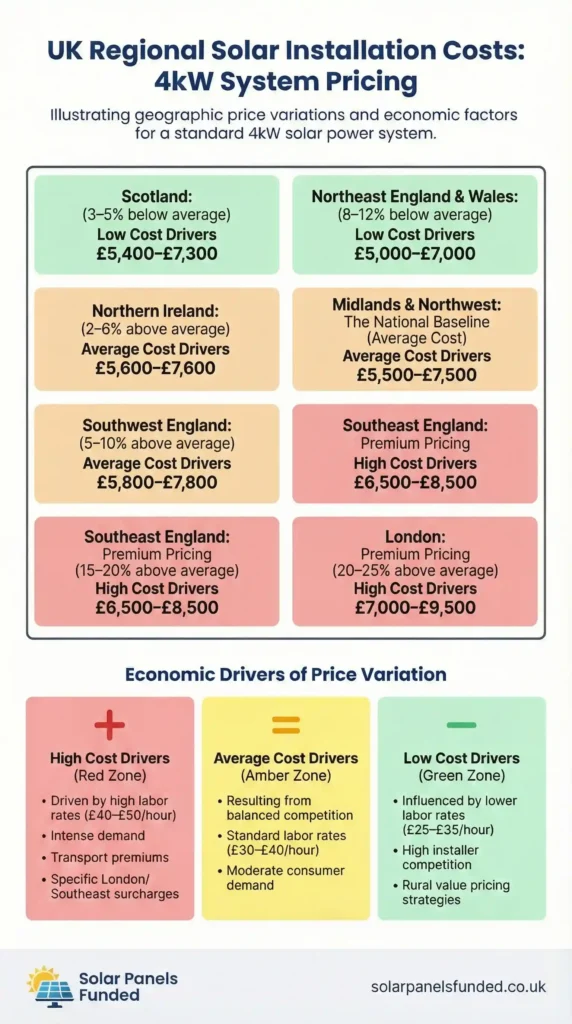
London and Southeast England installations cost 15-25% above national averages at £6,500-£10,000 for standard 4kW systems. High demand, expensive labour rates (£35-£50 per hour) and increased material transport costs drive premium pricing. Scotland, Northeast England and Wales offer lowest pricing at £5,000-£7,500 for equivalent systems with installer rates of £25-£35 per hour.
Scotland, Northeast and Wales Value Pricing
Scotland installations cost £5,400-£7,300 for 4kW systems representing 5-10% discounts versus national averages. Lower labour rates (£25-£35 per hour) and reduced demand enable competitive pricing. Remote Scottish locations face surcharges for material transport and installer travel.
Northeast England including Newcastle, Durham and Sunderland offers lowest UK pricing at £5,000-£7,000. Lower living costs and installer competition drive bargain rates. Wales installations cost £5,200-£7,200 with rural areas offering best value. Island locations including Scottish islands and Isle of Wight face 20-40% premiums for logistics.
Rural versus Urban Installation Pricing
Urban installations benefit from installer competition driving competitive quotes. Multiple companies operating within small areas enable price comparison and negotiation. Urban scaffolding companies offer better rates through regular business volume. Material suppliers deliver more economically to concentrated urban markets.
Rural installations face travel charges when located more than 30 miles from installer bases. Charges range £100-£300 depending on distance. Remote locations require overnight accommodation for installers adding £150-£300. Scaffolding hire costs increase 15-30% for rural deliveries. Limited local installer choice reduces competition enabling higher pricing.
How do you calculate solar installation payback periods?
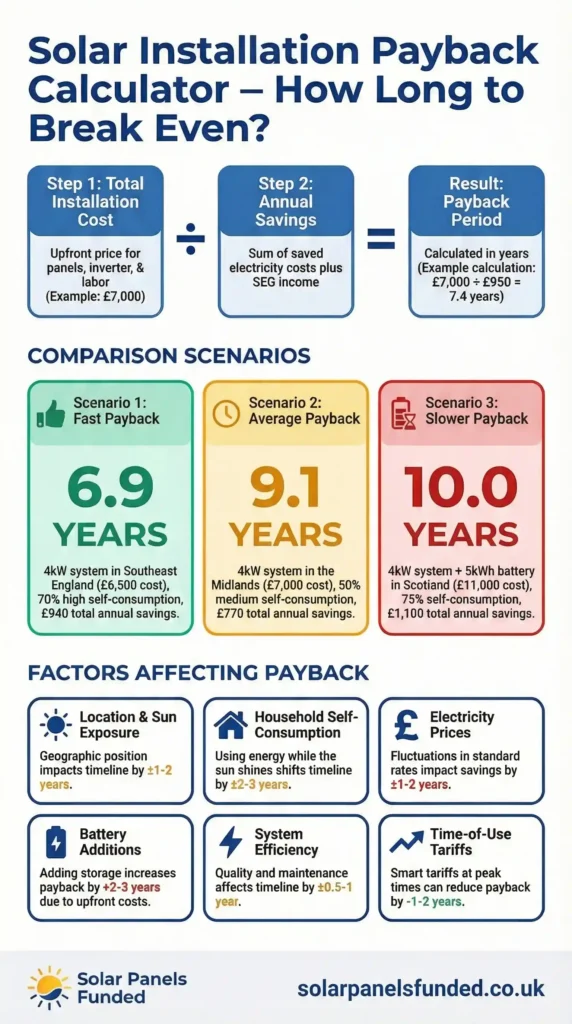
Payback periods calculate years required for electricity savings to equal installation costs. Divide total system cost by annual savings to determine payback in years. A £7,000 installation saving £800 annually achieves 8.75-year payback. Current UK payback periods range 7-15 years depending on electricity prices, system costs, usage patterns and export tariff rates.
| Region | Labour Cost | Equipment Cost | Scaffolding | Electrical Work | Total Cost Range (4kW) | % vs National Average | Installer Hourly Rate | Installer Competition | Transport Premium | Typical Payback Period |
|---|---|---|---|---|---|---|---|---|---|---|
| London | £2,400-£3,200 | £2,500-£3,500 | £600-£1,000 | £400-£700 | £7,000-£9,500 | +20-25% | £40-£50/hour | HIGH | +£200-£300 | 9-11 years |
| Southeast England | £2,200-£2,900 | £2,400-£3,400 | £500-£900 | £350-£650 | £6,500-£8,500 | +15-20% | £35-£45/hour | HIGH | +£150-£250 | 8-10 years |
| Southwest England | £1,800-£2,400 | £2,300-£3,300 | £400-£800 | £300-£600 | £5,800-£7,800 | +5-10% | £30-£40/hour | MEDIUM | +£100-£200 | 7-9 years |
| East England | £1,900-£2,500 | £2,300-£3,300 | £450-£800 | £300-£600 | £6,000-£7,900 | +8-12% | £30-£40/hour | MEDIUM | +£100-£200 | 7-9 years |
| Midlands | £1,700-£2,300 | £2,200-£3,200 | £400-£700 | £300-£600 | £5,500-£7,500 | National average | £30-£40/hour | MEDIUM | £0-£100 | 8-10 years |
| Northwest England | £1,700-£2,300 | £2,200-£3,200 | £400-£700 | £300-£600 | £5,500-£7,500 | National average | £28-£38/hour | MEDIUM | £0-£100 | 8-10 years |
| Northeast England | £1,500-£2,100 | £2,100-£3,100 | £350-£650 | £250-£550 | £5,000-£7,000 | -8-12% | £25-£35/hour | LOW | £0-£100 | 8-11 years |
| Yorkshire | £1,600-£2,200 | £2,200-£3,200 | £400-£700 | £300-£600 | £5,400-£7,300 | -3-5% | £28-£38/hour | MEDIUM | £0-£100 | 8-10 years |
| Wales | £1,500-£2,100 | £2,100-£3,100 | £350-£650 | £250-£550 | £5,000-£7,000 | -8-12% | £25-£35/hour | LOW | +£50-£150 | 8-11 years |
| Scotland | £1,600-£2,200 | £2,200-£3,200 | £400-£700 | £300-£600 | £5,400-£7,300 | -3-5% | £28-£38/hour | MEDIUM | +£100-£200 | 9-12 years |
| Northern Ireland | £1,700-£2,300 | £2,300-£3,300 | £400-£750 | £300-£650 | £5,600-£7,600 | +2-6% | £28-£38/hour | LOW | +£150-£300 | 9-11 years |
London and Southeast Premium Pricing
London installations average £8,000-£10,000 for 4kW systems representing 20-25% premiums. Labour rates reach £40-£50 per hour versus £30-£40 national average. High cost of living, congestion charges and parking restrictions increase installer expenses. Material suppliers charge transport premiums for London deliveries adding £150-£300.
Southeast regions including Surrey, Kent and Sussex see 15-20% premiums at £7,000-£9,000 for 4kW systems. Strong demand and limited installer availability enable higher pricing. Premium equipment preferences and larger average system sizes increase regional averages.
Midlands and Northwest Standard Pricing
Birmingham, Manchester and Liverpool installations cost £5,500-£7,500 for 4kW systems aligning with national averages. Balanced installer competition and moderate labour rates (£30-£40 per hour) create competitive markets. Material transport costs remain reasonable with good motorway access.
East Midlands including Leicester, Nottingham and Derby offer similar pricing at £5,500-£7,500. West Midlands and Northwest markets feature established installer networks providing competitive quotes. Urban areas see slightly higher pricing than surrounding rural regions.
Factors Affecting Payback Calculations
Electricity prices significantly impact payback with higher rates shortening recovery periods. Current UK electricity averages 24-28p per kWh in 2026. Each penny increase shortens payback by 0.5-1 year for typical 4kW systems. Price cap increases accelerate payback while decreases extend recovery periods.
Self-consumption rates determine savings value. Households using 50% of generated electricity directly save more than those exporting 70%. Self-consumption rates vary from 30% for working professionals to 70% for retired households home during daytime. Battery storage increases self-consumption from 30-40% to 60-80% improving payback despite higher upfront costs.
Smart Export Guarantee (SEG) payments provide income for exported electricity. Rates range 3-15p per kWh depending on supplier with Octopus Agile offering highest returns. Export income adds £100-£300 annually for typical systems. Fixed export tariffs provide 4-6p per kWh generating £80-£150 yearly income.
System Size Impact on Payback
Larger systems spread fixed costs across more panels improving per-kW economics. A 3kW system costing £6,000 saves £500 annually achieving 12-year payback. A 6kW system costing £10,000 saves £1,100 annually achieving 9-year payback. Economies of scale benefit larger installations through better payback despite higher upfront costs.
System efficiency affects generation and payback. High-efficiency panels generate 5-10% more electricity than budget alternatives. This produces £50-£100 additional annual savings shortening payback by 0.5-1 year. Premium panels costing £1,500 extra take 15-20 years to recoup through efficiency gains alone.
| Scenario | System Size | Installation Cost | Annual Electricity Savings | Annual SEG Income | Total Annual Savings | Payback Period (Years) |
|---|---|---|---|---|---|---|
| 3kW system, high self-consumption (70%) | 3kW | £5,500 | £550 | £80 | £630 | 8.7 years |
| 4kW system, medium self-consumption (50%) | 4kW | £7,000 | £650 | £120 | £770 | 9.1 years |
| 4kW system, high self-consumption (70%) | 4kW | £7,000 | £850 | £90 | £940 | 7.4 years |
| 4kW system + 5kWh battery, high self-consumption (75%) | 4kW | £11,000 | £1,050 | £50 | £1,100 | 10.0 years |
| 5kW system, medium self-consumption (50%) | 5kW | £8,000 | £800 | £150 | £950 | 8.4 years |
| 6kW system, low self-consumption (30%) | 6kW | £9,500 | £750 | £250 | £1,000 | 9.5 years |
| 6kW system, high self-consumption (70%) | 6kW | £9,500 | £1,200 | £100 | £1,300 | 7.3 years |
| 6kW system + 10kWh battery, high self-consumption (80%) | 6kW | £15,000 | £1,550 | £40 | £1,590 | 9.4 years |
| Southeast location premium (£8,500, 4kW) | 4kW | £8,500 | £900 | £110 | £1,010 | 8.4 years |
| Northeast location value (£5,500, 4kW) | 4kW | £5,500 | £650 | £100 | £750 | 7.3 years |
| With time-of-use tariff (Octopus Agile) | 4kW + 5kWh | £11,000 | £1,100 | £200 (arbitrage) | £1,300 | 8.5 years |
Battery Storage Payback Considerations
Battery systems extend payback periods by 2-4 years despite improving self-consumption. A £7,000 installation with £4,500 battery costs £11,500 total. Annual savings increase from £800 to £1,100 through higher self-consumption but payback extends from 8.75 to 10.5 years. Battery replacement after 10-15 years adds £3,000-£5,000 lifecycle costs.
Time-of-use tariffs improve battery payback economics. Octopus Agile or Economy 7 tariffs enable cheap overnight charging and expensive peak discharge. Arbitrage opportunities generate £150-£400 additional annual savings shortening battery payback. Without time-of-use tariffs batteries extend overall payback significantly.
Regional Payback Variations
Southern England installations achieve faster payback through higher solar irradiance. Brighton receives 15-20% more annual sunshine than Manchester generating 15-20% more electricity. This shortens payback by 1-2 years compared to northern locations. Southwest regions including Cornwall achieve best UK solar performance.
Northern regions face 1-2 year longer payback periods through reduced generation. Scotland, Northeast England and Northern Ireland receive 10-15% less annual sunshine than southern regions. Lower installation costs partially offset reduced generation maintaining reasonable payback periods of 10-14 years.
What hidden costs increase solar installation expenses?
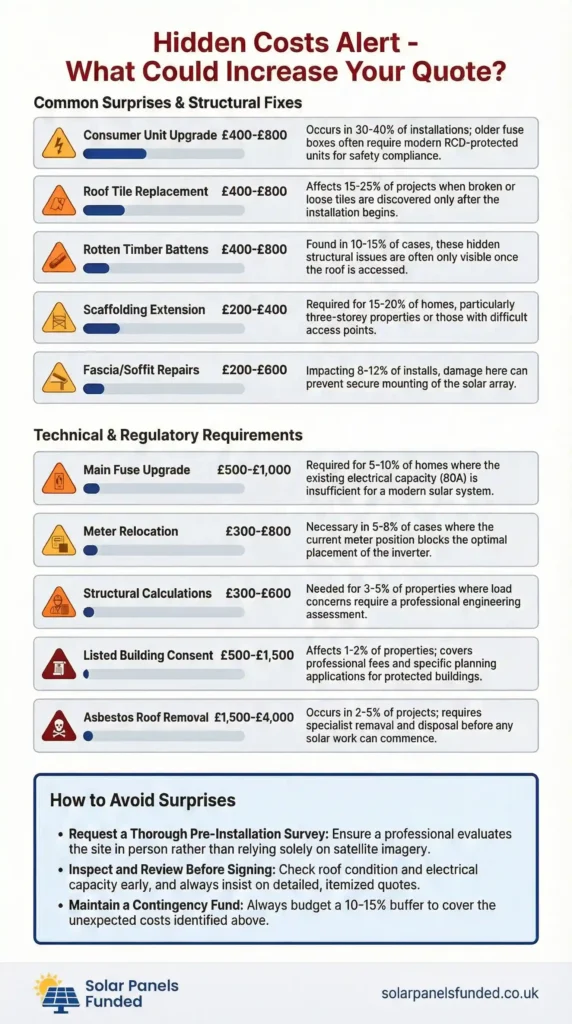
Hidden costs add £500-£2,000 to initial quotes when discovered during installation. Roof repairs, electrical upgrades, planning permissions and access challenges commonly surprise homeowners. Thorough site surveys identify most hidden costs before signing contracts. Request detailed quotes itemizing all potential extras avoiding surprise bills during installation.
Roof and Structural Hidden Costs
Rotten timber battens require replacement before installation at £400-£800 for materials and labour. Surveyors inspect roof structures during site visits identifying repair needs. Fascia or soffit damage costs £200-£600 to repair preventing future issues. Asbestos cement roofs need specialist removal and disposal at £1,500-£4,000 before installation proceeds.
Structural calculations cost £300-£600 when surveyors identify load concerns. Engineers assess roof capacity for panel weight and wind loading. Strengthening work costs £600-£2,000 depending on required interventions. Listed buildings need Listed Building Consent adding £500-£1,500 professional fees and application costs.
Electrical System Hidden Costs
Consumer unit replacements cost £400-£800 when existing fuse boxes lack capacity. Modern solar installations require RCD protection and adequate circuit capacity. Older homes with 60A or 80A main fuses need upgrades to 100A costing £500-£1,000 including DNO coordination.
Meter relocations cost £300-£800 when optimal inverter locations require meter moves. This includes electrician labour and DNO approval. Earth bonding upgrades cost £150-£400 ensuring electrical safety compliance. Smart meter installations coordinated with solar systems cost £0-£200 depending on existing arrangements.
| Hidden Cost Category | Frequency (% of Installations) | Typical Cost Range | Avoidable? | Detection Timing | Prevention Method | Impact on Total Budget |
|---|---|---|---|---|---|---|
| Roof Tile Replacement | 15-25% | £400-£800 | Partially | During survey or installation | Pre-installation roof inspection | 5-10% increase |
| Rotten Timber Battens | 10-15% | £400-£800 | NO | During installation | Detailed attic inspection | 5-10% increase |
| Consumer Unit Upgrade | 30-40% | £400-£800 | NO | During electrical survey | Electrical system review | 5-10% increase |
| Main Fuse Upgrade (60A to 100A) | 5-10% | £500-£1,000 | NO | During electrical assessment | DNO capacity check | 7-12% increase |
| Fascia/Soffit Repairs | 8-12% | £200-£600 | Partially | Visual survey | External inspection | 3-7% increase |
| Asbestos Roof Removal | 2-5% | £1,500-£4,000 | NO | Material testing | Professional survey | 20-50% increase |
| Scaffolding Extension (3 storeys) | 15-20% | £200-£400 | NO | Site measurement | Accurate height assessment | 3-5% increase |
| Meter Relocation | 5-8% | £300-£800 | Partially | Inverter positioning | Optimal layout planning | 4-8% increase |
| Structural Calculation Required | 3-5% | £300-£600 | NO | Load assessment | Engineering review | 4-7% increase |
| Listed Building Consent | 1-2% | £500-£1,500 | NO | Planning check | Property status verification | 7-15% increase |
| Ground Mounted Foundation Work | 8-10% | £600-£1,200 | NO | Ground mounted systems only | Soil testing | 8-12% increase |
| Bird Protection Mesh | 20-30% | £150-£400 | YES (optional) | Installer recommendation | Future maintenance consideration | 2-4% increase |
Access and Scaffolding Hidden Costs
Difficult access properties facing narrow streets or limited gardens increase scaffolding costs by 30-50%. Scaffolding erected over buildings costs £800-£1,400 versus £400-£800 standard pricing. Protected surfaces including driveways, patios or gardens need covering adding £100-£250 hire costs.
Scaffolding extensions for three-storey properties or steep roofs cost £200-£400 beyond initial quotes. Temporary road closures or parking suspensions cost £150-£400 for permits and signage. Listed buildings requiring traditional tube scaffolding cost £200-£400 more than modern system scaffolding.
Optional Extras and Add-Ons
Bird protection mesh prevents pigeon nesting under panels at £150-£400 for materials and installation. This protects wiring from damage and maintains roof hygiene. Generation meters beyond standard installations cost £100-£250 for additional monitoring.
EV charger installations alongside solar systems cost £400-£800 labour plus £400-£1,200 equipment. Coordinating installations saves separate call-out fees of £150-£300. Premium monitoring systems with detailed analytics cost £200-£500 beyond standard inverter monitoring.
Permitting and Inspection Costs
DNO applications for systems exceeding 3.68kW cost £150-£300 in application fees. Some regions charge higher G99 application fees reaching £400-£600. Building Regulations notifications through local Building Control cost £150-£400 when not using Competent Person Schemes.
MCS certification costs £100-£200 per installation funding scheme operations. These costs typically include in installer quotes but some companies itemize separately. Electrical Installation Certificates (EIC) cost £80-£150 when provided by separate electricians not included in installation teams.
How do you compare and verify installer quotes?
Request three written quotes from MCS-certified installers comparing equipment specifications, labour costs, warranties and payment terms. Itemized quotes separate panel costs, inverter pricing, labour charges, scaffolding and electrical work enabling direct comparison. Verify MCS certification through mcscertified.com database and check insurance coverage through direct insurer contact.
Essential Quote Components
Complete quotes include system size in kW and kilowatt-hours, panel brand and model, inverter type and capacity, labour costs with estimated days, scaffolding costs, electrical work costs, VAT breakdown, payment schedule and total price. Missing components indicate incomplete quoting or hidden costs appearing later.
Verify credentials when choosing qualified installers to ensure proper certification, insurance coverage and professional standards throughout installation.
Panel specifications should list manufacturer, model number, wattage, efficiency rating and warranty terms. Inverter details include brand, capacity, efficiency, warranty and monitoring capabilities. Labour quotes specify daily rates, number of installers and expected completion time.
Quote Red Flags
Quotes 30-40% below average suggest substandard equipment, unlicensed work or business instability. £4,000-£5,000 quotes for 4kW systems indicate budget panels, minimal labour or missing scaffolding. Unusually high quotes above £10,000 for standard 4kW installations suggest overpricing unless using premium equipment.
Vague quotes without equipment specifications hide quality concerns. Lump-sum pricing without itemization prevents verification of value. Pressure tactics demanding immediate decisions indicate unprofessional practices. Requests for large upfront deposits exceeding 50% risk financial loss if companies cease trading.
Verifying Installer Credentials
MCS certification verification through mcscertified.com database confirms installer qualification. Active certifications display certification numbers and expiry dates. Expired or suspended certifications invalidate SEG eligibility and VAT relief. RECC membership through recc.org.uk provides deposit protection and complaint procedures.
Insurance verification requires viewing actual certificates showing policy numbers, coverage amounts and expiry dates. Public liability insurance minimum £5 million protects against property damage. Professional indemnity insurance covers design errors or performance shortfalls. Contact insurers directly using policy numbers confirming active coverage.
Comparing Equipment Quality
Panel tier rankings indicate quality with Tier 1 manufacturers offering best warranties and performance. Tier 1 brands include Canadian Solar, JinkoSolar, LONGi, Trina Solar and Q CELLS. Tier 2 and 3 brands offer lower prices but reduced warranties and potential availability issues.
Inverter brands vary significantly in warranty length and monitoring capabilities. Premium brands (SolarEdge, SMA, Fronius) provide 10-12 year warranties versus 5-10 years for budget alternatives (Growatt, Solis). Monitoring systems range from basic inverter displays to sophisticated online platforms with predictive maintenance.
Payment Terms and Protection
RECC members limit deposits to 25% of total cost protecting against financial loss. Staged payments at deposit, mid-installation and completion reduce risk versus full upfront payment. Credit card payments between £100-£30,000 gain Section 75 protection enabling refunds if services not delivered.
Escrow payment arrangements release funds only after satisfactory installation completion. Some installers offer 0% finance for 12-24 months spreading costs interest-free. Longer-term finance at 4-8% APR enables affordability but increases total costs by 10-20% over term.
Frequently Asked Questions About Solar Installation Costs
How much does it cost to install solar panels on a house?
Standard residential installations cost £5,500-£8,500 for 4kW systems including all labour, equipment and scaffolding. Larger 6kW systems cost £8,000-£11,000. Small 3kW systems cost £5,000-£7,000. Battery additions increase costs by £3,500-£6,000 depending on capacity.
What is the average cost per kW for solar installation?
Residential installations cost £1,200-£2,500 per kW with pricing decreasing as system size increases. Small 3kW systems cost £1,667-£2,333 per kW. Large 6kW systems cost £1,333-£1,833 per kW. Commercial installations achieve £800-£1,500 per kW through economies of scale.
How much do installers charge for labour?
Installer hourly rates range £25-£45 depending on location and experience. Southeast England rates reach £35-£50 per hour. Northern regions charge £25-£35 per hour. Complete labour for 4kW systems costs £1,600-£2,400 for 1.5-2 days work with two installers.
What adds most to installation costs?
Battery storage adds most at £3,500-£6,000 increasing total costs by 50-80%. Roof repairs add £400-£2,000 when structural issues discovered. Consumer unit upgrades add £400-£800 for electrical compliance. Difficult access increases scaffolding costs by £400-£600 beyond standard pricing.
Are there cheaper alternatives to professional installation?
DIY installation voids equipment warranties, fails building regulations and risks electrical safety. Professional installation ensures MCS certification enabling SEG payments and VAT relief. Labour represents only 25-35% of total costs making DIY savings limited while increasing risks significantly.
How much does scaffolding cost for solar installation?
Standard two-storey scaffolding costs £400-£800 for 1-2 week hire. Three-storey properties require £600-£1,200. Difficult access increases costs to £800-£1,400. Mobile towers for bungalows cost £200-£400. Scaffolding represents 5-10% of total installation costs.
Do installation costs include VAT?
Residential solar installations qualify for 0% VAT until March 31, 2027 under temporary relief. This saves £1,100-£1,700 on £5,500-£8,500 installations. Commercial installations pay standard 20% VAT. Battery installations included with solar systems qualify for 0% VAT.
How much do electrical upgrades cost?
Consumer unit replacements cost £400-£800 for modern RCD-protected boards. Main fuse upgrades from 60A to 100A cost £500-£1,000. Meter relocations cost £300-£800. Additional circuits or surge protection cost £200-£400. DNO applications cost £150-£300 for export capacity.
Can installation costs increase after signing contracts?
Contracts should specify fixed pricing protecting against increases except for homeowner-requested changes. Unforeseen roof repairs discovered during installation add costs. Request thorough site surveys before signing identifying all potential extras. Written quotes with detailed itemization prevent surprise charges.
What financing options reduce upfront costs?
Many installers offer 0% APR finance for 12-24 months enabling interest-free payments. Longer-term finance at 4-8% APR spreads costs over 3-10 years increasing total payments by 10-30%. Green mortgages or personal loans offer alternative financing. Government schemes like ECO4 provide grants for eligible households reducing or eliminating costs.
solar panel installer UK guide
- November 24, 2025
Pool Solar Panels Installation
- December 2, 2025