

How Much Does a Solar Battery Cost in the UK: Complete 2026 Price Guide
Solar battery costs in the UK range from £3,000 to £10,000 depending on capacity, brand, and installation complexity. A standard 5kWh battery system costs £4,000 to £5,500 installed, while larger 10kWh systems reach £6,500 to £8,000. Prices include the battery unit, compatible inverter or hybrid system, installation labour, electrical work, and MCS certification. This guide breaks down all costs, compares brands, explains capacity options, and helps you determine whether battery storage provides value for your solar installation.
Table of Contents
ToggleHow much do solar batteries cost in the UK?
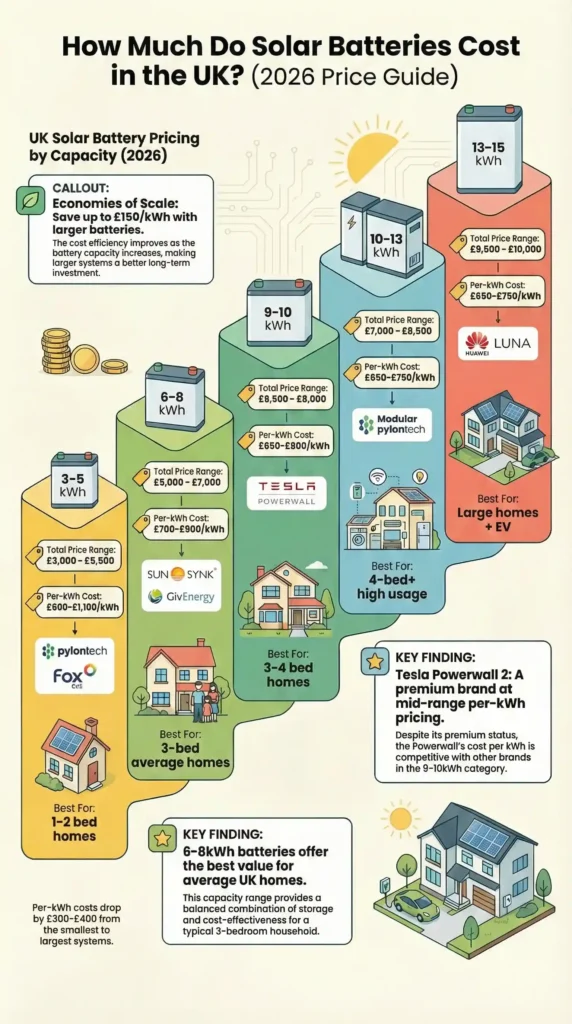
Solar battery systems cost £3,000 to £10,000 installed in the UK market for 2026. Small 3-5kWh batteries suitable for modest storage needs range from £3,000 to £5,500. Medium 6-9kWh batteries serving average households cost £5,000 to £7,000. Large 10-15kWh systems for high consumption or energy independence reach £6,500 to £10,000. Prices include battery hardware, compatible inverter technology, professional installation, electrical integration, and necessary certification.
| Capacity | Storage kWh | Price Range | Average Cost | Per-kWh Cost | Installation | Equipment Only | Best Brand Examples | Household Type | Annual Storage |
|---|---|---|---|---|---|---|---|---|---|
| Small | 3-5 kWh | £3000-£5500 | £4250 | £850/kWh | £500-£800 | £2500-£4200 | Pylontech US3000C, Fox ESS 5kWh | 1-2 bedroom | 1500-2000 kWh |
| Medium-Small | 6-8 kWh | £5000-£7000 | £6000 | £750/kWh | £600-£900 | £4000-£5800 | SunSynk 8.2kWh, GivEnergy 9.5kWh | 3 bedroom | 2500-3500 kWh |
| Medium | 9-10 kWh | £6500-£8000 | £7250 | £725/kWh | £700-£1000 | £5500-£6800 | Tesla Powerwall 13.5kWh | 3-4 bedroom | 3500-4500 kWh |
| Large | 10-13 kWh | £7000-£8500 | £7750 | £700/kWh | £800-£1100 | £6000-£7200 | Pylontech 14.4kWh modular | 4 bedroom | 4500-5500 kWh |
| Extra Large | 13-15 kWh | £8500-£10000 | £9250 | £680/kWh | £900-£1200 | £7300-£8500 | Huawei Luna 15kWh | 4+ bed + EV | 5500-6500 kWh |
| Commercial Small | 15-20 kWh | £10000-£13000 | £11500 | £650/kWh | £1000-£1500 | £8800-£11200 | Modular Pylontech/BYD | Small business | 6500-8000 kWh |
| Commercial Medium | 20-30 kWh | £13000-£18000 | £15500 | £620/kWh | £1200-£2000 | £11500-£15800 | Commercial battery banks | Medium business | 8000-12000 kWh |
Small Battery Systems (3-5 kWh Capacity)
Small solar batteries with 3 to 5 kilowatt-hour storage capacity cost £3,000 to £5,500 installed. These systems suit households with modest electricity consumption or those seeking basic backup power during peak tariff periods. Popular models include GivEnergy 5kWh (£4,200), Pylontech US3000C (£3,800), and Fox ESS 5kWh (£4,500). Small batteries store enough electricity to power essential appliances for 3 to 5 hours or shift 4 to 6 kilowatt-hours of solar generation from daytime to evening use. Installation costs account for £500 to £800 of the total price.
Medium Battery Systems (6-9 kWh Capacity)
Medium capacity batteries between 6 and 9 kilowatt-hours cost £5,000 to £7,000 installed. This size serves average UK households consuming 8 to 12 kilowatt-hours daily. Leading options include Tesla Powerwall 2 (13.5kWh at £7,500), GivEnergy 9.5kWh (£6,200), and SunSynk 8.2kWh (£5,800). Medium batteries enable 60 to 80 percent self-sufficiency when paired with appropriately sized solar panels. These systems store sufficient electricity for overnight consumption and morning routines before solar generation resumes. Installation complexity increases slightly with larger units requiring reinforced mounting and upgraded electrical connections.
Large Battery Systems (10-15 kWh Capacity)
Large solar batteries offering 10 to 15 kilowatt-hours storage cost £6,500 to £10,000 installed. High-consumption households, electric vehicle owners, or those pursuing maximum energy independence choose these systems. Premium options include Tesla Powerwall 2 (£7,500), Huawei Luna 15kWh (£9,200), and modular Pylontech configurations (£8,000-£10,000). Large batteries support 80 to 95 percent self-sufficiency rates, eliminating most grid electricity purchases. These systems require professional electrical assessments to verify household infrastructure handles increased current loads. Installation costs rise to £800 to £1,200 due to additional electrical work and longer installation times.
Battery-Only Pricing vs Complete System Costs
Battery unit costs alone range from £2,200 to £7,500 before installation expenses. A 5kWh battery unit costs £2,800 to £4,000 equipment-only. Adding compatible hybrid inverter (£800-£1,500), installation labour (£500-£800), electrical modifications (£200-£500), and certification (£150-£250) brings total installed costs to £4,000-£5,500. Equipment-only pricing attracts competent DIY installers but voids manufacturer warranties and prevents SEG payment eligibility without proper MCS certification. Professional installation ensures warranty protection, compliant electrical work, and access to export payment schemes.
Retrofit Battery Addition to Existing Solar Systems
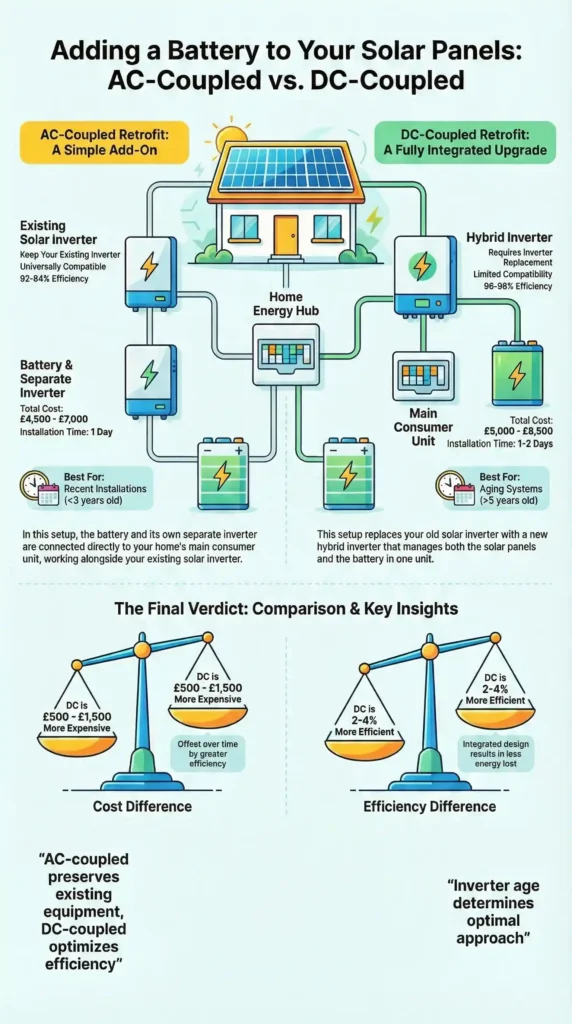
Retrofitting battery storage to existing solar installations costs £3,500 to £8,500 depending on current inverter compatibility. AC-coupled batteries connecting through separate inverters cost £4,500 to £7,000 installed, avoiding solar system modifications. DC-coupled batteries requiring inverter replacement cost £5,000 to £8,500 including new hybrid inverter. Retrofit installations add £300 to £600 beyond new installation costs due to integration complexity and potential electrical upgrades. Systems installed before 2020 often need complete inverter replacement for battery compatibility, increasing retrofit expenses significantly.
What factors affect solar battery costs?
Solar battery prices vary based on capacity size, battery chemistry technology, brand reputation, inverter compatibility requirements, and installation complexity. Capacity represents the largest cost driver with prices increasing £600 to £800 per additional kilowatt-hour. Lithium iron phosphate batteries cost 15 to 25 percent more than standard lithium-ion but offer superior longevity and safety. Premium brands command £1,000 to £2,500 premiums over budget alternatives. Hybrid inverter requirements add £800 to £1,500 when existing systems need upgrades. Complex installations requiring electrical panel upgrades or extensive cable runs increase labour costs £300 to £800.
Battery Capacity and Storage Size
Battery capacity directly determines pricing with costs ranging from £600 to £900 per kilowatt-hour installed. A 5kWh battery costs £800 per kWh (£4,000 total) while 10kWh systems drop to £700 per kWh (£7,000 total) through economies of scale. Larger batteries spread fixed installation costs across more capacity, improving per-kWh value. Household electricity consumption patterns should guide capacity selection. Homes using 10 kilowatt-hours daily between 5pm and midnight need 8 to 10kWh batteries for complete evening coverage. Oversizing batteries adds upfront costs without proportional benefit when solar generation cannot fully charge excess capacity.
Battery Chemistry and Technology Type
Lithium iron phosphate batteries cost £4,500 to £9,000 compared to £3,500 to £7,500 for standard lithium-ion chemistry. LiFePO4 technology offers 6,000 to 10,000 charge cycles versus 4,000 to 6,000 cycles for lithium-ion, justifying the 15 to 25 percent premium through extended lifespan. Safety advantages including lower fire risk and better thermal stability attract risk-conscious buyers despite higher costs. Lead-acid batteries remain available at £2,000 to £3,500 but suffer short 2,000 cycle lifespans and 50 percent depth-of-discharge limitations, making them false economy for most applications. Newer solid-state battery technology entering markets at £10,000 to £15,000 provides superior performance but remains cost-prohibitive for residential use.
Brand Reputation and Warranty Coverage
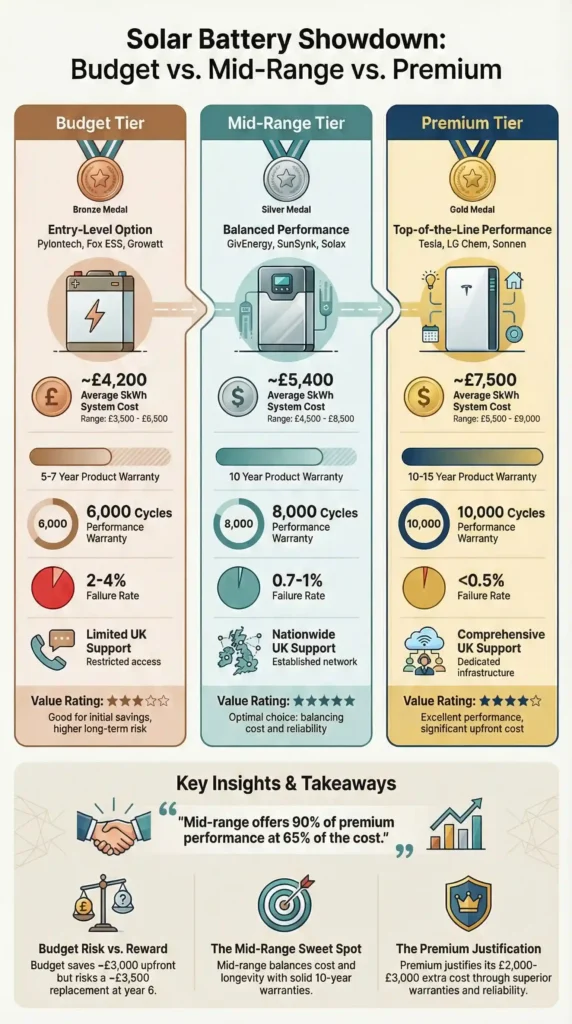
Premium brands including Tesla, LG Chem, and Sonnen command £1,500 to £3,000 premiums over emerging Chinese manufacturers. Tesla Powerwall 2 costs £7,500 installed compared to £5,000 for equivalent GivEnergy capacity. Brand premiums reflect established UK support networks, proven reliability records, and comprehensive 10-year warranties. Budget brands offer 5 to 7 year warranties versus 10 to 15 years from premium manufacturers. Warranty terms significantly impact total ownership costs when battery replacements cost £3,000 to £6,000. Established brands demonstrate sub-1 percent failure rates over 5 years while budget alternatives show 2 to 4 percent failure rates requiring warranty claims or replacement costs.
Inverter Compatibility and Upgrade Requirements
Existing solar inverter compatibility affects battery addition costs significantly. AC-coupled batteries compatible with any inverter type cost £4,500 to £7,000 including separate battery inverter. DC-coupled systems requiring hybrid inverter installation cost £5,000 to £8,500 including inverter replacement (£1,000-£2,000) plus battery. Homes with string inverters installed before 2018 typically need hybrid inverter upgrades adding £1,200 to £2,000 to battery costs. Micro-inverter systems accept only AC-coupled batteries limiting options but avoiding inverter replacement. Inverter compatibility assessments during quotation prevent unexpected costs during installation.
Installation Complexity and Electrical Work
Standard battery installations cost £500 to £800 labour including mounting, wiring, commissioning, and certification. Complex installations requiring consumer unit upgrades, additional earth bonding, or extensive cable runs increase costs to £800 to £1,500. Properties with inadequate electrical earthing need upgrades costing £200 to £500 before battery installation. Garage or outbuilding battery placement adds £150 to £400 for cable runs versus wall-mounting near existing solar equipment. Three-storey properties or difficult access locations incur £100 to £300 additional scaffolding or equipment hire costs. Pre-installation electrical surveys identify upgrade requirements preventing cost surprises during installation.
How do solar battery prices compare by brand?
Solar battery prices vary £2,000 to £5,000 between budget and premium brands for equivalent capacity. Budget brands including Pylontech and Fox ESS cost £3,500 to £5,500 for 5-8kWh systems. Mid-range manufacturers like GivEnergy and SunSynk price at £4,500 to £6,500 for similar capacity. Premium brands including Tesla, LG Chem, and Sonnen command £6,500 to £9,000 for comparable storage. Price differences reflect warranty duration, proven reliability, UK support infrastructure, and brand recognition rather than significant performance gaps.
| Brand | Tier | 5kWh System Cost | Per-kWh | Warranty Years | Cycles Rated | End Warranty Capacity | UK Support | Failure Rate 5yr | Lead Time | Value Score |
|---|---|---|---|---|---|---|---|---|---|---|
| Pylontech | Budget | £4200 | £840/kWh | 5-7 years | 6000 | 60% | Limited | 2-4% | 2-4 weeks | ⭐⭐⭐ |
| Fox ESS | Budget | £4500 | £900/kWh | 5-7 years | 6000 | 60-65% | Regional | 2-3% | 3-5 weeks | ⭐⭐⭐ |
| Growatt | Budget | £4800 | £960/kWh | 5-7 years | 6000 | 65% | Growing | 3-4% | 4-6 weeks | ⭐⭐⭐ |
| GivEnergy | Mid-Range | £5400 | £1080/kWh | 10 years | 8000 | 70% | Nationwide | 0.7-1% | 1-2 weeks | ⭐⭐⭐⭐⭐ |
| SunSynk | Mid-Range | £5600 | £1120/kWh | 10 years | 8000 | 70% | Nationwide | 0.8-1.2% | 2-3 weeks | ⭐⭐⭐⭐⭐ |
| Solax | Mid-Range | £5800 | £1160/kWh | 10 years | 7000 | 70% | Strong | 1-1.5% | 2-4 weeks | ⭐⭐⭐⭐ |
| Alpha ESS | Mid-Range | £6000 | £1200/kWh | 10 years | 8500 | 70% | Developing | 0.8-1% | 3-5 weeks | ⭐⭐⭐⭐ |
| Tesla Powerwall 2 | Premium | £7500 | £556/kWh* | 10 years | 10000 | 70% | Excellent | <0.5% | 4-8 weeks | ⭐⭐⭐⭐ |
| LG Chem RESU | Premium | £7200 | £1440/kWh | 10 years | 10000 | 70% | Excellent | <0.5% | 6-10 weeks | ⭐⭐⭐⭐ |
| Sonnen | Premium | £8500 | £1700/kWh | 10-15 years | 10000 | 70-80% | Excellent | <0.3% | 8-12 weeks | ⭐⭐⭐⭐ |
| BYD | Emerging | £6200 | £1240/kWh | 10 years | 9000 | 70% | Growing | 0.6-0.9% | 4-6 weeks | ⭐⭐⭐⭐ |
| Huawei Luna | Emerging | £6800 | £1360/kWh | 10 years | 9500 | 70% | Good | 0.5-0.8% | 5-8 weeks | ⭐⭐⭐⭐ |
Budget Battery Brands (£3,500-£5,500)
Pylontech batteries cost £3,500 to £5,000 installed for 5 to 7.2 kilowatt-hour capacity. These Chinese-manufactured units offer reliable lithium iron phosphate chemistry with 6,000 cycle ratings and 5-year warranties. Fox ESS batteries range from £3,800 to £5,200 for 5 to 8kWh systems with modular expansion capabilities. Growatt batteries price at £4,000 to £5,500 including 6kWh to 9.5kWh options and compatible hybrid inverters. Budget brands deliver 90 to 95 percent of premium brand performance at 40 to 50 percent cost savings. Limited UK service networks and shorter warranties represent primary compromises. Five-year warranty coverage means potential replacement costs at year 6 to 10 when premium brands remain under warranty protection.
Mid-Range Battery Brands (£4,500-£6,500)
GivEnergy batteries cost £4,500 to £6,500 for 5kWh to 9.5kWh systems with 10-year warranties and established UK support. These systems combine reliable performance with responsive customer service and nationwide installer networks. SunSynk batteries range from £5,000 to £6,800 for 5.32kWh to 11kWh configurations offering modular scalability. Solax batteries price at £5,200 to £7,000 for 6.3kWh to 11.6kWh capacity with hybrid inverter integration. Mid-range brands balance affordability against premium brand recognition. Extended 10-year warranties eliminate mid-life replacement concerns. UK-based technical support resolves issues faster than budget brand alternatives requiring international assistance.
Premium Battery Brands (£6,500-£9,000)
Tesla Powerwall 2 costs £7,500 installed for 13.5 kilowatt-hour capacity with 10-year warranty and industry-leading brand recognition. This integrated system includes built-in inverter eliminating separate inverter costs but limiting retrofit flexibility. LG Chem RESU batteries range from £6,500 to £8,500 for 6.5kWh to 13kWh storage with proven reliability and 10-year coverage. Sonnen batteries cost £8,000 to £12,000 for 5kWh to 15kWh modular systems emphasising German engineering and 10-year warranties. Premium brands justify higher costs through established performance records, comprehensive warranties, and superior customer support. Market liquidity ensures spare parts availability and warranty claim processing throughout system lifetimes.
Emerging Battery Brands and Technologies
Alpha ESS batteries cost £4,800 to £7,200 for 5.7kWh to 13.3kWh systems gaining UK market share through competitive pricing. BYD batteries range from £5,500 to £8,500 for 7.1kWh to 14.2kWh capacity backed by automotive battery manufacturing expertise. Huawei Luna batteries price at £7,000 to £9,500 for 5kWh to 15kWh systems leveraging telecommunications technology experience. Emerging brands offer modern features including smartphone app control, AI optimisation, and modular expansion at mid-range pricing. Limited UK installation history means unproven long-term reliability. Rapid technology advancement risks obsolescence when newer models offer superior performance at similar costs.
Warranty Terms and Support Quality Comparison
Warranty coverage spans 5 to 15 years across battery brands with significant cost implications. Premium brands offer 10-year comprehensive warranties covering parts, labour, and performance guarantees maintaining 70 percent capacity. Mid-range manufacturers provide 10-year parts warranties with labour coverage varying by installer agreements. Budget brands typically offer 5 to 7 year warranties with performance guarantees dropping to 60 percent end-of-warranty capacity. Warranty claim processing times range from 2 weeks (premium brands) to 8 weeks (budget imports). UK-based service centres enable faster repairs while international warranty processing causes extended system downtime. Warranty value calculations should factor replacement costs of £3,000 to £6,000 against brand premium differences.
What size solar battery do I need and what does it cost?
Solar battery sizing depends on household electricity consumption patterns, solar panel generation capacity, and energy independence goals. Households consuming 10 kilowatt-hours daily need 6 to 8kWh batteries for evening coverage costing £5,000 to £6,500. High-consumption properties using 15 to 20 kilowatt-hours daily require 10 to 13kWh batteries costing £7,000 to £8,500. Battery capacity should match 60 to 80 percent of evening and overnight consumption rather than total daily usage since solar panels directly power daytime needs.
Calculating Required Battery Capacity
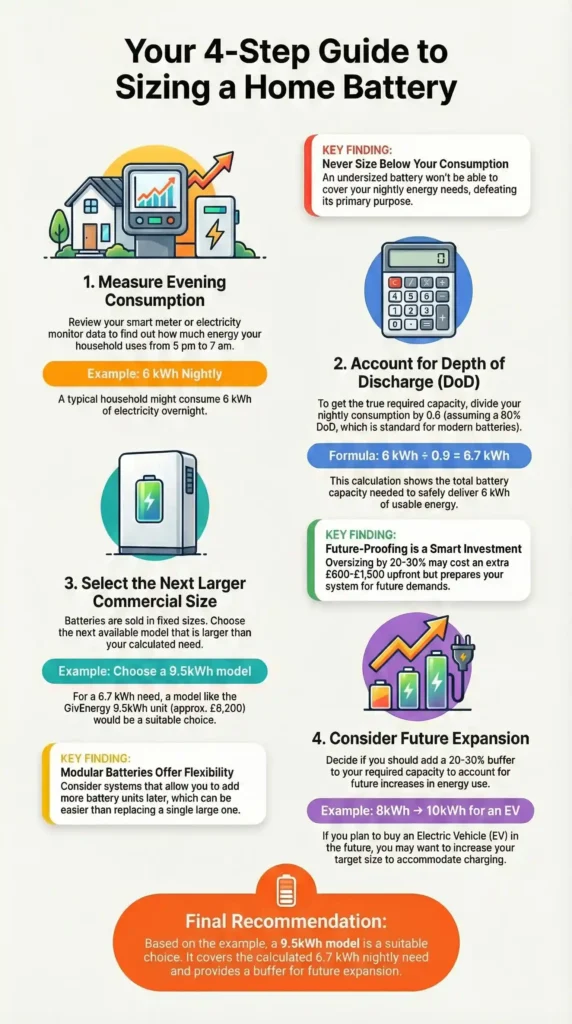
Battery capacity requirements equal evening plus overnight electricity consumption divided by 0.9 (accounting for 90 percent usable depth of discharge). Households using 6 kilowatt-hours from 5pm to 7am need 6.7kWh batteries (6 ÷ 0.9), typically met by 7kWh or 8kWh products costing £5,200 to £6,000. Properties consuming 10 kilowatt-hours nightly require 11kWh batteries (10 ÷ 0.9) costing £7,000 to £7,800. Smart meter data provides accurate consumption patterns for sizing calculations. Conservative sizing selects the next larger commercial capacity above calculated requirements ensuring adequate coverage during low solar generation periods.
Small Household Battery Sizing (1-2 Bedrooms)
Small households consuming 6 to 8 kilowatt-hours daily need 3 to 5kWh batteries costing £3,500 to £5,000. Evening consumption typically reaches 3 to 4 kilowatt-hours between 5pm and midnight requiring 4kWh minimum battery capacity. Popular configurations include Pylontech US3000C (3.55kWh at £3,800) or GivEnergy 5kWh (£4,500). Small batteries paired with 6 to 8 panel solar systems achieve 70 to 85 percent self-sufficiency rates. Winter generation limitations mean grid electricity remains necessary during December through February low-production months. Oversizing to 6kWh adds £800 to £1,200 but provides buffer capacity during cloudy periods.
Medium Household Battery Sizing (3 Bedrooms)
Average three-bedroom households consuming 10 to 12 kilowatt-hours daily need 6 to 8kWh batteries costing £5,000 to £6,500. Evening and overnight usage typically totals 6 to 7 kilowatt-hours requiring 7kWh to 8kWh storage. Recommended systems include SunSynk 8.2kWh (£5,800), GivEnergy 9.5kWh (£6,200), or modular Pylontech 7.2kWh (£5,500). Medium batteries combined with 10 to 12 panel solar installations deliver 75 to 90 percent annual self-sufficiency. Peak summer months achieve near-complete independence while winter months require 30 to 50 percent grid supplementation. This sizing balances upfront investment against practical energy storage needs.
Large Household Battery Sizing (4+ Bedrooms)
Large households consuming 15 to 20 kilowatt-hours daily need 10 to 13kWh batteries costing £7,000 to £8,500. Properties with electric vehicle charging, heat pumps, or high appliance usage require substantial storage capacity. Tesla Powerwall 2 (13.5kWh at £7,500) serves as popular single-unit solution. Modular systems including Pylontech 14.4kWh (£8,200) or GivEnergy 19kWh (£10,500) provide scalability options. Large batteries paired with 14 to 18 panel arrays achieve 85 to 95 percent self-sufficiency excluding vehicle charging. Electric vehicle charging adds 15 to 25 kilowatt-hours weekly consumption requiring dedicated vehicle charging consideration separate from household battery sizing.
Oversizing Considerations and Future Expansion
Oversizing batteries by 20 to 30 percent costs £600 to £1,500 additional but provides capacity buffer for consumption increases or solar production variability. Installing 8kWh when calculations suggest 6kWh adds £800 but accommodates appliance additions or electric vehicle purchases. Modular battery systems including Pylontech and BYD enable future capacity expansion adding 3kWh to 5kWh modules costing £2,000 to £3,500. Expansion costs exceed initial installation efficiency due to separate labour charges and potential electrical upgrades. Planning for known future changes including heat pump installations or electric vehicle purchases justifies oversizing initial battery capacity versus future expansion costs.
How much does it cost to add a battery to existing solar panels?
Adding battery storage to existing solar panel installations costs £3,500 to £8,500 depending on current inverter compatibility and battery capacity selection. AC-coupled battery additions cost £4,500 to £7,000 including separate battery inverter compatible with any existing solar inverter. DC-coupled battery installations requiring hybrid inverter replacement cost £5,000 to £8,500 including new inverter (£1,000-£2,000) plus battery. Retrofit costs exceed new installation pricing by £300 to £800 due to integration complexity, electrical modifications, and potential system rebalancing requirements.
| Comparison Factor | AC-Coupled | DC-Coupled | Difference | Winner |
|---|---|---|---|---|
| Total System Cost (5kWh) | £4500-£7000 | £5000-£8500 | £500-£1500 more | AC-Coupled |
| Inverter Replacement | Not required | Required | £1000-£2000 | AC-Coupled |
| Round-Trip Efficiency | 92-94% | 96-98% | 2-4% better | DC-Coupled |
| Annual Efficiency Loss | 40-80 kWh | 20-40 kWh | 20-40 kWh saved | DC-Coupled |
| 10yr Efficiency Savings | £0 | £150-£300 | £150-£300 value | DC-Coupled |
| Installation Complexity | Simple | Moderate | 1-2 hours more | AC-Coupled |
| Installation Time | 1 day | 1-2 days | 4-8 hours | AC-Coupled |
| Inverter Compatibility | Any inverter | Requires hybrid | Universal | AC-Coupled |
| System Integration | Separate | Unified | Better monitoring | DC-Coupled |
| Future Expandability | Limited | Good | Easier expansion | DC-Coupled |
| Warranty Coverage | Dual warranties | Single warranty | Simpler claims | DC-Coupled |
| Best For | Recent inverters (<3yr) | Aging inverters (>5yr) | Context-dependent | Both |
AC-Coupled Battery Retrofit Costs
AC-coupled batteries connect to household electrical systems independent of solar inverters, costing £4,500 to £7,000 installed for 5kWh to 10kWh capacity. This approach preserves existing solar equipment while adding storage capability. Popular AC-coupled options include Tesla Powerwall 2 (£7,500), GivEnergy AC Battery (£5,800), and SolarEdge Energy Bank (£6,500). AC-coupling suits all inverter types including older string inverters and micro-inverter systems. Slightly lower efficiency (92-94 percent) versus DC-coupling (96-98 percent) results from dual energy conversion. Installation requires consumer unit modifications and new battery inverter mounting costing £600 to £900 labour.
DC-Coupled Battery Retrofit with Inverter Replacement
DC-coupled battery retrofits require hybrid inverter installation replacing existing solar inverters, costing £5,000 to £8,500 total. Hybrid inverters cost £1,000 to £2,000 depending on system size and features. Battery costs add £3,000 to £5,500 for 5kWh to 10kWh capacity. Complete system costs include inverter (£1,200-£2,000), battery (£4,000-£6,000), and installation (£800-£1,200). DC-coupling provides superior efficiency (96-98 percent) and integrated system management through single inverter control. This approach suits systems with aging inverters due for replacement within 2 to 3 years. Inverter replacement adds upfront costs but delivers better long-term system performance and efficiency.
Electrical Upgrade Requirements for Retrofits
Retrofit battery installations often require electrical upgrades costing £200 to £800 beyond standard installation expenses. Consumer units installed before 2018 frequently need surge protection device additions (£150-£300) for battery compliance. Earthing systems may require supplementary electrodes (£200-£400) meeting current regulations. Main supply fuses sometimes need capacity increases from 60A to 80A or 100A costing £250 to £500 through distribution network operators. Cable upgrades between consumer unit and battery location add £150 to £400 for longer cable runs or increased capacity requirements. Pre-installation electrical surveys identify necessary upgrades preventing unexpected costs during retrofit work.
Comparison: Retrofit vs New Combined Installation
Separate battery retrofits cost £3,500 to £8,500 compared to £7,500 to £13,000 for combined solar-plus-battery installations. Adding batteries later avoids upfront costs but sacrifices integration efficiency and combined installation savings. New installations benefit from optimised inverter selection, integrated wiring, and single installation mobilisation. Retrofit approaches make sense when solar systems operate effectively and remain within warranty periods. Properties planning solar installations within 12 months should specify battery-ready hybrid inverters even without immediate battery purchase. Battery-ready inverters cost £200 to £400 more than basic inverters but eliminate future inverter replacement expenses when adding storage. For strategies on finding the best solar panel prices when planning combined installations, review our price comparison guide.
Timing Considerations for Battery Addition
Battery retrofit timing affects costs through technology advancements and market pricing trends. Immediate retrofits cost current market prices but enable instant benefits including bill savings and energy independence. Delaying 2 to 3 years may reduce battery costs 10 to 15 percent through technology improvements and market competition. However, delayed retrofits forfeit 2 to 3 years of electricity bill savings worth £500 to £900 annually. Inverter warranty expiration timing influences retrofit decisions since systems needing inverter replacement within 3 years benefit from immediate hybrid inverter battery retrofits. Homes with inverters under warranty and operating properly should consider AC-coupled retrofits preserving existing equipment. Understanding the solar panel installation process helps plan for future battery integration from the outset.
What are solar battery installation costs?
Solar battery installation costs range from £500 to £1,500 depending on system complexity, mounting requirements, and electrical modifications needed. Standard installations mounting batteries on garage or utility room walls cost £500 to £800 including labour, materials, and commissioning. Complex installations requiring consumer unit upgrades, outdoor weatherproof enclosures, or three-storey cable runs increase costs to £900 to £1,500. Installation pricing includes battery mounting hardware, electrical connections, system configuration, testing, and MCS certification documentation.
| Cost Component | Standard Install | Complex Install | DIY (No Labour) | Mandatory? | Included in Quote? | When Not Included | Notes |
|---|---|---|---|---|---|---|---|
| Battery Unit | £2800-£6500 | £2800-£6500 | £2800-£6500 | Yes | Always | Never | Core equipment cost |
| Installation Labour | £400-£700 | £900-£1500 | £0 | Professional only | Usually | Sometimes itemised | 8-16 hour job |
| Mounting Hardware | £50-£150 | £200-£400 | £50-£150 | Yes | Usually | Budget quotes | Brackets, fixings |
| Electrical Cables | £100-£200 | £250-£500 | £100-£200 | Yes | Usually | Extended runs | 16-25mm² sizing |
| Consumer Unit Work | £150-£300 | £400-£800 | Not DIY-able | Often | Sometimes | Old units | Breakers, SPD |
| Inverter (if needed) | £800-£1500 | £800-£1500 | £800-£1500 | DC-coupled | Sometimes | Retrofit only | Hybrid inverter |
| Earth Bonding | £0-£150 | £200-£400 | Not DIY-able | If needed | Rarely | Pre-2018 homes | Supplementary earth |
| MCS Certification | £150-£250 | £150-£250 | Not available | SEG access | Usually | Must verify | DNO notification |
| Building Regs | £100-£200 | £100-£200 | Not DIY-able | Yes | Usually | Must verify | Council notification |
| Scaffolding | £0 | £300-£600 | £0 | External only | Rarely | 3-storey homes | Access equipment |
| Commissioning | £80-£150 | £150-£300 | £0 | Professional only | Usually | Must verify | Testing, setup |
Standard Installation Labour Costs
Professional battery installation labour costs £400 to £700 for straightforward single-day installations. Qualified electricians charge £50 to £75 hourly with standard installations requiring 8 to 10 hours. Labour includes unpacking and positioning battery unit, mounting wall brackets, running cables to consumer unit and inverter, making electrical connections, system programming, and customer training. MCS-certified installers handle G99 grid connection applications and building regulations notifications included in installation pricing. Weekend or evening installations attract £100 to £200 premium charges for scheduling flexibility.
Mounting and Location Costs
Battery mounting costs vary from £50 to £400 depending on location and requirements. Wall mounting in garages or utility rooms costs £50 to £150 for standard brackets and fixings. Floor-standing battery cabinets cost £200 to £400 providing aesthetic housings and environmental protection. External wall mounting requires weatherproof enclosures costing £300 to £600 protecting batteries from temperature extremes and moisture. Outbuilding installations add £150 to £400 for extended cable runs from main consumer units. Ground-floor locations minimise costs while upper-floor installations add £100 to £250 for material handling and cable routing complexity.
Electrical Work and Consumer Unit Modifications
Consumer unit modifications cost £150 to £500 when batteries require dedicated circuits or surge protection additions. Installing new breakers for battery circuits costs £80 to £150 per circuit. Surge protection device additions meeting 18th Edition wiring regulations cost £120 to £250. Main switch upgrades from 80A to 100A rating cost £200 to £350 when battery loads exceed existing capacity. Earthing system supplements including additional earth rods cost £150 to £400 for properties with inadequate existing earthing. Modern consumer units meeting current standards avoid most modification costs while older Wylex or MEM units often need complete replacement costing £400 to £800.
Cable and Wiring Installation Costs
Electrical cable costs range from £100 to £500 depending on cable run lengths and capacity requirements. Standard installations within 5 metres of consumer units cost £100 to £200 for 16mm to 25mm cable. Extended runs to outbuildings or distant mounting locations cost £250 to £500 for longer cable lengths. Underground cable burial for garage or garden building installations adds £150 to £350 including conduit and excavation. Three-storey properties need extended cable runs costing £200 to £400 threading cables through multiple floors. Communication cables linking batteries to inverters and monitoring equipment add £50 to £150 to installation costs.
Certification and Documentation Costs
MCS certification processing costs £150 to £250 per battery installation enabling SEG payment eligibility. Building regulations notification adds £100 to £200 submitted to local authorities by certified installers. G99 grid connection applications to distribution network operators cost £100 to £150 processing fees. Electrical Installation Certificates documenting compliant installations cost £80 to £150 provided by Part P registered electricians. Annual MCS installer fees and professional indemnity insurance costs distribute across multiple installations but contribute £50 to £100 per installation to overall pricing. Complete documentation packages ensure warranty protection, regulatory compliance, and export payment scheme access.
Do solar batteries save money and what is the payback period?
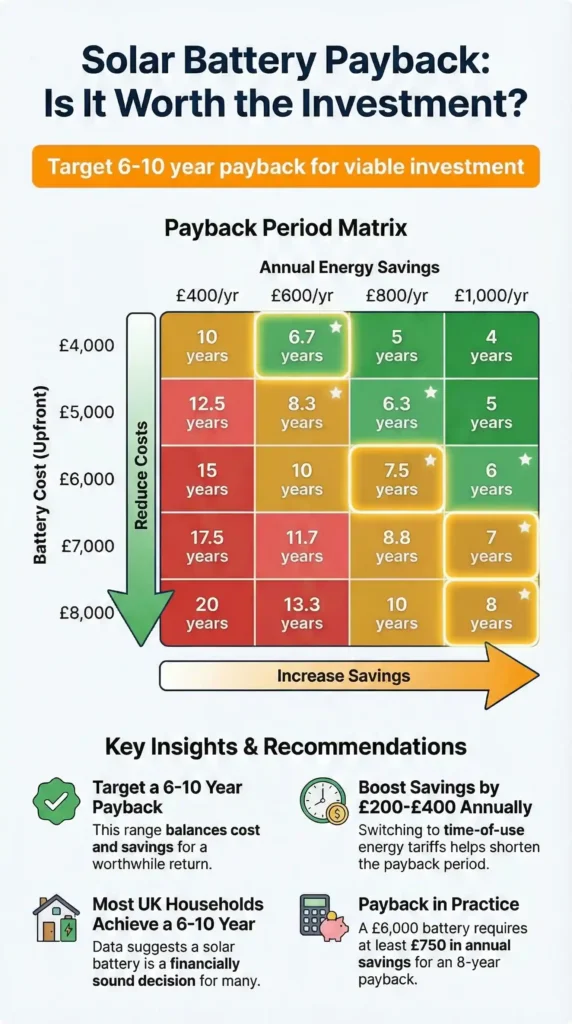
Solar batteries save £400 to £900 annually through electricity bill reduction and time-of-use tariff optimisation. Typical payback periods range from 6 to 12 years depending on battery costs, electricity consumption patterns, and tariff structures. Batteries priced at £4,500 saving £600 annually achieve 7.5-year payback. Higher-cost systems at £7,500 saving £750 annually reach 10-year payback. Time-of-use tariffs including Octopus Agile or Economy 7 accelerate payback by maximising cheap rate charging and expensive rate discharge cycles.
| Battery Cost | £300/yr Savings | £500/yr Savings | £700/yr Savings | £900/yr Savings | £1200/yr Savings |
|---|---|---|---|---|---|
| £3500 | 11.7 years | 7.0 years | 5.0 years | 3.9 years | 2.9 years |
| £4000 | 13.3 years | 8.0 years | 5.7 years | 4.4 years | 3.3 years |
| £4500 | 15.0 years | 9.0 years | 6.4 years | 5.0 years | 3.8 years |
| £5000 | 16.7 years | 10.0 years | 7.1 years | 5.6 years | 4.2 years |
| £5500 | 18.3 years | 11.0 years | 7.9 years | 6.1 years | 4.6 years |
| £6000 | 20.0 years | 12.0 years | 8.6 years | 6.7 years | 5.0 years |
| £6500 | 21.7 years | 13.0 years | 9.3 years | 7.2 years | 5.4 years |
| £7000 | 23.3 years | 14.0 years | 10.0 years | 7.8 years | 5.8 years |
| £7500 | 25.0 years | 15.0 years | 10.7 years | 8.3 years | 6.3 years |
| £8000 | 26.7 years | 16.0 years | 11.4 years | 8.9 years | 6.7 years |
Annual Electricity Bill Savings Calculation
Annual savings from solar batteries depend on stored energy utilisation and electricity rate differentials. Households storing 2,000 kilowatt-hours annually at 24 pence per unit save £480 yearly. Higher consumption properties storing 3,500 kilowatt-hours save £840 annually at standard rates. Time-of-use tariff users maximise savings through strategic charging and discharging. Octopus Agile tariff users shift 2,500 kilowatt-hours from peak rates (35p/kWh) to off-peak rates (10p/kWh) saving £625 annually. Winter months reduce savings 40 to 60 percent due to decreased solar generation and increased grid reliance.
Payback Period by Battery Cost and Usage
Battery payback periods range from 6 to 14 years across different cost and usage scenarios. A £4,000 battery saving £650 annually achieves 6.2-year payback. Mid-range £6,000 batteries saving £750 annually reach 8-year payback. Premium £8,000 batteries saving £900 annually achieve 8.9-year payback. Payback calculations exclude potential electricity rate increases that accelerate returns. Annual 5 percent electricity price increases reduce payback periods by 1 to 2 years through compounding savings. Battery degradation reducing capacity 20 percent over 10 years extends payback periods 6 to 12 months versus stable capacity assumptions.
Time-of-Use Tariff Optimisation Benefits
Time-of-use electricity tariffs accelerate battery payback through rate arbitrage opportunities. Economy 7 tariffs charging 9p per kilowatt-hour overnight versus 28p daytime enable £380 to £620 additional annual savings. Octopus Agile tariffs with dynamic pricing create £450 to £750 extra savings through strategic discharge during peak price periods. Smart batteries automatically optimise charging and discharging schedules maximising tariff advantages. Static time-of-use tariffs deliver predictable savings while dynamic tariffs introduce volatility affecting annual returns. Combined solar generation and off-peak grid charging enables year-round battery utilisation improving return on investment.
Factors Reducing Battery Financial Returns
Several factors diminish battery financial returns extending payback periods. Battery degradation reducing capacity 2 to 3 percent annually decreases savings over system lifetime. Electricity rate reductions through improved solar panel efficiency or consumption reduction lower battery value. Technology advancement creating superior batteries at lower costs makes current purchases less attractive. Grid export payments through SEG at 4 to 15 pence per kilowatt-hour may exceed battery storage value for low-consumption households. Properties generating excess solar electricity beyond household and battery capacity should compare export income against battery storage savings.
Non-Financial Benefits and Backup Power Value
Batteries provide non-financial benefits including backup power during outages, energy independence, and environmental impact reduction. Backup power capabilities during grid failures add £200 to £500 annual value for households experiencing frequent interruptions. Energy independence reducing grid reliance provides satisfaction and security worth £150 to £300 annually in subjective value. Carbon emission reduction eliminating 1 to 2 tonnes annually contributes environmental benefits worth £50 to £100 in carbon offset equivalents. Combined financial and non-financial benefits reduce effective payback periods 12 to 24 months versus pure financial analysis.
What government grants or schemes help with battery costs?
No specific UK government grants directly fund solar battery purchases in 2026. The 0 percent VAT rate on residential solar installations including batteries reduces costs by approximately £700 to £1,400 compared to standard 20 percent VAT. Smart Export Guarantee payments for excess solar electricity provide £100 to £400 annual income offsetting battery costs indirectly. Some local authorities offer general energy efficiency grants covering battery installations for qualifying low-income households. ECO4 scheme may include batteries as part of comprehensive home energy upgrades for eligible properties.
| Scheme Name | Type | Savings Amount | Eligibility | Application Process | Availability 2026 | Battery Coverage | Estimated Value |
|---|---|---|---|---|---|---|---|
| 0% VAT Rate | Tax Relief | £700-£1400 | All residential | Automatic | Until 2027 | Full coverage | £1000 average |
| Smart Export Guarantee | Income | £100-£400/year | Solar + export | Through supplier | Ongoing | Indirect offset | £150 average/yr |
| ECO4 Scheme | Grant | Up to 100% | Means-tested | Via installer | Until 2026 | If part of package | £4000-£6000 |
| Local Authority Grants | Grant | £500-£2000 | Varies by council | Council application | Limited budgets | Selected councils | £800 average |
| Green Homes Grant | Grant (ended) | Up to £5000 | N/A | Closed 2021 | Not available | N/A | £0 |
| Feed-in Tariff | Income (ended) | N/A | Closed 2019 | Not accepting new | Legacy only | N/A | £0 |
Zero VAT on Residential Battery Installations
Residential solar battery installations qualify for 0 percent VAT saving £700 to £1,400 on typical £4,000 to £8,000 systems. This government policy effective until 2027 reduces installation costs without application processes or eligibility restrictions. Standard 20 percent VAT on £6,000 battery system would add £1,200 cost. Zero rating eliminates this expense making batteries more accessible. Commercial and rental property installations pay standard 20 percent VAT excluding them from residential relief. Zero VAT applies to battery hardware, installation labour, and associated electrical work when part of qualifying residential renewable installations.
Smart Export Guarantee Income Offsetting Costs
Smart Export Guarantee payments for excess solar generation provide £100 to £400 annual income helping offset battery investment costs. Households exporting 500 to 1,500 kilowatt-hours annually at 4 to 15 pence per unit earn £100 to £225 yearly. Higher export rates from Octopus Outgoing tariffs at 15p per kilowatt-hour generate £225 to £400 annually for 1,500 to 2,500 kilowatt-hour exports. Battery installations reduce export volumes by 40 to 70 percent as stored electricity offsets evening consumption. The £100 to £400 income loss must be compared against £400 to £900 battery savings to determine net benefit. Low-consumption households generating substantial excess may benefit more from SEG export income than battery installation.
ECO4 Scheme Battery Inclusion
ECO4 scheme potentially covers battery costs as part of comprehensive energy efficiency upgrades for qualifying low-income households. The scheme prioritises insulation, heating, and solar panels with batteries considered supplementary measures. Eligibility requires means-tested benefits receipt and property EPC ratings between D and G. Battery inclusion depends on individual installer scheme offerings and remaining grant budget allocations. Applications processed through participating installers rather than direct government applications. ECO4 funding typically covers 100 percent of installation costs including batteries when included in approved upgrade plans. Review complete solar panel grant eligibility criteria to determine qualification for schemes including battery coverage.
Local Authority Energy Efficiency Grants
Selected local authorities offer energy efficiency grants potentially covering battery installations for qualifying residents. Grant availability, amounts, and eligibility vary by council area. Typical grants range from £500 to £2,000 toward battery costs for low-income or fuel poverty households. Applications require proof of residency, income verification, and property assessments. Grant programmes operate with limited annual budgets exhausting funds mid-year in popular areas. Homeowners should check council websites or contact local energy advice services for current grant availability. Combining local grants with 0 percent VAT maximises cost reduction for qualifying households.
Future Grant Scheme Prospects
UK government has not announced specific battery grant programmes for 2026 or beyond. Industry advocates lobby for battery subsidies similar to discontinued Feed-in Tariff solar panel incentives. Energy security priorities and grid stability concerns may drive future battery incentive programmes. Scotland and Wales operate separate devolved energy policies potentially introducing regional battery support schemes. Homeowners considering batteries should monitor government renewable energy announcements for emerging financial support. Waiting for potential future grants risks missing current 0 percent VAT benefits expiring in 2027 and foregone annual savings during delay periods.
How long do solar batteries last and what are replacement costs?
Solar batteries last 10 to 15 years depending on chemistry type, usage patterns, and maintenance quality. Lithium iron phosphate batteries endure 6,000 to 10,000 charge cycles equivalent to 15 to 20 years under typical usage. Standard lithium-ion batteries handle 4,000 to 6,000 cycles lasting 10 to 15 years. Battery capacity degrades 2 to 3 percent annually reducing usable storage over time. A 10kWh battery retains 8kWh usable capacity after 10 years. Replacement costs range from £3,000 to £7,000 for equivalent capacity, declining 30 to 50 percent from original purchase prices through technology improvements.
| Chemistry Type | Typical Cost 5kWh | Cycle Life | Calendar Life | Depth of Discharge | Annual Degradation | 10yr Capacity | Temperature Range | Safety Rating |
|---|---|---|---|---|---|---|---|---|
| Lithium Iron Phosphate | £4500-£6500 | 6000-10000 | 15-20 years | 90-95% | 1.5-2.5% | 75-85% | -20°C to 60°C | Excellent |
| Lithium-Ion (NMC) | £4000-£6000 | 4000-6000 | 10-15 years | 80-90% | 2-3% | 70-80% | -10°C to 45°C | Good |
| Lithium-Ion (LCO) | £3800-£5500 | 3000-5000 | 8-12 years | 80-85% | 2.5-3.5% | 65-75% | -5°C to 40°C | Acceptable |
| Lead-Acid (AGM) | £2000-£3500 | 2000-3000 | 5-8 years | 50% | 4-6% | 50-60% | 0°C to 40°C | Good |
| Solid-State (emerging) | £10000-£15000 | 15000+ | 20-25 years | 95-100% | <1% | 90-95% | -40°C to 80°C | Excellent |
Expected Battery Lifespan by Chemistry Type
Lithium iron phosphate batteries last 15 to 20 years through 6,000 to 10,000 charge cycles at 90 percent depth of discharge. Premium LiFePO4 batteries from BYD or Pylontech endure 8,000+ cycles before reaching 80 percent capacity. Standard lithium-ion batteries last 10 to 15 years handling 4,000 to 6,000 cycles. Budget lithium-ion options may reach only 4,000 cycles equivalent to 8 to 12 years under daily cycling. Lead-acid batteries last 3 to 7 years through 2,000 to 3,000 cycles making them unsuitable for daily solar storage applications. Cycle life assumes recommended depth of discharge limits with excessive discharge reducing lifespan 20 to 40 percent.
Battery Degradation Rates and Capacity Loss
Solar batteries degrade 2 to 3 percent capacity annually under normal operating conditions. A 10kWh battery loses 200 to 300 watt-hours yearly, retaining 7 to 8kWh after 10 years. Degradation accelerates under extreme temperature conditions, deep discharge cycles, or rapid charge rates. Premium batteries degrade slower at 1.5 to 2 percent annually while budget options may reach 3 to 4 percent yearly. Warranty performance guarantees typically promise 70 percent capacity retention after 10 years. Batteries falling below 70 percent capacity may warrant replacement despite continued operation. Gradual degradation allows capacity planning and replacement timing rather than sudden failures.
Warranty Coverage and Replacement Eligibility
Battery warranties span 5 to 15 years with performance guarantees ensuring 60 to 70 percent end-of-warranty capacity. Premium brands offer 10-year warranties guaranteeing 70 percent capacity retention. Mid-range manufacturers provide 10-year parts coverage with 70 percent capacity guarantees. Budget brands offer 5 to 7 year warranties with 60 to 65 percent retention promises. Warranty claims require professional assessment and documentation proving premature degradation. Replacement batteries under warranty cost only labour (£200-£400) with manufacturers covering hardware. Post-warranty replacements cost full battery prices plus installation totalling £3,500 to £8,000 depending on capacity.
Battery Replacement Costs and Technology Improvements
Battery replacement costs in 10 to 15 years will likely drop 30 to 50 percent below current pricing through technology advancement. A 10kWh battery costing £7,000 today may cost £3,500 to £4,900 when replacement becomes necessary. Improved energy density provides equivalent capacity in smaller, cheaper units. Lithium-ion prices declined 80 percent over past decade with continued reductions expected. Replacement timing coincides with potential solar panel or inverter upgrades creating opportunities for complete system modernisation. Modular battery systems enable partial capacity replacement extending overall system life beyond single-unit alternatives.
Extending Battery Lifespan Through Proper Usage
Proper battery maintenance and usage patterns extend lifespan 20 to 40 percent beyond average expectations. Maintaining batteries between 20 to 90 percent state of charge rather than 0 to 100 percent extends cycle life 30 percent. Temperature control keeping batteries 10 to 25 degrees Celsius reduces degradation rates significantly. Avoiding rapid charge and discharge rates increases longevity by minimising cell stress. Regular firmware updates from manufacturers optimise battery management systems preventing premature wear. Annual professional inspections identifying connection issues or cooling problems prevent accelerated degradation. Following manufacturer guidelines for depth of discharge limits and charge rates maximises return on investment.
Frequently Asked Questions About Solar Battery Costs UK
How much does a solar battery cost for a 3-bedroom house?
Solar batteries for typical 3-bedroom houses consuming 10 to 12 kilowatt-hours daily cost £5,000 to £6,500 installed. A 6kWh to 8kWh battery provides adequate storage for evening and overnight usage costing £5,200 to £6,200. Popular options include GivEnergy 9.5kWh (£6,200), SunSynk 8.2kWh (£5,800), and Pylontech 7.2kWh (£5,500). This sizing enables 75 to 85 percent self-sufficiency when paired with 10 to 12 solar panels. Installation costs account for £600 to £800 of total pricing.
Are solar batteries worth the cost?
Solar batteries justify costs for households with high evening electricity consumption and favourable time-of-use tariffs. Systems costing £4,500 to £6,500 save £500 to £800 annually achieving 6 to 10 year payback periods. Batteries become worthwhile when annual savings exceed 10 percent of installation costs. Properties with low evening consumption or high SEG export income may benefit more from grid export than battery storage. Non-financial benefits including backup power and energy independence add value beyond financial calculations.
How much does a Tesla Powerwall cost in the UK?
Tesla Powerwall 2 costs £7,500 installed in the UK including 13.5 kilowatt-hour battery, integrated inverter, installation labour, and 10-year warranty. Equipment-only pricing reaches £6,500 with professional installation adding £800 to £1,200. Powerwall combines battery and inverter in single unit simplifying installation but limiting retrofit flexibility. Premium pricing reflects brand recognition, proven reliability, and comprehensive warranty coverage. Alternative batteries with equivalent capacity cost £5,500 to £7,000 offering similar performance at lower prices.
Can I get a grant for a solar battery?
No specific UK government grants directly fund solar battery purchases in 2026. The 0 percent VAT rate on residential installations saves £700 to £1,400 compared to standard 20 percent VAT. ECO4 scheme may include batteries for qualifying low-income households as part of comprehensive energy upgrades. Some local authorities offer energy efficiency grants covering battery costs for eligible residents. Smart Export Guarantee provides income offsetting battery investment costs indirectly through solar export payments.
How long does a solar battery last?
Solar batteries last 10 to 15 years depending on chemistry type and usage patterns. Lithium iron phosphate batteries endure 15 to 20 years through 6,000 to 10,000 charge cycles. Standard lithium-ion batteries handle 10 to 15 years with 4,000 to 6,000 cycles. Capacity degrades 2 to 3 percent annually with batteries retaining 70 to 80 percent capacity after 10 years. Warranties typically guarantee 70 percent capacity retention for 10 years with premium brands offering 15-year coverage.
What is the cheapest solar battery?
Budget solar batteries cost £3,000 to £4,500 installed for 3kWh to 5kWh capacity. Pylontech US3000C costs £3,500 for 3.55kWh storage. Fox ESS 5kWh systems price at £3,800 to £4,200. Growatt 5kWh batteries range from £4,000 to £4,500. These budget options deliver reliable performance with 5 to 7 year warranties. Premium brands cost £1,500 to £3,000 more offering extended warranties and established UK support networks justifying higher pricing.
Do solar batteries work during power cuts?
Solar batteries provide backup power during grid outages when installed with appropriate backup functionality. Systems with backup capability automatically disconnect from grid and power selected circuits during outages. Not all battery systems include backup features with some requiring grid connection for operation. Backup-capable batteries including Tesla Powerwall 2, GivEnergy, and SunSynk cost £500 to £1,000 more than non-backup alternatives. Backup systems power essential circuits for 4 to 24 hours depending on battery capacity and load requirements.
How much does it cost to install a battery with solar panels?
Combined solar panel and battery installations cost £8,500 to £14,000 for complete systems. A 10-panel 4kW solar array with 5kWh battery costs £9,000 to £11,000 installed. Larger 12-panel systems with 8kWh batteries range from £11,500 to £14,000. Combined installations save £500 to £1,000 versus separate panel and battery installations through integrated inverter selection and single installation mobilisation. Prices include panels, battery, hybrid inverter, mounting, installation, and certification. For detailed breakdown of complete solar panel system costs including equipment, labour, and ongoing expenses, see our comprehensive solar cost analysis.
Can I add a battery to my existing solar panels?
Existing solar panel systems accept battery additions through AC-coupled or DC-coupled retrofit installations. AC-coupled batteries cost £4,500 to £7,000 installed preserving existing solar inverters. DC-coupled retrofits requiring hybrid inverter replacement cost £5,000 to £8,500 including new inverter. Retrofit costs exceed new installation pricing £300 to £800 due to integration complexity. Pre-2018 solar installations often need hybrid inverter upgrades for battery compatibility adding £1,200 to £2,000 expenses.
What size battery do I need for solar panels?
Battery sizing depends on evening and overnight electricity consumption rather than total daily usage. Households using 6 kilowatt-hours from 5pm to 7am need 7kWh batteries costing £5,000 to £5,800. Properties consuming 10 kilowatt-hours nightly require 11kWh batteries costing £7,000 to £7,800. Battery capacity should equal evening consumption divided by 0.9 accounting for 90 percent usable depth of discharge. Smart meter data provides accurate consumption patterns for proper sizing calculations.
Solar battery costs in the UK range from £3,000 to £10,000 installed with pricing determined by capacity, brand, and installation complexity. Careful sizing based on consumption patterns, comparison of warranty terms, and consideration of retrofit versus new installation costs ensures optimal battery investment. Financial returns through electricity bill savings compete with non-financial benefits including energy independence and backup power capability. Understanding all cost factors, available schemes, and realistic payback periods enables informed battery purchase decisions.

Solar Energy Funding Specialist & Home Energy Advisor
Zachariah Eaton is a UK-based solar energy funding specialist with a focus on helping homeowners access grants, financing schemes, and cost-saving renewable solutions. He has spent years researching government-backed programmes such as ECO4, Smart Export Guarantee (SEG), and local funding initiatives to make solar more accessible. Zachariah writes practical, easy-to-understand guides that help households reduce energy bills and transition to clean energy with confidence.
Best solar panel prices UK
- Zachariah Eaton
- November 10, 2025
solar inverter cost in the UK
- Zachariah Eaton
- November 20, 2025