
Best Solar Panel Prices UK: How to Find the Lowest Deals in 2026
Finding the best solar panel prices in the UK requires understanding current market rates, knowing where to look for deals, and comparing offers effectively. This comprehensive guide reveals actual 2026 pricing, identifies the cheapest suppliers, explains seasonal discounts, and shows you how to secure the lowest possible price for quality solar installations.
Table of Contents
ToggleWhat are the current solar panel prices in the UK for 2026?
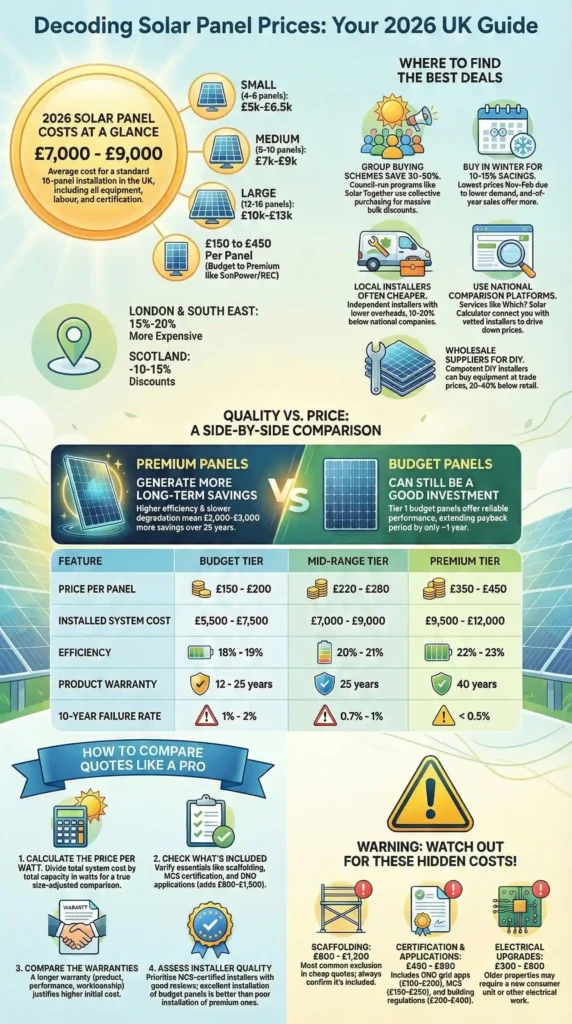
Solar panel system prices in the UK range from £4,500 for small 2-panel installations to £12,000 for larger 12-panel systems. The average 10-panel installation costs £7,000 to £9,000 including equipment, labour, scaffolding, and certification. Price per kilowatt varies between £1,200 and £1,800 depending on equipment quality and installer choice.
Small systems with 4-6 panels suitable for modest electricity needs cost £5,000 to £6,500. Medium-sized 8-10 panel installations serving average households range from £7,000 to £9,000. Large systems with 12-16 panels for high consumption properties or those seeking maximum generation cost £10,000 to £13,000.
Equipment-only prices for panels alone range from £150 to £450 per panel before installation. Budget Tier 1 panels from manufacturers like Longi or Trina cost £150 to £200 per panel. Mid-range panels from JA Solar or Jinko price at £220 to £280 per panel. Premium panels from SunPower or REC command £350 to £450 per panel.
Full installation prices per panel including all costs average £350 to £750 depending on system size and complexity. Smaller installations cost more per panel due to fixed setup costs like scaffolding and certification spreading across fewer units. Larger installations achieve economies of scale reducing per-panel costs significantly.
Regional price variations exist across the UK. London and South East installers charge 15 to 20 percent premiums compared to UK averages. Scottish cities offer 10 to 15 percent discounts reflecting lower operating costs. Northern Ireland shows the highest prices due to limited installer competition and transport costs.
Where can I find the cheapest solar panel prices in the UK?
Group buying schemes like Solar Together offer the cheapest prices through collective purchasing power. These council-run programmes negotiate bulk discounts with vetted installers, delivering savings of 30 to 50 percent compared to individual quotes. Registration typically opens once yearly with limited enrolment windows.
Wholesale suppliers selling equipment only without installation provide the lowest equipment costs. Distributors like Midsummer Energy, UK Solar Supplies, and Solar Trade Sales offer trade prices 20 to 40 percent below retail. This option suits competent DIY installers or those hiring separate labour. Learn more about where to buy solar panels at trade prices to source equipment directly.
National comparison platforms including Which? Solar Calculator and Energy Saving Trust quote service connect you with multiple installers simultaneously. These services leverage installer competition to secure competitive pricing while maintaining quality standards through vetted networks.
Seasonal sales periods from November to December offer significant discounts as installers clear stock and secure year-end revenue. End-of-financial-year deals in March provide similar opportunities. Winter installations generally cost 10 to 15 percent less than summer peak season pricing.
Factory-direct purchases from panel manufacturers eliminate distributor markups. Some manufacturers like Canadian Solar and Trina operate UK sales divisions selling directly to consumers. Savings of 15 to 25 percent are possible though manufacturer relationships with installers may complicate installation sourcing.
Local installer networks often provide better value than national brands. Independent installers operating with lower overheads pass savings to customers while maintaining equivalent technical competence. Prices typically run 10 to 20 percent below national company rates.
How do I compare solar panel prices fairly?
Like-for-like equipment comparison requires matching panel wattage, efficiency ratings, and warranty terms across quotes. A 400-watt panel costs more than a 350-watt panel, but lower quantities of higher-wattage panels may provide better overall value. Compare total system capacity in kilowatts rather than panel counts.
Included services vary dramatically between quotes affecting true cost comparisons. Verify whether prices include scaffolding, DNO applications, MCS certification, building regulations approval, and any required electrical upgrades. Hidden exclusions can add £800 to £1,500 to headline prices.
Price per watt calculations enable size-adjusted comparisons. Divide total system cost by total capacity in watts to obtain this metric. Systems ranging from 3.5 to 4.5 kilowatts typically cost £1,650 to £2,025 per kilowatt installed. Lower rates indicate better value for given equipment specifications. For a complete breakdown of all ownership costs including maintenance, insurance, and degradation, see our guide on total cost of solar panel ownership.
Warranty comparison reveals long-term value beyond upfront pricing. Panel warranties range from 12 to 40 years product coverage. Inverter warranties span 5 to 25 years depending on type. Workmanship warranties from installers vary from 2 to 10 years. Longer warranties justify higher initial costs through reduced future expenses.
Installation quality indicators separate cheap from good value. Check installer MCS certification, insurance coverage, customer reviews, and business longevity. Quotes from uncertified installers offering prices 30 percent below market rates often indicate substandard work or missing legal requirements.
Payment terms affect true costs when financing is involved. Cash purchases cost baseline amounts. Interest-free credit over 24 months matches cash prices. Loans at 9.9 percent APR over 10 years nearly double total costs. Factor financing charges when comparing installer payment options.
What is the price difference between cheap and quality solar panels?
Budget solar panels from Tier 1 manufacturers cost £150 to £200 per panel with 380 to 410 watt ratings. These panels offer 12 to 25 year product warranties and 18 to 19 percent efficiency. Total system costs using budget panels range from £5,500 to £7,500 for typical installations.
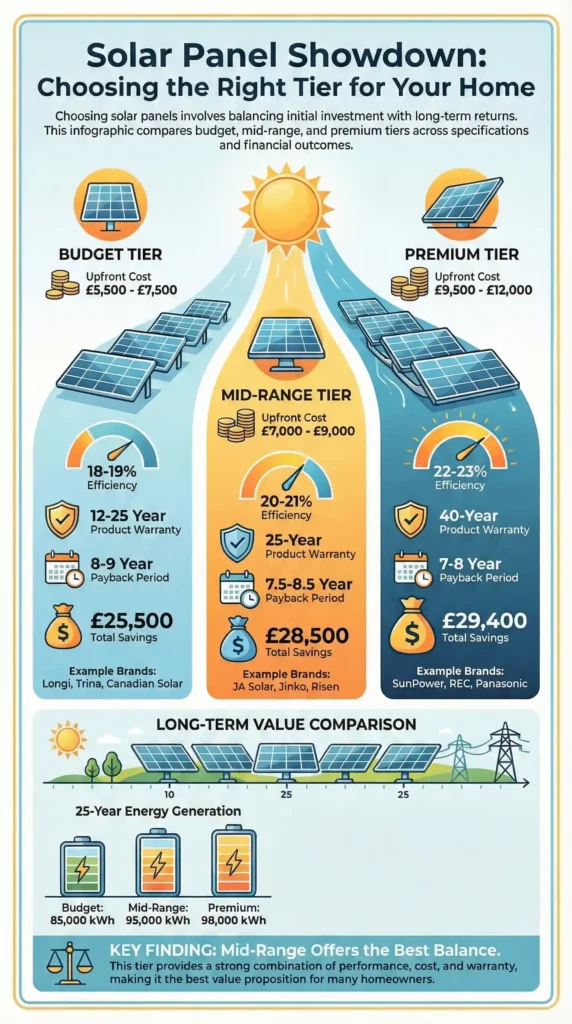
Mid-range solar panels price at £220 to £280 per panel with 420 to 450 watt outputs. Manufacturers like JA Solar, Jinko, and Trina provide these options with 25 year product warranties and 20 to 21 percent efficiency. Complete installations using mid-range equipment cost £7,000 to £9,000.
Premium solar panels from SunPower, REC, or Panasonic command £350 to £450 per panel offering 400 to 440 watts. These feature 40 year product warranties, 22 to 23 percent efficiency, and superior aesthetics. Full installations with premium panels cost £9,500 to £12,000 for standard systems.
Performance differences between tiers impact long-term returns. Budget panels generate 10 to 15 percent less electricity over their lifetime compared to premium options due to lower efficiency and faster degradation rates. This translates to £2,000 to £3,000 less savings over 25 years.
Reliability variations affect maintenance costs and warranty claims. Premium panels experience failure rates below 0.5 percent over 10 years. Budget panels show 1 to 2 percent failure rates requiring warranty replacements. Mid-range options fall between at 0.7 to 1 percent failure rates.
Aesthetic considerations influence property value and personal satisfaction. Premium all-black panels with sleek frames enhance property appearance. Budget panels with visible silver frames and blue cells appear more industrial. Visual impact matters for front-facing installations or conservation areas.
When is the best time to buy solar panels for lowest prices?
Winter months from November through February offer the lowest solar panel prices as installer demand drops sharply. Seasonal discounts of 10 to 15 percent below summer rates are common. Installation availability is immediate with no waiting lists, and installers negotiate more readily on pricing.
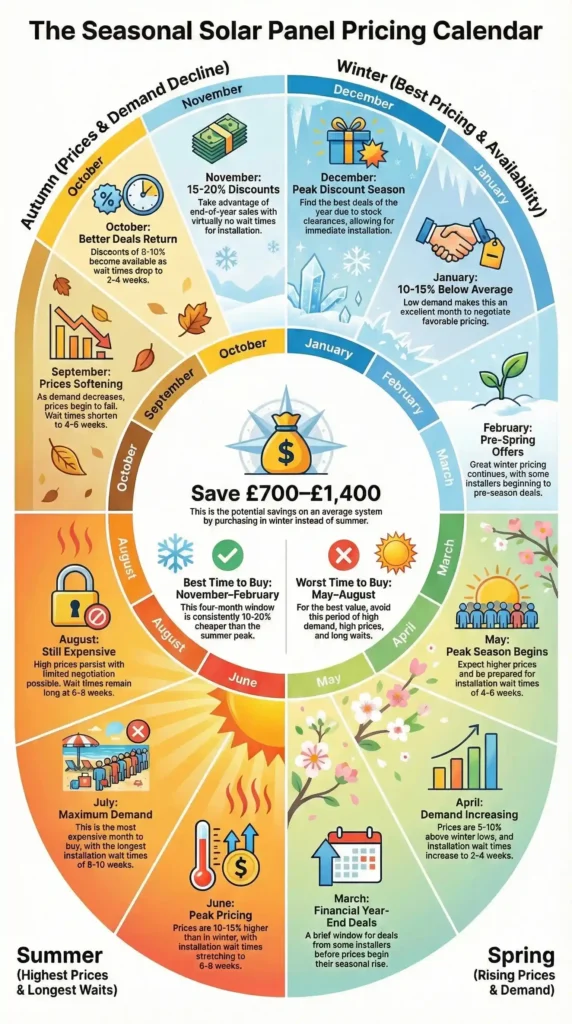
End-of-year sales from November through December target revenue goals and stock clearance. Installers offer promotional discounts to meet annual targets and reduce inventory before tax year closing. Savings of 15 to 20 percent on equipment or installation labour frequently appear.
March presents opportunities during financial year-end for many businesses. Installers seeking strong quarterly results before April offer competitive pricing. Stock clearance before new model releases creates additional incentive for discounting older panel models.
Summer peak season from May through August brings highest prices and longest wait times. Demand surge creates installer leverage reducing negotiation room. Prices run 10 to 15 percent above winter rates, and installation scheduling extends 8 to 12 weeks out.
Midweek and off-peak installation scheduling can secure discounts. Installers prefer filling weekday slots over weekend work commanding premium rates. Flexibility on installation dates may yield 5 to 8 percent savings through efficient crew scheduling.
| Month | Average Price vs Baseline | Discount/Premium | Installer Demand | Typical Wait Time | Deal Availability | Quote Negotiations | Best For |
|---|---|---|---|---|---|---|---|
| January | -12% | 10-15% discount | Very Low | Immediate | High | Very Easy | Maximum savings |
| February | -10% | 8-12% discount | Low | 1 week | High | Easy | Great value |
| March | -5% | 3-8% discount | Moderate | 1-2 weeks | Moderate | Moderate | Year-end deals |
| April | +2% | Baseline | Moderate-High | 2-4 weeks | Low | Difficult | Avoid if possible |
| May | +8% | 5-10% premium | High | 4-6 weeks | Very Low | Very Difficult | Peak season begins |
| June | +12% | 10-15% premium | Very High | 6-8 weeks | None | Extremely Difficult | Worst month |
| July | +15% | 12-18% premium | Peak | 8-10 weeks | None | Impossible | Avoid completely |
| August | +10% | 8-12% premium | Very High | 6-8 weeks | Very Low | Very Difficult | Still expensive |
| September | +5% | 3-8% premium | High | 4-6 weeks | Low | Difficult | Prices softening |
| October | -3% | 2-5% discount | Moderate | 2-4 weeks | Moderate | Moderate | Good value returns |
| November | -15% | 12-20% discount | Low | 1-2 weeks | Very High | Easy | Best deals start |
| December | -18% | 15-20% discount | Very Low | Immediate | Maximum | Very Easy | Peak discount season |
Economic downturn periods create buyer advantages as competition intensifies. Recession conditions force installers to maintain revenue through competitive pricing. Monitor market conditions for opportune purchasing windows during economic uncertainty.
Are cheaper solar panels worth buying?
Cheaper solar panels deliver acceptable performance for budget-conscious buyers prioritising upfront savings over long-term optimisation. Budget Tier 1 panels from reputable manufacturers provide reliable 25-year operation at 10 to 15 percent lower lifetime generation than premium alternatives. The £2,000 to £3,000 upfront savings may outweigh reduced long-term returns for some buyers.
Payback period differences between panel tiers affect purchase decisions. Budget panels extend payback from 8 to 9 years compared to 7 to 8 years for premium panels. The one-year difference is manageable given lower initial investment. Mid-range panels offer optimal balance achieving 7.5 to 8.5 year payback with moderate upfront costs.
Quality threshold considerations prevent false economy. Tier 1 manufacturer designation indicates minimum acceptable quality standards. Avoid unbranded or Tier 2/3 panels regardless of low prices as failure rates exceed 5 percent over 10 years. Stick to recognised manufacturers even when buying budget options.
Warranty coverage comparison reveals hidden costs. Budget panels with 12-year product warranties may require replacement before 25-year performance warranties expire. Premium 40-year product warranties eliminate mid-life replacement concerns. Calculate potential replacement costs when evaluating budget options.
Property tenure influences panel tier decisions. Owners planning to sell within 10 years benefit less from premium panel longevity. Budget or mid-range panels provide adequate performance during ownership period. Long-term property owners maximise returns through premium panel investment.
Installation quality matters more than panel tier for overall system success. Excellent installation of budget panels outperforms poor installation of premium equipment. Prioritise installer competence over panel tier if budget constraints require trade-offs.
How much can group buying schemes save on solar panel prices?
Solar Together group buying programmes deliver savings of 30 to 50 percent compared to individual retail quotes. Council-run schemes aggregate demand across thousands of households, negotiating volume discounts with vetted installers. A typical 10-panel installation costing £9,000 individually may cost £5,400 to £6,300 through Solar Together.
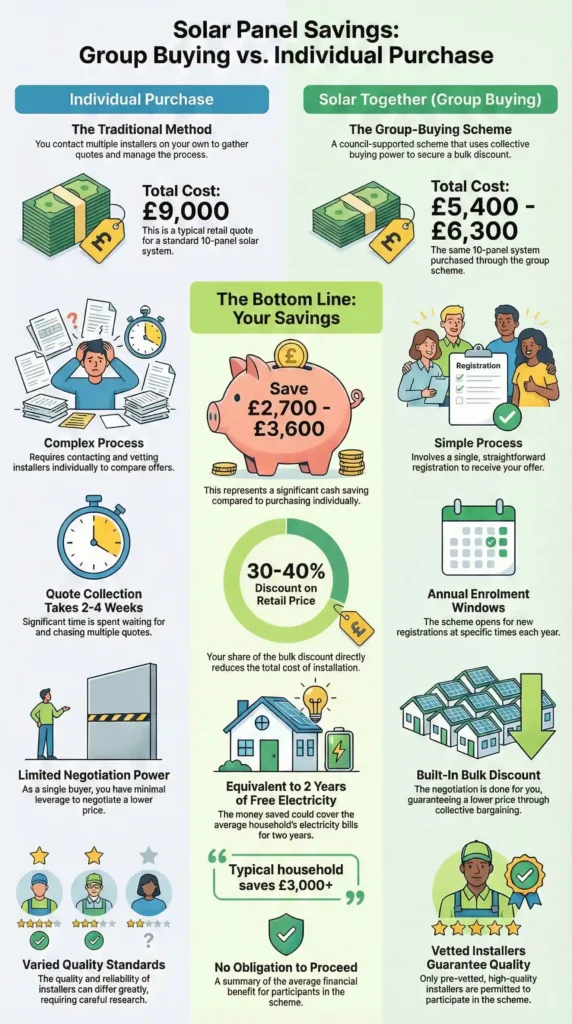
Registration processes occur annually with specific enrolment windows. Councils announce registration periods typically in autumn, accepting applications for 4 to 6 weeks. Auctions follow where installers bid for collective installation contracts. Winners provide standardised quotes to all registered participants.
Participation requirements vary by council area. Some schemes remain open to all residents while others prioritise low-income households or specific property types. Check your local council website for Solar Together availability and eligibility criteria in your region.
Equipment specifications in group buying schemes balance quality and affordability. Schemes typically specify mid-range Tier 1 panels from manufacturers like Jinko or Trina with 25-year warranties. Inverter options include both string and micro inverters. Battery additions are often available at discounted rates.
Acceptance remains voluntary after receiving quotes. Participants review standardised pricing and decide whether to proceed. No obligation exists to accept offers. However, declining and re-registering for future rounds is typically permitted.
| Factor | Individual Purchase | Solar Together Group Buying | Difference/Savings |
|---|---|---|---|
| 10-Panel System Price | £9000 | £5400-£6300 | £2700-£3600 (30-40%) |
| 14-Panel System Price | £11500 | £7500-£8600 | £2900-£3900 (25-35%) |
| Equipment Quality | Varies by installer | Standardized Tier 1 mid-range | Comparable quality |
| Installer Vetting | User responsibility | Council pre-vetted | Enhanced assurance |
| Quote Collection Time | 2-4 weeks (3-5 quotes) | Single registration | Time savings |
| Negotiation Leverage | Limited (individual buyer) | Built-in (bulk discount) | Significant advantage |
| Customization Options | Fully flexible | Standardized packages | Less flexibility |
| Warranty Terms | Varies (2-10 year workmanship) | Standardized (typically 5+ years) | Consistent coverage |
| Payment Flexibility | Varies by installer | Standardized terms | Transparent pricing |
| Availability | Year-round | Annual enrollment windows | Limited window |
| Geographic Coverage | All UK | Participating council areas only | Limited coverage |
| Registration Cost | £0 | £0 | Equal |
| Obligation to Accept | None | None | Equal |
| Battery Addition Cost | £4000-£5500 | £3200-£4400 | £800-£1100 savings |
Limitations include reduced customisation compared to individual procurement. Panel placement, system size options, and equipment brands follow standardised configurations. Buyers seeking specific premium brands or custom designs may find individual procurement more suitable despite higher costs.
What hidden costs should I watch for in cheap solar panel quotes?
Scaffolding exclusions represent the most common hidden cost in cheap quotes. Full scaffolding hire costs £600 to £1,200 for standard two-storey homes. Quotes excluding scaffolding appear artificially low while requiring substantial additional payment. Always confirm scaffolding inclusion in headline prices.
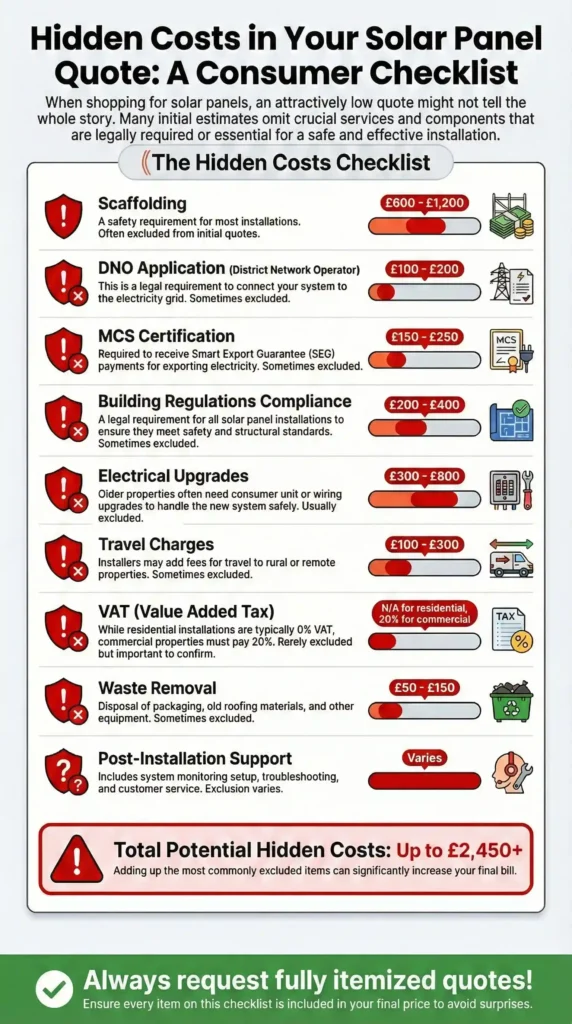
DNO application fees for grid connection permissions add £100 to £200 per installation. Cheap quotes may omit these mandatory costs, surprising buyers during final billing. Distribution Network Operator approval is legally required for all grid-tied systems. Verify DNO application handling and costs upfront.
MCS certification registration fees of £150 to £250 enable SEG payment eligibility. Some installers exclude these costs from quotes, adding them later. MCS registration is mandatory for accessing government incentives. Confirm whether quotes include full certification processing.
Electrical upgrades including consumer unit replacements or meter changes add £300 to £800 when required. Older properties often need electrical modernisation before solar installation. Quotes should specify whether electrical assessments and potential upgrades are included.
Building regulations approval costs £200 to £400 depending on local authority requirements. All solar installations require building control notification. Cheaper installers may charge this separately. Ensure quotes clarify building regulations handling and costs.
| Cost Category | Typical Cost | Included in Standard Quotes? | Included in Cheap Quotes? | Impact if Missing | Mandatory? | Notes |
|---|---|---|---|---|---|---|
| Scaffolding | £600-£1200 | Yes (95%) | Sometimes (40%) | Major | Yes | Most installations require it |
| DNO Application | £100-£200 | Usually (85%) | Sometimes (50%) | Moderate | Yes | Legally required for grid connection |
| MCS Certification | £150-£250 | Usually (90%) | Sometimes (60%) | Major | For SEG only | Required for SEG payments |
| Building Regulations | £200-£400 | Usually (80%) | Rarely (30%) | Major | Yes | All installations need approval |
| Electrical Upgrades | £300-£800 | Rarely (20%) | Never (0%) | Major | If needed | Older properties often require |
| Consumer Unit Replacement | £400-£700 | Rarely (15%) | Never (0%) | Major | If needed | Pre-17th edition boards |
| Travel/Rural Charges | £100-£300 | Sometimes (40%) | Rarely (10%) | Moderate | Varies | Properties >50 miles from base |
| Waste Removal | £50-£150 | Usually (70%) | Sometimes (40%) | Minor | No | Packaging disposal |
| Post-Install Monitoring | £0-£200 | Sometimes (50%) | Rarely (20%) | Minor | No | Remote system monitoring |
| Design/Survey Fees | £0-£200 | Usually (80%) | Sometimes (50%) | Minor | No | Some installers charge separately |
Travel surcharges for properties beyond standard service areas add £100 to £300. Installers typically cover travel within 30 to 50 miles. Rural locations or areas outside normal coverage attract additional charges. Confirm whether your location incurs travel fees.
How do online solar panel prices compare to installer quotes?
Online equipment prices from wholesale suppliers run 20 to 40 percent below installed system costs from professional installers. A complete equipment package costing £3,000 online becomes a £7,000 installed system through professional installers. The £4,000 difference covers labour, scaffolding, certification, and installer overhead.
DIY installation using online equipment suits competent tradespeople with electrical qualifications. Self-installation saves labour costs of £2,000 to £3,000 for typical residential systems. However, DIY work voids manufacturer warranties and disqualifies systems from SEG payments without proper MCS certification.
Online marketplaces like eBay and Amazon list solar equipment at competitive prices. Panels range from £120 to £380 each depending on specifications. Complete DIY kits with panels, inverters, and mounting hardware cost £2,500 to £5,000. Buyer beware applies as warranty support and product authenticity vary.
Specialist solar wholesalers including Midsummer Energy and Solar Trade Sales offer trade prices to verified buyers. Account setup requires business registration or trade credentials. Prices run 15 to 25 percent below consumer retail while maintaining manufacturer warranties and support.
Online quote platforms connect buyers with multiple installers competing for business. Services like Which? Solar, Energy Saving Trust, and Solar Guide provide free quote comparison. These platforms deliver competitive pricing through installer competition while maintaining quality through vetting processes.
Comparison shopping across online and traditional channels yields optimal pricing. Obtain online equipment prices as negotiation benchmarks when discussing quotes with installers. Equipment cost awareness prevents overpricing and identifies value-focused installers.
What are the price ranges for different solar panel system sizes?
Small 2-4 panel systems generating 0.8 to 1.6 kilowatts cost £3,500 to £5,000 installed. These suit low electricity consumption households, supplementary power needs, or space-constrained properties. Panels cost £350 to £450 each installed due to fixed setup costs spreading across few units.
Medium 6-8 panel systems producing 2.4 to 3.2 kilowatts range from £5,500 to £7,500. This size serves average UK households consuming 2,900 kilowatt-hours annually. Per-panel installed costs drop to £280 to £350 as fixed costs distribute across more units.
Standard 10-12 panel installations generating 4.0 to 4.8 kilowatts cost £7,000 to £9,500. These represent the most popular size for UK homes, providing substantial bill reduction without excessive capacity. Installed panel costs reach optimal efficiency at £250 to £320 per unit.
Large 14-16 panel systems delivering 5.6 to 6.4 kilowatts price at £9,500 to £12,000. High-consumption households, electric vehicle owners, or those seeking maximum self-sufficiency choose these sizes. Economies of scale reduce per-panel costs to £240 to £300 installed.
Extra-large systems exceeding 16 panels for 6.4+ kilowatts range from £12,000 to £16,000. These suit large properties with high daytime electricity usage or planned future consumption increases. Cost per kilowatt reaches minimum levels of £1,400 to £1,600 for these installations.
| System Size | Panels | Capacity (kW) | Price Range | Price per Panel | Price per kW | Best For | Typical Annual Generation |
|---|---|---|---|---|---|---|---|
| Small | 2-4 | 0.8-1.6 | £3500-£5000 | £350-£450 | £1750-£2100 | Low usage homes/supplements | 800-1600 kWh |
| Small-Medium | 6-8 | 2.4-3.2 | £5500-£7500 | £280-£350 | £1650-£1950 | 2-bed homes/modest consumption | 2400-3200 kWh |
| Standard | 10-12 | 4.0-4.8 | £7000-£9500 | £250-£320 | £1550-£1850 | 3-bed homes/average UK household | 4000-4800 kWh |
| Large | 14-16 | 5.6-6.4 | £9500-£12000 | £240-£300 | £1500-£1750 | 4-bed homes/high usage | 5600-6400 kWh |
| Extra-Large | 18-20 | 7.2-8.0 | £12000-£15000 | £230-£280 | £1450-£1700 | Large homes/EV charging | 7200-8000 kWh |
| Commercial | 20+ | 8.0+ | £15000+ | £220-£260 | £1400-£1600 | Business/very high usage | 8000+ kWh |
Commercial systems over 20 kilowatts enter different pricing structures with costs per kilowatt dropping to £1,000 to £1,400. Bulk purchasing, simplified installations on large roof areas, and reduced per-site setup costs enable commercial pricing advantages.
How do solar panel prices vary by manufacturer and quality tier?
Budget Tier 1 manufacturers including Longi, Trina, and Canadian Solar price panels at £150 to £200 each for 380 to 410 watt models. These brands deliver reliable performance with 25-year warranties and 18 to 19 percent efficiency. Total installed system costs using budget brands range from £5,500 to £7,500.
Mid-range manufacturers like JA Solar, Jinko, and Risen offer panels at £220 to £280 each producing 420 to 450 watts. These feature 25-year product warranties, 20 to 21 percent efficiency, and established UK support networks. Complete installations using mid-range equipment cost £7,000 to £9,000.
| Quality Tier | Brand Examples | Price per Panel | Wattage | Efficiency | Product Warranty | Performance Warranty | Degradation Rate | 10-Panel System Cost | Failure Rate (10yr) |
|---|---|---|---|---|---|---|---|---|---|
| BUDGET | Longi, Trina, Canadian Solar | £150-£200 | 380-410W | 18-19% | 12-25 years | 25 years | 0.55%/year | £5500-£7500 | 1-2% |
| MID-RANGE | JA Solar, Jinko, Risen | £220-£280 | 420-450W | 20-21% | 25 years | 25 years | 0.45%/year | £7000-£9000 | 0.7-1% |
| PREMIUM | SunPower, REC, Panasonic | £350-£450 | 400-440W | 22-23% | 40 years | 25 years | 0.25%/year | £9500-£12000 | <0.5% |
| EMERGING | Aiko, DAS Solar, Astronergy | £180-£240 | 430-450W | 21-22% | 25-30 years | 25 years | 0.40%/year | £6500-£8500 | 0.8-1.2% |
| EUROPEAN | Meyer Burger, REC | £320-£420 | 410-430W | 21-22% | 25-30 years | 25 years | 0.35%/year | £9000-£11500 | 0.5-0.8% |
Premium brands including SunPower, REC, LG, and Panasonic command £350 to £450 per panel for 400 to 440 watt outputs. Superior aesthetics, 40-year warranties, 22 to 23 percent efficiency, and lowest degradation rates justify premium pricing. Full systems using premium panels cost £9,500 to £12,000.
Emerging Chinese brands like Aiko, DAS Solar, and Astronergy offer competitive pricing at £180 to £240 per panel with impressive specifications. These newer market entrants provide 430 to 450 watts, N-type cell technology, and 25 to 30 year warranties. UK market presence remains limited affecting installer availability.
European manufacturers including Meyer Burger and REC command premium prices reflecting European production costs. Panels cost £320 to £420 each with 410 to 430 watt outputs. European manufacturing appeals to buyers prioritising local production despite higher costs.
British-made panels from manufacturers operating UK facilities are extremely rare. Viridian Solar produces in-roof systems domestically at premium pricing. Most UK-branded panels use Asian manufacturing with British company oversight. True British production commands 30 to 50 percent premiums.
What package deals and bundle offers provide best value?
Complete system packages including panels, inverter, mounting, and installation provide best value through consolidated pricing. Installers offering package deals typically discount 10 to 15 percent compared to itemised component pricing. Standard packages for 10-panel systems cost £7,000 to £8,500 all-inclusive.
Panel and battery bundles deliver savings of £800 to £1,200 compared to adding battery storage separately later. Integrated installations avoid duplicate scaffolding, electrical work, and certification fees. Packages with 10 panels and 5-kilowatt-hour battery cost £10,000 to £12,000.
Multi-property deals where neighbours coordinate installations together save 8 to 12 percent per household. Installers reduce per-site setup costs and travel expenses when completing multiple nearby installations. Three neighbouring installations save each household £600 to £1,000.
Solar plus EV charger packages combine two green technologies at bundled pricing. Joint installation saves £300 to £500 on separate charger installation costs. Packages with panels and 7-kilowatt charger cost £8,500 to £10,500 depending on system size.
Maintenance packages prepaid during installation secure discounted annual service rates. Five-year maintenance agreements cost £400 to £600 compared to £150 to £180 per year purchased separately. Prepaid maintenance provides 20 to 30 percent savings over separate annual purchases.
Finance packages offering interest-free credit over 24 months provide payment flexibility without extra costs. Longer-term finance at 4.9 to 9.9 percent APR costs more overall but spreads payments manageably. Calculate total finance costs when evaluating package value.
How do I negotiate better solar panel prices with installers?
Multiple quote comparison creates negotiation leverage by demonstrating market awareness. Obtaining three to five quotes establishes pricing baselines and identifies outliers. Present lower quotes to higher-priced installers requesting price matching or equipment upgrades at original prices.
Cash payment offers provide negotiation opportunity as installers avoid credit card processing fees of 2 to 3 percent. Offering immediate cash payment may secure 5 to 8 percent discounts on total costs. However, never pay full amounts upfront regardless of discounts offered.
Flexible timing provides negotiation advantage during installer quiet periods. Winter installation acceptance, midweek scheduling, or off-peak timing enables 5 to 10 percent discounts. Installers prefer filling calendar gaps over leaving crews idle.
Equipment specification flexibility enables value optimisation. Accept installer preferred brands when performance and warranties match requirements. Installers achieve better margins on favoured suppliers and pass some savings to flexible buyers through reduced prices or upgraded specifications.
Volume commitment through referrals or multiple property arrangements secures preferential pricing. Promising two additional customer referrals may yield 5 to 8 percent discounts. Multiple family properties installed together command bulk pricing benefits.
Review-based incentives where positive online reviews earn discounts create mutual benefit. Installers value authentic positive reviews for marketing. Offering thoughtful reviews in exchange for 3 to 5 percent discounts benefits both parties.
What government schemes affect solar panel pricing?
Smart Export Guarantee payments affect net system costs through long-term revenue. SEG rates ranging from 1 to 15 pence per kilowatt-hour exported generate £100 to £400 annually. Over 20 years, SEG income reduces effective system costs by £2,000 to £8,000 depending on export volumes and rates.
VAT rates at 0 percent for residential solar installations reduce costs significantly compared to standard 20 percent rates. This government policy saves £1,400 to £2,400 on typical £7,000 to £12,000 installations. Commercial installations pay standard VAT increasing effective prices substantially.
ECO4 scheme eligibility provides free or subsidised installations for qualifying low-income households. Systems worth £7,000 to £12,000 install at no cost to eligible recipients. Qualification requires means-tested benefits receipt and property EPC ratings between D and G. Learn more about government grant schemes for solar panels and check your qualification status.
Local authority grant programmes in some regions offer solar panel subsidies. Schemes vary by council with grants of £500 to £2,000 toward installation costs. Check your local council website for current grant availability and application procedures.
Home upgrade grants in off-gas grid properties provide solar panel funding as part of comprehensive energy efficiency improvements. Grants cover costs up to £7,500 per property for eligible rural homes. Solar panels combine with insulation and heating upgrades under this programme.
Interest-free loans through some local authorities enable solar installations without upfront costs. Repayment terms span 5 to 10 years with no interest charges. This effectively spreads installation costs across manageable monthly payments without finance charges.
Are clearance and end-of-line solar panels worth buying?
Clearance solar panels from previous model years offer genuine savings of 20 to 40 percent off retail prices. Panel technology evolves gradually, meaning last-year models perform comparably to current releases. A 420-watt panel from 2024 selling at £160 rather than £240 provides excellent value.
End-of-line stock arises when manufacturers introduce new model series with minor improvements. Previous generation panels maintain full manufacturer warranties and identical reliability. Only aesthetic changes or marginal efficiency gains differentiate models.
Stock clearance sales occur when UK distributors or installers reduce inventory before new shipments arrive. These sales target cash flow improvement and warehouse space optimisation rather than product defects. Discounts of 15 to 30 percent are common.
Factory second panels with cosmetic imperfections sell at steep discounts despite full functionality. Minor scratches, colour variations, or packaging damage reduce prices 30 to 50 percent. Performance remains identical to perfect units. Verify warranty coverage includes factory seconds before purchasing.
Discontinued model availability requires careful consideration of ongoing support. Check whether manufacturer discontinuation affects warranty claims or replacement panel availability if future repairs become necessary. Well-established manufacturers maintain support for discontinued models throughout warranty periods.
Urgent closing sales from installers ceasing operations create risky opportunities. Deeply discounted equipment paired with questionable warranty support and installer workmanship guarantees present significant risk. Avoid installers showing financial distress regardless of attractive pricing.
How do solar panel prices compare between direct purchase and finance?
Cash purchase prices represent baseline costs without interest charges or financing fees. A £8,000 system purchased with cash costs exactly £8,000 total. This represents optimal pricing when funds are available without opportunity costs exceeding financing rates.
Interest-free credit over 12 to 24 months matches cash pricing without additional costs. Some installers or finance providers offer 0 percent APR promotions. Total payments equal cash prices spread across monthly instalments. This option provides payment flexibility without penalty.
Low-interest financing at 4.9 percent APR over 5 years adds £1,100 to a £8,000 system. Total repayment reaches £9,100 across 60 monthly payments of £152. Moderate interest costs may prove worthwhile when cash deployment elsewhere generates higher returns.
| Payment Method | APR | Term (Months) | Monthly Payment | Total Paid | Interest Paid | Effective Cost Increase | Time to Positive Cash Flow |
|---|---|---|---|---|---|---|---|
| Cash Payment | 0% | N/A | £8000 upfront | £8000 | £0 | 0% | Immediate** |
| Interest-Free Credit | 0% | 24 | £333 | £8000 | £0 | 0% | Month 1 |
| Low Interest (Short) | 4.9% APR | 60 | £150 | £9100 | £1100 | 13.8% | Month 7 |
| Standard Interest (Medium) | 7.9% APR | 84 | £125 | £10500 | £2500 | 31.3% | Month 13 |
| High Interest (Long) | 9.9% APR | 120 | £128 | £15400 | £7400 | 92.5% | Month 28 |
| Credit Card (Poor) | 21.9% APR | 60 | £220 | £13200 | £5200 | 65% | Month 20 |
Standard financing at 9.9 percent APR over 10 years nearly doubles system costs. An £8,000 system costs £15,400 total across 120 monthly payments of £128. High-interest long-term finance dramatically undermines solar investment economics. Avoid this option unless cash flow constraints are severe.
Loan origination fees and arrangement charges increase effective financing costs beyond stated APR. Fees of £150 to £400 add to total amounts borrowed. Factor all fees when calculating true financing costs against cash purchase pricing.
Savings comparison reveals financing viability. Monthly electricity bill savings should exceed finance payments for economic sense. If £128 monthly payments exceed typical £90 bill reductions, long-term high-interest finance creates net negative cash flow.
What price differences exist between supply-only and installed systems?
Supply-only equipment packages cost 40 to 55 percent less than fully installed systems from professional installers. A complete equipment set costing £3,500 becomes a £7,000 to £8,000 installed system. The £3,500 to £4,500 difference covers labour, scaffolding, and professional services.
Labour costs for professional installation range from £2,000 to £3,000 for standard residential systems. This includes design, electrical work, mounting, system commissioning, and certification. Experienced installers complete typical installations in two to three days. Explore detailed breakdown of installation labour costs including regional variations and complexity factors.
Scaffolding hire costs £600 to £1,200 for two-storey properties depending on duration and complexity. DIY buyers must arrange separate scaffolding hire adding this cost to supply-only equipment. Professional installers include scaffolding in quoted prices through established supplier relationships.
Certification and compliance costs including MCS registration, DNO applications, and building regulations total £500 to £800. Professional installers handle all certification as included services. DIY installers must navigate certification processes independently and pay fees separately.
Warranty considerations affect true cost comparisons. Manufacturer warranties on panels and inverters remain valid for supply-only purchases. However, installation workmanship warranties only apply to professional installations. DIY installation voids professional installation guarantees.
SEG payment eligibility requires MCS-certified installation regardless of equipment source. DIY installations using supply-only equipment cannot claim SEG payments unless installed by MCS-certified professionals. This requirement undermines DIY cost savings for most buyers.
Frequently Asked Questions About Solar Panel Prices UK
What is the average price for solar panels in the UK?
The average solar panel installation costs £7,000 to £9,000 for a standard 10-panel system generating 4 kilowatts. This includes all equipment, labour, scaffolding, and certification. Price per kilowatt ranges from £1,650 to £2,025 depending on equipment quality and installer choice. Smaller systems cost £5,000 to £6,500 while larger installations reach £10,000 to £13,000.
Are solar panels cheaper in winter?
Yes, solar panels cost 10 to 15 percent less during winter months from November through February. Installer demand drops during cold weather creating pricing flexibility. Winter installations also benefit from immediate availability with no waiting lists and greater negotiation leverage. End-of-year sales in November and December offer additional discounts of 15 to 20 percent.
How much do cheap solar panels cost?
Budget Tier 1 solar panels cost £150 to £200 per panel before installation for 380 to 410 watt models. Complete installations using budget panels range from £5,500 to £7,500 for typical 10-panel systems. These deliver reliable performance with 25-year warranties despite lower upfront costs. Avoid unbranded panels below £120 regardless of attractive pricing.
What is included in solar panel prices?
Standard solar panel quotes include panels, inverter, mounting equipment, installation labour, scaffolding, DNO applications, MCS certification, and building regulations approval. Verify each inclusion as some installers exclude scaffolding or certification fees from headline prices. Hidden exclusions can add £800 to £1,500 to quoted costs. Always request itemised quotes clarifying all inclusions.
Can I negotiate solar panel prices?
Yes, solar panel prices are negotiable, particularly during winter months or when presenting multiple competing quotes. Cash payment, flexible installation timing, and referral promises provide negotiation leverage. Realistic negotiation yields 5 to 15 percent discounts or equipment upgrades. Avoid installers unwilling to discuss pricing as this indicates inflexible margins or overpricing.
How do Solar Together prices compare to retail?
Solar Together group buying schemes deliver prices 30 to 50 percent below individual retail quotes through bulk purchasing power. A typical £9,000 retail installation costs £5,400 to £6,300 through Solar Together. Participation requires registration during annual enrolment windows. Equipment specifications follow standardised configurations with less customisation than individual procurement.
Are online solar panel prices reliable?
Online solar panel prices from reputable wholesalers are reliable for equipment-only purchases. Prices run 20 to 40 percent below installed system costs from professional installers. However, online prices exclude labour, scaffolding, and certification worth £3,500 to £4,500. Online equipment purchasing suits competent DIY installers with electrical qualifications. Most buyers require professional installation despite higher costs.
What affects solar panel pricing most?
System size affects pricing most significantly through economies of scale. Small systems cost £350 to £450 per panel installed while large installations achieve £240 to £300 per panel. Equipment quality creates 30 to 40 percent price ranges between budget and premium options. Installer choice varies prices 15 to 25 percent between local independents and national companies.
Do solar panel prices include batteries?
No, standard solar panel prices exclude battery storage unless explicitly specified. Panel-only systems cost £5,500 to £9,000 for typical installations. Adding battery storage increases costs by £3,000 to £5,000 depending on capacity. Always clarify whether quotes include batteries as this dramatically affects total pricing. Battery additions often qualify for package discounts when installed simultaneously with panels.
How do I find the lowest solar panel prices?
Find lowest prices by obtaining quotes from Solar Together group buying schemes, comparing three to five independent local installers, timing purchases for November-December sales, and negotiating with cash payment offers. Winter installation acceptance and flexible timing secure 10 to 15 percent discounts. Avoid the cheapest quotes if prices fall 30+ percent below market rates as this indicates substandard work.
This comprehensive guide to solar panel pricing in the UK provides the information needed to find genuine deals, avoid overpricing, and secure quality installations at competitive rates. Understanding market pricing, seasonal variations, and negotiation strategies ensures optimal value for your solar investment.

Solar Energy Funding Specialist & Home Energy Advisor
Zachariah Eaton is a UK-based solar energy funding specialist with a focus on helping homeowners access grants, financing schemes, and cost-saving renewable solutions. He has spent years researching government-backed programmes such as ECO4, Smart Export Guarantee (SEG), and local funding initiatives to make solar more accessible. Zachariah writes practical, easy-to-understand guides that help households reduce energy bills and transition to clean energy with confidence.
Best Solar Panel Installers in Solihull
- Zachariah Eaton
- November 8, 2025
solar battery cost in the UK
- Zachariah Eaton
- November 12, 2025