Solar Panel Funding in the UK
Solar panel funding in the UK provides households and businesses with financial pathways to reduce installation costs through government grants, regional programmes, and alternative financing mechanisms. This comprehensive guide examines all active funding routes in January 2026, including ECO4 scheme details before its March 2026 closure, Warm Homes Plan provisions, Smart Export Guarantee benefits, regional programmes across England, Scotland, Wales and Northern Ireland, plus detailed eligibility criteria and application processes for each funding type.
Table of Contents
ToggleUnderstanding Solar Panel Funding Mechanisms in 2026
Solar panel funding refers to financial support structures designed to lower upfront costs for photovoltaic system installations on residential, commercial, and social housing properties. The UK government allocated £13.2 billion to the Warm Homes Plan, demonstrating continued commitment to renewable energy accessibility despite the scheduled March 2026 termination of the ECO4 scheme.
Typical domestic solar installations range from £4,216 to £9,837 depending on system capacity and property requirements. Funding programmes address this primary adoption barrier through direct grants, partial subsidies, tax relief mechanisms, and group purchasing schemes.
Primary Funding Categories Available in 2026
Government-backed schemes operate across multiple delivery frameworks, each targeting specific household categories and property types. Understanding these distinct funding routes enables property owners to identify applicable support mechanisms.
Direct Grant Programmes
ECO4 scheme providing full or partial installation coverage until March 31 2026. Warm Homes Local Grant offering up to £30,000 for eligible properties. Regional schemes in Scotland, Wales and Northern Ireland with devolved criteria.
Tax Relief Mechanisms
Zero percent VAT on solar panel supply and installation until March 31 2027. Potential savings of approximately £2,850 on typical 4kW residential systems. Relief applies across England, Scotland and Wales.
Income Generation Schemes
Smart Export Guarantee payments for surplus energy returned to grid. Average annual earnings between £80 and £170 for domestic installations. No eligibility restrictions or expiration dates.
Group Purchasing Programmes
Solar Together bulk buying schemes reducing costs through collective negotiation. Local authority coordination enabling 10 to 20 percent price reductions. Registration-based participation open to all qualifying postcodes.
ECO4 Scheme: Final Months of Energy Company Obligation Programme
The Energy Company Obligation 4 represents the UK government’s flagship solar funding initiative, scheduled to conclude on March 31 2026. Chancellor Rachel Reeves confirmed no extension period, transitioning support focus toward Warm Homes Plan delivery frameworks.
ECO4 Programme Structure and Delivery
Ofgem administers the £4 billion ECO4 programme, compelling energy suppliers with customer bases exceeding 150,000 to fund energy efficiency improvements for eligible households. Obligated suppliers include British Gas, EDF Energy, E.ON, Octopus Energy, Scottish Power, and SSE.
The scheme encompasses solar panel installations alongside insulation upgrades, heating system replacements, and heat pump conversions. As of February 2026, suppliers delivered 38,005 solar panel installations, representing 5.75 percent of total ECO4 measures.
Funding allocations vary based on property assessments and household circumstances. Energy companies determine grant levels and select approved solar panel installers for each project. Eligible participants receive complete coverage in numerous cases, though some installations require homeowner contributions for supplementary measures.
| Metric | Value | Percentage of Total ECO4 |
|---|---|---|
| Total ECO4 Measures Delivered | 660,487 | 100% |
| Solar Panel Installations | 38,005 | 5.75% |
| Heating Controls Installed | 343,453 | 52.0% |
| Insulation Measures | 197,345 | 29.9% |
| Heat Pump Installations | 52,639 | 8.0% |
| Other Efficiency Measures | 29,045 | 4.4% |
| Average Solar Installation Cost | £6,850 | - |
| Total Solar Funding Distributed | £260,342,500 | - |
ECO4 Eligibility Requirements for January 2026
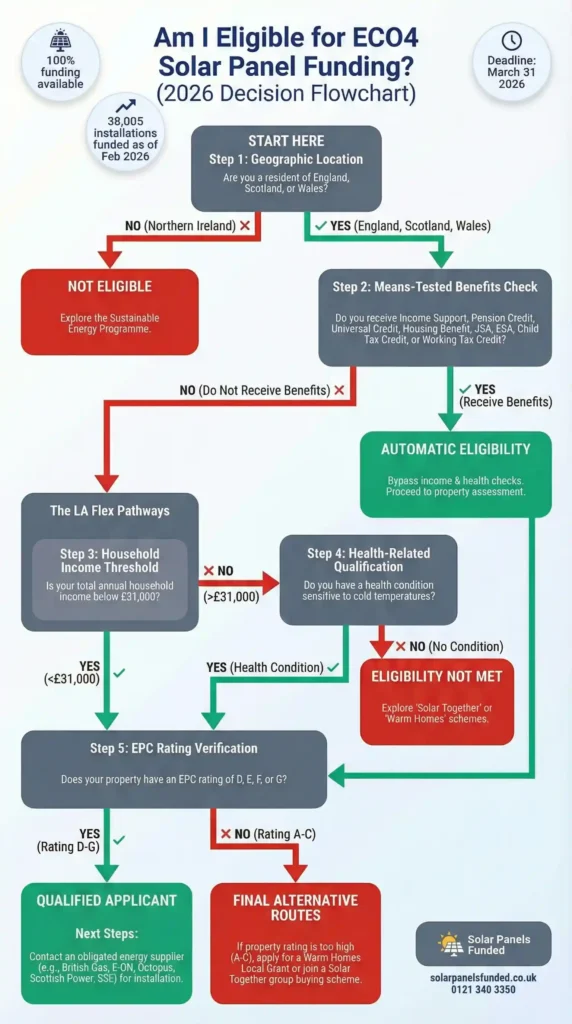
Government funding for solar panels through ECO4 targets households meeting benefit-based or income-threshold criteria.
Help to Heat Group Qualification
Recipients of Income Support, Pension Credit, Universal Credit with earnings threshold. Housing Benefit, Employment and Support Allowance, Job Seekers Allowance. Child Tax Credit, Working Tax Credit, Warm Home Discount participants.
Property-Based Requirements
Located in England, Scotland or Wales (ECO4 unavailable in Northern Ireland). Energy Performance Certificate rating of D, E, F or G. Owner-occupied dwellings or private rental properties with documented landlord consent. Structurally suitable roof orientation, pitch angle and shading conditions.
Local Authority Flexible Eligibility Extensions
Income thresholds below £31,000 annual household earnings. Health conditions worsened by cold temperatures. Fuel debt exceeding 13 weeks on standard meters. Energy supplier referrals for vulnerable circumstances.
| Eligibility Route | Income Threshold | Benefit Requirement | EPC Rating | Property Type | Geographic Coverage |
|---|---|---|---|---|---|
| Standard Help to Heat | No limit if receiving benefits | Yes - means-tested benefits | D, E, F, G | Owner-occupied or rental | England, Scotland, Wales |
| LA Flex (Income) | £31,000 annual | Not required | D, E, F, G | Owner-occupied or rental | Council-dependent |
| LA Flex (Health) | No limit | Not required | D, E, F, G | Owner-occupied or rental | Council-dependent |
| LA Flex (Fuel Debt) | No limit | Not required | D, E, F, G | Owner-occupied only | England, Scotland, Wales |
| Supplier Flex | Supplier discretion | Not required | D, E, F, G | Owner-occupied or rental | Supplier-dependent |
ECO4 Application Process Before March 2026 Deadline
Contact obligated energy supplier from approved provider list. Complete telephone assessment covering property specifications and heating requirements. Arrange home survey with TrustMark registered installer to verify suitability. Review assessment report detailing recommended measures and funding allocation. Approve installation proposal and confirm scheduling. Installer executes approved work and submits compliance documentation. Energy supplier settles payment directly with installation contractor.
Application processing timelines span two to eight weeks depending on regional demand and installer scheduling capacity. Early submission before March deadline essential for securing funding approval.
| Stage | Duration | Activities | Potential Delays |
|---|---|---|---|
| Initial Contact | 1-3 days | Contact supplier, register interest | High call volumes |
| Telephone Assessment | 3-7 days | Property questions, eligibility check | Document gathering |
| Home Survey Booking | 5-14 days | Schedule surveyor visit | Surveyor availability |
| Property Survey | 1 day | Physical inspection, measurements | Weather conditions |
| Assessment Report | 7-14 days | Report preparation, funding approval | Technical reviews |
| Installation Scheduling | 7-21 days | Contractor booking | Contractor availability |
| Installation Day | 1-3 days | Panel installation, testing | Site complications |
| Compliance Submission | 3-7 days | Paperwork finalization | Document verification |
| Total Timeline | 28-70 days | Full process | Multiple factors |
ECO4 Programme Limitations and Practical Considerations
Professional solar panel installations comprise 6.2 percent of ECO4 measures, as energy suppliers prioritise simpler installations including heating controls (52 percent of measures) and insulation upgrades. This reflects supplier discretion in funding allocation and installation complexity preferences.
Quality concerns emerged regarding installation workmanship in certain cases, necessitating careful installer verification through TrustMark registration checks and customer review examination. The scheme’s March 2026 termination creates application urgency for eligible households.
Warm Homes Plan: Long-Term Funding Framework 2025-2028
The Warm Homes Plan commenced in April 2025 as the UK government’s primary energy efficiency programme, operating through 2028 with £13.2 billion allocated funding. This initiative replaces previous Home Upgrade Grant and Local Authority Delivery schemes.
Warm Homes Local Grant Programme Structure
The Warm Homes Local Grant distributes £500 million through 278 local authorities across England, Scotland and Wales. Participating councils receive funding allocations to improve energy efficiency and heating systems in eligible properties within their jurisdictions.

Qualified households access up to £30,000 in grant support, structured as £15,000 for energy performance upgrades (including solar panels, battery storage, insulation, draught-proofing, doors and glazing) plus £15,000 for low-carbon heating systems (heat pumps, electric storage heaters, biomass boilers).
| Region | Local Authorities Participating | Total Funding Allocated | Average per Authority | Properties Eligible |
|---|---|---|---|---|
| Southeast England | 47 | £89.5 million | £1.9 million | 42,350 |
| Northwest England | 38 | £76.2 million | £2.0 million | 38,100 |
| London | 33 | £62.7 million | £1.9 million | 28,450 |
| Southwest England | 29 | £54.3 million | £1.9 million | 26,150 |
| Yorkshire & Humber | 26 | £49.8 million | £1.9 million | 24,900 |
| East Midlands | 24 | £45.6 million | £1.9 million | 22,800 |
| West Midlands | 23 | £43.7 million | £1.9 million | 21,850 |
| Eastern England | 21 | £39.9 million | £1.9 million | 19,950 |
| Northeast England | 18 | £34.2 million | £1.9 million | 17,100 |
| Wales | 12 | £22.8 million | £1.9 million | 11,400 |
| Scotland | 7 | £13.3 million | £1.9 million | 6,650 |
| Total | 278 | £532.0 million | £1.9 million | 259,700 |
Warm Homes Eligibility Framework
Household Income Thresholds
Combined annual household earnings below £36,000 to £39,000 (council-dependent). Households receiving means-tested benefits regardless of income levels. Properties located in Index of Multiple Deprivation bands 1 to 3.
Property Energy Performance Requirements
Energy Performance Certificate ratings between D and G. Properties without existing EPC assessments receive free evaluation. Off-grid heating systems (oil, coal, LPG, electric storage heaters).
Geographic Availability
England-based properties in participating local authority areas. Scotland and Wales residents through devolved administration equivalents. Northern Ireland operates separate Sustainable Energy Programme.
Warm Homes Application Methodology
Visit local authority website to verify participation status and available funding. Complete online eligibility assessment tool provided by council. Submit supporting documentation (proof of income, benefit letters, property ownership). Arrange property survey with council-approved energy assessor. Receive grant offer detailing approved measures and funding allocation. Select installer from council-approved contractor list. Schedule installation and receive final approval documentation.
Council processing times vary from four weeks to twelve weeks based on application volumes and funding availability within each authority’s allocation period.
| Feature | ECO4 Scheme | Warm Homes Local Grant |
|---|---|---|
| Maximum Funding | Up to 100% installation cost | Up to £30,000 (£15k solar/efficiency) |
| Programme End Date | March 31 2026 | March 2028 |
| Income Threshold | £31,000 or benefit-dependent | £36,000-£39,000 (council-dependent) |
| EPC Requirements | D, E, F, G ratings | D, E, F, G ratings |
| Geographic Coverage | England, Scotland, Wales | England primarily (278 councils) |
| Application Timeline | 8-10 weeks average | 12-16 weeks average |
| Battery Storage Included | Rarely | Sometimes included in allocation |
| Processing Authority | Obligated energy suppliers | Local authority councils |
| Funding Source | Energy supplier obligations | Direct government grants |
| Installer Selection | Supplier-chosen | Council-approved list |
Smart Export Guarantee: Ongoing Income Generation from Solar Systems
The Smart Export Guarantee launched January 1 2020, requiring licensed energy suppliers to pay households for surplus electricity exported to the National Grid. Unlike time-limited grant programmes, SEG operates indefinitely without scheduled termination.
SEG Payment Framework and Tariff Structures
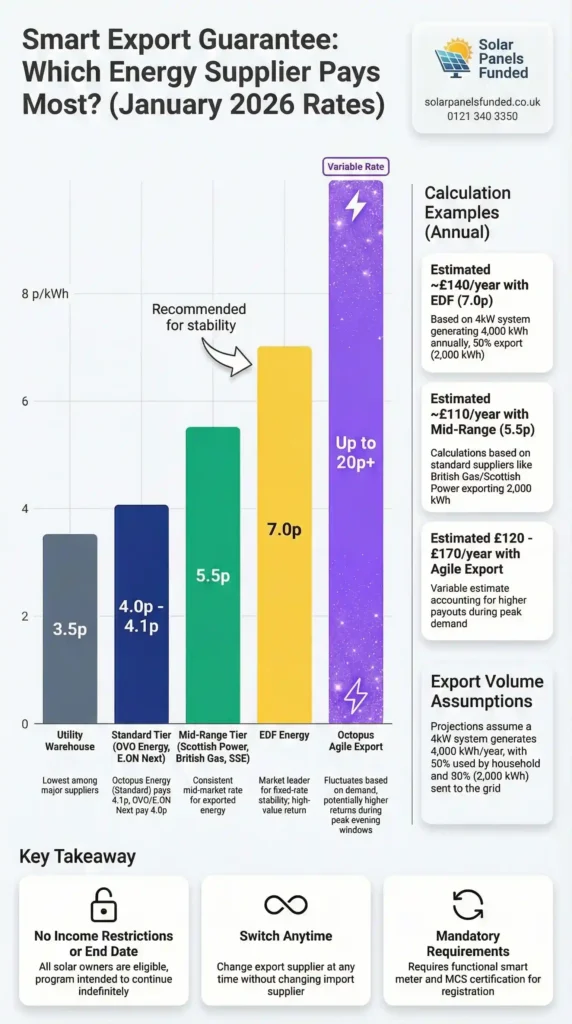
Energy suppliers set individual export rates, typically ranging from 4 pence to 11 pence per kilowatt-hour. Average domestic installations generate surplus exports delivering £80 to £170 annual income, supplementing direct electricity bill savings.
| Energy Supplier | Standard Export Rate | Variable Rate Option | Payment Frequency | Minimum System Size | Annual Income (4kW System) |
|---|---|---|---|---|---|
| Octopus Energy | 4.1p per kWh | Agile Export (up to 20p+ per kWh) | Monthly | No minimum | £82-£164 |
| British Gas | 5.5p per kWh | Not available | Quarterly | No minimum | £110 |
| E.ON Next | 4.0p per kWh | Not available | Quarterly | No minimum | £80 |
| EDF Energy | 7.0p per kWh | Not available | Quarterly | No minimum | £140 |
| Scottish Power | 5.5p per kWh | Not available | Quarterly | No minimum | £110 |
| OVO Energy | 4.0p per kWh | Not available | Monthly | No minimum | £80 |
| SSE | 5.5p per kWh | Not available | Quarterly | No minimum | £110 |
| Utility Warehouse | 3.5p per kWh | Not available | Monthly | No minimum | £70 |
Higher export rates apply during peak demand periods through time-of-use tariffs. Octopus Agile Export pays spot market rates, occasionally exceeding 20p per kWh during grid stress events.
SEG Eligibility and Registration Requirements
All solar panel owners with systems up to 5 megawatts capacity qualify for SEG participation. Registration requires completed Microgeneration Certification Scheme approval for installations, plus working export meter (smart meter preferred).
Property owners select preferred energy supplier offering SEG tariffs, independent of electricity import supplier. Multiple suppliers provide quotes enabling rate comparison before registration.
Zero Percent VAT Relief on Solar Panel Installations
The UK government implemented zero percent VAT rate on energy-saving materials and installation services from April 1 2022, extending through March 31 2027. This relief applies to solar panel supply and fitting across England, Scotland and Wales.
VAT Relief Financial Impact
Standard 20 percent VAT on typical £7,300 solar installation adds £1,460 to purchase cost. Zero percent relief delivers direct £1,460 saving for average 4.5kW residential system suitable for three-bedroom properties.
Relief encompasses complete installation packages including panels, inverters, mounting hardware, electrical components and labour charges. Separate purchases of panels and installation services retain standard VAT rates.
| System Size | Typical Installation Cost | 20% VAT (if applicable) | 0% VAT Saving | Effective Price with Relief |
|---|---|---|---|---|
| 3.5kW (Small) | £5,800 | £1,160 | £1,160 | £5,800 |
| 4.0kW (Average) | £6,450 | £1,290 | £1,290 | £6,450 |
| 4.5kW (Large) | £7,300 | £1,460 | £1,460 | £7,300 |
| 5.5kW (Extra Large) | £8,950 | £1,790 | £1,790 | £8,950 |
| 6.5kW (Premium) | £10,200 | £2,040 | £2,040 | £10,200 |
VAT Relief Qualification Criteria
Installations on residential properties qualify automatically. Combined supply-and-install contracts from registered installers. Solar thermal systems and photovoltaic systems both eligible. Battery storage systems included within relief framework when installed alongside panels.
Commercial property installations and standalone battery purchases without concurrent solar installation attract standard VAT rates.
Regional Solar Funding Programmes Across UK Nations
Scotland, Wales and Northern Ireland operate devolved funding schemes alongside UK-wide programmes, each with distinct eligibility frameworks and application processes.
Scotland: Home Energy Scotland Loan and Grants
Home Energy Scotland closed new solar panel referrals in June 2024, though applications submitted before this date continue processing. The programme offered £6,000 total support (£1,250 grant plus £4,750 optional loan) for solar thermal and hybrid systems.
Current Scottish funding channels through Warmer Homes Scotland scheme providing ECO4-equivalent support for energy efficiency measures. Scottish homeowners access ECO4 directly through obligated energy suppliers.
Wales: Warm Homes Programme and Nest Scheme
The Warm Homes Programme replaced the previous Nest Scheme in April 2024, operating through April 2031 with enhanced solar installation focus. Previous scheme delivered solar to 18.3 percent of supported households in 2022-23.
Welsh Programme Eligibility
Recipients of means-tested benefits including Universal Credit and Housing Benefit. Health conditions exacerbated by cold indoor temperatures. Household income below £36,000 annual threshold. Properties with Energy Performance Certificate ratings D to G.
Applications processed through Welsh government’s energy advice service. Average processing times span six to ten weeks from initial assessment through installation approval.
Northern Ireland: Sustainable Energy Programme
Northern Ireland operates separate funding through Sustainable Energy Programme administered by Northern Ireland Housing Executive. Solar panel support targets social housing properties and low-income private households.
ECO4 does not extend to Northern Ireland properties. Residents explore Sustainable Energy Programme grants or alternative financing through community renewable energy cooperatives.
| Region | Programme Name | Maximum Funding | Income Threshold | EPC Requirement | End Date | Application Method |
|---|---|---|---|---|---|---|
| England | ECO4 | Up to 100% cost | £31,000 | D-G | March 2026 | Energy suppliers |
| England | Warm Homes Local | £30,000 | £36,000-£39,000 | D-G | March 2028 | Local councils |
| Scotland | Warmer Homes Scotland | Varies | Means-tested | D-G | Ongoing | Home Energy Scotland |
| Scotland | ECO4 (via suppliers) | Up to 100% cost | £31,000 | D-G | March 2026 | Energy suppliers |
| Wales | Warm Homes Programme | Varies | £36,000 | D-G | April 2031 | Welsh Government |
| Wales | ECO4 (via suppliers) | Up to 100% cost | £31,000 | D-G | March 2026 | Energy suppliers |
| Northern Ireland | Sustainable Energy | Varies | Means-tested | Varies | Ongoing | NI Housing Executive |
Solar Together: Group Purchasing Schemes Reducing Installation Costs
Solar Together operates as government-backed group-buying initiative coordinated by local authorities across England, Scotland and Wales. The programme enables bulk panel purchases through competitive tender processes, reducing per-installation costs without direct grants but you must compare solar panel prices across suppliers before final decision.
Solar Together Operational Framework
Participating councils register interested households during defined registration windows (typically February through April). Accumulated registrations enable councils to tender installation contracts to approved suppliers.
Successful suppliers provide discounted quotes to all registered households, typically 10 to 20 percent below individual market rates. Households retain choice to accept or decline quotes without obligation.
| System Size | Individual Market Quote | Solar Together Quote | Absolute Saving | Percentage Saving | Households Benefiting (2025) |
|---|---|---|---|---|---|
| 3.5kW | £5,800 | £4,930 | £870 | 15.0% | 2,450 |
| 4.0kW | £6,450 | £5,483 | £967 | 15.0% | 8,900 |
| 4.5kW | £7,300 | £6,205 | £1,095 | 15.0% | 12,350 |
| 5.5kW | £8,950 | £7,158 | £1,792 | 20.0% | 4,200 |
| 6.5kW | £10,200 | £8,160 | £2,040 | 20.0% | 1,850 |
| Weighted Average | £7,140 | £6,069 | £1,071 | 15.0% | 29,750 |
Solar Together Participation Requirements
Homeowners and landlords in participating local authority areas qualify regardless of income or benefit status. Properties require suitable roof space, structural integrity and electrical capacity for solar installation.
Registration opens during specific windows announced by participating councils. Missed registration periods require waiting for subsequent annual cycle.
Business Solar Panel Funding and Commercial Schemes
Businesses access distinct funding routes separate from domestic schemes, targeting operational cost reduction and carbon footprint mitigation.
Public Sector Decarbonisation Scheme
Government-backed initiative supporting public sector building solar installations. Fourth phase launched February 2024 with target of 75 percent carbon emissions reduction by 2037.
Schools, hospitals, local government buildings and emergency services facilities qualify for capital funding covering solar PV systems, battery storage and related energy efficiency improvements.
Business Energy Efficiency Grants
Regional development agencies and local enterprise partnerships provide grants for SME solar installations. Funding availability varies by location and industry sector.
Common Business Eligibility Criteria
Registered UK business with trading history. Annual turnover thresholds (typically £100,000 to £5,000,000 range). Properties with suitable commercial roof space. Business rates payment current and compliant.
Application processes require detailed business plans, financial projections, and carbon reduction targets.
Solar Panel Funding Application Documentation Requirements
Successful funding applications require comprehensive supporting documentation across all scheme types. Preparation before application submission reduces processing delays.
Essential Documents for Household Applications
Identity and Property Verification
Photo identification (passport, driving licence). Council tax statements or utility bills confirming address. Property ownership documentation (title deeds, mortgage statements). Landlord consent letters for rental properties.
Financial and Benefit Evidence
Recent bank statements showing income deposits. Benefit award letters dated within past three months. P60 tax forms or payslips for employed applicants. Self-assessment tax returns for self-employed applicants.
Property Energy Documentation
Current Energy Performance Certificate (dated within past ten years). Previous energy bills demonstrating consumption patterns. Building insurance policy confirming structural coverage. Planning permission for listed buildings or conservation areas.
| Document Type | ECO4 | Warm Homes | Solar Together | Business Grants | Northern Ireland SEP |
|---|---|---|---|---|---|
| Photo ID | ✓ Required | ✓ Required | ✓ Required | ✓ Required | ✓ Required |
| Proof of Address | ✓ Required | ✓ Required | ✓ Required | ✓ Required | ✓ Required |
| Property Ownership | ✓ Required | ✓ Required | Optional | ✓ Required | ✓ Required |
| Benefit Award Letters | ✓ If claiming | ✓ If claiming | Not required | Not applicable | ✓ If claiming |
| Income Evidence | For LA Flex | ✓ Required | Not required | ✓ Required | ✓ Required |
| EPC Certificate | ✓ Required (D-G) | ✓ Required (D-G) | Recommended | Not required | Varies |
| Council Tax Statement | ✓ Required | ✓ Required | Optional | Not applicable | Optional |
| Landlord Consent | If renting | If renting | Not applicable | If leased | If renting |
| Business Registration | Not applicable | Not applicable | Not applicable | ✓ Required | Not applicable |
| Financial Accounts | Not applicable | Not applicable | Not applicable | ✓ 3 years | Not applicable |
Business Application Documentation
Companies provide additional materials including:
VAT registration certificates. Companies House registration confirmation. Business premises ownership or lease agreements. Director identification and business banking information. Three years’ financial accounts or management forecasts.
Solar Funding Eligibility Calculators and Pre-Assessment Tools
Online eligibility tools help households determine qualification before formal applications. Multiple organisations provide free assessment calculators.
Energy Saving Trust Eligibility Checker
Energy Saving Trust offers comprehensive eligibility assessment covering ECO4, Warm Homes grants, and regional schemes. The tool requires:
Postcode to determine local authority participation. Age and type of property. Number of occupants and household composition. Current heating system details. Benefit receipt status.
Results indicate likely qualifying schemes with confidence ratings. The checker does not replace formal applications, serving as preliminary guidance.
Supplier-Specific Assessment Tools
British Gas, E.ON, and Octopus Energy provide dedicated ECO4 eligibility checkers on corporate websites. These tools assess qualification for supplier-administered ECO4 projects before committing to formal application processes.
Understanding Solar Panel Funding Reviews and Customer Experiences
Customer feedback provides practical insights into funding application experiences across different schemes and regions. Analysis of 2024-2025 application cycles reveals consistent patterns.
Positive Outcomes Reported by Funded Households
Households securing ECO4 or Warm Homes funding report:
Average electricity bill reductions between £650 and £1,020 annually. Energy Performance Certificate improvements averaging 2.3 rating points. Professional installation quality from MCS-certified contractors. Clear communication throughout application and installation phases. Post-installation support for system monitoring and maintenance queries.
Common Challenges in Funding Applications
Application difficulties include:
Processing delays during peak application periods (January through March). Documentation requests for benefit verification requiring multiple submissions. Property survey rejections due to shading, roof condition, or structural limitations. Installer availability constraints causing scheduling delays. Regional funding exhaustion before application submission dates.
Early application submission and complete documentation assembly mitigate most processing delays. Households with borderline eligibility benefit from pre-application consultations with scheme administrators.
Solar Panel Financing Alternatives for Non-Qualifying Households
Households ineligible for grants access alternative financing mechanisms to spread installation costs while maintaining manageable payment structures.
Solar Panel Finance Options Through Energy Suppliers
Multiple suppliers offer solar financing with terms from 12 to 240 months.
British Gas Solar Finance
12.9 percent APR representative rate. Loan amounts £3,000 to £25,000. Terms up to 10 years. Deposit options from zero to 25 percent.
E.ON Solar Payment Plans
11.5 percent APR representative rate. Minimum loan value £5,000. Maximum term 15 years. Early repayment options without penalties.
Octopus Solar Subscription
No upfront cost subscription model. Fixed monthly payments for 20-year term. System ownership transfers after contract completion. Includes maintenance and insurance coverage.
Green Home Finance Providers
Specialist green finance lenders offer competitive rates for renewable installations:
The Eco Experts Green Loans: 8.9 percent APR, terms to 25 years. Zopa Green Home Improvement Loans: 7.5 percent APR, £7,500 to £35,000. The Co-operative Bank Green Loans: 9.9 percent APR, up to £50,000.
Interest rates reflect individual credit assessments. Representative APR examples assume excellent credit scores.
Landlord-Specific Solar Panel Funding Routes
Private and social landlords access dedicated funding streams for rental property improvements, subject to distinct application frameworks.
ECO4 for Private Rental Properties
Private landlords with properties meeting ECO4 criteria apply through obligated energy suppliers. Tenant cooperation essential for home assessments and benefit verification.
Landlords provide:
Proof of property ownership through title deeds or mortgage documentation. Current tenancy agreements showing occupied status. Tenant consent forms for assessment visits and installation works. Energy Performance Certificate for rental property.
Funded improvements remain with property during tenancy changes, benefiting successive occupants through reduced energy costs.
Social Housing Decarbonisation Fund
Social housing providers (housing associations, local authorities, arm’s length management organisations) access targeted funding through Warm Homes Social Housing Fund component.
Properties owned by registered social landlords qualify for comprehensive retrofit packages including solar panels, insulation, heating systems and ventilation improvements.
Solar Funding Application Timelines and Processing Expectations
Understanding typical processing stages helps applicants manage expectations and plan installation schedules.
| Stage | ECO4 Timeline | Warm Homes Timeline | Solar Together Timeline |
|---|---|---|---|
| Application Submission | Days 1-3 | Days 1-5 | Registration window only |
| Eligibility Assessment | Days 3-14 | Days 5-21 | Automatic for postcode |
| Property Survey Booking | Days 14-28 | Days 21-42 | After quote acceptance |
| Physical Survey | Day 28-35 | Day 42-56 | Day 7-14 after booking |
| Assessment Report | Days 35-49 | Days 56-77 | Included in quote |
| Funding Approval | Days 49-56 | Days 77-91 | N/A (pre-approved) |
| Installer Scheduling | Days 56-70 | Days 91-112 | Days 14-35 |
| Installation Completion | Days 70-77 | Days 112-126 | Days 35-49 |
| Total Average Duration | 8-10 weeks | 12-16 weeks | 5-7 weeks post-quote |
Solar Panel Funding Impact on Property Values and EPC Ratings
Funded solar installations deliver measurable property value improvements through enhanced Energy Performance Certificates and reduced operating costs.
EPC Rating Improvements from Solar Installations
Typical domestic installations add 10 to 25 EPC points, often elevating properties by one or two rating bands:
Band E properties (21-38 points) elevate to Band D (39-54 points). Band D properties reach Band C (55-68 points). Band C properties approach Band B (69-80 points).
EPC improvements affect:
Residential property saleability and buyer appeal. Rental market competitiveness and achievable rental rates. Minimum Energy Efficiency Standards compliance for landlords. Council tax banding in some local authorities.
Property Valuation Premium from Solar Panels
Market analysis indicates solar panels add 1 to 3 percent to property values, varying by region and property type:
Southeast England: 2.8 percent average premium. Northwest England: 2.1 percent average premium. Scotland: 1.8 percent average premium. Wales: 1.5 percent average premium.
Younger systems (installed within five years) command higher premiums than systems approaching end-of-life replacement cycles.
Post-Installation Maintenance Requirements for Funded Systems
Funded installations follow identical maintenance protocols to purchased systems, ensuring long-term performance and warranty compliance.
Annual Maintenance Tasks
Clean panels twice yearly (spring and autumn) using water and soft brush. Check inverter display for error codes or performance warnings. Inspect roof mounting security and weather sealing integrity. Monitor generation output through manufacturer apps or online portals. Trim nearby vegetation to prevent developing shade patterns.
Professional Servicing Recommendations
Electrical safety inspections every five years by qualified electricians. Inverter functional testing and firmware updates annually. Roof structural assessments every ten years for mounting integrity. Full system performance audits at year 10 and year 20 milestones.
Warranty conditions typically require professional annual servicing. Documentation of completed maintenance protects warranty coverage.
Solar Panel Funding and Long-Term Energy Security Benefits
Household energy independence strengthens through funded solar installations, reducing vulnerability to wholesale market volatility and supply disruptions.
Energy Independence Metrics
Average 4kW domestic systems generate 3,400 to 4,200 kilowatt-hours annually in UK climates. Typical household consumption averages 3,800 kilowatt-hours, enabling 70 to 90 percent self-sufficiency during daylight hours.
Battery storage increases self-consumption rates to 85 to 95 percent by storing surplus generation for evening use. Though batteries typically fall outside standard funding scope, future schemes may expand coverage.
Community Energy Security Through Distributed Generation
High-density solar adoption within local areas reduces grid dependency and enhances network resilience. Local authority areas with 25 percent or more residential solar penetration demonstrate:
Reduced peak demand strain during summer months. Lower transmission losses through localised generation. Enhanced grid stability during supply disruptions. Community resilience during energy market turbulence.
Common Solar Funding Misconceptions and Factual Clarifications
Misinformation surrounding solar funding creates barriers to successful applications. Clarifying prevalent misconceptions improves access rates.
Misconception: All UK Households Qualify for Free Solar Panels
Reality: Funding targets low-income households, benefit recipients, and properties with poor energy efficiency ratings. Universal free solar programmes do not exist in the UK.
Misconception: Solar Funding Covers Battery Storage
Reality: Most schemes fund solar panels and inverters only. Battery storage typically requires separate funding or self-financing, though some Warm Homes allocations permit storage within overall grant limits.
Misconception: Solar Panels Work Only During Summer
Reality: Modern photovoltaic technology generates electricity from daylight, not heat. UK systems produce approximately 45 to 50 percent of annual generation during October through March period, maintaining winter bill reductions.
Misconception: Funded Systems Have Lower Quality
Reality: All funded installations must meet identical MCS standards as privately funded systems. Panels, inverters and components match commercial market specifications.
Misconception: Funding Applications Require Professional Assistance
Reality: Direct applications through energy suppliers or councils require no intermediary services. Energy brokers and consultants provide optional support but add no qualification benefits.
Preparing Properties for Solar Panel Funding Assessments
Pre-assessment preparations increase approval rates and identify potential issues before formal surveyor visits.
Roof Condition Pre-Assessment Checklist
Inspect tiles or slates for cracks, missing units, or water damage. Check roof valleys and flashing for deterioration or leaks. Verify adequate rafter strength for additional panel weight (40kg per square meter typical). Measure roof sections to calculate available panel area. Photograph roof from ground level and adjacent buildings.
Properties with significant roof defects require repair before funding approval. Some schemes include roof repair within overall grant allocation if repairs enable solar installation.
Electrical System Readiness
Consumer unit (fuse box) age and capacity assessment. Available spare ways for solar AC isolator switch. Earth bonding compliance with current regulations. Distribution network operator notification requirements. Meter upgrade necessity for export capability.
Older consumer units often require replacement to accommodate solar integration. Warm Homes grants typically include electrical upgrades within funding allocation.
Addressing Shading Challenges
Significant shading reduces system viability and funding approval likelihood. Assessments evaluate shading from:
Chimneys and vent pipes on installation roof. Adjacent buildings creating seasonal shadow patterns. Mature trees with branches overhanging roof sections. Roof-mounted aerials and satellite dishes.
Shading affecting more than 20 percent of optimal panel placement typically results in funding rejection or reduced system size recommendations.
Future Solar Panel Funding Developments Beyond 2026
ECO4 closure in March 2026 creates funding uncertainty, though government commitments indicate continued renewable support through alternative mechanisms.
New Homes Solar Requirements from October 2026
Private Members’ Bill proposing mandatory solar installation on all new homes from October 1 2026. Bill requirements include:
Solar PV systems covering minimum 40 percent of ground floor area equivalent. Exemptions for flats exceeding 15 storeys due to limited roof space. Developer responsibility for installation and initial ownership transfer. Building regulation integration enforcing compliance.
Parliamentary second reading scheduled January 17 2026. Bill passage would substantially increase residential solar adoption through new-build requirements rather than retrofit funding.
Warm Homes Plan Extension and Expansion
Government energy security strategies suggest Warm Homes Plan continuation beyond 2028 end date. Proposed enhancements include:
Battery storage inclusion within standard grant allocations. Increased individual household grant limits to £40,000. Expanded eligibility criteria capturing moderate-income households. Regional allocation adjustments targeting highest energy poverty areas.
Official announcements expected during 2026 Budget statements.
Solar Panel Funding Appeal Processes for Rejected Applications
Application rejections prompt appeal opportunities through structured review mechanisms.
ECO4 Appeal Procedures
Initial rejection notices specify grounds: property ineligibility, benefit verification failure, or technical unsuitability. Appeal submissions require:
Additional supporting evidence addressing rejection grounds. Independent EPC assessment if original rating disputed. Alternative benefit documentation if initial verification failed. Second opinion structural survey if roof suitability questioned.
Energy suppliers review appeals within 28 days. Ofgem complaints process available for unresolved disputes.
Warm Homes Local Grant Appeals
Council decisions follow local government complaint procedures:
Stage 1: Request decision review from assessing officer’s manager. Stage 2: Formal complaint to council’s housing standards team. Stage 3: Local Government and Social Care Ombudsman referral.
Appeals succeed most frequently when new evidence demonstrates income threshold compliance or property energy efficiency criteria satisfaction.

Solar Energy Funding Specialist & Home Energy Advisor
Zachariah Eaton is a UK-based solar energy funding specialist with a focus on helping homeowners access grants, financing schemes, and cost-saving renewable solutions. He has spent years researching government-backed programmes such as ECO4, Smart Export Guarantee (SEG), and local funding initiatives to make solar more accessible. Zachariah writes practical, easy-to-understand guides that help households reduce energy bills and transition to clean energy with confidence.
Solar Panels Cleaning
- Zachariah Eaton
- December 6, 2025
Government grants for solar panels UK explained
- Zachariah Eaton
- December 15, 2025