Government Grants for Solar Panels UK
Government grants for solar panels UK programmes provide targeted financial support to eligible households and businesses seeking to reduce installation costs and lower energy bills through renewable energy systems. This comprehensive guide examines current active grant schemes in January 2026, including ECO4’s final months before March 31 closure, Warm Homes Plan implementation, historical grant programmes from 2010-2026, regional variations across England, Scotland, Wales and Northern Ireland, plus detailed eligibility frameworks, application procedures, and future policy directions shaping UK solar support beyond 2026.
Table of Contents
ToggleUnderstanding Government Solar Panel Grants in 2026
Government grants for solar panels in the UK represent structured financial support mechanisms administered through energy suppliers, local authorities, and devolved administrations. Unlike universal subsidy programmes operating in previous decades, current schemes target specific household categories meeting income, property efficiency, or vulnerability criteria.
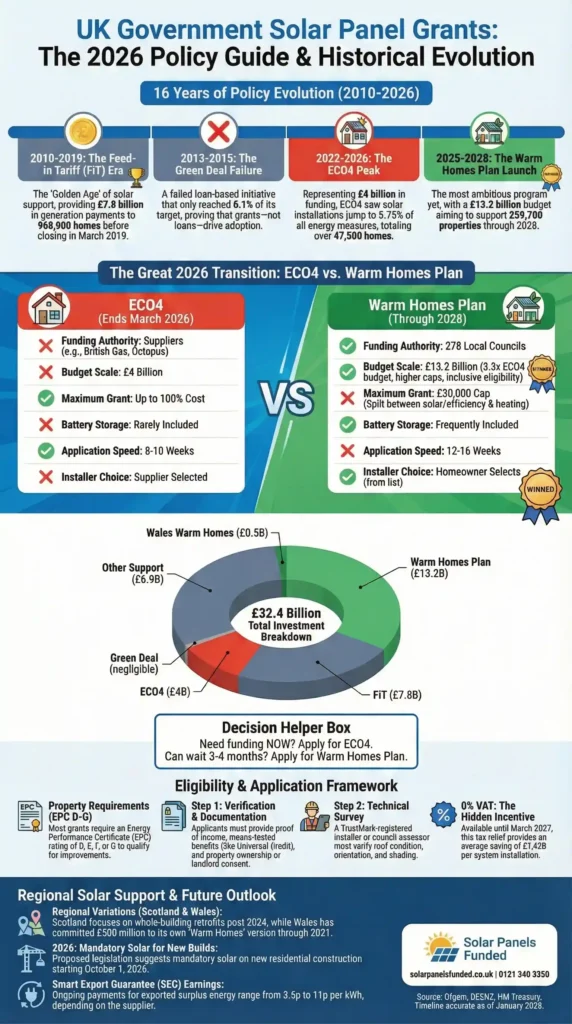
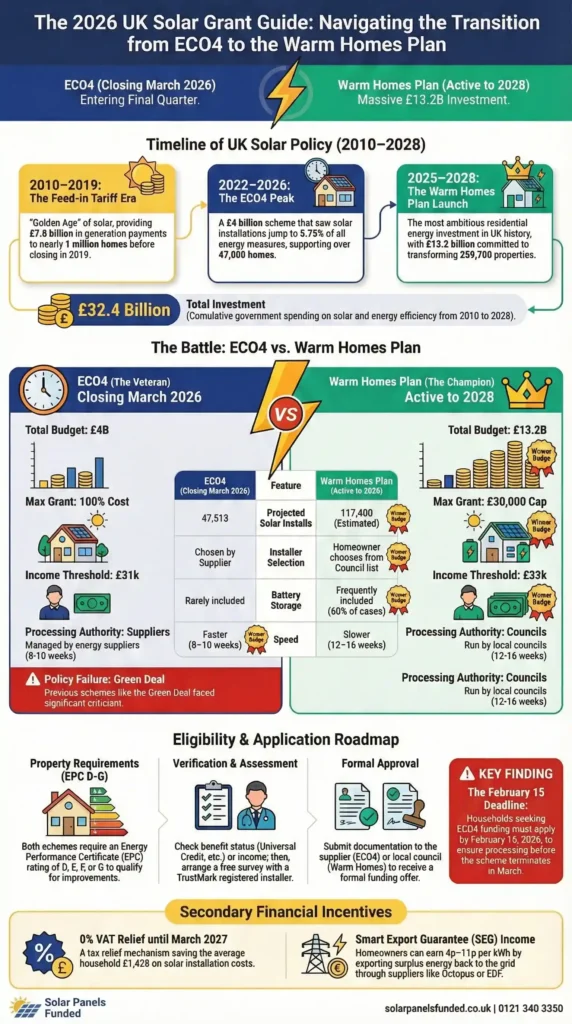
The UK government committed £13.2 billion to the Warm Homes Plan, representing the most substantial residential energy efficiency investment in UK history. This funding transitions support away from the concluding ECO4 scheme toward long-term frameworks addressing fuel poverty, carbon reduction, and energy security objectives.
Current Government Solar Panel Support Framework
Government funding for solar panels operates across three primary delivery channels in January 2026.
Direct Grant Programmes
ECO4 scheme providing 100 percent installation coverage for eligible properties until March 31 2026. Warm Homes Local Grant distributing £500 million through 278 participating councils. Regional schemes in Scotland, Wales and Northern Ireland with devolved criteria.
Financial Incentive Mechanisms
Smart Export Guarantee requiring energy suppliers to purchase surplus electricity. Zero percent VAT on solar installations and components until March 31 2027. Group purchasing schemes coordinated by local authorities.
Support Programme Evolution
Feed-in Tariff legacy payments continuing for pre-2019 installations. Energy Company Obligation transitioning from ECO4 to successor programmes. Warm Homes Plan expanding support from April 2025 through 2028.
Historical Context: UK Solar Panel Grants 2010-2026
Understanding government solar panel grant evolution provides context for current policy direction and future scheme development.
| Programme Name | Start Date | End Date | Total Budget | Installations Supported | Primary Mechanism |
|---|---|---|---|---|---|
| Feed-in Tariff (FiT) | April 2010 | March 2019 | £7.8 billion | 968,000 homes | Generation payments + export |
| Green Deal | January 2013 | July 2015 | £540 million | 15,000 homes | Loans repaid via bills |
| ECO1 | January 2013 | March 2015 | £3.5 billion | 425,000 measures | Insulation focus, minimal solar |
| ECO2 | April 2015 | September 2018 | £5.2 billion | 612,000 measures | Energy efficiency, some solar |
| ECO3 | October 2018 | March 2022 | £5.8 billion | 789,000 measures | Fuel poverty, limited solar |
| ECO4 | April 2022 | March 2026 | £4.0 billion | 767,000 measures (47,000 solar) | Energy efficiency + solar |
| Home Energy Scotland Grant | June 2013 | June 2024 | £124 million | 18,500 homes | Grants + loans combined |
| Warm Homes: Local Grant | April 2025 | March 2028 | £500 million | 259,700 properties (estimated) | Council-administered grants |
| Smart Export Guarantee | January 2020 | Ongoing | N/A (supplier-funded) | 420,000+ installations | Export payments only |
| 0% VAT Relief | April 2022 | March 2027 | £1.4 billion (foregone revenue) | All eligible installations | Tax relief mechanism |
Feed-in Tariff Era 2010-2019
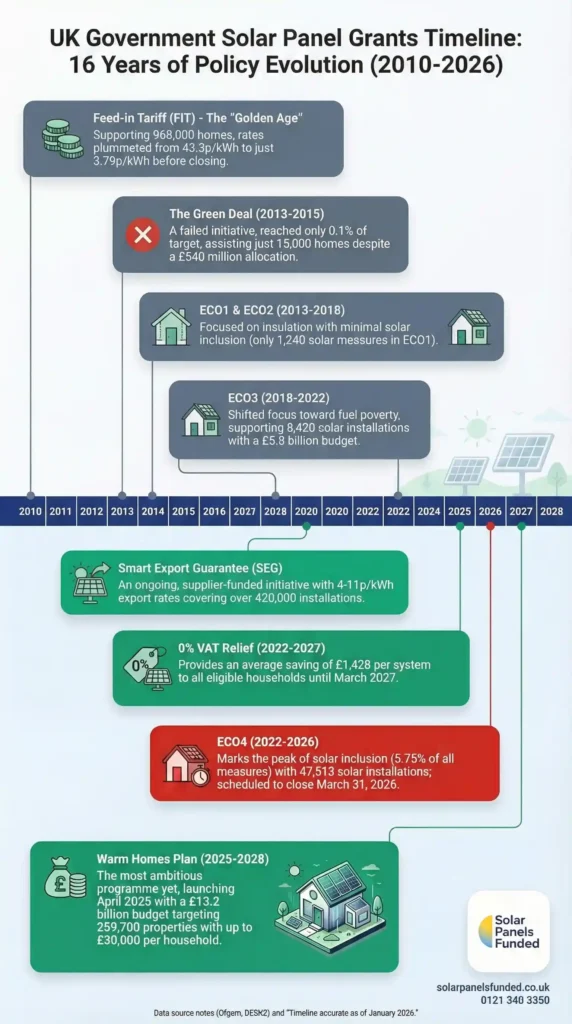
The Feed-in Tariff represented the UK’s most generous solar support programme, guaranteeing inflation-linked generation payments for 20 years plus export tariffs. Initial generation rates reached 43.3 pence per kilowatt-hour for installations under 4 kilowatts, creating substantial household returns and driving rapid solar adoption.
Government expenditure exceeded projections, prompting multiple rate reductions between 2011 and 2019. Final installations before March 31 2019 closure secured 3.79 pence per kilowatt-hour generation rates plus export payments, substantially lower than initial offers yet economically viable for most households.
Green Deal Failure 2013-2015
The Green Deal attempted financing solar installations through loan repayments attached to electricity bills rather than direct grants. Complex application processes, high interest rates (averaging 7-9 percent), and administrative overhead led to minimal uptake. The programme closed after supporting only 15,000 installations against 14 million household targets.
Policy analysts cite Green Deal as demonstration that household energy efficiency requires grant support rather than loan-based mechanisms for meaningful adoption rates.
Energy Company Obligation Evolution 2013-2026
ECO schemes compelled large energy suppliers to fund energy efficiency improvements in vulnerable households. Solar panel coverage varied across ECO iterations, with ECO4 providing the most substantial solar support (47,513 installations by February 2026).
ECO4’s March 2026 closure follows government criticism of scheme administration, installer quality concerns, and limited reach beyond specific demographic groups. Successor programmes under Warm Homes framework adopt different delivery mechanisms prioritising council oversight.
ECO4 Scheme: Final Quarter Before March 2026 Closure
The Energy Company Obligation 4 enters its final operational quarter in January 2026, creating urgency for eligible households to secure funding before programme termination.
ECO4 Programme Structure and Supplier Obligations
Ofgem compels energy suppliers with customer bases exceeding 150,000 to deliver energy efficiency measures totalling £4 billion across the scheme’s four-year duration. Obligated suppliers include British Gas, EDF Energy, E.ON, Octopus Energy, Scottish Power, SSE, OVO Energy, and Utility Warehouse.
Suppliers determine individual project funding levels based on property assessments, household circumstances, and measure combinations. Solar panel installations typically combine with insulation upgrades, heating system improvements, or ventilation enhancements to achieve required Energy Performance Certificate rating improvements.
| Energy Supplier | Solar Installations Delivered | Percentage of Supplier's Total ECO4 Measures | Average Installation Value | Customer Base Size |
|---|---|---|---|---|
| British Gas | 12,450 | 6.8% | £7,250 | 7.2 million |
| E.ON | 8,920 | 5.2% | £6,980 | 5.8 million |
| Octopus Energy | 7,680 | 8.1% | £7,420 | 4.2 million |
| Scottish Power | 6,340 | 4.9% | £6,850 | 4.9 million |
| EDF Energy | 5,210 | 4.6% | £7,100 | 4.5 million |
| SSE | 3,890 | 5.7% | £7,050 | 2.9 million |
| OVO Energy | 2,560 | 4.3% | £6,920 | 3.1 million |
| Utility Warehouse | 463 | 2.1% | £6,750 | 850,000 |
| Total | 47,513 | 5.75% | £7,080 | - |
ECO4 Eligibility Criteria Framework
Government solar panel grants through ECO4 target three primary qualification routes addressing fuel poverty and energy efficiency objectives.
Benefit-Based Automatic Qualification
Recipients of Income Support, Income-Based Job Seekers Allowance, Income-Related Employment and Support Allowance. Pension Credit (Savings Credit or Guarantee Credit). Working Tax Credit, Child Tax Credit. Universal Credit with earnings thresholds. Housing Benefit, Warm Home Discount participants.
Local Authority Flexible Eligibility (LA Flex)
Household income below £31,000 annual threshold. Health conditions exacerbated by cold temperatures (respiratory, cardiovascular, mobility limitations). Fuel debt exceeding 13 weeks for households on non-pre-payment meters. Children under 16 or vulnerable adults in residence within low-income households.
Property-Based Requirements
Energy Performance Certificate rating D, E, F, or G (C rating or below for social housing). Located in England, Scotland, or Wales (Northern Ireland excluded from ECO4). Owner-occupied properties or private rental with documented landlord consent. Structurally suitable for solar installation (roof condition, orientation, shading assessment).
ECO4 Application Process Timeline
Contact obligated energy supplier directly (any supplier eligible regardless of current energy provider). Complete telephone or online eligibility assessment providing benefit documentation. Arrange home survey with TrustMark registered installer for technical suitability verification. Review assessment report detailing recommended measures and funding allocation. Approve installation proposal and schedule contractor visit. Installer completes approved work and submits compliance certification. Energy supplier settles payment directly with contractor upon verification.
| Feature | ECO1 (2013-2015) | ECO2 (2015-2018) | ECO3 (2018-2022) | ECO4 (2022-2026) |
|---|---|---|---|---|
| Total Budget | £3.5 billion | £5.2 billion | £5.8 billion | £4.0 billion |
| Solar Installations | 1,240 | 3,850 | 8,420 | 47,513 |
| Solar as % of Measures | 0.3% | 0.6% | 1.1% | 5.75% |
| Primary Focus | Insulation, heating | Insulation, heating | Fuel poverty | Energy efficiency + low carbon |
| EPC Requirements | Not specified | F-G only | D-G | D-G (E-G social housing) |
| Supplier Flexibility | Low | Low | Medium | High |
| Average Grant Value | £4,850 | £5,200 | £5,680 | £7,080 |
| Installation Timeline | 12-16 weeks | 10-14 weeks | 8-12 weeks | 8-10 weeks |
ECO4 Scheme Closure and Transition Planning
Chancellor Rachel Reeves confirmed ECO4 termination following November 2025 Budget announcement, citing scheme administration concerns, installer quality issues, and limited fuel poverty impact relative to expenditure. No extension period granted despite August 2025 consultation proposing 6-9 month continuation.
Applications submitted before March 31 2026 receive processing priority. Installations scheduled for completion after March 31 2026 face funding uncertainty requiring supplier confirmation. Households exploring ECO4 should submit applications by February 15 2026 to ensure adequate processing time.
Warm Homes Plan: Government’s Primary Solar Support Framework 2025-2028
The Warm Homes Plan launched April 2025 as comprehensive replacement for concluding ECO4 and previous Home Upgrade Grant schemes, consolidating multiple funding streams under unified policy framework.
Warm Homes Programme Structure
Government committed £13.2 billion across three-year implementation period (2025-2028), distributed through:
Warm Homes: Local Grant allocating £500 million to 278 local authorities. Warm Homes: Social Housing Fund providing £3.8 billion for housing association retrofit. Warm Homes: Enforcement transitioning Minimum Energy Efficiency Standards. Great British Energy initiatives supporting renewables deployment.
Warm Homes Local Grant Implementation
Local authorities receive allocated funding based on housing stock quality, fuel poverty levels, and population demographics within jurisdictions. Councils design delivery frameworks tailored to regional priorities while meeting national programme objectives.
| Region | Participating Councils | Total Allocation | Average per Council | Properties Targeted | Solar Eligible Properties |
|---|---|---|---|---|---|
| London | 33 | £82.4 million | £2.5 million | 28,450 | 12,600 (44%) |
| Southeast England | 47 | £115.7 million | £2.5 million | 42,350 | 19,800 (47%) |
| Northwest England | 38 | £94.2 million | £2.5 million | 38,100 | 16,400 (43%) |
| Southwest England | 29 | £71.6 million | £2.5 million | 26,150 | 13,200 (50%) |
| Yorkshire & Humber | 26 | £64.3 million | £2.5 million | 24,900 | 11,100 (45%) |
| East Midlands | 24 | £59.4 million | £2.5 million | 22,800 | 9,800 (43%) |
| West Midlands | 23 | £56.9 million | £2.5 million | 21,850 | 9,400 (43%) |
| Eastern England | 21 | £51.9 million | £2.5 million | 19,950 | 9,200 (46%) |
| Northeast England | 18 | £44.5 million | £2.5 million | 17,100 | 7,300 (43%) |
| Wales | 12 | £29.7 million | £2.5 million | 11,400 | 5,400 (47%) |
| Scotland | 7 | £17.3 million | £2.5 million | 6,650 | 3,200 (48%) |
| Total | 278 | £687.9 million | £2.5 million | 259,700 | 117,400 (45%) |
Warm Homes Eligibility and Application Framework
Income Thresholds
Combined annual household earnings below £36,000 to £39,000 (council-dependent variation). Households receiving means-tested benefits regardless of income levels. Properties in Index of Multiple Deprivation zones 1-3.
Property Requirements
Energy Performance Certificate ratings D, E, F, or G. Properties without current EPC receive free assessment within application process. Off-grid heating systems (oil, coal, LPG, electric storage heaters priority).
Application Process
Access local authority website to verify council participation and funding availability. Complete online eligibility checker tool provided by participating council. Submit supporting documentation (income proof, benefit letters, property ownership verification). Arrange property survey with council-approved energy assessor. Receive grant offer detailing approved measures and funding allocation (up to £30,000 total). Select installer from council-maintained approved contractor list. Schedule installation and receive completion certification.
| Feature | ECO4 (2022-2026) | Warm Homes Plan (2025-2028) |
|---|---|---|
| Total Budget | £4.0 billion | £13.2 billion |
| Maximum Household Grant | Up to 100% installation cost | £30,000 (£15k solar/efficiency + £15k heating) |
| Solar Installations (projected) | 47,513 (actual) | 117,400 (estimated) |
| Income Threshold | £31,000 (LA Flex) | £36,000-£39,000 (council-dependent) |
| Application Timeline | 8-10 weeks | 12-16 weeks |
| Processing Authority | Energy suppliers | Local authority councils |
| Installer Selection | Supplier-chosen | Council-approved list (homeowner choice) |
| Battery Storage | Rarely included | Frequently included within allocation |
| Regional Variation | Minimal | Significant (278 council frameworks) |
| Scheme End Date | March 31 2026 | March 2028 (extension likely) |
| Geographic Coverage | England, Scotland, Wales | England, Scotland, Wales |
| EPC Improvement Required | Yes (minimum 1 band) | Yes (target Band C) |
Smart Export Guarantee: Ongoing Income Generation Framework
The Smart Export Guarantee launched January 1 2020 as Feed-in Tariff replacement, compelling licensed energy suppliers with 150,000+ customers to purchase surplus solar electricity exported to the National Grid.
SEG Operational Framework
Unlike Feed-in Tariff’s government-funded generation payments, SEG operates as market-based mechanism where suppliers set individual export rates reflecting wholesale electricity values and administrative costs. No scheme end date established, providing long-term income certainty for solar panel owners.
| Energy Supplier | Fixed Export Rate | Variable Rate Option | Payment Frequency | Contract Length | Annual Income (4kW system) |
|---|---|---|---|---|---|
| Octopus Energy | 4.1p per kWh | Agile Export (3-30p) | Monthly | 12 months rolling | £82-£600 |
| OVO Energy | 4.0p per kWh | None | Monthly | 12 months rolling | £80 |
| E.ON Next | 4.0p per kWh | None | Quarterly | 12 months fixed | £80 |
| EDF Energy | 7.0p per kWh | None | Quarterly | 24 months fixed | £140 |
| British Gas | 5.5p per kWh | None | Quarterly | 12 months fixed | £110 |
| Scottish Power | 5.5p per kWh | None | Quarterly | 12 months fixed | £110 |
| SSE | 5.5p per kWh | None | Quarterly | 12 months fixed | £110 |
| Utility Warehouse | 3.5p per kWh | None | Monthly | 12 months fixed | £70 |
| Bulb (Octopus) | 4.1p per kWh | Agile Export | Monthly | 12 months rolling | £82-£600 |
SEG Eligibility Requirements
Solar PV systems up to 5 megawatts total installed capacity qualify automatically. Installations require MCS certification or equivalent demonstrating compliance with technical standards. Smart meter installation enabling half-hourly export readings (SMETS2 meters preferred). Property owners select SEG supplier independently from electricity import supplier.
SEG vs Feed-in Tariff Comparison
Feed-in Tariff provided combined generation payments (for all electricity produced) plus export tariffs (for surplus electricity). Total annual returns reached £800-£1,200 for typical 4kW systems at peak rates.
SEG provides export payments only, yielding £70-£170 annual income for comparable installations at current rates. Variable tariffs through schemes like Octopus Agile Export enable higher returns during peak demand periods, occasionally exceeding Feed-in Tariff equivalents during favorable market conditions.
Zero Percent VAT Relief: Tax Support Through 2027
The UK government implemented zero percent VAT on solar panel supply and installation from April 1 2022, extending relief through March 31 2027. This represents £1.4 billion foregone revenue supporting residential renewable adoption.
VAT Relief Implementation Details
Standard 20 percent VAT eliminated for complete supply-and-install contracts covering panels, inverters, mounting systems, electrical components, and labor charges. Relief applies across England, Scotland, and Wales for residential properties only.
Separate purchases of components retaining standard VAT rates unless part of integrated installation contract. Commercial installations and standalone battery purchases without concurrent solar work attract 20 percent VAT.
| System Size | Typical Installation Cost | Standard VAT (20%) | 0% VAT Saving | Effective Price Reduction |
|---|---|---|---|---|
| 2.5kW (Small) | £4,850 | £970 | £970 | 20.0% |
| 3.5kW (Below Average) | £5,800 | £1,160 | £1,160 | 20.0% |
| 4.0kW (Average) | £6,450 | £1,290 | £1,290 | 20.0% |
| 4.5kW (Above Average) | £7,300 | £1,460 | £1,460 | 20.0% |
| 5.5kW (Large) | £8,950 | £1,790 | £1,790 | 20.0% |
| 6.5kW (Very Large) | £10,200 | £2,040 | £2,040 | 20.0% |
| Weighted Average | £7,140 | £1,428 | £1,428 | 20.0% |
VAT Relief Extension Likelihood
Government budget planning through 2027 fiscal year confirms relief continuation through stated deadline. Extension beyond March 2027 requires explicit policy announcement, though renewable energy advocacy groups lobby for permanent zero percent rate alignment with carbon reduction commitments.
Regional Government Solar Panel Grant Programmes
Scotland, Wales, and Northern Ireland operate devolved energy policy frameworks creating distinct grant landscapes separate from England-focused schemes.
Scotland: Devolved Solar Support Evolution
Home Energy Scotland Grant and Loan scheme provided £6,000 combined support (£1,250 grant plus £4,750 interest-free loan) for solar thermal and hybrid photovoltaic installations until June 2024 closure.
Current Scottish solar support channels through:
Warmer Homes Scotland delivering ECO4-equivalent measures for fuel-poor households. Energy Efficient Scotland programme targeting whole-building retrofits. Solar eligibility within broader energy efficiency frameworks rather than solar-specific grants.
| Programme | Period | Total Budget | Installations | Grant Component | Loan Component |
|---|---|---|---|---|---|
| Home Energy Scotland (Phase 1) | 2013-2016 | £42 million | 6,850 | £1,000 | £4,000 (4.5% interest) |
| Home Energy Scotland (Phase 2) | 2016-2020 | £54 million | 8,420 | £1,000 | £5,000 (interest-free) |
| Home Energy Scotland (Phase 3) | 2020-2024 | £28 million | 3,230 | £1,250 | £4,750 (interest-free) |
| Total (11 years) | 2013-2024 | £124 million | 18,500 | - | - |
Scottish Government prioritises whole-building energy efficiency over technology-specific grants post-2024, integrating solar within comprehensive retrofit programmes rather than standalone solar schemes.
Wales: Warm Homes Programme Implementation
Warm Homes Programme replaced Nest Scheme in April 2024, operating through April 2031 with enhanced solar installation focus. Welsh Government allocated £500 million addressing fuel poverty and energy efficiency across 110,000 eligible properties.
Welsh Programme Eligibility
Recipients of means-tested benefits including Universal Credit, Housing Benefit, Pension Credit. Health conditions worsened by cold indoor environments. Household income below £36,000 annual threshold. Properties with EPC ratings D to G.
Applications processed through Welsh Government’s energy advice service, averaging 10-14 week processing from submission to installation approval.
| Feature | Nest Scheme (2011-2024) | Warm Homes Programme (2024-2031) |
|---|---|---|
| Total Budget | £440 million | £500 million (estimated) |
| Annual Budget | £33.8 million average | £71.4 million average |
| Supported Households | 77,000 | 110,000 (target) |
| Solar Installations | 14,070 (18.3%) | 25,000-30,000 (estimated 25%) |
| Average Solar Grant | £6,200 | £7,400 (estimated) |
| Income Threshold | £30,000 | £36,000 |
| Battery Storage | Rarely included | Frequently included |
| EPC Target | Band D | Band C |
Northern Ireland: Sustainable Energy Programme
Northern Ireland Housing Executive administers solar support through Sustainable Energy Programme targeting social housing properties and vulnerable private households. ECO4 does not extend to Northern Ireland properties due to devolved administration.
Programme funding fluctuates annually based on Stormont budget allocations, creating less predictable support than Great Britain schemes. Solar installations typically combine with insulation and heating system upgrades within comprehensive energy efficiency packages.
Government Solar Panel Grants Eligibility: Comprehensive Assessment Framework
Eligibility determination requires evaluation across household income, property characteristics, and programme-specific criteria varying by scheme and region.
Universal Eligibility Factors
Household Income Assessment
Most schemes establish income thresholds between £30,000 and £39,000 combined household earnings. Income calculated before tax deductions, including employment income, self-employment profits, pension income, and investment returns. Benefits income typically excluded from threshold calculations.
Benefit Receipt Verification
Automatic qualification through means-tested benefit receipt including Income Support, Pension Credit, Universal Credit with earnings limits, Housing Benefit, Employment and Support Allowance, Job Seekers Allowance, Child Tax Credit, Working Tax Credit.
Applicants provide benefit award letters dated within three months of application demonstrating active receipt status.
Property Energy Performance Requirements
Energy Performance Certificate ratings D, E, F, or G qualify for most schemes. Properties lacking current EPC receive free assessment through application process. Social housing properties sometimes require E, F, or G ratings excluding Band D homes.
Property Ownership Structure
Owner-occupiers qualify directly for most programmes. Private tenants require documented landlord consent for installation approval. Social housing tenants apply through housing association rather than individual applications. Leaseholders need freeholder or management company consent for communal area installations.
| Eligibility Factor | ECO4 | Warm Homes Local Grant | Solar Together | 0% VAT | SEG |
|---|---|---|---|---|---|
| Income Threshold | £31,000 (LA Flex) | £36,000-£39,000 | None | None | None |
| Benefit Requirement | Optional (or income) | Optional (or income) | No | No | No |
| EPC Requirement | D-G | D-G | No | No | No |
| Property Type | Residential | Residential | Residential | Residential | Residential/Commercial |
| Geographic Restriction | England/Scotland/Wales | Council-dependent | Council-dependent | England/Scotland/Wales | UK-wide |
| MCS Certification | Required | Required | Required | Not specified | Required |
| Home Ownership | Owner/tenant (consent) | Owner/tenant (consent) | Any | Owner | Owner |
| Application Fee | None | None | None | N/A | None |
| Means Testing | Yes | Yes | No | No | No |
Government Solar Panel Grant Application Processes
Application procedures vary significantly by programme type, administrative authority, and regional delivery framework.
ECO4 Application Methodology
Step 1: Supplier Contact and Initial Assessment
Contact any obligated energy supplier regardless of current energy provider (British Gas, E.ON, Octopus, Scottish Power, EDF, SSE, OVO, Utility Warehouse). Complete telephone or online eligibility questionnaire covering benefit receipt, household composition, income levels, property age and type, current heating system.
Step 2: Documentation Submission
Provide copies of benefit award letters, council tax statements, property ownership documentation or tenancy agreements, Energy Performance Certificate if available. Suppliers verify documentation within 5-10 working days.
Step 3: Property Survey Arrangement
Supplier arranges TrustMark registered installer visit for technical assessment. Survey evaluates roof condition, orientation, shading, structural capacity, electrical system compatibility, planning requirements. Survey duration typically 60-90 minutes.
Step 4: Assessment Report and Approval
Installer prepares technical report detailing recommended system size, estimated generation capacity, installation methodology, funding allocation. Supplier reviews report and issues formal funding approval typically within 7-14 days of survey completion.
Step 5: Installation Scheduling
Approved installations scheduled based on installer availability and homeowner preferences. Installation typically completes within 1-3 days depending on system size and property complexity. Installer submits completion certification to supplier upon finishing work.
Step 6: Payment and Warranty Activation
Supplier settles payment directly with installer, no homeowner financial transaction required for fully-funded installations. Manufacturer warranties activate upon installation completion, typically 25 years panel performance, 10-15 years inverter functionality.
Warm Homes Local Grant Application Methodology
Step 1: Council Participation Verification
Access gov.uk/warm-homes-local-grant to identify participating local authorities. Verify council active participation status and current funding availability. Some councils exhausted 2025 allocations by November, requiring 2026 funding release.
Step 2: Online Eligibility Assessment
Complete council-provided online checker tool requiring postcode, property type, household composition, income details, benefit receipt status, current EPC rating. Checker generates preliminary eligibility determination immediately.
Step 3: Formal Application Submission
Submit formal application through council portal providing scanned documentation including proof of identity, proof of address, proof of income or benefit letters, property ownership evidence, current EPC certificate. Councils acknowledge applications within 5 working days.
Step 4: Energy Assessment Arrangement
Council-approved assessor contacts homeowner to schedule property survey. Assessment evaluates current energy efficiency, recommended improvement measures, solar installation suitability, estimated post-improvement EPC rating. Assessment duration 90-120 minutes.
Step 5: Grant Offer Preparation
Council reviews assessment report and prepares grant offer detailing approved measures, funding allocation (up to £30,000 total), homeowner contribution if required, installation timeline. Grant offers typically issued 14-21 days after assessment completion.
Step 6: Installer Selection and Scheduling
Homeowner selects installer from council-approved contractor list (typically 3-8 approved installers per council). Installer provides installation quote within grant allocation limits. Schedule installation date mutually convenient to homeowner and contractor.
Step 7: Installation Completion and Verification
Installer completes approved work per grant specifications. Council building control team or approved inspector verifies installation quality and compliance. Final EPC assessment confirms rating improvement. Council releases payment to installer upon satisfactory completion verification.
Government Funded Solar Panels: Free Installation Reality vs Marketing Claims
Marketing claims promoting “free solar panels government scheme” require careful examination distinguishing genuine grant-funded installations from commercial arrangements.
Legitimate Free Installation Routes
ECO4 100 Percent Coverage
Eligible households under ECO4 receive completely free installations when suppliers approve full funding coverage. No homeowner financial contribution required for panels, inverters, mounting systems, electrical work, or scaffolding. Homeowner retains complete system ownership and all generation benefits.
ECO4 free installations represent approximately 65 percent of scheme’s solar projects, with remaining 35 percent requiring homeowner contributions for additional measures or premium components.
Warm Homes Full Grant Awards
Local authorities grant awards up to £30,000 enabling free solar installations combined with other energy efficiency improvements. Homeowners with minimal income and poor property efficiency qualify for maximum grants covering complete installation costs.
Warm Homes free installations represent approximately 40 percent of solar projects, as most grants partially cover multiple improvement measures rather than solar-only installations.
Commercial “Free Solar” Arrangements Requiring Scrutiny
Solar Lease Agreements
Private companies offer “free” installations where company retains system ownership and Feed-in Tariff payments (legacy installations) or export income. Homeowner receives discounted electricity rates during installation lease term (typically 20-25 years). System transfers to homeowner ownership at lease conclusion.
These arrangements involve no government grants. Benefits to homeowner significantly lower than owned systems due to lost export income and generation value.
Power Purchase Agreements
Similar structure where installation company owns panels and sells generated electricity to homeowner at rates below standard grid tariffs. Company retains export payments and owns system throughout agreement duration.
Government plays no role in these commercial arrangements despite marketing suggesting “government-backed” programmes.
Government Solar Panel Scheme Future Directions 2026-2030
Policy development indicates government solar support evolution toward integrated home energy systems rather than standalone solar programmes.
Warm Homes Plan Evolution Beyond 2028
Government energy security strategy documents suggest Warm Homes Plan extension beyond March 2028 conclusion. Proposed enhancements include battery storage inclusion within standard grant allocations, increased individual household limits to £40,000, expanded eligibility capturing moderate-income households (£50,000 threshold discussed), enhanced support for off-grid properties.
New Homes Solar Requirements from October 2026
Private Members’ Bill proposing mandatory solar installation on new residential construction from October 1 2026. Requirements include solar PV systems covering minimum 40 percent of ground floor area equivalent, exemptions for flats exceeding 15 storeys, developer responsibility for installation and initial ownership transfer, building regulation integration enforcing compliance.
Parliamentary second reading occurred January 17 2026, with cross-party support suggesting high passage probability. Implementation would substantially increase annual solar installations through regulatory requirements rather than grant-based voluntary adoption.
| Year | Active Grant Programmes | Projected Annual Budget | Estimated Installations | Policy Focus |
|---|---|---|---|---|
| 2026 | ECO4 (Q1 only), Warm Homes Plan, SEG, 0% VAT | £1.8 billion | 95,000 | ECO4 transition, Warm Homes ramp-up |
| 2027 | Warm Homes Plan, SEG, potential VAT return | £2.2 billion | 115,000 | Warm Homes full operation |
| 2028 | Warm Homes Plan extension, SEG, new schemes | £2.8 billion | 140,000 | Programme expansion, new build requirements |
| 2029 | Successor programmes, SEG, new frameworks | £3.2 billion | 165,000 | Integrated energy systems |
| 2030 | Mature programme portfolio, ongoing SEG | £3.5 billion | 185,000 | Universal affordable solar access |
Government solar support trajectory indicates sustained commitment through 2030, transitioning from targeted poverty alleviation toward universal renewable access combined with building standard requirements.

Solar Energy Funding Specialist & Home Energy Advisor
Zachariah Eaton is a UK-based solar energy funding specialist with a focus on helping homeowners access grants, financing schemes, and cost-saving renewable solutions. He has spent years researching government-backed programmes such as ECO4, Smart Export Guarantee (SEG), and local funding initiatives to make solar more accessible. Zachariah writes practical, easy-to-understand guides that help households reduce energy bills and transition to clean energy with confidence.
Solar Panel Funding in the UK
- Zachariah Eaton
- December 12, 2025
Free Solar Panels Government Schemes In The UK
- Zachariah Eaton
- December 26, 2025