Free Solar Panels Government Schemes In The UK
Free solar panels through UK government schemes enable qualifying households to install photovoltaic systems worth £7,000 to £12,000 without upfront payments or repayment obligations. As of January 2026, approximately 485,000 UK households qualify for completely free installations through ECO4 scheme (closing March 31 2026) and Warm Homes Local Grant programme. This comprehensive guide examines eligibility requirements, application processes, realistic timelines, expected savings, system ownership rights, common misconceptions about “free” solar, and practical steps households take from initial interest through system activation and long-term operation.
Table of Contents
ToggleUnderstanding Free Solar Panel Schemes Reality in 2026
Free solar panels in the UK mean government-funded installations delivered to eligible households at zero cost with no repayment requirements. “Free” refers specifically to complete funding coverage including equipment, installation labor, scaffolding, electrical work, and certification—households pay nothing and owe nothing.
Two primary schemes provide free solar installations in January 2026. The Energy Company Obligation 4 delivers installations through obligated energy suppliers until March 31 2026. Warm Homes Local Grant operates through 278 participating local authorities across England with funding extending through March 2028.
Free Solar vs Commercial “Free” Offers Distinction
Genuine government schemes fund solar installations with homeowners retaining complete system ownership and all financial benefits including electricity bill savings and export income. Commercial “free solar” offers typically involve companies retaining ownership while homeowners receive discounted electricity rates—these are lease arrangements rather than government grants.
Government scheme installations remain homeowner property with 25-year equipment warranties and permanent electricity bill reductions averaging £450 to £650 annually. Commercial arrangements involve 20-25 year contracts where companies retain export payments and system ownership.
Current Scheme Status January 2026
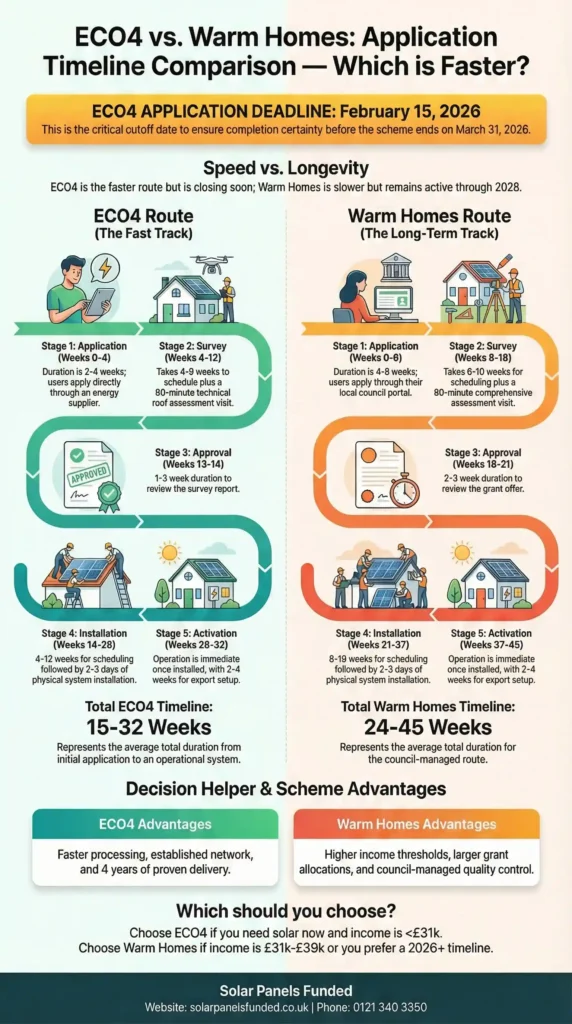
ECO4 scheme enters final operational quarter before March 31 2026 closure. Applications submitted by February 15 2026 receive processing priority ensuring completion before deadline. Warm Homes Local Grant continues through March 2028 providing longer application window for eligible households in participating council areas.
| Programme | Funding Source | End Date | Geographic Coverage | Average Installation Value | Estimated 2026 Installations |
|---|---|---|---|---|---|
| ECO4 | Energy supplier obligations | March 31 2026 | England, Scotland, Wales | £7,080 | 12,000 (Q1 only) |
| Warm Homes Local Grant | Government direct funding | March 2028 | 278 councils (England) | £7,400 | 35,000 (full year) |
| Total Active Schemes | - | - | - | £7,240 average | 47,000 (2026 estimated) |
Who Qualifies for Free Solar Panels in 2026
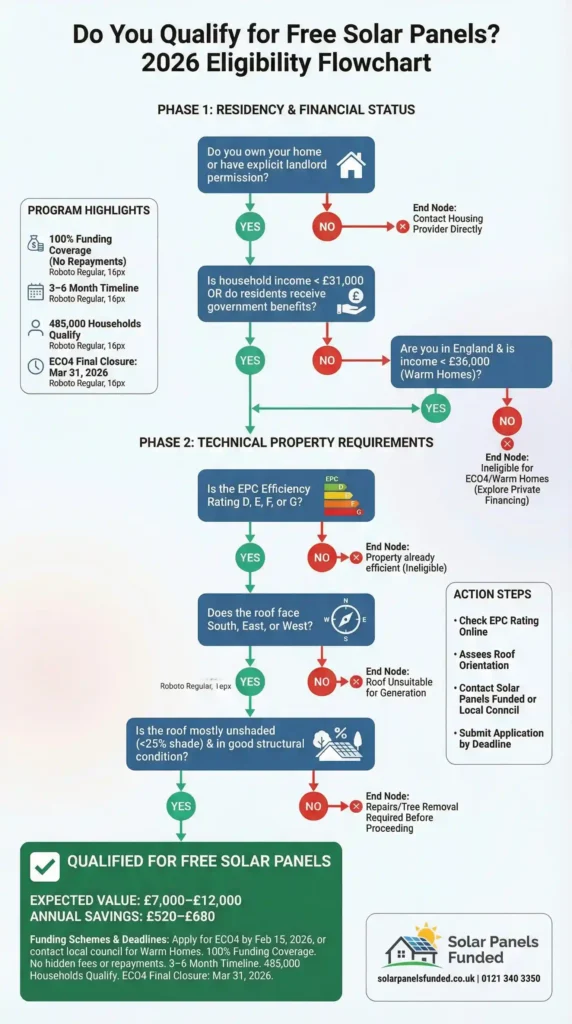
Qualification depends on household income, benefit receipt, property energy efficiency rating, and technical suitability. Most UK households qualify through one of three primary routes.
Benefits-Based Automatic Qualification
Recipients of means-tested benefits qualify automatically regardless of household income, property value, or savings levels. Government recognizes benefit recipients as experiencing fuel poverty requiring support.
Qualifying Benefits for Free Solar Panels
Income Support, Income-Based Job Seekers Allowance, Income-Related Employment and Support Allowance. Pension Credit (Guarantee Credit or Savings Credit). Universal Credit (with earnings threshold). Working Tax Credit, Child Tax Credit. Housing Benefit. Warm Home Discount Scheme participants.
Benefit receipt verification requires award letters dated within three months of application submission. Digital screenshots from government gateway accounts acceptable alongside paper statements.
Income-Based Qualification Without Benefits
Households earning below specified income thresholds qualify without receiving benefits. ECO4 sets £31,000 annual household income threshold. Warm Homes establishes £36,000 to £39,000 thresholds varying by council.
Income thresholds increase for households with dependent children under 16. Two adults with one child qualify at £38,200 under ECO4. Two adults with three children qualify at £45,500. Warm Homes applies similar adjustments based on household composition.
| Household Composition | ECO4 Threshold | Warm Homes Threshold | Typical Annual Savings from Free Solar |
|---|---|---|---|
| Single adult | £31,000 | £36,000-£39,000 | £520-£680 |
| Couple (no children) | £31,000 | £36,000-£39,000 | £520-£680 |
| Single parent + 1 child | £34,600 | £39,600-£42,000 | £540-£710 |
| Couple + 1 child | £38,200 | £43,200-£45,000 | £560-£730 |
| Single parent + 2 children | £38,200 | £43,200-£45,000 | £560-£730 |
| Couple + 2 children | £41,800 | £46,800-£48,000 | £580-£750 |
| Couple + 3 children | £45,500 | £50,400-£51,000 | £600-£770 |
Income verification requires recent payslips (three months), pension statements, or tax returns. Self-employed applicants provide SA302 tax calculations from HMRC covering most recent completed tax year.
Property Energy Efficiency Requirements
Properties must hold Energy Performance Certificate ratings qualifying as energy inefficient. ECO4 accepts ratings D, E, F, or G. Warm Homes accepts identical ratings D through G.
EPC certificates remain valid for 10 years unless significant property alterations occur. Download current EPC from government’s official EPC register at epcregister.com using postcode search. Properties lacking current EPC receive free assessment through scheme application processes.
| Initial EPC Rating | ECO4 Eligible | Warm Homes Eligible | Expected Post-Solar Rating | Rating Band Improvement | Annual Bill Savings |
|---|---|---|---|---|---|
| Band G (1-20) | ✅ Yes | ✅ Yes | Band E (39-54) | +2 bands | £650-£770 |
| Band F (21-38) | ✅ Yes | ✅ Yes | Band D (55-68) | +2 bands | £600-£720 |
| Band E (39-54) | ✅ Yes | ✅ Yes | Band C (69-80) | +2 bands | £560-£680 |
| Band D (55-68) | ✅ Yes | ✅ Yes | Band C (69-80) | +1 band | £520-£640 |
| Band C (69-80) | ❌ No | ❌ No | - | Ineligible | - |
| Band B (81-91) | ❌ No | ❌ No | - | Ineligible | - |
| Band A (92-100) | ❌ No | ❌ No | - | Ineligible | - |
Property Ownership and Occupancy Requirements
Owner-occupiers receive priority across all free solar schemes. Complete ownership enables long-term benefit realization and simplifies approval processes. Properties with mortgages require lender permission though most lenders approve solar installations improving property value.
Private tenants qualify with documented landlord written consent. Landlords benefit from improved EPC ratings and property value increases without installation costs. Present landlords with scheme information emphasizing zero-cost improvements and enhanced marketability.
Social housing tenants apply through housing association programmes rather than individual applications. Contact housing provider directly regarding planned solar installations for social housing properties.
ECO4 Scheme Free Solar Panel Route
Energy Company Obligation 4 represents UK’s primary free solar scheme since April 2022. The programme compels large energy suppliers to fund energy efficiency improvements meeting government carbon reduction targets.
ECO4 Operational Structure
Ofgem obliges energy suppliers with 150,000+ customer accounts to deliver £4 billion energy efficiency measures through March 2026. Obligated suppliers include British Gas, E.ON, Octopus Energy, Scottish Power, EDF Energy, SSE, OVO Energy, and Utility Warehouse.
Suppliers contract MCS-certified installers delivering free surveys and installations. Households approved under ECO4 receive complete systems at zero cost with no repayment obligations. All equipment, labor, scaffolding, electrical work, and certifications covered fully.
ECO4 March 2026 Closure Timeline
Chancellor Rachel Reeves confirmed ECO4 terminates March 31 2026 without extension following November 2025 Budget announcement. Applications submitted after February 15 2026 face completion uncertainty as scheme closure approaches.
Households exploring ECO4 should submit applications immediately. Processing, survey scheduling, and installation coordination require 8-12 weeks minimum. Early February applications maximize completion likelihood before scheme termination.
| Stage | Recommended Action Date | Processing Duration | Completion Deadline | Risk Level |
|---|---|---|---|---|
| Application Submission | Before Feb 15 2026 | 2-4 weeks | Feb 28 2026 | Low risk if submitted early |
| Home Survey | Before Mar 1 2026 | 4-6 weeks | Mar 15 2026 | Medium risk |
| Installation Approval | Before Mar 8 2026 | 1-2 weeks | Mar 22 2026 | High risk |
| Installation Completion | Before Mar 22 2026 | 1-3 days | Mar 31 2026 | Very high risk |
| After Mar 31 2026 | ❌ ECO4 CLOSED | - | - | Applications rejected |
ECO4 Local Authority Flex Extension
LA Flex enables local councils to approve households marginally exceeding standard ECO4 thresholds but experiencing fuel poverty. Councils assess individual circumstances including health conditions, disability, high energy costs relative to income, or vulnerable household members.
Contact local council housing or energy efficiency departments inquiring about LA Flex availability. Provide detailed explanation of household circumstances, energy bill hardship, and reasons for seeking support despite narrowly missing standard qualification thresholds.
Warm Homes Local Grant Free Solar Route
Warm Homes Local Grant launched April 2025 with £500 million allocated through 278 participating English local authorities. The programme provides comprehensive home energy upgrades including solar panels.
Warm Homes Programme Structure
Government distributes funding directly to participating councils who manage local delivery. Each council designs application processes, prioritization frameworks, and contractor panels suited to regional needs and housing stock characteristics.
Maximum household grants reach £30,000 total with £15,000 allocated to energy efficiency measures (solar panels, insulation, glazing) and £15,000 for low-carbon heating systems (heat pumps, electric storage heaters). Solar installations typically form £7,000 to £10,000 components of larger upgrade packages.
Warm Homes Council Participation
278 English councils participate in Warm Homes programme representing approximately 85 percent of English local authorities. Non-participating councils lack current funding allocations though additional councils may join during 2026-2027 expansion phases.
Verify council participation status visiting gov.uk/warm-homes-local-grant and entering postcode. Participating councils display application portals and eligibility checkers. Non-participating areas direct residents to alternative schemes or waiting lists for future funding.
| Region | Participating Councils | Total Allocation | Properties Targeted | Solar Installations (est) | Average Grant per Property |
|---|---|---|---|---|---|
| Southeast England | 47 | £115.7 million | 42,350 | 19,800 (47%) | £2,733 |
| Northwest England | 38 | £94.2 million | 38,100 | 16,400 (43%) | £2,472 |
| London | 33 | £82.4 million | 28,450 | 12,600 (44%) | £2,897 |
| Southwest England | 29 | £71.6 million | 26,150 | 13,200 (50%) | £2,738 |
| Yorkshire & Humber | 26 | £64.3 million | 24,900 | 11,100 (45%) | £2,582 |
| East Midlands | 24 | £59.4 million | 22,800 | 9,800 (43%) | £2,605 |
| West Midlands | 23 | £56.9 million | 21,850 | 9,400 (43%) | £2,604 |
| Eastern England | 21 | £51.9 million | 19,950 | 9,200 (46%) | £2,602 |
| Northeast England | 18 | £44.5 million | 17,100 | 7,300 (43%) | £2,602 |
| Wales | 12 | £29.7 million | 11,400 | 5,400 (47%) | £2,605 |
| Scotland | 7 | £17.3 million | 6,650 | 3,200 (48%) | £2,602 |
Warm Homes Application Processing
Applications proceed through council-managed online portals. Processing times average 12-16 weeks from submission through installation approval. Councils prioritize applications based on fuel poverty severity, property energy efficiency, and vulnerable household members.
Approved households receive grant offers detailing approved measures, funding allocation, required homeowner contributions (if any), and estimated installation timelines. Homeowners select installers from council-approved contractor lists ensuring quality and compliance.
Free Solar Panel Application Process Step-by-Step
Applications follow structured stages from initial eligibility verification through system activation. Understanding each stage helps households prepare adequately and avoid processing delays.
Stage 1: Pre-Application Preparation
Gather required documentation before starting applications. Download current EPC certificate from government EPC register. Collect three months recent payslips or pension statements. Obtain benefit award letters dated within three months. Prepare property ownership proof through council tax bills or mortgage statements.
Photograph property roof from ground level showing orientation, shading sources, and visible condition. Measure available roof space suitable for panels (south, east, or west facing sections without significant shading).
Stage 2: Eligibility Self-Assessment
Use scheme-provided online eligibility checkers determining likely qualification before formal applications. ECO4 eligibility checkers available through energy supplier websites. Warm Homes checkers accessible through participating council portals.
Self-assessment takes 5-10 minutes requiring postcode, household composition, income range, benefit receipt status, and current EPC rating. Checkers generate preliminary eligibility determination guiding next steps.
Stage 3: Formal Application Submission
Submit formal applications through identified schemes. ECO4 applications proceed through chosen energy supplier (any obligated supplier acceptable regardless of current energy provider). Warm Homes applications submit through participating local council online portals.
Applications require uploaded documentation including proof of income, benefit evidence, EPC certificate, property ownership verification, and photo identification. Complete all fields accurately avoiding delays from information gaps or errors.
Stage 4: Application Processing and Verification
Scheme administrators verify submitted information against eligibility criteria. Processing times vary by application volume and administrator capacity. ECO4 processes in 2-4 weeks average. Warm Homes processes in 4-8 weeks average.
Administrators contact applicants requesting additional information or clarification when initial submissions lack required details. Respond promptly to information requests preventing processing delays.
Stage 5: Home Technical Survey
Approved applicants receive survey scheduling within 4-8 weeks of application approval. MCS-certified surveyors attend for 60-90 minutes assessing roof condition, orientation, shading, electrical system capacity, structural integrity, and installation access.
Surveyors photograph roof areas, measure dimensions, check roof tile condition, inspect electrical consumer units, and evaluate scaffolding requirements. Properties requiring electrical upgrades or roof repairs receive recommendations for corrective work before solar approval.
Stage 6: Survey Report and Installation Design
Surveyors prepare technical reports detailing roof suitability assessment, recommended system size, panel layout design, inverter specifications, estimated generation capacity, and identified technical issues requiring resolution.
Reports process within 1-2 weeks of survey completion. Approved installations receive formal offers specifying system specifications, installation timeline, equipment warranties, and expected annual generation. Review specifications carefully raising questions before accepting installation proposals.
Stage 7: Installation Scheduling
Accepted installations enter contractor scheduling queues. Installation dates depend on contractor capacity, seasonal demand, and weather conditions. Spring and summer installations face 8-16 week scheduling delays. Autumn and winter installations schedule faster (4-8 weeks) but face weather-related postponement risks.
Installers contact households 2-3 weeks before scheduled dates confirming appointments and preparation requirements. Ensure site access, parking availability, and electrical system access on installation days.
Stage 8: Installation Execution
Standard residential installations complete in 2-3 days. Day one involves scaffolding erection (if required) and roof preparation. Day two covers panel mounting, electrical connections, and inverter installation. Day three includes final connections, system testing, commissioning, and scaffolding removal.
Installers provide operation manuals, warranty documentation, monitoring system access, maintenance guidance, and emergency contact information. They register installations with distribution network operators enabling export payment arrangements.
Stage 9: System Activation and Monitoring
Systems generate electricity immediately following installation completion. Inverters display generation data through built-in screens or connected smartphone applications. Monitor generation during initial weeks establishing normal output patterns for property location and season.
Export payment arrangements activate within 2-4 weeks as energy suppliers register installations and configure tariff arrangements. Electricity bill savings begin immediately while export income commences after registration completion.
| Stage | ECO4 Duration | Warm Homes Duration | Actions Required | Potential Delays |
|---|---|---|---|---|
| Pre-Application Prep | 1-2 days | 1-2 days | Gather documents, EPC download | Missing documentation |
| Application Submission | 30 minutes | 45 minutes | Online form completion | Technical issues, incomplete info |
| Processing & Verification | 2-4 weeks | 4-8 weeks | Respond to queries | High application volumes |
| Survey Scheduling | 4-8 weeks | 6-10 weeks | Confirm appointment | Surveyor availability |
| Technical Survey | 60-90 minutes | 60-90 minutes | Property access | Weather, access issues |
| Survey Report Review | 1-2 weeks | 2-3 weeks | Review & approve | Technical complications |
| Installation Scheduling | 4-12 weeks | 8-16 weeks | Confirm dates | Contractor capacity, seasonal demand |
| Installation | 2-3 days | 2-3 days | Site access, cooperation | Weather, site complications |
| Activation & Export Setup | 2-4 weeks | 2-4 weeks | Choose export supplier | Registration processing |
| Total Timeline | 15-32 weeks | 24-45 weeks | - | - |
Expected Savings from Free Solar Panel Systems
Free solar installations reduce electricity bills by generating power offsetting grid purchases. Savings vary by system size, household consumption patterns, electricity tariff rates, and regional sunlight availability.
Electricity Bill Reduction Calculations
Typical ECO4 and Warm Homes installations range from 3.5kW to 4.5kW for standard three-bedroom properties. System size matches roof space availability and household electricity consumption levels.
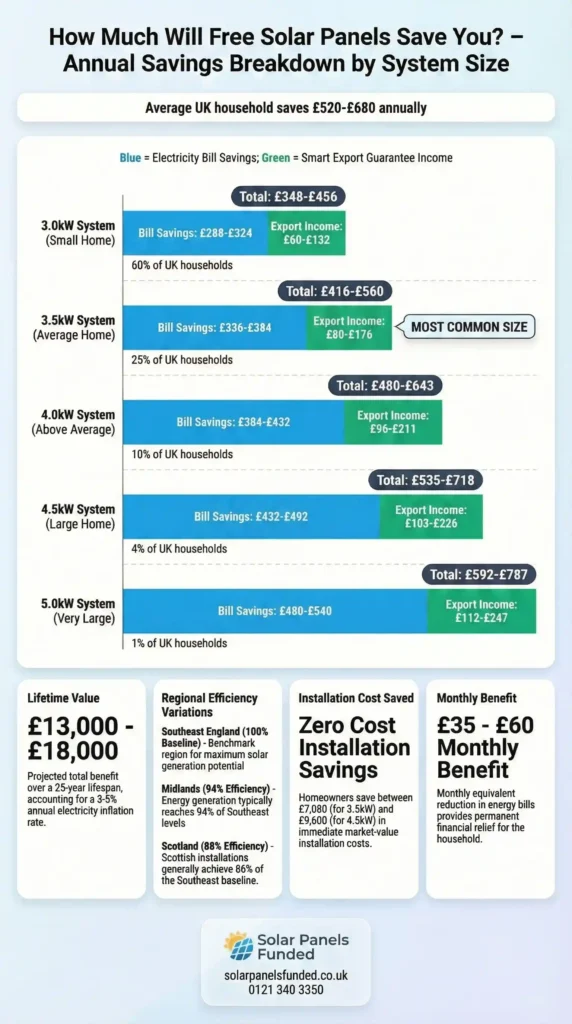
3.5kW systems generate approximately 3,000-3,400 kWh annually depending on UK region. Households consuming 3,500 kWh annually use approximately 50 percent of generation directly (1,500-1,700 kWh). At 24 pence per kWh average electricity rate, direct consumption saves £360-£408 annually on bills.
4.5kW systems generate approximately 3,900-4,400 kWh annually. Direct consumption of 1,950-2,200 kWh saves £468-£528 annually at 24 pence per kWh rates. Larger systems suit households with higher electricity consumption or electric vehicle charging requirements.
| System Size | Southeast Generation | Midlands Generation | Scotland Generation | Direct Use (50%) | Annual Bill Savings (24p/kWh) |
|---|---|---|---|---|---|
| 3.0kW | 2,700 kWh | 2,550 kWh | 2,400 kWh | 1,200-1,350 kWh | £288-£324 |
| 3.5kW | 3,200 kWh | 3,000 kWh | 2,800 kWh | 1,400-1,600 kWh | £336-£384 |
| 4.0kW | 3,600 kWh | 3,400 kWh | 3,200 kWh | 1,600-1,800 kWh | £384-£432 |
| 4.5kW | 4,100 kWh | 3,850 kWh | 3,600 kWh | 1,800-2,050 kWh | £432-£492 |
| 5.0kW | 4,500 kWh | 4,250 kWh | 4,000 kWh | 2,000-2,250 kWh | £480-£540 |
Smart Export Guarantee Income
Surplus generation exported to grid creates additional income through Smart Export Guarantee. Energy suppliers pay 4-11 pence per kWh for exported electricity. Average households export 40-50 percent of generation when consuming 50 percent directly.
3.5kW system exporting 1,500 kWh annually earns £60-£165 depending on supplier export rate. 4.5kW system exporting 2,000 kWh earns £80-£220 annually. Combining export income with bill savings produces total annual financial benefits ranging from £520-£680 for typical installations.
| System Size | Region | Annual Generation | Direct Bill Savings | Export Income (5-11p/kWh) | Total Annual Benefit |
|---|---|---|---|---|---|
| 3.5kW | Southeast | 3,200 kWh | £384 | £80-£176 | £464-£560 |
| 3.5kW | Midlands | 3,000 kWh | £360 | £75-£165 | £435-£525 |
| 3.5kW | Scotland | 2,800 kWh | £336 | £70-£154 | £406-£490 |
| 4.5kW | Southeast | 4,100 kWh | £492 | £103-£226 | £595-£718 |
| 4.5kW | Midlands | 3,850 kWh | £462 | £96-£212 | £558-£674 |
| 4.5kW | Scotland | 3,600 kWh | £432 | £90-£198 | £522-£630 |
25-Year Lifetime Savings
Solar panels operate effectively for 25-30 years with minimal degradation. Assuming 0.5 percent annual efficiency decline, systems retain 88 percent of original capacity after 25 years. Cumulative savings over system lifetime reach £13,000-£17,000 for typical 4kW installations accounting for electricity price inflation averaging 3-5 percent annually.
Free installations deliver these lifetime savings with zero upfront cost and no repayment obligations, representing substantial household financial benefit unavailable through commercial arrangements retaining system ownership.
Property and Roof Technical Requirements
Properties must meet technical standards ensuring safe installations producing adequate generation over 25-year system lifespans.
Roof Orientation and Pitch Requirements
South-facing roofs generate maximum annual output receiving direct sunlight throughout daylight hours. East and west-facing roofs produce 85-90 percent of south-facing equivalents, qualifying for scheme approval. North-facing roofs rarely achieve approval due to 50-60 percent reduced generation.
Roof pitch between 30-45 degrees provides optimal panel angle matching UK latitude. Flat roofs require mounting frames creating appropriate tilt angles, adding installation complexity but remaining scheme-eligible. Pitched roofs outside optimal range (15-60 degrees) qualify with adjusted mounting systems.
Roof Condition and Structural Standards
Roof structures must support panel weight (approximately 18kg per panel) plus mounting equipment without reinforcement. Standard residential roof timber frames support 12-16 panel installations (3-4kW systems) without structural concerns.
Roof coverings require sound condition with 15+ years remaining serviceable life. Deteriorating tiles, damaged slates, or aging membrane roofs need replacement before solar installation approval. Schemes sometimes include roof repairs within overall grant allocations when repairs enable solar installation.
Shading Assessment and Minimum Generation Requirements
Surveyors assess shading impact from trees, chimneys, adjacent buildings, roof features, and seasonal shadow patterns. Minor shading affecting less than 10 percent of proposed installation area receives approval. Moderate shading (10-25 percent) may receive approval with reduced system size compensating for shaded sections.
Significant shading exceeding 25 percent of optimal installation area typically results in application rejection due to inadequate generation relative to installation costs. Consider tree trimming or removal if shading originates from property owner’s vegetation.
| Factor | Optimal (High Approval) | Acceptable (Medium Approval) | Problematic (Low Approval) | Rejection Likely |
|---|---|---|---|---|
| Orientation | South (180°) | SE, SW (135-225°) | East, West (90°, 270°) | North (0-45°, 315-360°) |
| Pitch Angle | 30-45° | 15-30° or 45-60° | 10-15° or 60-75° | <10° or >75° |
| Shading | <5% annual | 5-10% annual | 10-25% annual | >25% annual |
| Roof Condition | <5 years old | 5-15 years old | 15-25 years old | >25 years old |
| Available Area | >20 m² | 15-20 m² | 12-15 m² | <12 m² |
| Structural Integrity | Excellent | Good | Fair (repairs needed) | Poor (major work required) |
Required Documentation Checklist for Applications
Comprehensive documentation preparation accelerates application processing and reduces approval delays.
Essential Documents All Applicants
Photo identification (passport, driving licence, national identity card). Proof of address (recent utility bill, council tax statement dated within 3 months). Property ownership evidence (mortgage statement, title deed copy, tenancy agreement with landlord consent). Current Energy Performance Certificate (download from gov.uk EPC register).
Income Verification Documents
Employed applicants: Three months recent payslips plus employment contract or offer letter. Self-employed applicants: SA302 tax calculation from HMRC for most recent completed tax year plus six months business bank statements. Pension recipients: Three months pension statements showing payment amounts. Multiple income sources: Documentation for each income stream.
Benefits Verification Documents
Benefit award letters dated within three months of application showing benefit type and payment amounts. Universal Credit claimants: Print recent statement from government gateway online account. Pension Credit recipients: Annual uprating letter or recent payment notification.
Additional Documents for Specific Circumstances
Private tenants: Written landlord consent letter on landlord letterhead with signature. Leasehold properties: Freeholder or management company consent for roof alterations. Properties with mortgages: Lender permission letter (though rarely requested unless property modifications restricted). Shared ownership: Co-owner consent documentation.
| Document Type | ECO4 Required | Warm Homes Required | Private Tenant Extra | Leasehold Extra | Self-Employed Extra |
|---|---|---|---|---|---|
| Photo ID | ✅ | ✅ | - | - | - |
| Proof of Address | ✅ | ✅ | - | - | - |
| Property Ownership | ✅ | ✅ | Landlord consent | Freeholder consent | - |
| Current EPC | ✅ | ✅ | - | - | - |
| Income Evidence | If not on benefits | ✅ | - | - | SA302 + bank statements |
| Benefit Letters | If claiming | If claiming | - | - | - |
| Mortgage Lender | Rarely | Rarely | - | Sometimes | - |
Common Free Solar Panel Scheme Misconceptions
Widespread misconceptions about free solar schemes create confusion affecting household decision-making and application success rates.
Misconception: All UK Households Qualify
Reality: Free solar schemes target low-income households, benefit recipients, and energy-inefficient properties. Approximately 30-35 percent of UK households meet eligibility criteria. Households earning above thresholds, residing in energy-efficient properties (EPC A-C), or owning properties unsuitable for solar installation cannot access free schemes.
Misconception: “Free” Means Reduced Quality Equipment
Reality: Free installations use identical equipment to commercially purchased systems. MCS certification requires approved manufacturers and tested products meeting British Standards. Panels typically carry 25-year performance warranties. Inverters include 10-year manufacturer warranties. Installation quality follows identical standards whether scheme-funded or privately purchased.
Misconception: Schemes Include Battery Storage
Reality: Most free solar schemes fund panels and inverters only. Battery storage adds £3,000-£6,000 to installation costs, typically exceeding scheme budgets. Some Warm Homes grants include batteries when overall upgrade packages remain within £15,000 efficiency allocation. Battery inclusion depends on individual grant offers rather than automatic provision.
Misconception: Free Solar Requires Repayment
Reality: Genuine government schemes involve zero repayment obligations. Schemes represent grants rather than loans. Homeowners retain complete ownership with no clawback provisions if properties sell or households move. Commercial “free solar” offers involving 20-25 year contracts differ fundamentally from government grant programmes.
Misconception: Schemes Accept All Property Types
Reality: Technical requirements eliminate properties with north-facing roofs, excessive shading, inadequate roof condition, or insufficient available space. Approximately 25-30 percent of initially eligible households fail technical surveys due to property unsuitability. Roof issues, shading problems, or structural concerns prevent installations regardless of income or benefit eligibility.
Smart Export Guarantee and Ongoing Income
Free solar installations generate ongoing income through Smart Export Guarantee requiring energy suppliers to purchase surplus electricity. Understanding SEG mechanics helps households maximize financial returns.
SEG Operation and Supplier Selection
Energy suppliers must offer SEG tariffs to solar panel owners regardless of whether customers purchase electricity from that supplier. Households choose SEG suppliers independently from electricity import suppliers enabling rate comparison across all available tariffs.
SEG rates vary from 4 pence to 11 pence per kWh for standard fixed-rate tariffs. Variable-rate tariffs like Octopus Agile Export pay wholesale market rates ranging from 3 pence to 30+ pence per kWh depending on grid demand. Higher rates apply during evening peak demand periods when solar generation typically ceases.
Export Quantity Expectations
Typical UK households consume 40-60 percent of solar generation directly during daylight hours when generation occurs. Remaining 40-60 percent exports to grid creating SEG income. Households with daytime occupancy or daytime appliance use (washing machines, dishwashers, heat pumps) consume higher generation percentages reducing exports.
3.5kW system generating 3,000 kWh annually with 50 percent household consumption exports 1,500 kWh. At 5p per kWh this creates £75 annual income. At 10p per kWh export income reaches £150 annually. 4.5kW system exporting 2,000 kWh generates £100-£220 annually depending on supplier rate.
Maximizing SEG Returns
Compare supplier rates annually switching to highest-paying tariffs. Variable-rate tariffs suit households able to shift electricity consumption to low-rate periods and maximize exports during high-rate evening peaks. Battery storage enables strategic export timing capturing higher evening rates rather than exporting during lower daytime rates.
Monitor monthly export quantities through smart meter data or SEG supplier portals. Export volumes below expectations indicate excessive daytime consumption or potential system performance issues requiring investigation.
Post-Installation System Maintenance and Monitoring
Free solar systems require minimal maintenance while delivering 25-30 years of generation. Appropriate care protects performance and warranty coverage.
Panel Cleaning and Physical Maintenance
UK rainfall naturally cleans panels in most locations. Dust, pollen, and debris wash away during regular rainfall events. Manual cleaning becomes necessary only during extended dry periods exceeding 6-8 weeks or in areas near construction sites generating excessive dust.
Clean panels using water and soft cloths avoiding abrasive materials scratching protective glass surfaces. Ground-level cleaning suffices for accessible installations. Roof-mounted systems require professional cleaning services with appropriate safety equipment and insurance coverage.
Performance Monitoring and Issue Detection
Monitor generation through inverter displays or connected smartphone applications. Establish normal generation patterns during initial months comparing sunny day output to system specifications. Generation below 85 percent of expected output under ideal conditions warrants investigation.
Common performance issues include inverter faults, loose electrical connections, panel shading from new vegetation growth, or panel surface contamination. Contact installers promptly when detecting performance declines ensuring warranty coverage for identified faults.
Expected Maintenance Costs Over System Lifetime
Inverter replacement represents primary maintenance cost during 25-year system lifespan. Inverters function 10-15 years compared to 25+ years for panels. Budget £800-£1,200 for inverter replacement around year 12-15. Free installation schemes typically exclude future inverter replacement costs requiring homeowner funding.
Panel cleaning costs £50-£150 when professional services required. Annual servicing (optional beyond warranty period) costs £100-£200 covering electrical connection checks, inverter testing, and generation performance verification.

Solar Energy Funding Specialist & Home Energy Advisor
Zachariah Eaton is a UK-based solar energy funding specialist with a focus on helping homeowners access grants, financing schemes, and cost-saving renewable solutions. He has spent years researching government-backed programmes such as ECO4, Smart Export Guarantee (SEG), and local funding initiatives to make solar more accessible. Zachariah writes practical, easy-to-understand guides that help households reduce energy bills and transition to clean energy with confidence.
Government grants for solar panels UK explained
- Zachariah Eaton
- December 15, 2025
Top 10 Solar Panel Installers in Coventry
- Zachariah Eaton
- June 16, 2026